
Judge, 1930-11-08 · page 9 of 36
Judge — November 8, 1930 — page 9: what you’re looking at
What you’re looking at
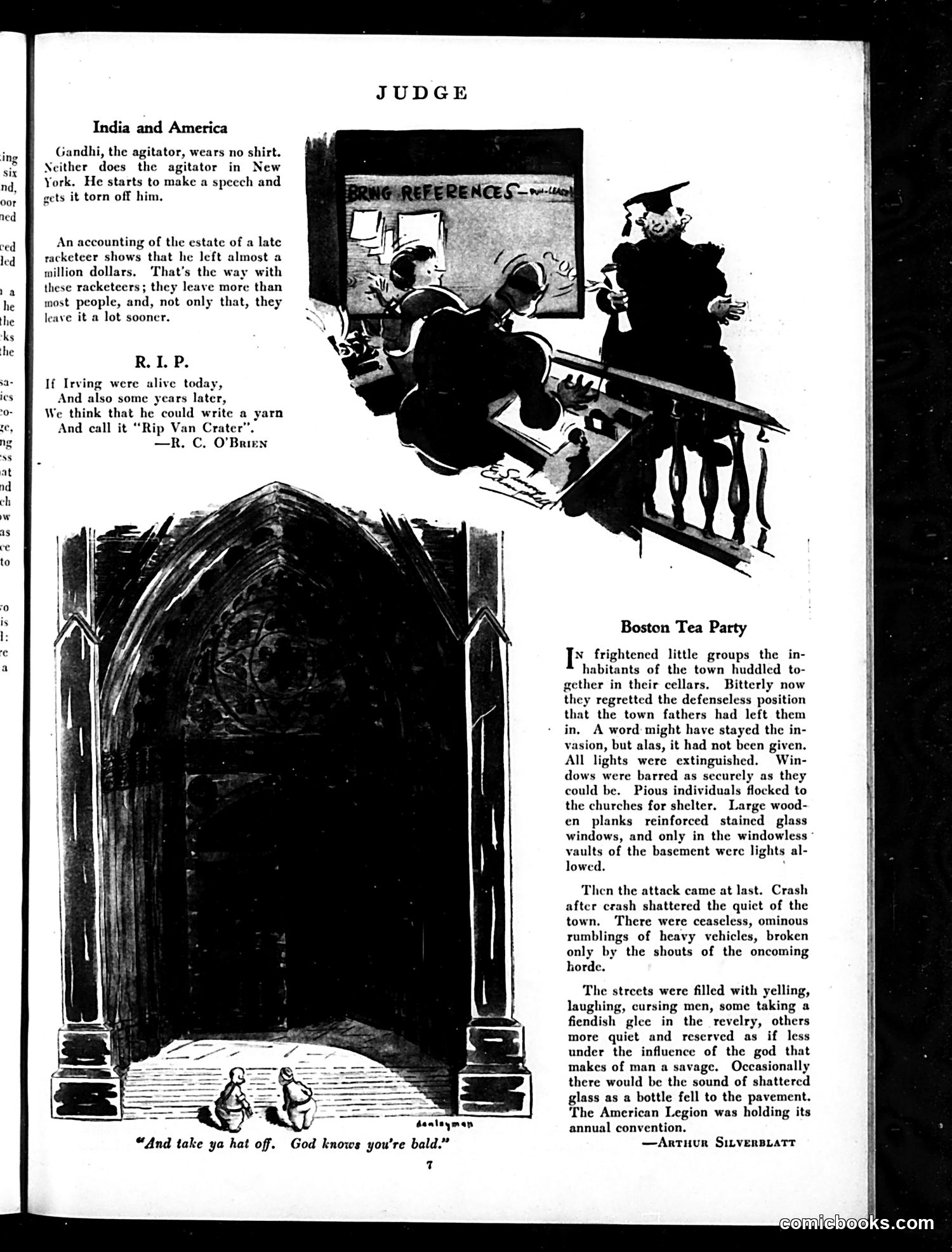
# Judge Magazine Page Analysis This page satirizes American social and political figures through several brief items: **"India and America"** compares Gandhi (the Indian independence leader known for wearing homespun cloth) to a shirtless agitator in New York whose shirt gets torn off during a speech—mocking both as disruptive rabble-rousers. **"R.I.P."** jokes darkly about racketeers (organized crime figures) leaving large estates—implying they die young and violently, unlike legitimate wealthy people. **"Boston Tea Party"** is the page's main satirical piece. Despite its historical title referencing the 1773 protest, the text describes townspeople barricading themselves in fear of an "invasion"—then reveals the "attack" is merely the **American Legion holding its annual convention**. The satire mocks the American Legion as rowdy, destructive vandals (breaking windows, yelling), suggesting the veterans' organization behaves like an invading horde rather than respectable citizens. The bottom cartoon caption appears unrelated social commentary on baldness.
📄 Transcribed text from this page (OCR, searchable)
Machine-transcribed from the original scan — historical spelling and the odd misread are preserved.
India and America Gandhi, the agitator, wears no shirt. Neither does the agitator in New York, He starts to make a speech and gets it torn off him. An accounting of the estate of a late racketeer shows that he left almost a million dollars. That's the way with these racketeers; they leave more than most people, and, not only that, they leave it a lot sooner. RI. P. If Irving were alive today, And also some years later, We think that he could write a yarn And call it “Rip Van Crater’ —R. C. O’Brien Boston Tea Party Ix frightened little groups the in- habitants of the town huddled to- gether in their cellars. Bitterly now they regretted the defenseless position that the town fathers had left them in, A word might have stayed the in- vasion, but alas, it had not been given. All lights were extinguished. Win- dows were barred as securely as they could be. Pious individuals flocked to the churches for shelter. Large wood- en planks reinforced stained glass windows, and only in the windowless vaults of the basement were lights al- lowed. : Then the attack came at last. Crash after crash shattered the quict of the town. There were ceaseless, ominous rumblings of heavy vehicles, broken only by the shouts of the oncoming horde. The streets were filled with yelling, laughing, cursing men, some taking a fiendish glee in the revelry, others more quiet and reserved as if less under the influence of the god that makes of man a savage. Occasionally there would be the sound of shattered glass as a bottle fell to the pavement. The American Legion was holding its r ‘ annual convention. “And take ya hat off. God knows you're bald.” —Artuur SitvensLatr 7