
Judge, 1930-11-08 · page 10 of 36
Judge — November 8, 1930 — page 10: what you’re looking at
What you’re looking at
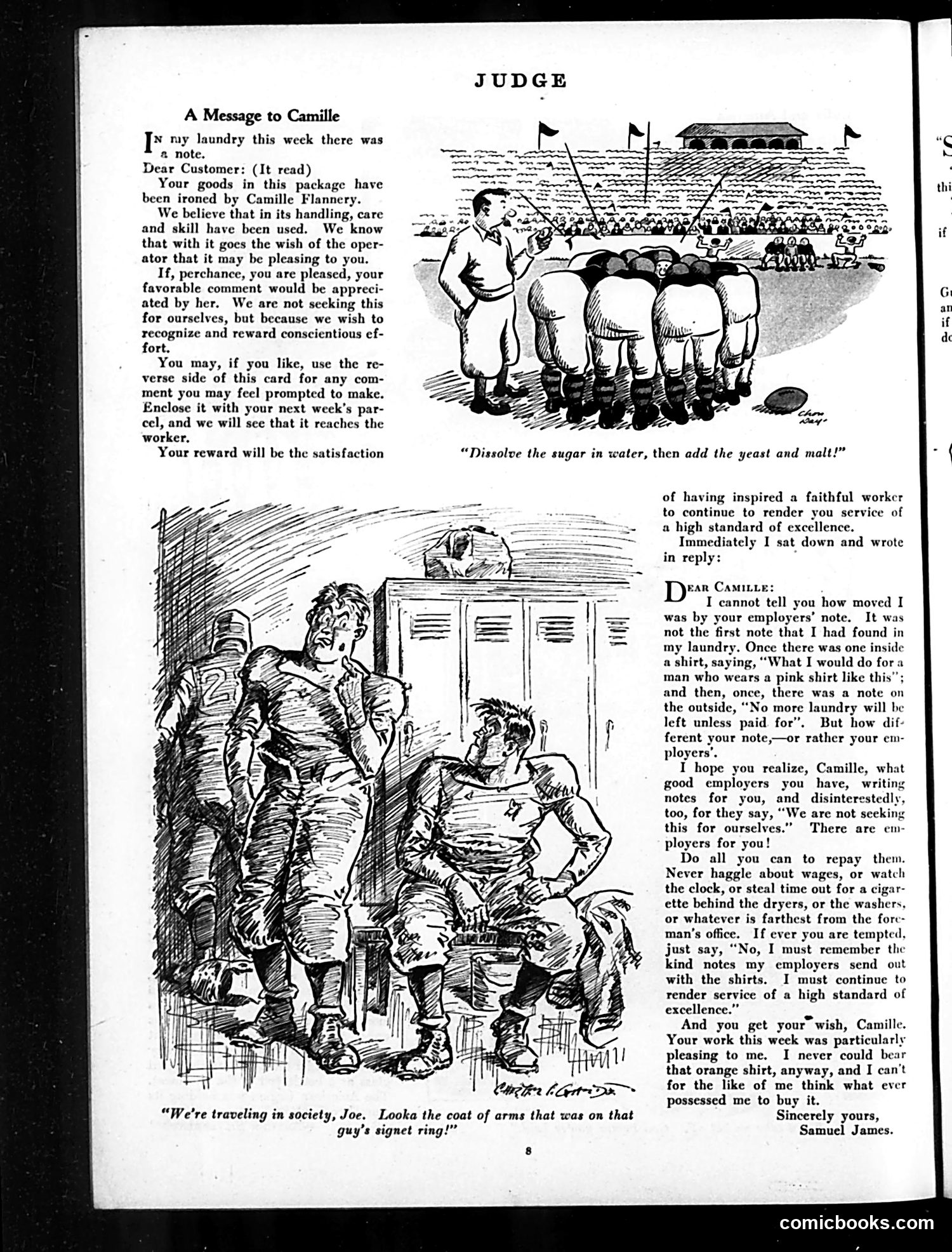
# Judge Magazine Page Analysis This page contains a satirical piece titled "A Message to Camille" critiquing workplace management practices and class relations. The main content is a fictional exchange: a laundry receives a note from their employer praising worker Camille Flannery by name, inviting customer feedback. The "Judge" (author Samuel James) responds with mock-earnest praise, but the satire lies in exposing the paternalism: the employer seeks to manipulate worker loyalty through flattery and public recognition rather than fair wages. James's reply ironically celebrates these "good employers" while listing all the exploitative behaviors workers must suppress—no wage complaints, no time-stealing, constant excellence—framed as gratitude for hollow praise. The two cartoons provide visual commentary: one shows a horse-racing scene (top), another depicts crowded tenement life (bottom). The bottom cartoon's caption mocks pretension ("traveling in society"), reinforcing the page's theme of class hypocrisy and performative virtue among the wealthy.
📄 Transcribed text from this page (OCR, searchable)
Machine-transcribed from the original scan — historical spelling and the odd misread are preserved.
A Message to Camille Ir muy laundry this week there was a note. Dear Customer: (It read) Your goods in this package have been ironed by Camille Flannery. We believe that in its handling, care and skill have been used. We know that with it goes the wish of the oper- ator that it may be pleasing to you. If, perchance, you are pleased, your favorable comment would be appreci- ated by her. We are not seeking this for ourselves, but because we wish to recognize and reward conscientious ef- fort. You may, if you like, use the re- verse side of this card for any com- ment you may feel prompted to make. Enclose it with your next week’s par- cel, and we will see that it reaches the worker, Your reward will be the satisfaction “Dissolve the sugar in water, then add the yeast and malt!” of having inspired a faithful worker to continue to render you service of a high standard of excellence. Immediately I sat down and wrote in reply: : D™" Came: I cannot tell you how moved I was by your employers’ note. It was not the first note that I had found in my laundry. Once there was one inside a shirt, saying, “What I would do fora man who wears a pink shirt like this”; and then, once, there was a note on the outside, “No more laundry will be left unless paid for”. But how dif- ferent your note,—or rather your cm- ployers’. I hope you realize, Camille, what good employers you have, writi notes for you, and disinterestedly, too, for they say, “We are not seeking this for ourselves.” There are em- ployers for you! Do all you can to repay them. Never haggle about wages, or watch the clock, or steal time out for a cigar- ette behind the dryers, or the washers, or whatever is farthest from the fore- man’s office. If ever you are tempted, just say, “No, I must remember the kind notes my employers send out with the shirts. I must continue to render service of a high standard of excellence.” ro And you get your wish, Camille. Your work this week was particularly pleasing to me. I never could bear that orange shirt, anyway, and I can’t Fane lemsee bjt for the like of me think what ever possessed me to buy it. “We're traveling in society, Joe. Looka the coat of arms that was on that Sincerely yours, guy’s signet ring!” Samuel James. 8 comicbooks.com