
Judge, 1930-11-01 · page 15 of 36
Judge — November 1, 1930 — page 15: what you’re looking at
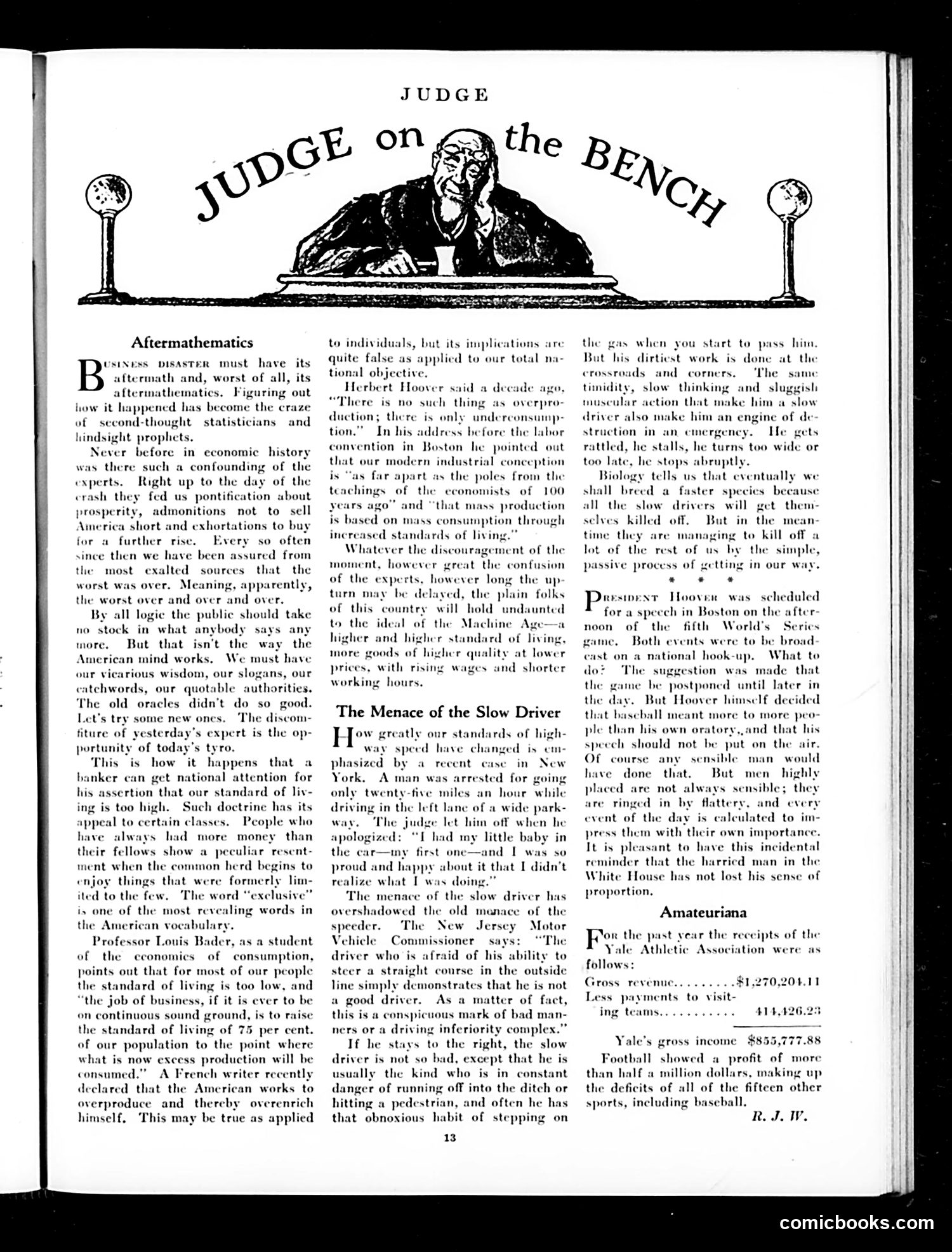
A restored page from Judge, 1930-11-01. Page through the whole issue in the reader above.
📄 Transcribed text from this page (OCR, searchable)
Machine-transcribed from the original scan — historical spelling and the odd misread are preserved.
Aftermathematics USINESS Disaster must have its B aftermath and, worst of all, its ftermathematics. Figuring out how it happened has become the craze of second-thought statisticians and hindsight prophets. Never before in economic history was there such a confounding of the experts. Right up to the day of the crash they fed us pontification about prosperity, admonitions not to sell America short and exhortations to buy E Every so often since then we have been assured from the most exalted sources that the worst was over. Meaning, apparently, the worst over and over and over. By all logic the public should take no stock in what anybody says any more, But that isn’t the way the American mind works, We must have our vicarious wisdom, our sl catchwords, our quotable authorities. The old oracles didn't do so good. Let's try some new ones. ‘The discom- fiture of yesterday's expert is the op- portunity of today’s tyro. This is how it happens that a nker can get national attention for t our standard of liv- Such doctrine has its People who than for a further rise. Ss, our hi his assertion tha ing is too high. 1 to certain classes. ppes have always had more money their fellows show a peculiar r ment when the common herd be enjoy things that were formerly lim ited to the few. The word “exclusive is one of the most revealing words in the American vocabulary, Professor Louis Bader, as a student of the consumption, points out that for most of our people th andard of living is too low, and the job of business, if it is ever to be on continuous sound ground, is to the standard of living of 75 per cent. of our population to the point where what is now excess production will be consumed.” A French writer recently jared that the American works to overproduce and thereby overenrich himself. ‘This may be true as applied economics of dee to individuals, but its implications are quite false »plicd to our total na- tional objecti Herbert Hoover said a decade : “There is no such thing as overpro- duction; there is only undereonsump- tion.” In his address before the labor convention in Boston he pointed out that our modern industrial conception nf the economists of 100 and “that mass production ed on mass consumption through ed standards of living.” tever the discouragement of the moment, however great the , ont of the experts, however long the up turn may be delayed, the plain folks of this country will hold undaunted to the the Mz er quality at lower prices, with rising w working hours. y and shorter The Menace of the Slow Driver Ho ateatly our standards of hig way speed have 1 is cm- phasized by a recent case in New York. A man was arrested for going only twenty-five miles an hour whik driving in the left lane of a wide park- ay. The judge let him off when he apologized: “I had iy little baby in the car—my first one— proud and happy about what I was doin dT was so that I didn’t realiz The menace of the slow driver has : of the Motor overshadowed the old) mex speeder. The New Jersey Vehicle Commissioners driver who is afraid of his « steer a straight course in the line simply demonstrates that he is not a good driver. As a matter of ispicuous mark of bad man- ners or a driving inferiority complex.” If he stays to the right, the slow driver is not so bad, except that he is usually the kind who is in constant danger of running off into the ditch or itting a pedestrian, and often he has that obnoxious habit of stepp 13 this is a ¢ the gas when you start to pass him, But his dirtiest work is done at the erossrouds and corners. ‘The timidity, slow thinki muscular action that m: struction in an emergeney rattled, he stalls, he turns too wide or too late, he stops abruptly. Biology tells us that eventually we all the slow drivers will get the selves killed off. But in the mean time they are managing to kill off lot of the rest of us by the simple, passive process of getting i * * « Peesteest Hoover was scheduled for a speech in Boston on the after- noon of the fifth World's Series Both events were to be broad cast on a national hook-up. What to dot The suggestion was made that the game be postponed until later in the day. But Hoover himself decided that baseball meant more to more peo- ple than his own oratory,and that his speech should not be put on the ai Of course sensible man would have done that. But men_ highly placed are not always sensible; they are ringed in by flattery, and every event of the day is calculated to im- s them with their own import our way. game, i} It ix pleasant to have this incident reminder that the harried man in the White House has not lost his sense of proportion. Amateuriana Fe the past year the receipts of the Yale Athletic Association were as follows: Gross revenue. ,270,208.11 Less payments to visit- ing te: ns 414.42 5,777.88 Yale’s gross income 1 showed a profit of more than half a million dollars, making up the deficits of all of the fifteen other sports, including baseball, RJ. W. comicbooks.com