
Judge, 1930-10-25 · page 9 of 36
Judge — October 25, 1930 — page 9: what you’re looking at
What you’re looking at
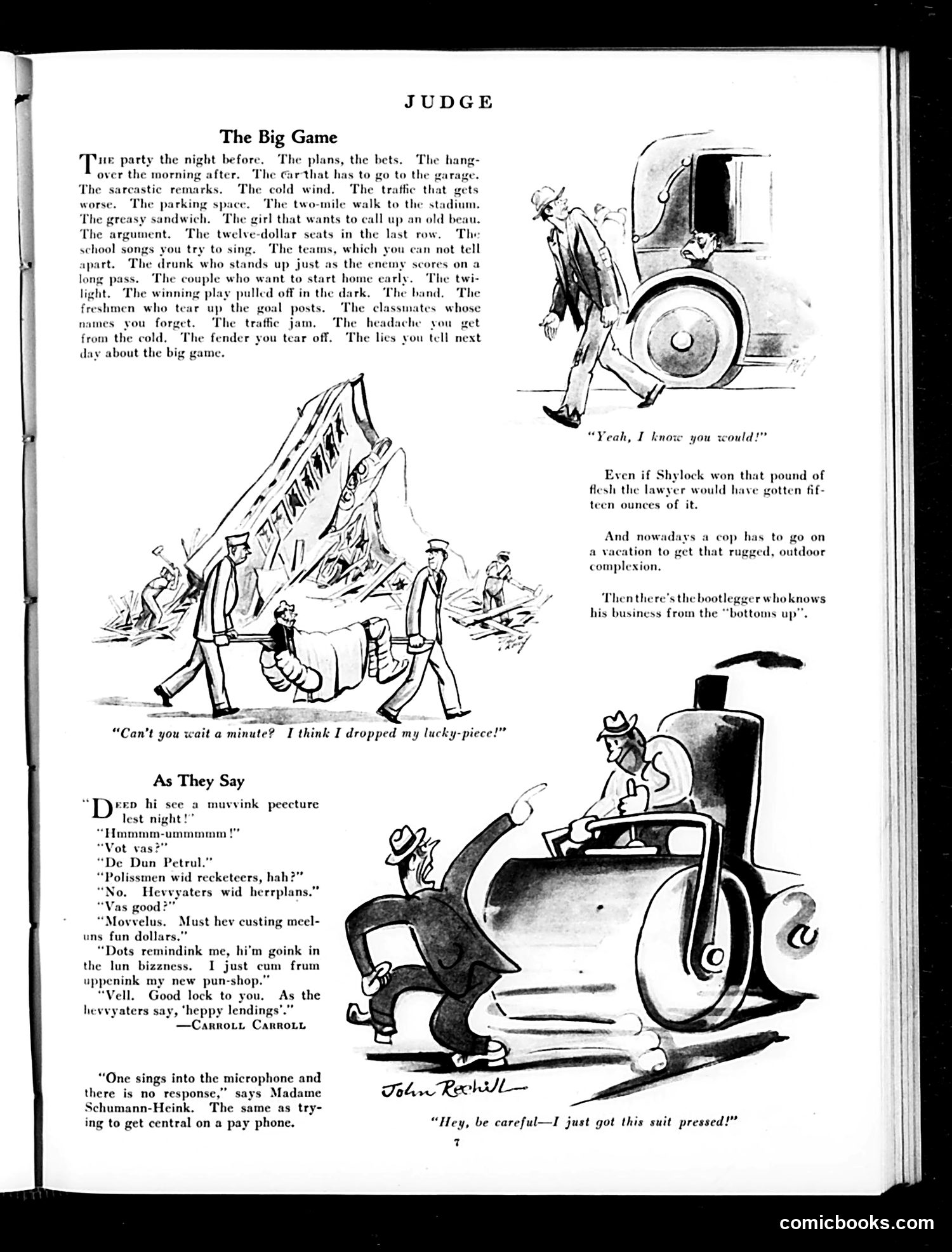
# Judge Magazine Page Analysis This page contains several satirical pieces about early 20th-century American life: **"The Big Game"** mockingly catalogs the miserable experience of attending a college football game—the hangover, cold weather, parking, expensive seats, drunk fans, and the lies told afterward about it being memorable. **Lower cartoons** depict everyday frustrations: a construction accident ("lucky-piece"), and a car accident where someone worries about a freshly-pressed suit. **"As They Say"** section presents ethnic dialect humor (common to the era), featuring what appears to be immigrant characters with heavy accents discussing urban life—bootleggers, police corruption, and business ventures. This reflects period stereotypes. **The Schumann-Heink reference** jokes about the famous opera singer's difficulty getting responses, comparing it to phone operator issues—poking fun at both celebrity pretension and contemporary telephone service frustrations. The overall tone is cynical about modern urban inconveniences, immigrant communities, and entertainment.
📄 Transcribed text from this page (OCR, searchable)
Machine-transcribed from the original scan — historical spelling and the odd misread are preserved.
The Big Game Tim party the night before, ‘The pl ver the morning after. The Cart to go to the } The sarcastic remarks. The cold wind. The trathe that ¢ \9 worse. The parking space. ‘The two-mile walk to the stadium, | The greasy sandwich. The girl that wants to call up an old bi The argument. The twelve-dollar seats in the last row. school songs you try to sing. ‘The teams, which you can not tell apart. The drunk who stands up just g pass. The couple who want to light. The winning play pulled off in the freshmen who tear up the goal posts. he classmates whose names you forget. ‘The traffic The headache you get from the cold, he fender you tear off. The lies you tell next day about the big game. s, the bets. Th s the enemy scores on a art home early. ‘The tw rk. The band. The “Yeah, I know you would!” Even if Shylock won that pound of flesh the lawyer would have gotten fif- teen ounces of it. And nowadays a cop has to go on a vacation to get that rugged, outdoor complexion. } Then there’s the bootlegger whoknows his business from the “bottoms up”. = “Can't you wait a minute? I think I dropped my lucky-piece!” lest night! Hmmmm-ummmmm !” “Vot v “De Dun Petrul.” “Polissmen wid recketeers, hah?” " Hevvyaters wid herrplans.” ‘as good? “Movvelus. Must hev custing meel- uns fun dolla " “Dots remindink me, hi'm goink in the lun bizzness. I just cum frum uppenink my new pun-shop.” “Vell. Good lock to you. As the hevvyaters say, ‘heppy lendings’.” —Carroit Carrotn “One sings into the microphone and there is no response,” says Madame Schumann-Heink. The same as try- ing to get central on a pay phone. “Hey, be careful—I just got this suit pressed!” 7 comicbooks.com