
Judge, 1930-10-25 · page 18 of 36
Judge — October 25, 1930 — page 18: what you’re looking at
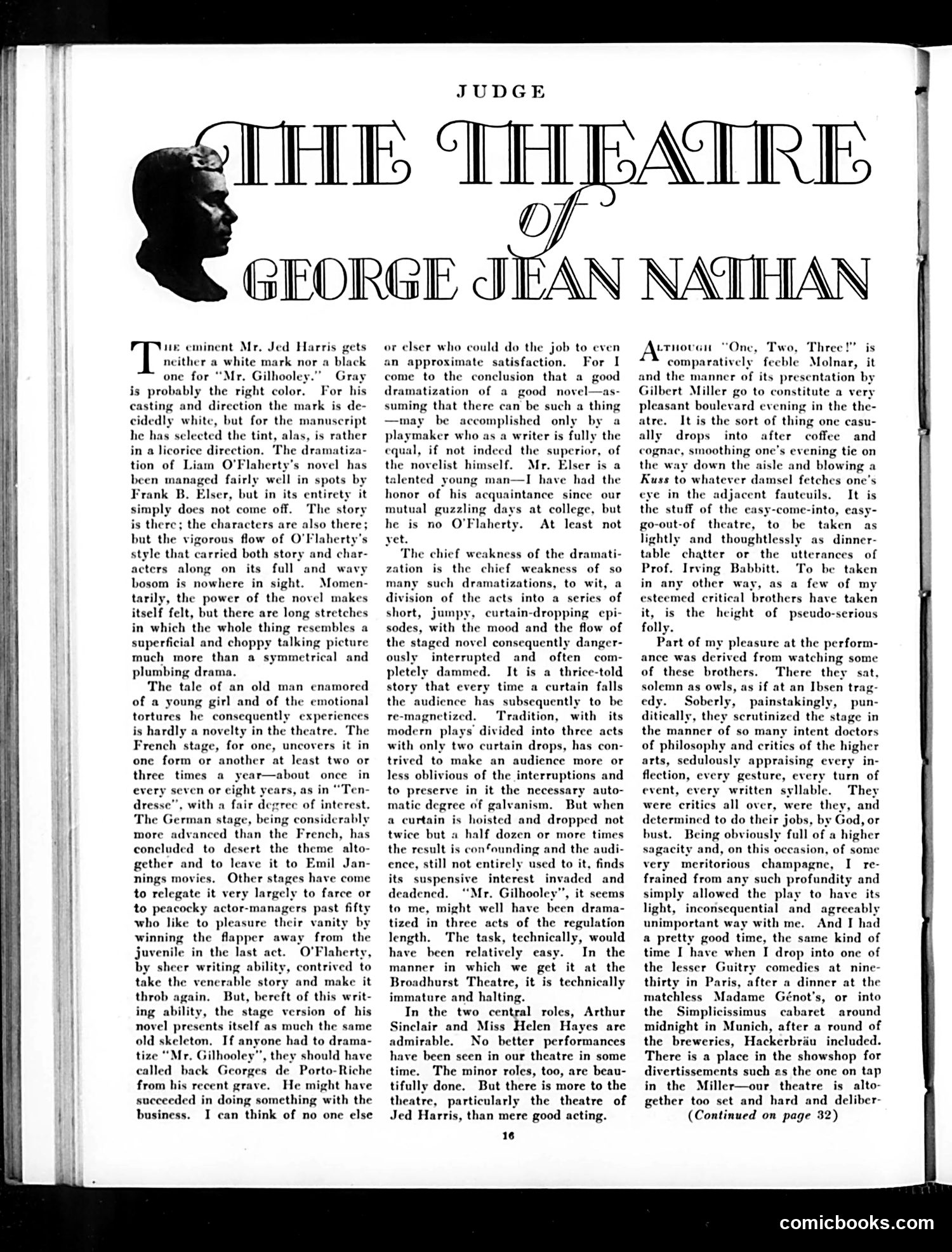
A restored page from Judge, 1930-10-25. Page through the whole issue in the reader above.
📄 Transcribed text from this page (OCR, searchable)
Machine-transcribed from the original scan — historical spelling and the odd misread are preserved.
li GEORGE J © eminent Mr. Jed Harris gets neither a white mark nor a bl one for “Mr. Gilhooley.” Gray is probably the right color. For his casting and direction the mark is de- cidedly white, but for the manuscript he has selected the tint, alas, is rather in a licorice direction. The dran tion of Liam O’Flahert. been mana Frank B. Elser, but in its entirety simply does not come off. The story is there; the characters are also there; but the vigorous flow of O'Flaherty's style that carried both story and char- acters along on full and wavy bosom is nowhere in sight. Momen- tarily, the power of the novel makes itself felt, but there are long stretches in which the whole thing resembles a superficial and choppy talking picture much more than a symmetrical and plumbing drama. The tale of an old man enamored of a young girl and of the emotional tortures he consequently experiences is hardly a novelty in the theatre. The French stage, for one, uncovers it in one form or another at least two or three times a year—about once in every seven or eight y in “Ten- dresse”, with a fair degree of interest. The German stage, being considerably more advanced than the French, has concluded to desert the theme alto- gether and to leave it to Emil Jan- nings movies. Other stages have come to relegate it very largely to farce or to peacocky actor-managers past fifty who like to pleasure their vanity by winning the flapper away from the juvenile in the last act. O'Flaherty, by sheer writing ability, contrived to take the venerable story and make it throb again, But, bereft of this writ- ing ability, the stage version of his novel presents itself as much the same old skeleton, If anyone had to drama- tize “Mr. Gilhooley”, they should have called back Georges de Porto-Riche from his recent grave. He might have succeeded in doing something with the business. I can think of no one else 0 or elser who could do the job to even an approximate satisfaction. For I come to the conclusion that a good dramatization of a good novel—as- suming that there be such a thing —may be accomplished only by a playmaker who as a writer is fully the equal, if not indeed the superior, of the novelist himself. Mr. Elser is a talented young man—I have had the honor of his acquaintance since our mutual guzzling days at college, but he is no O'Flaher At least not yet. The chief weakness of the dramati- zation is the chief weakness of so such dran ations, to wit, a n of the acts into a series of short, jumpy, curtain-dropping epi- sodes, with the mood and the flow of the staged novel consequently danger- ously interrupted and often com- pletely dammed. It is a thrice-told story that every time a curtain falls the ‘audience has subsequently to be re-magnetized. Tradition, with its modern plays’ divided into three acts with only two curtain drops, has con- trived to make an audience more or less oblivious of the interruptions and to preserve in it the necessary auto- matic degree of galvanism. But when a curtain is hoisted and dropped not twice but « half dozen or more times the result is confounding and the audi- ence, still not entirely used to it, finds its suspensive interest invaded and deadened. “Mr. Gilhooley”, it seems to me, might well have been drama- tized in three acts of the regulation length. The task, technically, would have been relatively easy. In the manner in which we get it at the Broadhurst Theatre, it is technically immature and halting. In the two central roles, Arthur Sinclair and Miss Helen Hayes are admirable. No better performances have been seen in our theatre in some time. The minor roles, too, are beau- tifully done. But there is more to the theatre, particularly the theatre of Jed Harris, than mere good acting. 16 AIRE © NACTHIAN Alteran “One, Two, Three!” is comparatively feeble Molnar, it and the manner of its presentation by Gilbert Miller go to constitute a very pleasant boulevard evening in the the- atre. It is the sort of thing one casu- ally drops into after coffee and cognac, smoothing one’s evening tie on the way down the aisle and blowing a Kuss to whatever damsel fetches one's eye in the adjacent fauteuils. It is the stuff of the easy-come-into, easy- go-out-of theatre, to be taken as lightly and thoughtlessly as dinner- table chatter or the utterances of Prof, Irving Babbitt. To be taken in any other way, as a few of my esteemed critical brothers have taken it, is the height of pseudo-serious folly. Part of my pleasure at the perform- ance was derived from watching some of these brothers. There they sat, solemn as owls, as if at an Ibsen trag- edy. Soberly, painstakingly, pun- ditically, they scrutinized the stage in the manner of so many intent doctors of philosophy and critics of the higher arts, sedulously appraising every in- flection, every gesture, every turn of event, every written syllable. They were critics all over, were they, and determined to do their jobs, by God, or bust. Being obviously full of a higher sagacity and, on this occasion, of some very meritorious champagne, I re- frained from any such profundity and simply allowed the play to have its light, inconsequential and agreeably unimportant way with me. And I had a pretty good time, the same kind of time I have when I drop into one of the lesser Guitry comedies at nine- thirty in Paris, after a dinner at the matchless Madame Génot's, or into the Simplicissimus cabaret around midnight in Munich, after a round of the breweries, Hackerbriiu included. There is a place in the showshop for divertissements such 2s the one on tap in the Miller—our theatre is alto- gether too set and hard and deliber- (Continued on page 32) comicbooks.com