
Judge, 1930-10-11 · page 16 of 36
Judge — October 11, 1930 — page 16: what you’re looking at
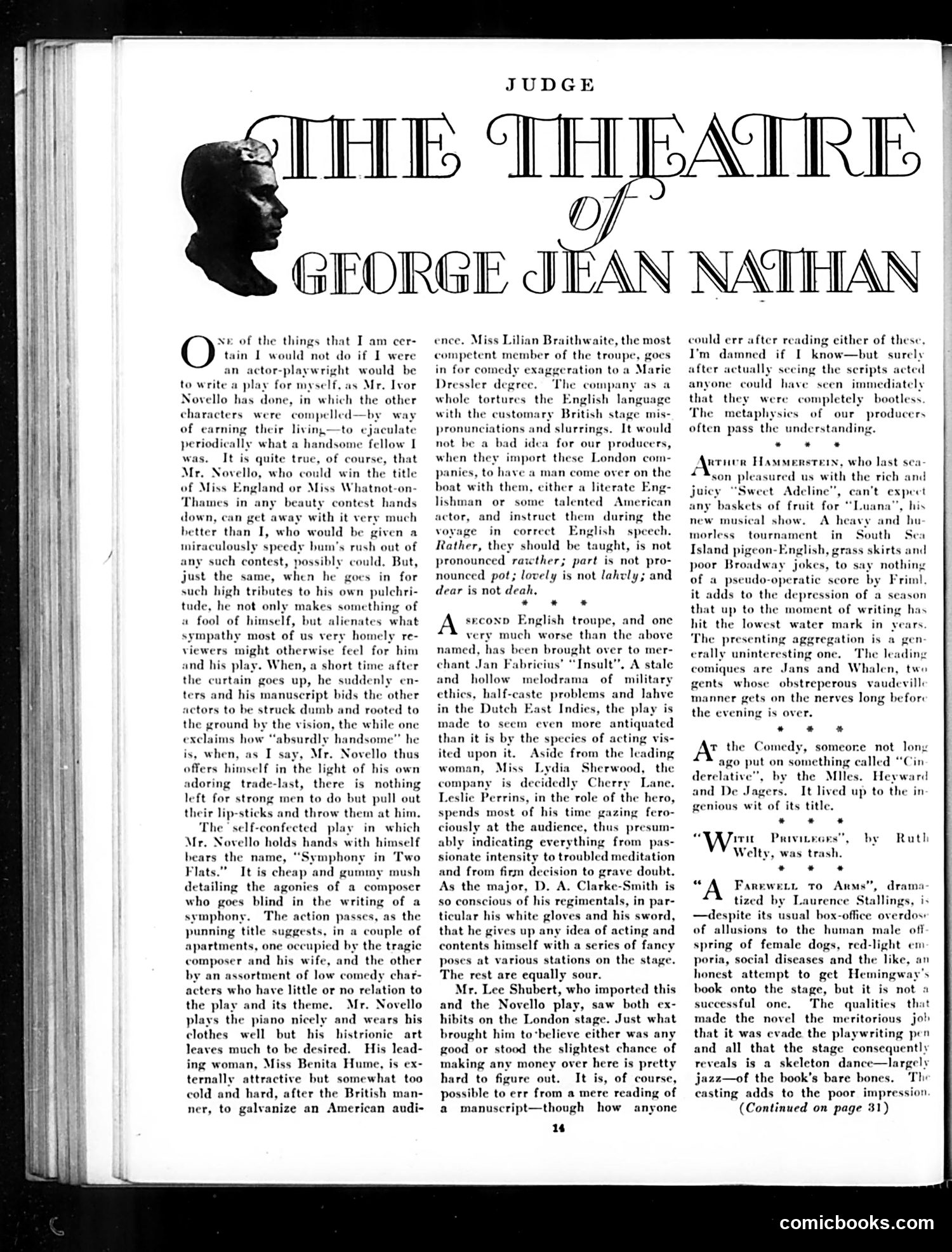
A restored page from Judge, 1930-10-11. Page through the whole issue in the reader above.
📄 Transcribed text from this page (OCR, searchable)
Machine-transcribed from the original scan — historical spelling and the odd misread are preserved.
ne of the things that I am cer- O tain I would not do if I were an actor-playwright would be to write a play for myself. ay Mr. Ivor Novello has done, in which the other characters were compelled—by way of earning their liviny—to ejacul periodically what a handsome fellow I was. It is quite true, of course, that Mr. Novello, who could win the title of Miss England or Miss Whatnot-on- Thames in any beauty contest hands down, can get away with it very much better than I, who would be given a miraculously speedy bum’s rush out of any such contest, possibly could. But, just the same, when he goes in for such high tributes to his own pulchri- tude, he not only makes something of « fool of himself, but alienates what sympathy most of us very homely re- viewers might otherwise feel for him and his play. When, a short time after the curtain goes up, he suddenly en- ters and his manuscript bids the other actors to be struck dumb and rooted to the ground by the vision, the while one exclaims how “absurdly handsome” he is, when, as I say, Mr. Novello thus offers himself in the light of his own adoring trade-last, there is nothing left for strong men to do but pull out their lip-sticks and throw them at him. The 'self-confected play in which ello holds hands with himself the name, “Symphony in Two Flats.” It is cheap and gummy mush detailing the agonies of a composer who goes blind the writing of a symphony. The action passes, as the punning title suggests. couple of apartments, one occupied by the tragic composer and his wife, and the other by an assortment of low comedy char- acters who have little or no relation to the play and its theme. Mr. Novello plays the piano nicely and wears his clothes well but his histrionic art leaves much to be desired. His lead- ing woman, Miss Benita Hume, is ex- ternally attractive but somewhat too cold and hard, after the British man- ner, to galvanize an American audi- JUDGE li GEORGE J 0 ence. Miss Lilian Braithwaite, the most competent member of the troupe, goes in for comedy tion toa Mari Dressler deg The company whole tortures the English language with the customary British stage mis- pronunciations and slurrings. It would not be a bad idea for our producers, when they import these London com- panies, to have a man come over on the boat with them, either a literate Eng- lishman or some talented American actor, and instruct them during the voyage in correct English speech. Rather, they should be taught, is not pronounced rawther; part is not pro- nounced pot; lovely is not lahvly; and dear is not deah. * # * A second English troupe, and one very much worse than the above en brought over to mer- Jan Fabricius’ “Insult”. A stale and hollow melodrama of military ethics, half-easte problems and lahve in the Dutch East Indies, the play is made to seem even more antiquated than it is by the species of acting vis- ited upon it. Aside from the leading > Miss dia Sherwood, the . dedly Cherry Lane. Leslie Perrins, in the role of the hero, spends most of his time gazing fero- ciously at the audience, thus presum- ably indicating everything from pas- sionate intensity to troubled meditation and from firm decision to grave doubt. As the major, D. A. Clarke-Smith is so conscious of his regimentals, in par- ticular his white gloves and his sword, that he gives up any idea of acting and contents himself with a series of fancy poses at various stations on the stage. The rest are equally sour. Mr. Lee Shubert, who imported this and the Novello play, saw both ex- hibits on the London stage. Just what brought him to-believe either was any good or stood the slightest chance of making any money over here is pretty hard to figure out. It is, of course, possible to err from a mere reading of a manuscript—though how anyone “4 ACRE: NACHHIAN could err after reading either of these. I'm damned if I know—but surely fter actually seeing the scripts nyone could have seen immediately that they were completely bootless ‘The metaphysics of our’ producers often pass the understanding. “ * « Aprien Hasorensters, who last sea Fh son pleasured us with the rich and juicy “Sweet Adeline”, can't expect any baskets of fruit for “Luana”, his new musical show. A heavy and hu morless tournament in South Sea Island pigeon-English, grass skirts and poor Broadway jokes, to say nothing of a pseudo-operatic score by Friml. it adds to the depression of a season that up to the moment of writing has hit the lowest water mark in years The presenting aggregation is a gen erally uninteresting one. The leading comiques are Jans and W . two gents whose obstreperous vaudevill: manner gets on the nerves long before the evening is over. * * t the Comedy, someore not lony zo put on something called “Cin derelative’, by the Mlles. Heyward and De Jagers. It lived up to the in genious wit of its title. * 8 * iit Privitkers”, by Ruth Welty, was trash. + * « “ Farrewett to Arms”, tized by Laurenc allings, is —despite its usual box-office overdos: of allusions to the human male off spring of female dogs, red-light em poria, social diseases and the like, an honest attempt to get Hemingway book onto the stage, but it is not s successful one. The qualities th made the novel the meritorious jo! that it was evade the playwriting pen and all that the stage consequently reveals is a skeleton dance—largely jazz—of the book's bare bones. Thi casting adds to the poor impression (Continued on page 31) comicbooks.com