
Judge, 1930-10-04 · page 25 of 36
Judge — October 4, 1930 — page 25: what you’re looking at
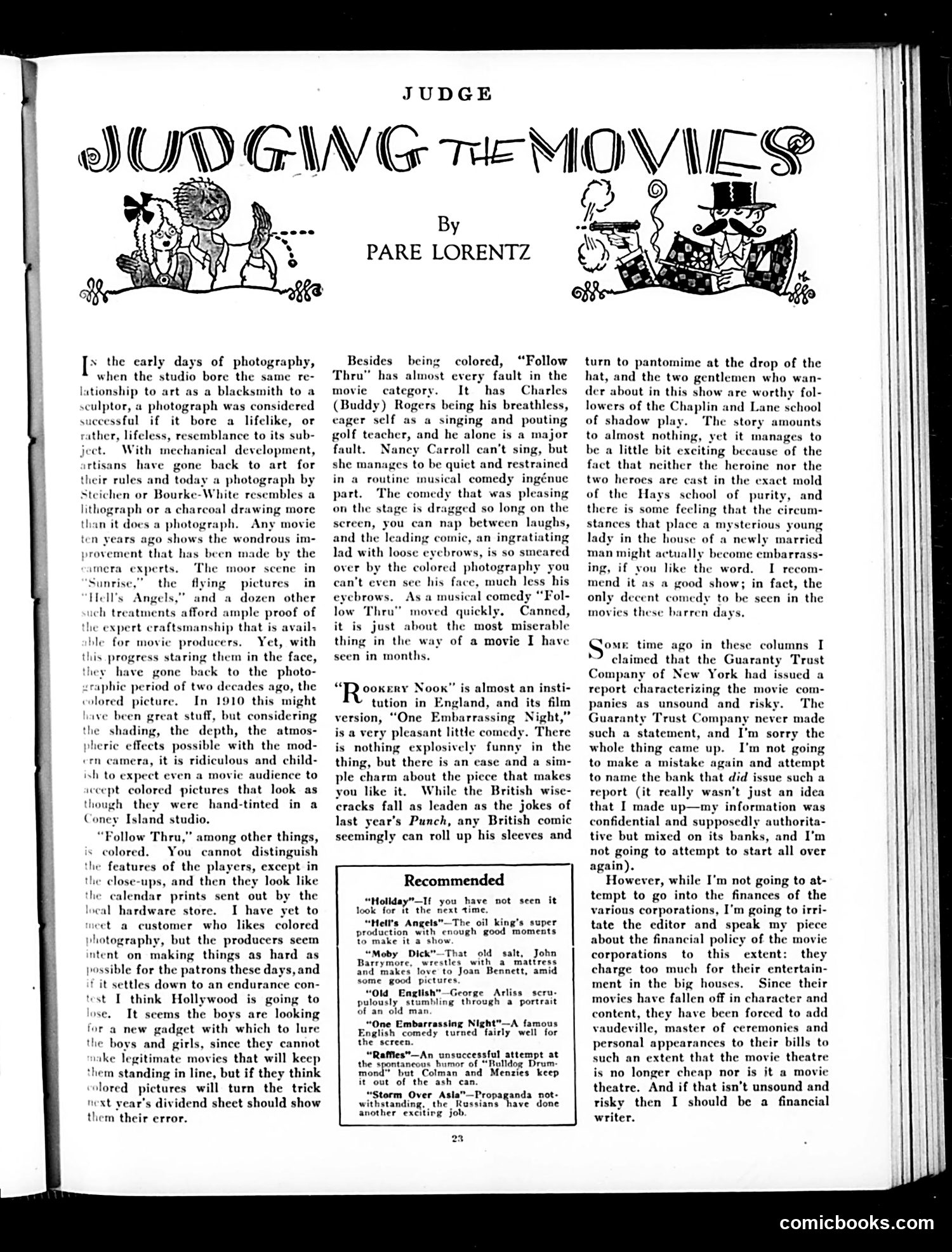
A restored page from Judge, 1930-10-04. Page through the whole issue in the reader above.
📄 Transcribed text from this page (OCR, searchable)
Machine-transcribed from the original scan — historical spelling and the odd misread are preserved.
I> the early days of photography, when the studio bore the same re- tionship to art as a blacksmith to a sculptor, a photograph was considered successful if it bore a lifelike, or rather, lifeless, resemblance to its sub- ject. With mechanical development, rtisans have gone back to art for their rules and today a photograph by Steichen or Bourke-White resembles a lithograph or a charcoal drawing more than it does a photograph. Any movie ten years ago shows the wondrous im- provement that has been made by the ‘mera experts, The moor scene in Sunrise,” the flying pictures in Hell's Angels," and a dozen other ich treatments afford ample proof of the expert craftsmanship that i ble for movie producers. Yet, with this progress staring them in the face, they have gone back to the photo- craphie period of two decades ago, the colored picture. In 1910 this might lave been great stuff, but considering he shading, the depth, the atmos- cts possible with the mod- it is ridiculous and child- ish to expect even a movie audience to ccept colored pictures that look as though they were hand-tinted in a Coney Island studio. “Follow Thru,” among other things, s colored. You cannot distinguish the features of the players, except in the close-ups, and then they look like calendar prints sent out by the cal hardware store. I have yet to neet a customer who likes colored shotography, but the producers seem ntent on ing things as hard as possible for the patrons these days, and t it settles down to an endurance con- est I think Hollywood is going to se. It seems the boys are looking a new gadget with which to lure aud since they cannot egi - movies that will keep hem standing i in line, but if they think colored pictures will turn the trick next year's dividend sheet should show them their error. JUDGE | SURG NG THe MA JV IS By PARE LORENTZ Besides being colored, “Follow Thru” has almost every fault in the movie category. It has Charles (Buddy) Rogers being his breathless, eager self as a singing and pouting golf teacher, and he alone is a major fault. Nancy Carroll can’t sing, but she manages to be quiet and rest in a routine musical comedy part. The comedy that was p on the stage is dragged so long on the reen, you can nap between laughs, nd the leading comic, an ingratiating As a music Thru” moved quickly. it is just about the most miserable thing in the way of a movie I have seen in months. “Rooxesy Noox” is almost an insti- tution in England, and its film version, “One Embarrassing Night,” is a very pleasant little comedy. There is nothing explosively funny in th thing, but there is an ease and a sim- ple charm about the piece that makes you like it. While the British wise cracks fall as leaden as the jokes of last year’s Punch, any British comic seemingly can roll up his sleeves and low Recommended “Hollday”—If you have not seen it look for i the next time, “Hell's Angeis”—The oil king's super production with enough good moments to make it a show “Moby Dick"—That old salt, John Barrymore, wrestles with a mattress and makes love to Joan Bennett, amid some good pictures. “Old. English"—George Arliss scru- pulously stumbling through a portrait of an old man. “One Embarrassing Night"—A famous English comedy turned fairly well for the screen. “Raffies"—An unsuccessful attempt at the spontaneous humor of “Bulldog Drum- mond” but Colman and Menzies keep it out of the ash can. “Storm Over Asia”. -propagasda) s not- withstanding, the Russians have done another exciting job. turn to pantomime at the drop of the hat, and the two gentlemen who wan- der about in this show are worthy fol- lowers of the Chaplin and Lane school of shadow play. The story amounts to almost nothing, yet it manages to be a little bit exciting because of the fact that neither the heroine nor the two heroes are cast in the e: of the Hays school of pur there is some feeling that the circum- stances that place a mysterious young lady in the house of « newly married man might actually become embarrass ing, if you like the word. I recom- mend it as a good show; in fact, the only decent comedy to be seen in the movies these barren days, ome time ago in these columns I claimed that the Guaranty Trust Company of New York had issued a report characterizing the movie com- panies as unsound and risky. The Guaranty Trust Company never made such a statement, and I’m sorry the whole thing came up. I’m not going to make a mistake again and attempt to name the bank that did issue such a report (it really wasn’t just an idea that I made up—my information was confidential and supposedly authorita- tive but mixed on its banks, and I’m not going to attempt to start all over again). However, while I'm not going to at- tempt to go into the finances of the various corporations, I'm going to irri- tate the editor and speak my piece about the financial policy of the movie corporations to this extent: they charge too much for their entertain- ment in the big houses. Since their movies have fallen off in character and content, they have been forced to add vaudeville, master of ceremonies and personal appearances to their bills to such an extent that the movie theatre is no longer cheap nor is it a movie theatre. And if that isn’t unsound and risky then I should be a financial writer. comicbooks.com