
Judge, 1930-10-04 · page 15 of 36
Judge — October 4, 1930 — page 15: what you’re looking at
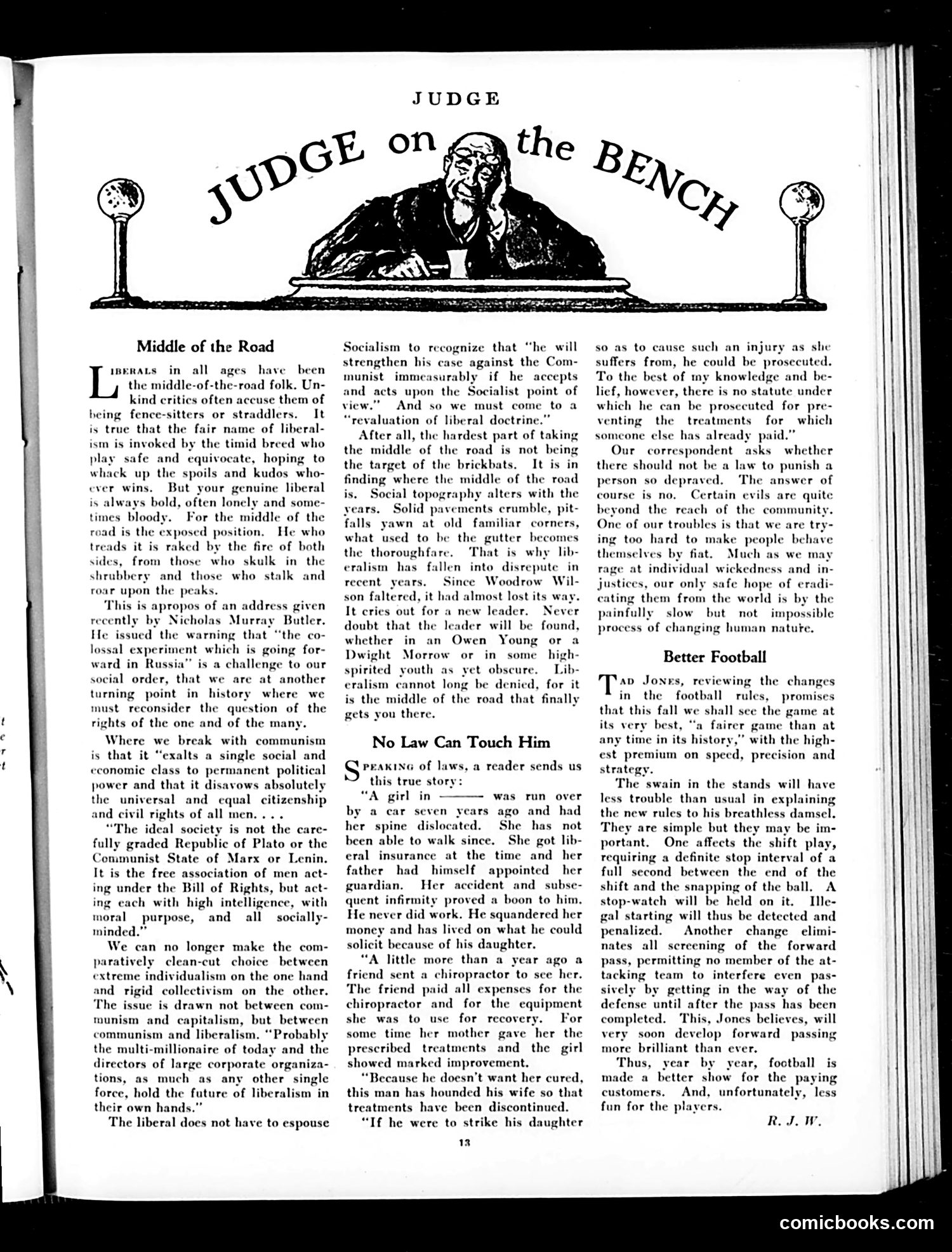
A restored page from Judge, 1930-10-04. Page through the whole issue in the reader above.
📄 Transcribed text from this page (OCR, searchable)
Machine-transcribed from the original scan — historical spelling and the odd misread are preserved.
Middle of the Road ipenats in all ages have been L the middle-of-the-road folk, Un- kind critics often accuse them of heing fence-sitters or straddlers. It is true that the fair name of liberal- ism is invoked by the timid breed who play safe and equivocate, hoping to whack up the spoils and kudos who- ever wins. But your genuine liberal is always bold, often lonely and some- times bloody. For the middle of the road is the exposed position. He who treads it is raked by the fire of both from those who skulk in the shrubbery and those who stalk and roar upon the peaks. This is apropos of an address given ently by Nicholas Murray Butler. He issued the warning that “the co- lossal experiment which is going for- is a challenge to our at we are at another turning point in history where we must reconsider the question of the rights of the one and of the many. Where we break with communism is that it “exalts a single s economic class to permanent politica power and that it disavows absolutely the universal and equal citizenship and civil rights of all men... . “The ideal society is not the care- fully graded Republic of Plato or the Communist State of Marx or Lenin. It is the free association of men act- ing under the Bill of Rights, but act- ing each with high intelligence, with moral purpose, and all socially- minded.” We can no longer make the com- parativ clean-cut choice between extreme individualism on the one hand and rigid collectivism on the other. The issue is drawn not between com- munism and capitalism, but between communism and liberalism. “Probably the multi-millionaire of today and the directors of large corporate organiza- tions, as much as any other single force, hold the future of liberalism in their own hands.” The liberal does not have to espouse sides, Socialism to recognize that “he will strengthen his case against the Com- munist immeasurably if he accepts and acts upon the Socialist point of And so we must come to a luation of liberal doctrine.” After all, the hardest part of taking the middle of the road is not being the target of the brickbats. It is in findi ng whe: re the middle of the road topography alters with the years. Solid pavements crumble, pit- falls yawn at old familiar corners, what used to be the gutter becomes the thoroughfare. "That is, why lib. fallen into disrepute in recent y Since Woodrow Wil- son faltered, it almost lost its w It cries out for a new leader. doubt that the leader will be whether Dwight Morrow or in some high- youth as yet obscure. Lib- | annot long be denied, for it is the middle of the road that finally gets you there. No Law Can Touch Him S rAKING of laws, a reader sends us this true story: “A girl in ———— was run over by a car seven years ago and had her spine dislocated. She has not been able to walk since. She got lib- eral insurance at the time and her father had himself appointed her guardian. Her accident and subse- quent infirmity proved a boon to him. He never did work. He squandered her money and has lived on what he could it because of his daughter. A little more than a year ago a friend sent a chiropractor to sce her. The friend paid all expenses for the chiropractor and for the equipment she was to use for recovery. For some time her mother gave her the prescribed treatments and the girl showed marked improvement. “Because he doesn’t want her cured, this man has hounded his wife so that treatments have been discontinued. “If he were to strike his daughter 18 Never found, in an Owen Young or a so as to cause such an injury as she suffers from, he could be prosecuted. To the best of my knowledge and be- lief, however, there is no statute under which he can be prosecuted for pre- venting the treatments for which someone else has already paid.” Our correspondent asks whether there should not be y to punish a person so depraved. The answer of course is no. Certain evils are quite beyond the reach of the community One of our troubles is that we are tr: ing too hard to make people behave themselves by Much as we may rage at individual wickedness and in- justices, our only safe hope of eradi- cating them from the world is by the painfully slow but not impossible process of changing human nature. Better Football [2m Jones, reviewing the changes in the football rules, promises that this fall we shall see the game at its very best, “a fairer game than at any time in its history,” with the high- est premium on speed, precision and in the stands will have less trouble than usual in explaining the new rules to his breathless damsel. They are simple but they may be im- portant. One affects the shift play, requiring a definite stop interval of a full second between the end of the shift and the snapping of the ball. A stop-watch will be held on it. Ie- gal starting will thus be detected and penalized. Another change el nates all screening of the forward pass, permitting no member of the at- g team to interfere even pas- by getting in the way of the defense until after the pass has been completed. This, Jones believes, will very soon develop forward passing more brilliant than ever. Thus, year by year, football is made a better show for the paying customers. And, unfortunately, less fun for the players. RILW. comicbooks.com