
Judge, 1930-08-23 · page 25 of 36
Judge — August 23, 1930 — page 25: what you’re looking at
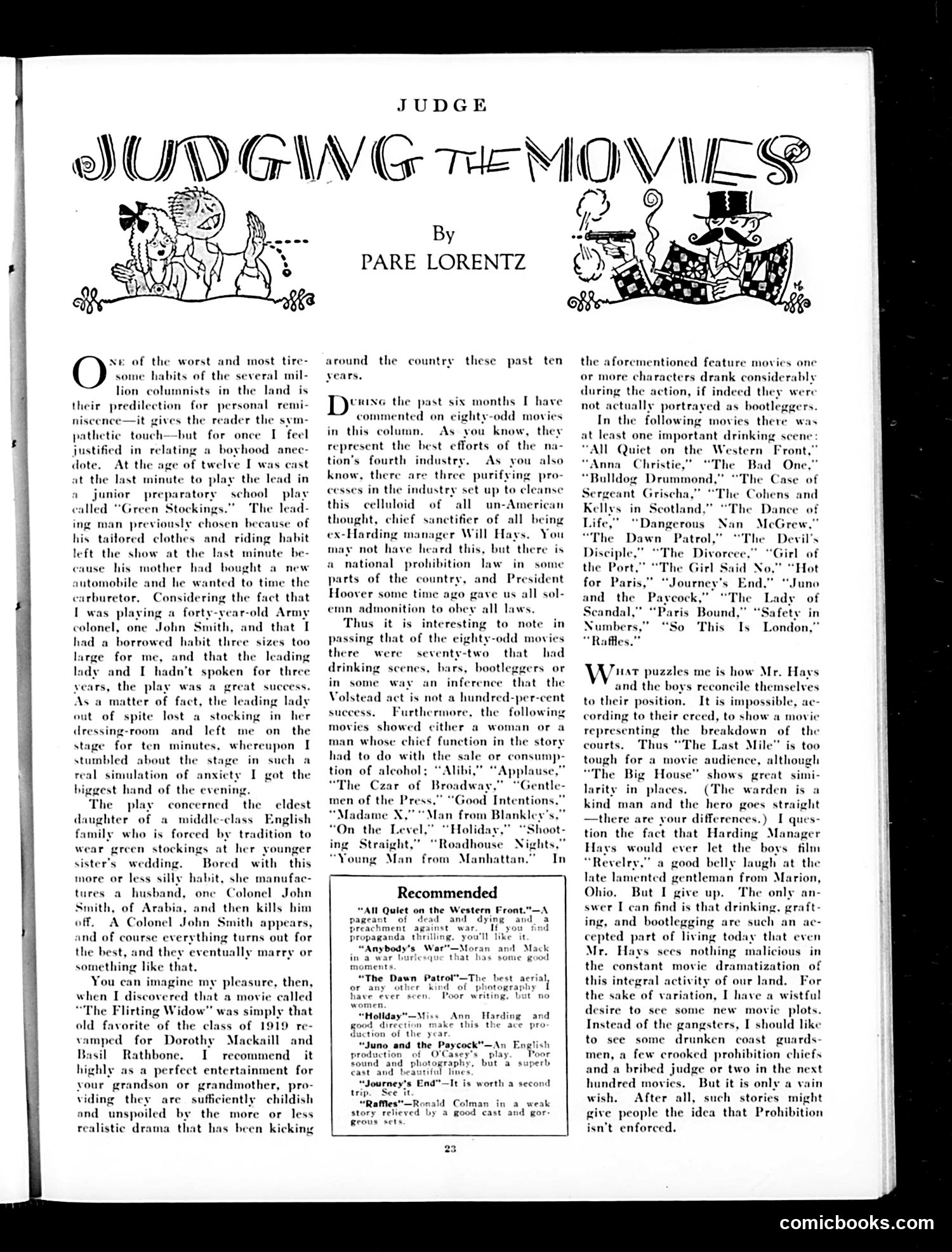
A restored page from Judge, 1930-08-23. Page through the whole issue in the reader above.
📄 Transcribed text from this page (OCR, searchable)
Machine-transcribed from the original scan — historical spelling and the odd misread are preserved.
JUDGE UD G\NVG HeE™ Be) ( ay IWS ne of the worst and most tire- some habits of the several mil- lion columnists in the land is their predilection for personal remi- i —it gives the reader the sym- touch—but for once I feel dote. at the last minute to play the lead in 1 junior school play called “Green Stockings.” The lead- ing man previously chosen because of his taifored clothes and riding habit left the show at the last minute be- se his mother had bought a new sutomobile and he w: the carburetor, Conside t that I was playing a forty colonel, one John Smit ad a borrowed habit three si © for me, and that the leading lady and [ hadn't spoken for three years, the play was a great success. As a matter of fact, the leading lady out of spite lost a stocking in her dressing-room and left. me on the stage for ten minutes, whereupon I stumbled about the stage in such a real simulation of anxicty I got the biggest hand of the evening. The play concerned — the daughter of a middle-class English family who is forced by tradition to wear green stockings at her younger sister's. wedding. Bored with this more or less silly habit, she manufac- tures a husband, one Colonel John Smith, of Arabia, and then kills him off, A Colonel John Smith appears, ind of course everything turns out for the best, and they eventually marry or something like that. eldest You can imagine my pleasure, then, when I discovered that a movie called “The Flirting Widow” was simply that old favorite of the class of 1 vamped for Dorothy Mac! Basil Rathbon highly 9 re- and it andmother, pro- viding they are iently childish and unspoiled by the more or less realistic drama that has been kicking By PARE LORENTZ around the country these past ten years. Demise the past six months 1 have commented on eighty-odd movies in this column. As you know, they represent the best efforts of the tion’s fourth industry. As you : know, there are three purifying cesses in the industry set up to clea this celluloid of “all un-Amer thought, chief sanctifier of all t ex-Harding manager Will I may not have heard this, but there is a national prohibition law in’ some parts of the country, and President Hoover some time ago gave us all sol- ¥ all laws. Thus it is interesting to note in passing that of the eighty-odd movies emn admonition to obe there were seventy-two that had drinking scenes, bars, bootleggers or in some way an inference that the Volstead act is not a hundred-per-cent success. Furthermore, the following movies showed cither a woman or a man whose chief function in the story had to do with the sale or consump- tion of alcohol; “Alibi,” “Applause,” “The Czar of Broadway.” “Gentle men of the Press,” “Good Intentions, “Madame X “On the I ing Straight,” Young Man from Recommended “AM Quiet on the Western Fron and dying f you fin Ann Harding and e this the ace pro: “Juno and the Paycock”—An English production of O'Casey’s play. Poor sound and photography, but a superb beautiful lines cast “Journey's End” —It is worth a second trip. See it “RaMes"—Ronald Colm a weak story relieved by a good cast and gor ie the aforementioned feature movies one or more characters drank considerably during the action, if indeed they v not actually portrayed as bootleggers. In the following movies there was at least one important drinking scene: “AIL Quiet on the Western Front,” “Anna Christie,” “The Bad One,” “Bulldog Drummond,” he Case of Sergeant Grischa,” “" he Cohens and Kellys in Scotland,” “The Dance Life,” “Dangerous Nan McGrew “The Dawn Patrol,” “The Devil's Disciple,” “The Divore the Port.” “The Girl for Paris,” and the Pay dal,” “Paris Bound, Numbers,” “So This Is “Raffles. London,” Wier puzzles me is how Mr. Hays and the boys reconcile themsel to their position. It is impossible, cording to their erced, to show a movie representing the breakdown of the courts. Thus “The Last Mile” is too tough for a movie audience, although “The Big House” shows gre: larity in places. (The ward kind man and the hero goes straight —there are your differences.) I ques- tion the fact that Harding Manager Hays would ever let the boys film “Revelry.” a good belly laugh at the late lamented gentleman from Marion, Ohio. But I give up. The only an- swer I can find is that drinking, graft- ing, and bootlegging are such an ac- cepted part of living today that even Mr. Hays sees nothing malicious in the constant movie dramatizs this integral activity of our land. For the sake of vs on, I have a wistful desire to sce some new movie plots. Instead of the gangsters, I should like to see some drunken coast gu: men, a few crooked prohibition chie and a bribed judge or two in the next hundred movies. But it is only a vain wish. After all, such stories might give people the idea that Prohibition isn’t enforced. simi- nis a ion of comicbooks.com