
Judge, 1930-07-26 · page 15 of 36
Judge — July 26, 1930 — page 15: what you’re looking at
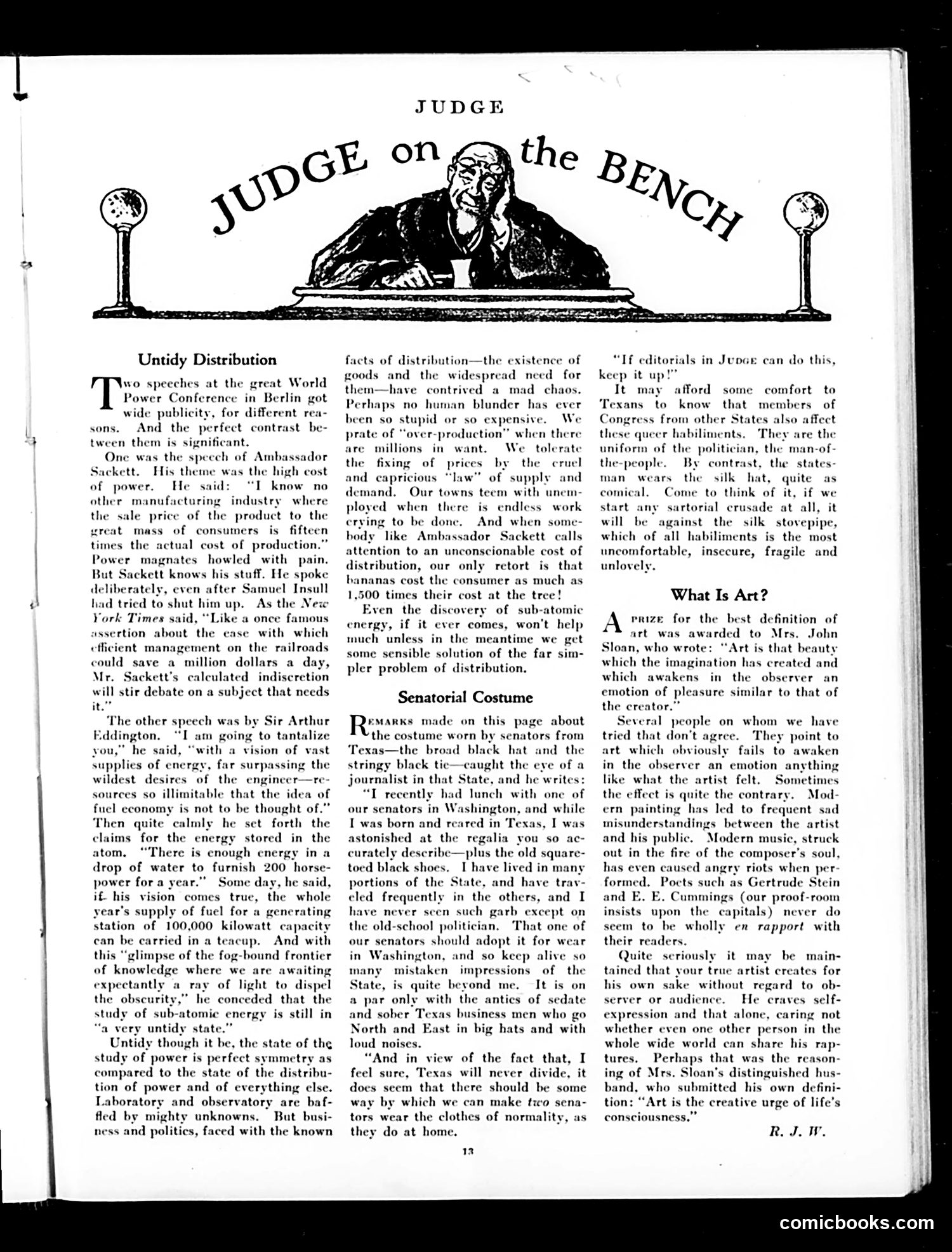
A restored page from Judge, 1930-07-26. Page through the whole issue in the reader above.
📄 Transcribed text from this page (OCR, searchable)
Machine-transcribed from the original scan — historical spelling and the odd misread are preserved.
Untidy Distribution wo speeches at the great World Power Conference in Berlin got wide publicity, for different rea- And the perfect contrast be- One was the speech of Ambassador Sackett. His theme was the high cost of power. He said: “I know no other manufacturing industry where the sale price of the product to the great mass of consumers is fifteen times the actual cost of production.” Power magnates howled with pai But Sackett knows his stuff. He spoke deliberately, even after Samuel Insull had tried to shut him up. As the New York Times said, “Like a once famous rrtion about the ease with which nt management on the railroads ave a million dollars a day, ackett’s calculated indiscretion could Mr. will stir debate on a subject that needs it.” The other speech Eddington. “I am going to tantalize you,” he said, “with a vision of vast supplies of energy, far surpassing the wildest desires of the engincer—re- sources so illimitable that the idea of fuel economy is not to be thought of.” Then quite calmly he set forth the ims for the energy stored in the om. ‘There is enough energy in a drop of water to furnish 200 hor: power fora y Some he said, if his vision comes true, the whole year's supply of fuel for a gencrating station of 100,000 kilowatt capacity can be carried in a teacup. And with this “glimpse of the fog-bound frontier of knowledge where we are awaiting expectantly of light to dispel the obscurity,” he conceded that the study of sub-atomic energy is still in “a very untidy state.” Untidy though it be, the state of the study of power is perfect symmetry as compared to the state of the distribu- tion of power and of everything else. Laboratory and observatory are baf- fled by mighty unknowns. But busi- ness and politics, faced with the known by Sir Arthur facts of distribution—the existence of goods and the widespread need for them—have contrived a mad chaos, Perhaps no human blunder has ever been so stupid or so expensive. W prate of “over-production” when th are millions in want. We tolerate the fixing of prices by the and capricious “law” of supply and demand. Our towns teem with unem- ployed when there is endless work erying to be done. And when some- body like Ambassador Sackett calls attention to an unconscionable cost of distribution, our only retort is that bananas cost the consumer as much as 500 times their cost at the tree! Even the discovery of sub-atomic energy, if it ever comes, won't help much unless in the meantime we get some sensible solution of the far sim- pler problem of distribution, cruel Senatorial Costume Remarxe made on this about the costume worn by senators from ck hat and the y black tie—caught the eye of a journalist in that State, and he writes: “T recently had lunch with one of our senators in Washington, and while I was born and reared in Texas, I w: astonished at the regalia you so ac- curately describe—plus the old square- toed black shoe I have lived in many portions of the State, and have trav- cled frequently in the others, and I have never seen such garb except on the old-school politician, That one of our senators should adopt it for wear in Washington, and so keep alive so many mistaken impressions of the State, is quite beyond me. It is on a par only with the antics of sedate and sober Texas business men who go North and East in big hats and with loud noises. “And in view of the fact that, I feel sure, Texas will never divide, it em that there should be some which we can make tzo sena- tors wear the clothes of normality, « they do at home. 12 “If editorials in Juoce can do this, keep it up!” It may afford some comfort to xans to know that members of Congress from other States also affect these quecr habiliments. They are the uniform of the politician, the man-of- the-people. By contrast, the states- man wears the silk hat, quite as comical, Come to think of it, if we start any sartorial crusade at all, it will be against the silk stovepipe, which of all habiliments is the most uncomfortable, insecure, fragile and unlovely, What Is Art? A prize for the best definition of art was awarded to Mrs. John Sloan, who wrote: “Art is that beauty which the imagination has created and which awakens in the observer an emotion of pleasure similar to that of the creator.” Several people on whom we have tried that don’t agree. They point to art which obviously fails to awaken in the observer an emotion anythir like what the artist felt. Sometimes the effect is quite the contrary. Mod- ern painting has led to frequent sad misunderstandings between the artist and his public. Modern music, struck out in the fire of the composer's soul, has even caused angry riots when per formed, Pocts such as Gertrude Stein and E. E. Cummings (our proof-room insists upon the capitals) never do seem to be wholly en rapport with their readers. Quite seriously it may be main- tained that your true artist creates for his own sake without regard to ob- server or audience. He craves self- expression and that alone, caring not whether even one other person in the whole wide world can share his rap- tures. Perhaps that was the reason- ing of Mrs. Sloan's distinguished hus- band, who submitted his own defini- tion: “Art is the creative urge of life's consciousness.” R.JILW. comicbooks.com