
Judge, 1930-07-12 · page 28 of 36
Judge — July 12, 1930 — page 28: what you’re looking at
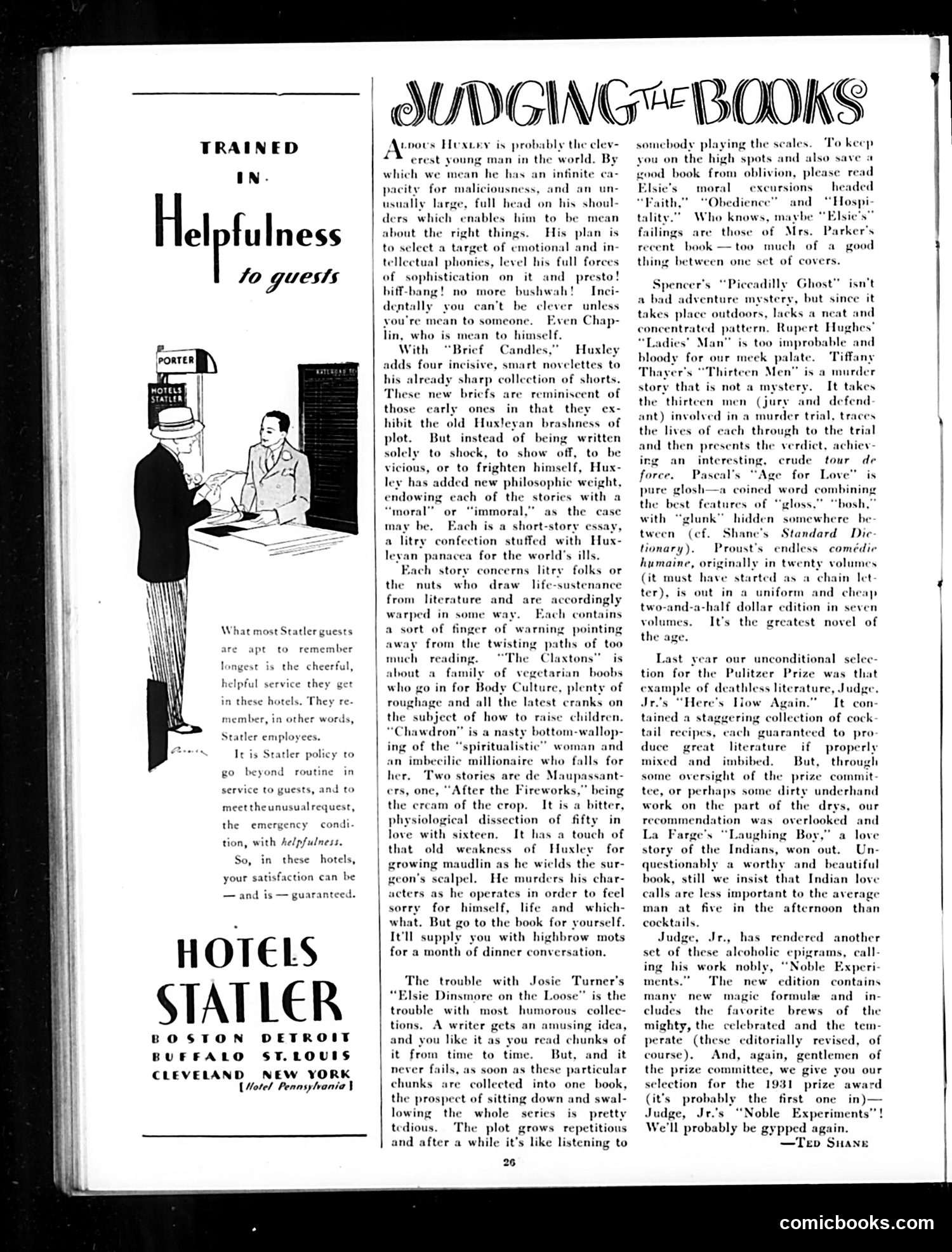
A restored page from Judge, 1930-07-12. Page through the whole issue in the reader above.
📄 Transcribed text from this page (OCR, searchable)
Machine-transcribed from the original scan — historical spelling and the odd misread are preserved.
TRAINED IN. el fulness | fo guests What most Statler guests ure apt to. remember longest is the cheerful, helpful service they get in these hotels. They re- member, in other words, Statler employees. Te is Sta ler policy to id service to guests, and to beyc routine in go meet theunusual request, the emergency condi- tion, with helpfulness. So, in these hotels, your satisfaction can be —and is — guaranteed. HOTELS STATLER BOSTON DETROIT BUFFALO ST.LOUIS CLEVELAND NEW YORK (Motel Pennsylvania} —— AdUDGING BOOKS povs Huxtey is probably the clev- man in the world. By inche has « iciousness, and an un- full head on his shoul- dles him to be mean about the right things. His plan is to select a t of emotional and in- tellectual phonies, level his full fe A erest ) which we mi pacity for me usually larg n infinite ca- ders which ces. | of sophistication on it and presto! biff-bang! no more bushwah! Inc dentally you can't be clever unless you're mean to someone. Even Chap- lin, who is mean to himself. With “Brief Candles,” Huxley adds four incisive, smart novelettes to his already sharp collection of shorts. These new reminiscent of n that they ex- n brashness of briefs are those early ones hibit the old Huxle plot. But instead of being written sol to shock, to show off, to be vicious, or to frighten himself, Hux- ley has added new philosophic weight, endowing each of the stories with a “moral” or “immora the m be, a short-story essay, a litry confection stuffed with Hux- levan panacea for the world’s ills. h story concerns litry folks or the nuts who draw life-sustenance from literature and are accordingly warped in some way. ch contains a sort of finger of warning pointing from the twisting paths of too much reading. “The Claxtons’ is about a family of vegetarian boobs who go in for Body Culture, plenty of roughage and all the latest cranks on the subject of how to “Chawdron” is a ty bottom-wallop- ing of the “spiritualistic” woman and an imbecilie millionaire who falls for her. Two stories are de Maupassant- ers, one, “After the Fireworks,” being the ercam of the crop. It is a bitter, physiological dissection of fifty in love with sixteen. It has a touch of that old weakness of Huxley for growing maudlin as he wiclds the sur- ‘on’s scalpel. He murders his char- eters as he operates in order to feel sorry for himself, life and which- what. But go to the book for yourself. It'll supply you with highbrow mots for a month of dinner conversation. as case Each aw ‘aise children, The trouble with Josie Turner's “Elsie Dinsmore on the Loose” is the trouble with most humorous collec- tions. A writer gets an ¢ and you like it as you read chunks of it from to time. But, and it never fails, as soon as these particular chunks are collected into one book, the prospect of sitting down and swal- lowing the whole series pretty The plot grows repetitious and after a while it’s like listening to nusing idea, is tedious. 26 save a somebody playing the scales. you on the high spots and al vod book from oblivion, please read moral excursions headed Isie’s aith,”” “Obedience” and “Hospi tality.” Who knows, maybe “Elsie’s” failings are those of Mrs. Parker's recent book —too much of a good thing between one set of covers. Spencer's “Piccadilly Ghost” isn’t a bad adventure mystery, but since it takes place outdoors, lacks a and concentrated pattern, Rupert Hughes’ “Ladies’ Man” is too improbable and bloody for our meek palate. ‘Tiffany Thay Thirteen Men” is a murder story that is not a mystery. It takes the thirteen men (jury and defend ant) involved in a murder trial, traces the lives of cach through to the t and then presents the verdict, achiev- ing an interesting, crude tour de force. Paseal’s for Love" is pure glosh—a coined word combinin the best features of “gloss.” “bosh with “glunk” hidden somewhere be tween (cf. Shane's Standard Dic Proust’s endless comédie humaine, originally in twenty volumes (it must have started as a chain let ter), is out in a uniform and cl two-and-a-half dollar edition in seve It’s the greatest novel of tionary). volumes. ast year our unconditional selee- tion for the Pulitzer Prize was that example of deathless literature, Judge. Jr's “Here's How Again.” It con- tained a staggering collection of cock tail recipes, each guaranteed to pro duce great literature if properly mixed and imbibed. But, through some oversight of the prize commit tee, or perhaps some dirty underhand work on the part of the drys, our recommendation overlooked and La Farge's “Laughing Boy,” a love story of the Indians, won Un- questionably a worthy and beautiful book, still we insist that Indian love calls are less important to the average man at five in the afternoon than cocktails. Judge, Jr, has rendered another set of these alcoholic epigrams, call- ing his work nobly, “Noble Experi ments.” The new edition contains ms new magic formule and in- cludes the favorite brews of the mighty, the celebrated and the tem- perate (these editorially revised, of course). And, in, gentlemen of the prize committee, we give you our selection for the 1931 prize award (it’s probably the first one in)— Judge, Jr.’ Noble Experiments We'll probably be gypped again. —Tep Suane comicbooks.com