
Judge, 1930-07-12 · page 15 of 36
Judge — July 12, 1930 — page 15: what you’re looking at
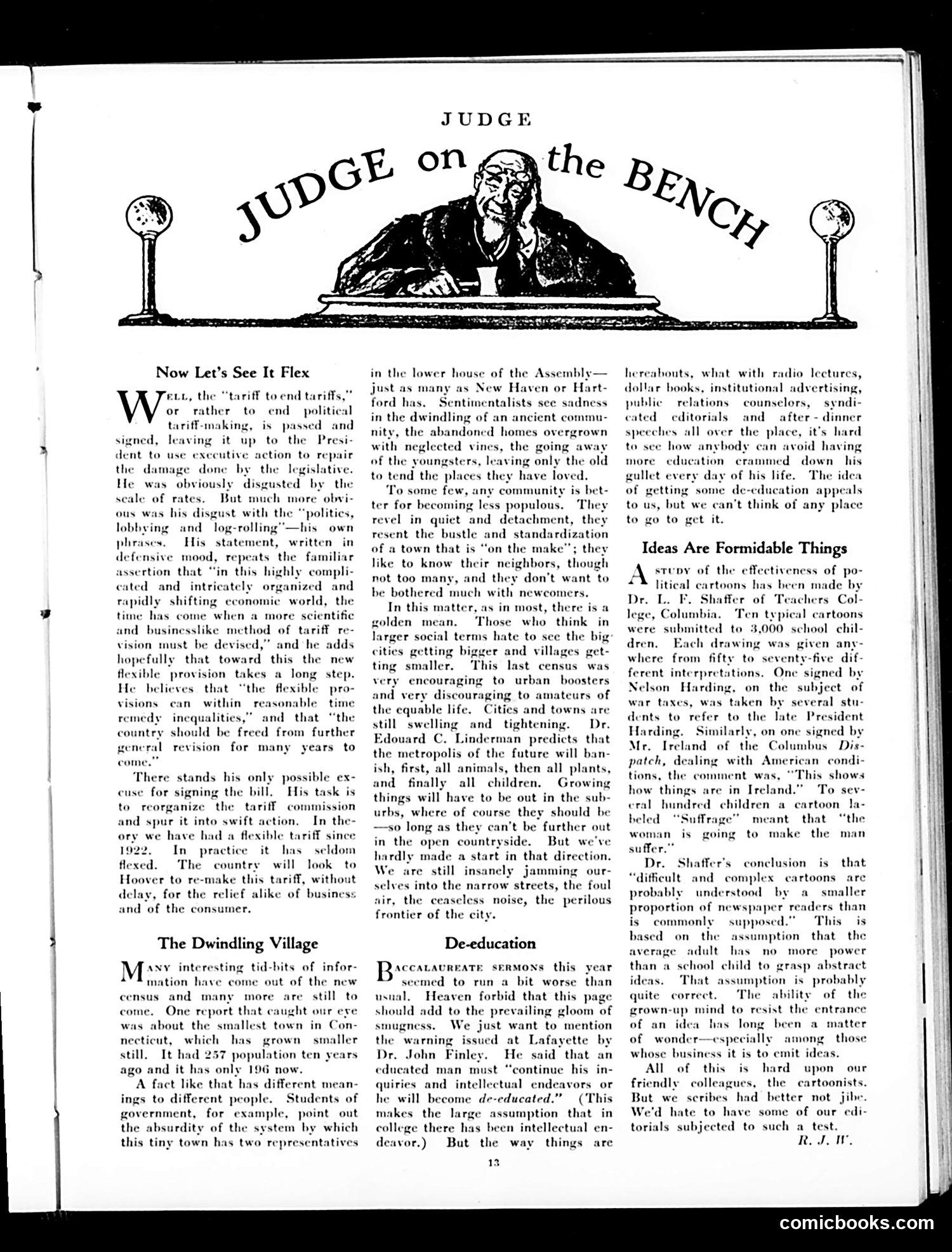
A restored page from Judge, 1930-07-12. Page through the whole issue in the reader above.
📄 Transcribed text from this page (OCR, searchable)
Machine-transcribed from the original scan — historical spelling and the odd misread are preserved.
d tariffs,” to end political tariff-naking, is passed and signed, leaving it up to the Presi- dent to use executive the dan action to repair age done by the legislative. He was obviously disgusted by the seale of rates. But much more obvi- ous was his disgust with the “polit lobbying and log-rolling’’—h ph His statement, writ! defensive mood, repe s own nin ts the familiar assertion that “in this highly compli- ed and intricately or nd rapidly shifting economic world, the time has come when a more scientific and businesslike method of tariff re- vision must be devised,” and he adds hopefully that toward this the new flexible provision takes a long step. He believes that “the flexible pro- visions can within’ r remedy inequalities,” and that “the country should be fri from further general revision for many years to come.” onable time There stands his only possible ex- cuse for signing the bill, His task is to reorganize the tariff commission and spur it into swift action, In the- ory we have had a flexible tariff since 1922, In practice it has seldom flexed. The country will look to Hoover to re-make this tariff, without delay, for the relief alike of business and of the consumer, The Dwindling Village Me’ interesting tid-hits of infor- mation have come out of the new census and many more still to come. One report that caught our ere yout the smallest town in Con- t, wh still, It had 257 population ten years ago and it has only 196 now. A fact like that has different mean- ings to different people. Students of government, for example, point out the absurdity of the system by which this tiny town has two representatives ch has grown smaller in the lower house of the Assembly — as New Haven or Hart- ford has. Sentimentalists see sadness in the dwindling o ancient commu- nity, the abandoned homes overgrown just as many with neglected vines, the going away of the youngsters, leaving only the old to tend the places they have loved. To some few, any community is bet- ter for becoming less populous. ‘The. revel in quiet and detachment, th resent the bustle and standardization of a town that is ‘ton the make”; the: like to know their neighbors, though not too many, and they don’t want to be bothered much with newcomers. In this matter, as in most, there is a golden mean. Those who think in larger social terms hate to see the big cities getting bigger and villages get- ting smaller. This last census was very encouraging to urban boosters and very discouraging to amateurs of the equable life. Cities and towns are still swelling and tightening. Dr. Edouard C. Linderman predicts t the metropolis of the future will ban- ish, first, all animals, then all plants, and finally all children. Growing things will have to be out in the sub- urbs, where of course they should be —so long as they can't be further out in the open countryside. But we've hardly made a start in that direction. We are still insanely jamming our- selves into the narrow streets, the foul air, the ceaseless noise, the perilous frontier of the city. De-education ACCALAUREATE SERMONS this y seemed to run a bit worse ti usual. Heaven forbid that this p should add to the prevailing gloom of smugness. We just want to mention the warning issued at Lafayette by Dr. John Finley. He d that an educated man must “continue his in- quiries and intellectual endeavors or he will become (This makes the large assumption that in college there has been intellectual en- deavor.) But the way things are 13 hereabouts, what with radio lectures, dollar books, institutional advertising, public relations counselors, syndi- cated editorials and after - dinner speeches all over the place, it’s hard to see how anybody can avoid having more education crammed down his gullet every day of his life. The idea ot yetting some de-education appeals to us, but we can’t think of any place to go to get it. Ideas Are Formidable Things A stupy of the effectiveness of po- litical cartoons has been made by Dr. L. Shaffer of 1 chers Col- lege, Columbia. Ten typical cartoons were submitted to 3,000 school chil- dren, Each drawing was given any- where from fifty to seventy-five dif- ferent interpretations. One signed by Nelson Harding, on the subject of war taxes, was taken by several stu- dents to refer to the late President Harding. Similarly, on one signed by Mr. Ireland of the Columbus Dis- patch, dealing with American condi- tions, the comment was, “This shows how things are in Ire To sev- eral hundred children a cartoon la- “Suffrag meant that “the is going to make the man Shaffer's conclusion is that “difficult. and complex cartoons are probably understood by a smaller proportion of newspaper readers than is commonly supposed.” This is based on the assumption that the average adult has no more power than a school child to grasp abstract ideas. That assumption is probably quite correct. ‘The ability of the grown-up mind to resist the entrance of an idea has long been a matter of wonder—especially among those whose business it is to emit ideas. All of this is hs friendly colleagues, the cartoonists. But we scribes had better not jibe. We'd hate to have some of our edi- torials subjected to such a test. R.IW. d upon our Hi Hi Hi Hl ‘| || } comicbooks.com