
Judge, 1930-07-12 · page 11 of 36
Judge — July 12, 1930 — page 11: what you’re looking at
What you’re looking at
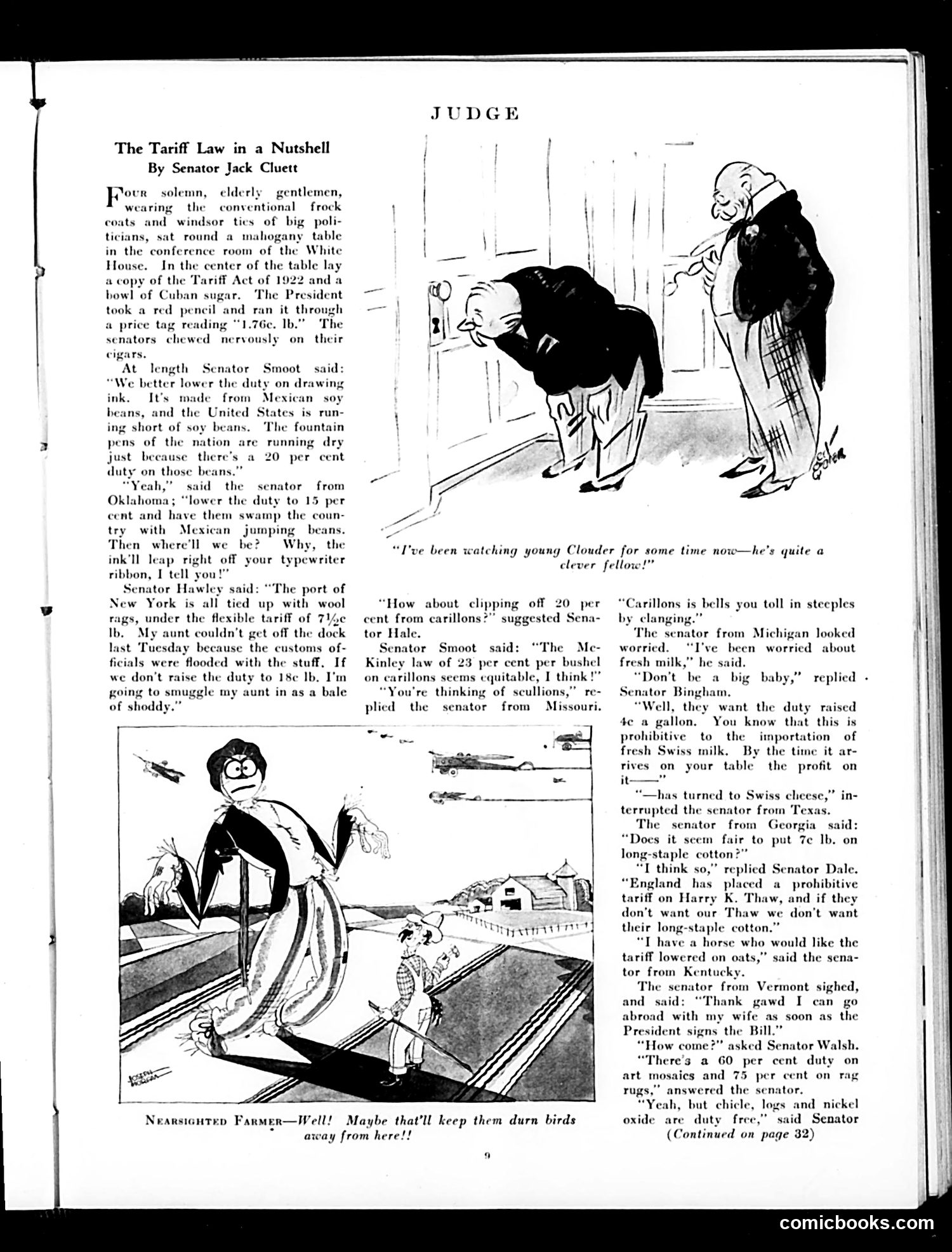
# The Tariff Law in a Nutshell This is political satire about the Tariff Act of 1922, mocking senators' confused and self-interested debates over import duties. The piece portrays politicians in the White House conference room discussing absurd tariff scenarios—Mexican jumping beans affecting typewriter ink, carillons (church bells) versus scullions (kitchen servants), Swiss milk turning to cheese during transport. The satire's point: senators prioritize protecting their home states' industries over logical policy. References include Senator Smoot (likely Reed Smoot, key tariff negotiator), and a joke about "Harry K. Thaw" (a notorious socialite involved in scandals) as an export to ridicule the arbitrary nature of tariff protections. The accompanying cartoon shows a farmer frustrated with tariffs. The humor exposes how tariff laws benefit wealthy interests while harming common citizens—the legislation's real-world consequences hidden behind politicians' circular, nonsensical reasoning.
📄 Transcribed text from this page (OCR, searchable)
Machine-transcribed from the original scan — historical spelling and the odd misread are preserved.
The Tariff Law in a Nutshell By Senator Jack Cluett Frere solemn, elderly gentlemen, wearing the conventional frock coats and windsor ties of big poli- ticians, sat round a mahogany table in the conference room of the White House. In the center of the table lay acopy of the Tariff Act of 1922 and a bowl of Cuban sugar. The President took a red pencil and ran it through a price tag reading “1.76c. Ib.” The senators chewed nervously on their cigars. At length Senator Smoot said: “We better lower the duty on drawing ink. It’s made from Mexican soy beans, and the United States is run- ing short of soy beans. ‘The fountain pens of the nation running dry just because there’s a 20 per cent duty on those beans.” “Yeah,” id the senator from Oklahoma; “lower the duty to 15 per cent and have them swamp the coun- with Mexican jumping beans. Then where'll we be? Why, the ink'll leap right off your typewriter ribbon, I tell you!” tor Hawley said: “The port of New York is all tied up with wool rags, under the flexible tariff of 7Y/4¢ Ib. My aunt couldn't get off the dock ficials were flooded with the stuff, If we don’t raise the duty to 18¢ Ib. I'm JUDGE “I've been watching young Clouder for some time now—he’s quite a clever fellow!" “How about clipping off 20° per cent from carillons?” suggested Sena- tor Hale. Senator Kin! on ¢ Smoot said: “The Me- law of 23 per cent per bushel lons seems equitable, I think !” You're thinking of scullions,” re- plied the senator from Missouri. ransianteD Farmer—Well! Maybe that'll keep them durn birds away from here!! “Carillons is bells you toll in steeples by clanging. - The senator from Michigan looked worried. fresh mil “I've been worried about i ig baby,” replied - Yell, they want the duty raised 4c a gallon. You know that this. is prohibitive to the importation of fresh Swiss milk, By the time it ar- “—has turned to Swiss cheese,” in- terrupted the senator from Ti The as. or from Georgia said: m fair to put Ze Ib. on long-staple think so,” replicd Senator Dale. gland has placed a prohibitive tariff on Harry K. Thaw, and if they don’t want our Thaw we don’t want their long-staple cotton.” “T have a horse who would like the tariff lowered on oats,” said the sena- tor from Kentucky The mont sighed, k gawd I can go wife as soon as the ?” asked Senator Walsh. “There's a GO per cent duty on art mosaics and 75 per cent on rag rugs,” answered the senator. “Yeah, but chicle, | and nickel oxide are duty free,” said Senator (Continued on page 32) Wt |i li 1 comicbooks.com