
Judge, 1930-06-21 · page 18 of 36
Judge — June 21, 1930 — page 18: what you’re looking at
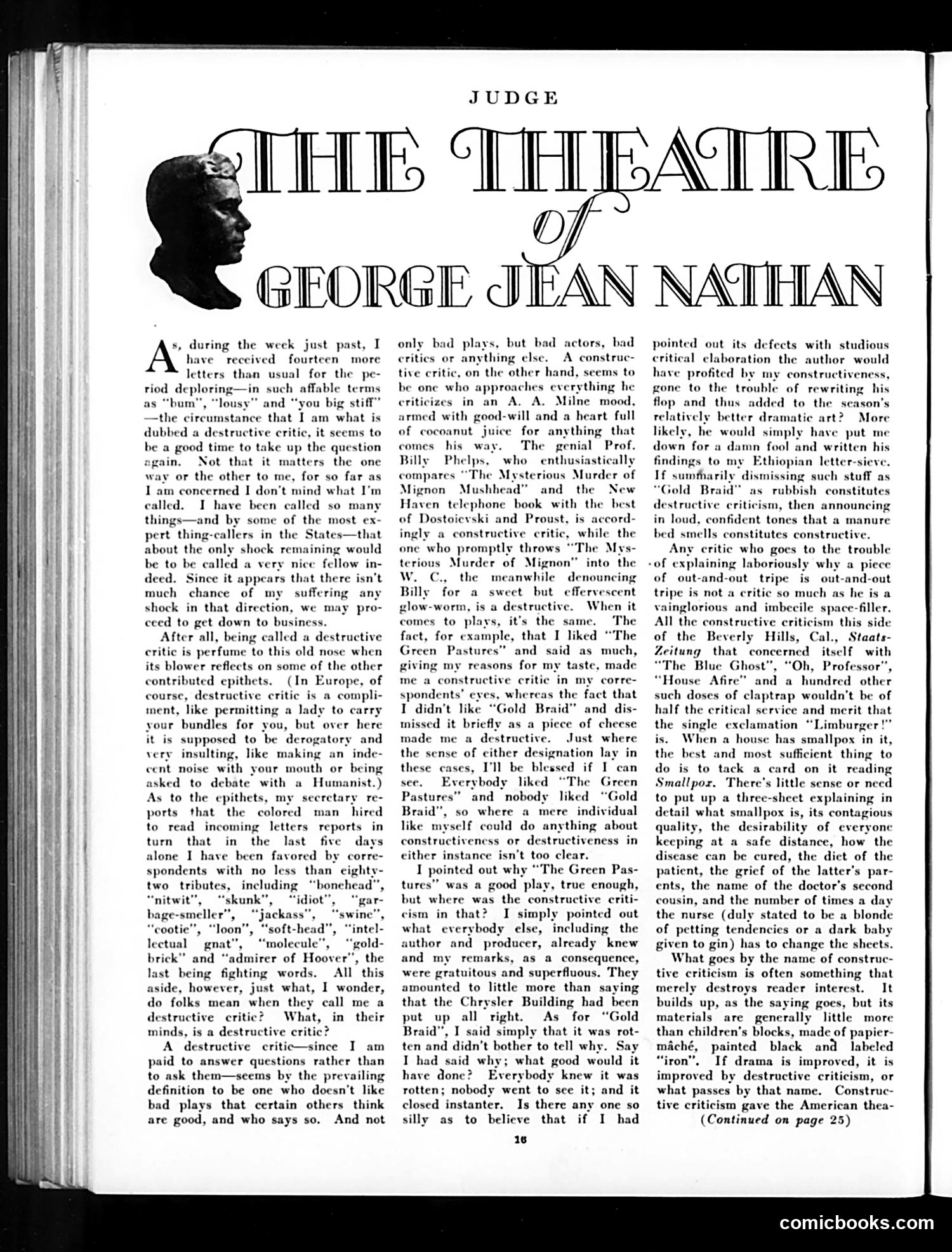
A restored page from Judge, 1930-06-21. Page through the whole issue in the reader above.
📄 Transcribed text from this page (OCR, searchable)
Machine-transcribed from the original scan — historical spelling and the odd misread are preserved.
ae & ALE GEORGE J s, during the week just past, I AN have ved fourteen more letters than usual for the pe- riod deploring—in such affable terms s “bum”, “lousy” and “you big stiff” —the circumstance that I am what is dubbed a destructive critic, it seems to be a good time to take up the question Not that it matters the one y or the other to me, for so far as 1 am concerned I don’t mind what I'm called. I ye been called so man: things—and by some of the most ex- pert thing-callers in the States—that about the only shock remaining would be to be called a very nice fellow in- deed. Since it appears that there isn’t much chance of my suffering any shock in that direction, we may pro- ceed to get down to business. After all, being called a destructive critic is perfume to this old nose when its blower reflects on some of the other contributed epithets. (In Europe, of course, destructive critic is a compli- ment, like permitting a lady to carry your bundles for you, but over here it is supposed to be derogatory and very insulting, like making an inde- cent noise with your mouth or being asked to debate with a Humanist.) As to the epithets, my secretary re- ports that the colored man_ hired to read incoming letters reports in turn that in the last five days alone I have been favored by corre- spondents with no less than eighty- “bonehead”, idiot”, “gare “jackass”, “swine”, “cootie’, “loon”, “soft-head”, “intel- lectual gi ,» “molecule”, “‘gold- brick” and “admirer of Hoover", the last being fighting words. All this aside, however, just what, I wonder, do folks mean when they call me a destructive critic? Wh: in their minds, is a destructive critic? A destructive critic—since I am paid to answer questions rather than to ask them—seems by the prevailing definition to be one who doesn't like bad plays that certain others think are good, and who says so. And not O only bad plays, but bad actors, bad critics or anything else. A construc- tive critic, on the other hand, seems to be one who approaches everything he criticizes in an A. A. Milne mood, armed with good-will and a heart full of cocoanut juice for anything that comes his way. The genial Prof. Billy Phelps, who enthusiastically compares “The Mysterious Murder of Mignon Mushhead” and the New Haven telephone book with the best of Dostoievs nd Proust, is accord- ingly a constructive critic, while the one who promptly throws “The Mys- terious Murder of Mignon” into the W. C., the meanwhile denouncing Billy for a sweet but effervescent glow-worm, is a destructive. When it comes to plays, it’s the same. The fact, for example, that I liked “The Green Pastures” and said as much, giving my reasons for my taste, made me a constructive critic in my corre- spondents’ eyes, whereas the fact that I didn't like “Gold Braid” and dis- missed it briefly as a piece of cheese made me a destructive. Just where the sense of cither designation lay i these cases, I'll be blessed if I can see. Everybody liked “The Green Pastures” and nobody liked “Gold Braid”, so where a mere individual like myself could do anything about constructiveness or destructiveness in either instance isn’t too clear. I pointed out why “The Green Pas- tures” was a good play, true enough, but where was the constructive criti- cism in that? I simply pointed out what everybody else, including the author and producer, already knew and my remarks, as a consequence, were gratuitous and superfluous. They amounted to little more than saying that the Chrysler Building had been put up all right. As for “Gold Braid”, I said simply that it was rot- ten and didn’t bother to tell why. Say I had said why; what good would it have done? Everybody knew it was rotten; nobody went to sce it; and it closed instanter. Is there any one so silly as to believe that if I had 16 ACR Es NACIHIAN pointed out its defects with studious critical elaboration the author would have profited by my constructiveness, gone to the trouble of rewriting his flop and thus added to the season's ively better dramatic art? More he would simply have put me down for a damn fool and written his findings to my Ethiopian letter-sieve. If sumfharily dismissing such stuff as as rubbish constitute: sm, then announci in loud, confident tones that a ma bed smells constitutes constructive. Any critic who goes to the trouble -of explaining laboriously why a piece of out-and-out tripe is out-and-out tripe is not a critic so much as he is a vainglorious and imbecile space-filler. All the constructive critic this side of the Beverly Hills, Cal., Staats- Zeitung that ‘concerned itself with “The Blue Ghost”, “Oh, Professor”, “House Afire’ and a hundred other such doses of claptrap wouldn't be of half the crit service and merit t the single exclamation “Limburger ! is. When a house has smallpox in it, the best and most sufficient thing to do is to tack a card on it reading Smallpox. There's little sense or need to put up a three-sheet explaining in detail what smallpox is, its contagious quality, ility of everyone keeping at a safe distance, how the disease can be cured, the diet of the patient, the grief of the latter's par- ents, the name of the doctor's second cousin, and the number of times a day the nurse (duly stated to be a blonde of petting tendencies or a dark baby given to gin) has to change the sheets. What goes by the name of construc- tive criticism is often something that merely destroys reader interest. It builds up, as the saying goes, but its materials are gencrally little more than children’s blocks, made of papier- miché, painted black and labeled “iron”, If drama is improved, it is improved by destructive criticism, or what passes by that name. Construc- tive criticism gave the American thea- (Continued on page 25) destructive ¢ comicbooks.com