
Judge, 1930-03-22 · page 27 of 36
Judge — March 22, 1930 — page 27: what you’re looking at
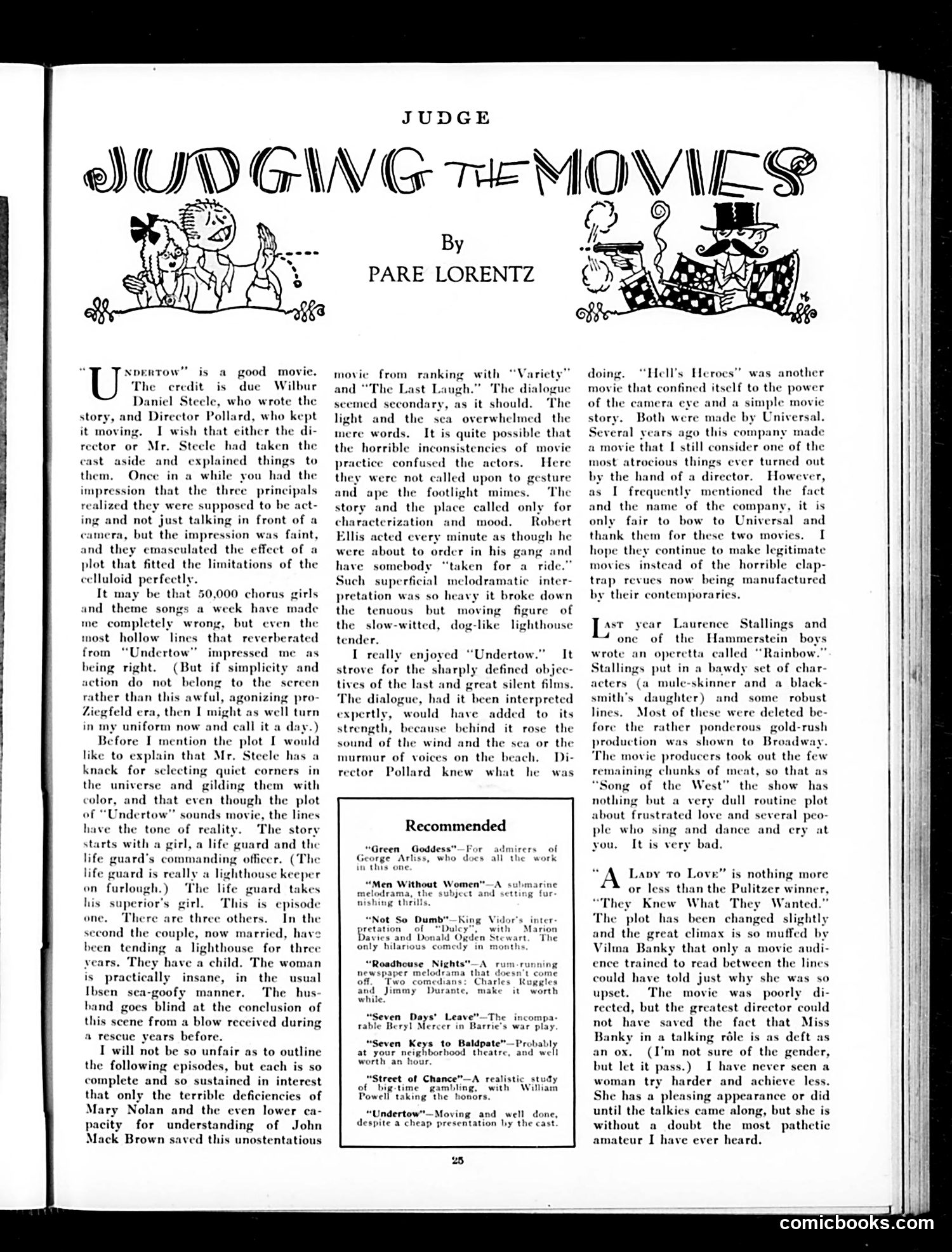
A restored page from Judge, 1930-03-22. Page through the whole issue in the reader above.
📄 Transcribed text from this page (OCR, searchable)
Machine-transcribed from the original scan — historical spelling and the odd misread are preserved.
Npentow” is a good movie. The credit is due Wilbur Daniel Steele, who wrote the or Pollard, who kept , h that either the di- rector or Mr. Steele had taken the st aside and explained things to them. Once in a while you had the impression that the three principals realized they were supposed to be act- ing and not just talking in front of a camera, but the impression was faint, and they emasculated the effect of a plot that fitted the limitations of the celluloid perfectly. It may be that 50,000 chorus girls and theme son a week have made me completely wrong, but even the most hollow lines that reverberated from “Undertow” impressed me as being right. (But if simplicity and action do not belong to the screen rather than this awful, agonizing pro- Ziegfeld era, then I might as well turn in my uniform now and call it a day.) Before I mention the plot I would like to explain that Mr. Stecle has a knack for selecting quict corners in the universe and gilding them with color, and that even though the plot of “Undertow” sounds movie, the lines have the tone of reality. The story starts with a girl, a life guard and the life guard’s commanding officer. (The life guard is really a lighthouse keeper on furlough.) ‘The life guard takes his superic irl. This is episode one. There are three others. In the second the couple, now married, have been tending a lighthouse for thre years. They have a child. The woman is practically insane, in the usual Ibsen sea-goofy manner. The hus- band goes blind at the conclusion of this scene from a blow received during a rescue years before. I will not be so unfair as to outline the following episodes, but each is so complete and so sustained in interest that only the terrible deficiencies of Mary Nolan and the even lower ca- pacity for understanding of John Mack Brown saved this unostentatious JUDGE movie from ranking with “V and “The Last Laugh.” The dialogue seemed secondary, as it should. The light and the sea overwhelmed the mere words. It is quite possible that the horrible inconsistencies of movie practice confused the actors. Here they were not called upon to gesture and ape the footlight mimes. The story and the place called only for rharacterization and mood. Robert is acted every minute as though he were about to order in his gang and have somebody “taken for a ride. Such superfic mclodramatic inter- pretation was so heavy it broke down the tenuous but moving figure of the slow-witted, dog-like lighthouse tender. I really enjoyed “Undertow.” It strove for the sharply defined objec- tives of the last and great silent films. The dialogue, had it been interpreted expertly, would have added to_ its strength, be behind it the sound of the wind and the sea or the murmur of voices on the beach, Di- rector Pollard knew w he was use rose Recommended “Green Goddess"—For admirers of orge Arliss, who docs all the work this one. “Men Without Women" drama, the hing thrills, “Not So Dumb" pretatil f "Dull Marion Davies and Donald ( The only hilarious comedy in “Roadhouse Nights"—A newspaper melodram off. Two comedians and Jimmy Durante, make ven Days’ Leave"—The incompa- rable Beryl Mercer in Barrie's war play ‘Seven Keys to Baldpate”—Probab! at your neighborhood theatre, and well worth an hour. “Street of Chance”—A realistic study of big-time gambling, with William Powell taking the honors. indertow"—Moving and well done, pite a cheap presentation hy the cast “Hell's Heroes” was another movie that confined itself to the power of the camera eye and a simple movie made by Universal. F » this company made a movie that I still consider one of the most atrocious things ever turned out by the hand of a director. However, I frequently mentioned the and the name of the company, only fair to bow to Universal thank them for these two movies. hope they continue to make legitin movies instead of the horrible el: trap revues now being manufactured by their contemporaries. Lit rear Laurence one of the EF wrote an operetta ¢ Stallings put inal acters (a Stallings and mmerstein boys Ned “Rainbow.” wdy set of char- mule-skinner and a black- smith’s daughter) and some robust lines. Most of these were deleted be- fore the rather ponderous gold-rush production was shown to Broadw. The movie producers took out the few remaining chunks of meat, so that as “Song of the West” the show has nothing but a very dull routine plot about frustrated love and several p ple who sing and dance and cry you, It is very bad. Lavy to Love” is nothing more or less than the Pulitzer winner, “They Knew What They Wanted The plot has been changed slightly and the great climax is so muffed by Vilma Banky that only a movie audi- ence trained to read between the lines could have told just why she was so upset. The movie was poorly di- rected, but the greatest director could not have saved the fact that Miss Banky in a talking réle is as deft as an ox. (I'm not sure of the gender, but let it pass.) I have never seen a woman try harder and She has a pleasing appearance or did until the talkies came along, but she is without a doubt the most pathetic amateur I have ever heard. chieve less. comicbooks.com