
Judge, 1930-03-22 · page 20 of 36
Judge — March 22, 1930 — page 20: what you’re looking at
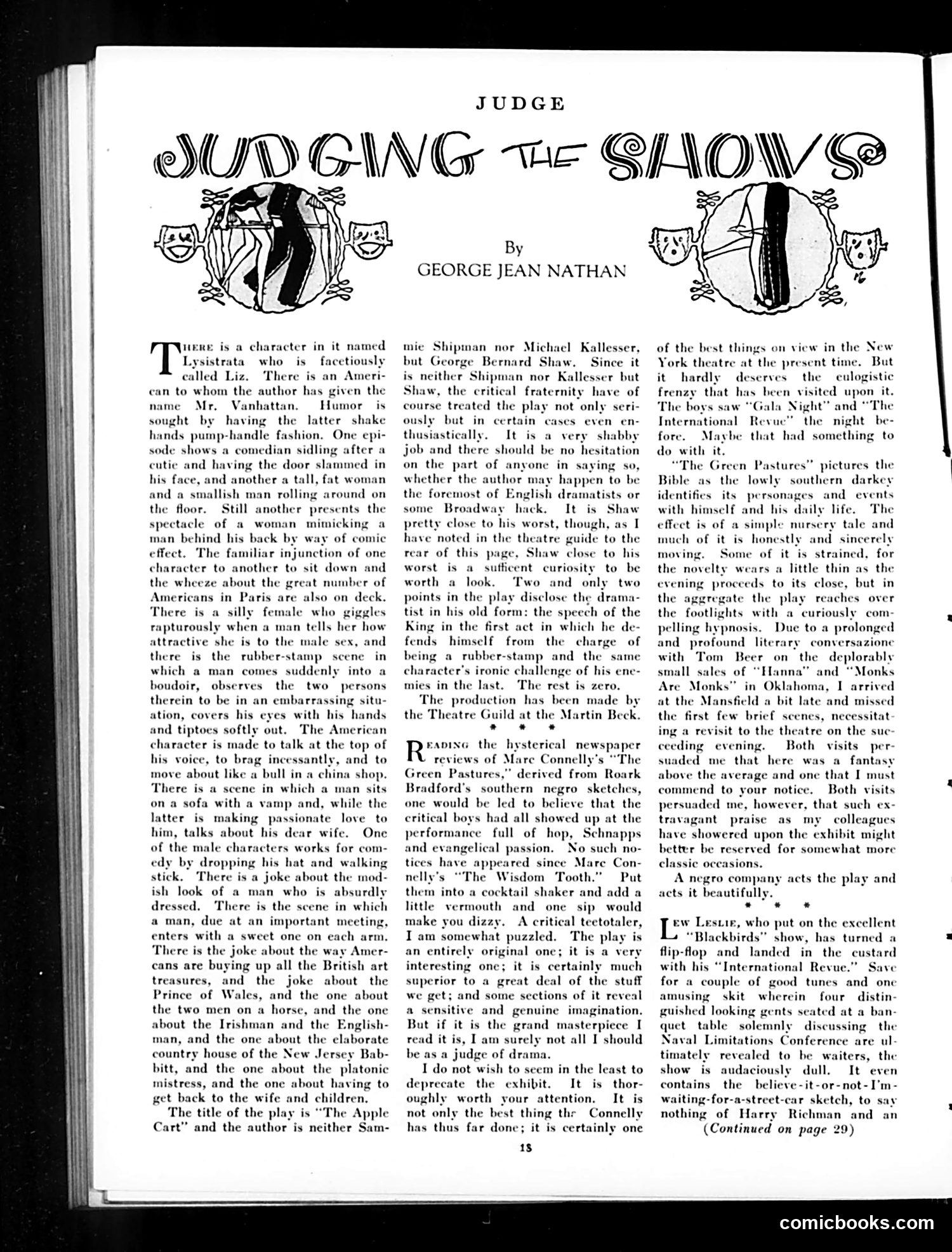
A restored page from Judge, 1930-03-22. Page through the whole issue in the reader above.
📄 Transcribed text from this page (OCR, searchable)
Machine-transcribed from the original scan — historical spelling and the odd misread are preserved.
eMYW eke is a character in it named | Lysistrata. who is facetiously ed Liz. There is an Ameri- can to whom the author has given the name Mr. Vanhat Humor is sought by having the latter shak hands pump-handle fashion. One ep sode shows cutie and having the door sl. his face, and another a tall, fat woman and a smallish man rollin ound on the floor. Still another presents the spec of a woman mimicking a man behind his back by of comic effect. The familiar injunction of one cter to a nother. to sit down and t number of so on deck. There is a silly female who giggles rapturously when a man tells her how attractive she is to the male sex, and there is the rubber-stamp scene in which a man comes suddenly into a boudoir, observes the two persons therein to be in an embarrassing situ- ation, covers his eyes with his hands nd tiptoes softly out. The American ch his v ster is made to talk at the top of ice, to brag incessantly, and to move about like a bull in a china shop. There a scene in which a man sits on a sofa h a vamp and, while the latter is making passionate love to him, talks about his dear wife. One of the male characters works for com- edy by dropping his hat and walking stick. There is a joke about the mod- look of a man who is absurdly dressed, There is the scene in which a man, due at an important meeting, enters with a sweet one on each arm, There is the joke about the cans are buying up all the Bri treasures, and the joke about the Prince of Wales, and the one about the two men on a horse, and the one about the Irishman and the man, and the one about the country house of the New Jersey Bab- bitt, and the one about the platonic mistress, and the one about having to get back to the wife and children. The title of the play is “The Apple Cart” and the author is neither Sam- ish Amer- ish art JUDGE NG we SAOW SG By GEORGE JEAN NATHAN inie Shipman nor Michael Kallesser, but George Bernard Shaw. Since it is neither Shipman nor Kallesser but Shaw, the critical fraternity have of course treated the play not only seri- but in certain cases even en- thusiastically. It is a very shabby job and there should be no hesitation on the part of anyone in saying so, whether the author may happen to be the foremost of English dramatists or some Broadway hack. It is Shaw pretty close to his worst, though, as I have noted in the theatre guide to the rear of this page, Shaw close to his worst is a sutficent curiosity to be worth a look. Two and only two points in the play disclose the drama- tist in his old form: the speech of the in the first act in which he himself from the charge of a rubber-stamp and the same acter's ironic challenge of his ene- mies in the last. The rest is zero. The production has been made by the Theatre Guild at the Martin Beck. 7 * «# Ruse the hysterical newspaper reviews of Mare Connelly’s “The Green Pastures,” derived from Roark Bradford’s southern negro sketches, one would be led to believe that the critical boys had all showed up at the performance full of hop, Schnapps and evangelical passion. No such no- tices have appeared since Mare Con- nelly’s “The Wisdom Tooth.” Put them into a cock shaker and add a little vermouth and one sip would make you diz: A critical tectotaler, I am Somewhat puzzled. The play is an entirely original one; it is a very interesting one; it is certainly much superior to a great deal of the stuff we get; and some sections of it reveal a sensitive and genuine imagination. But if it is the grand masterpiece I read it is, I am surely not all I should be as a judge of drama. I do not wish to seem in the least to ously de- fends deprecate the exhibit. It is. thor- oughly worth your attention. It is not only the best thing the Connelly has thus far done; it is certainly one 18 of the best things on view in the New York theatre at the present time. But it hardly deserves the culogistic that has been visited upon it. Night” and “The Revue” the night be- that had something to fore. Maybe do with it. “The Green Pasture: Bible as the lowly southern darkey identi ges and events with himself and his daily life. The effect is of a simple nursery tale and much of it is honestly and sincerely Some of it is strained, for wears a little thin as the evening proceeds to its close, but in the aggregate the play reaches over the footlights with a curiously com- pelling hypnosis. Due to a prolonged and profound literary conversazione Tom Beer on the deplorably small sales of “Hanna” and “Monks Are Monks” in Oklahoma, I arrived at the Mansfield a bit late and missed the first few brief scenes, necessitat ing a revisit to the theatre on the suc ceeding evening. Both per- suaded me that here was a fantasy above the average and one that I must commend to your not Both visits persuaded me, however, that such ex- travagant praise as my colleagues have showered upon the exhibit might bettur be reserved for somewhat more classic occasions. A negro company acts the play and acts it beautifully. eo ew ® [2% Leste: who pat on the excellent “Blackbirds” show, has turned a flip-flop pictures the its person moving. the novelty visits and landed in the custard with his “International Revue.” Save for a couple of good tunes and one amusing skit wherein four distin- guished looking gents seated at a ban- quet table solemnly discussing — the val Limitations Conference are ul- timately revealed to be waiters, the show is audaciously dull. It ¢ contains the k i ng-for-a-street sketch, to s: nothing of Harry Richman and (Continued on page 29) comicbooks.com