
Judge, 1930-03-15 · page 18 of 36
Judge — March 15, 1930 — page 18: what you’re looking at
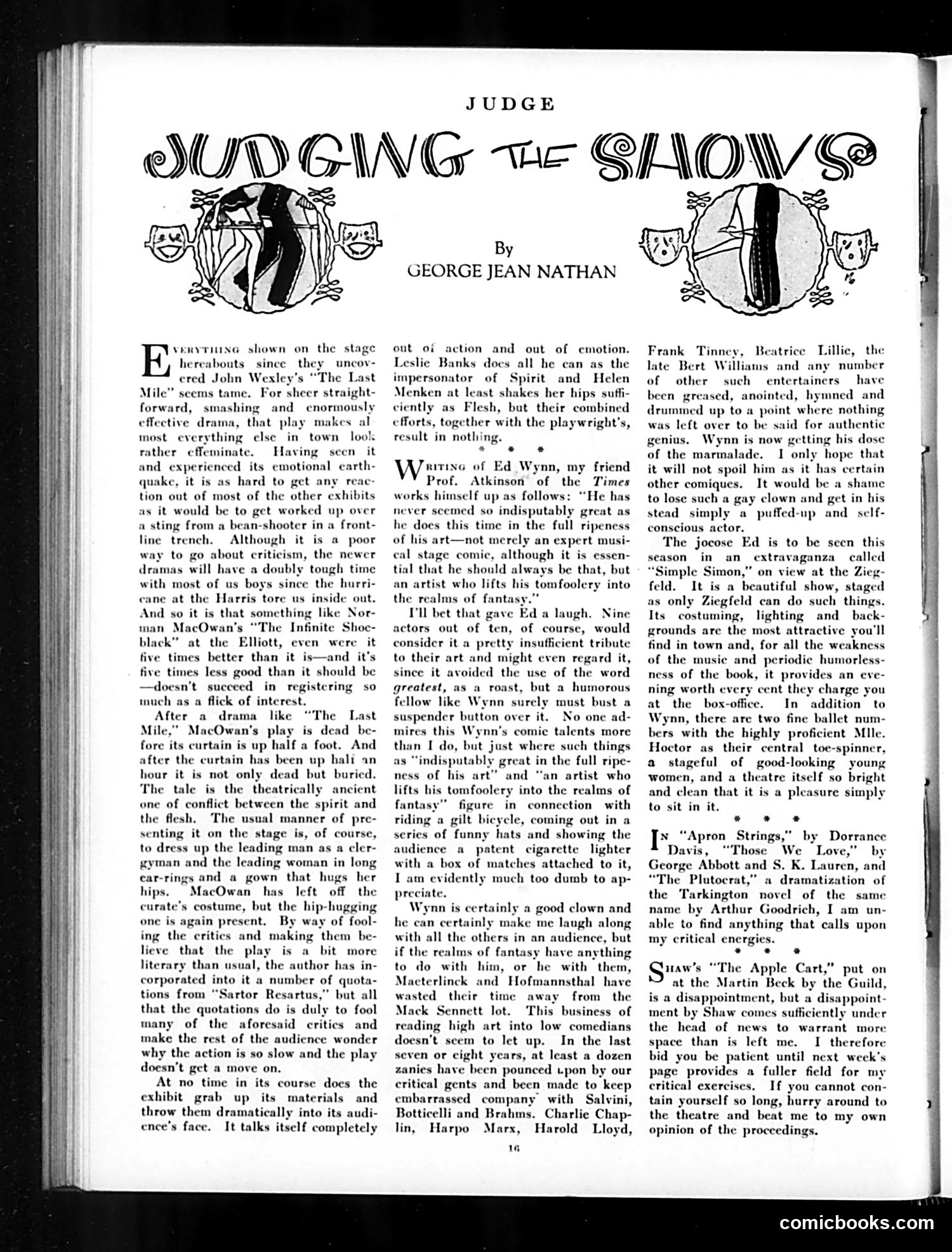
A restored page from Judge, 1930-03-15. Page through the whole issue in the reader above.
📄 Transcribed text from this page (OCR, searchable)
Machine-transcribed from the original scan — historical spelling and the odd misread are preserved.
JUDGE IG ee GANOWS venyTiixe shown on the stage hereabouts they uncov- ered John Wexley's “The Last For sheer straight- j and enormously effective drama, that play makes al most everything else in’ town lool rather effeminate. Having seen it and experienced its emotional earth- quake, it is as hard to get any reac- tion out of most of the other exhibits as it would be to get worked up over a sting from a bean-shooter in a front- line trench. Although it is a poor way to go about criticism, the newer dramas will have a doubly tough time with most of us boys since the hurri- cane at the Harris tore us inside out. And so it is that something like Nor- man MacOwan’s “The Infinite Shoc- ck” at the Elliott, even were it tive times better than it is—and it's five times less good than it should be —doesn't succeed in registering so much as a flick of interest. After a drama like “The Last Mile,” MacOwan's play is dead be- fore its curtain is up half a foot. And after the curtain has been up halt an hour it is not only dead but buried. The tale is the theatrically ancient one of conflict between the spirit and the flesh, The usual manner of pre- senting it on the stage is, of course, to dress up the leading man as a cler- gyman and the leading woman in long ear-rings and a gown that hugs her hips. MacOwan has left off the curate’s costume, but the hip-hugging one is again present. By way of fool- ing the critics and making them be- lieve that the play is a bit more literary than usual, the author has in- corporated into it a number of quota- tions from “Sartor Resartus,” but all that the quotations do is duly to fool many of the aforesaid critics and make the rest of the audience wonder why the action is so slow and the play doesn’t get a move on. At no time in its course does the exhibit grab up its materials and throw them dramatically into its audi- ence’s face. It talks itself completely By GEORGE JEAN NATHAN out of action and out of motion, Leslie Banks does all he can as the impersonator of Spirit and Helen Menken at least shakes her hips suffi- ciently as Flesh, but their combined efforts, together with the playwright’s, result in nothing. oe 8 Wrinve of Ed Wynn, my friend Prof. Atkinson of the Times works himself up as follows: “He has never scemed so indisputably great as he does this time in the full ripeness of his art—not merely an expert musi- cal stage comic, although it is essen- jal that he should always be that, but an artist who lifts his tomfoolery into the realms of fantasy.” I'll bet that gave Ed a laugh. Nine actors out of ten, of course, would consider it a pretty insufficient tribute to their art and might even regard it, since it avoided the use of the word greatest, as a roast, but a humorous fellow like Wynn surely must bust a suspender button over it. No one ad- mires this Wynn's comic talents more than I do, but just where such things as “indisputably great in the full ripe- ness of his art” and ‘an artist who lifts his tomfoolery into the realms of fantasy” figure in connection with ling a gilt cle, coming out in a series of funny hats and showing the idience a patent cigarette lighter h a box of matches attached to it, evidently much too dumb to ap- preciate. Wynn is certainly a good clown and he can certainly make me laugh along with all the others in an audience, but if the realms of fantasy have anything to do with him, or he with them, Maeterlinck and Hofmannsthal have asted their time away from the Mack Sennett lot. This business of ng high art into low comedians seem to let up. In the last seven or cight years, at least a dozen zanies have been pounced upon by our critical gents and been made to keep embarrassed company with Salvini, Botticelli and Brahms. Charlie Chap- lin, Harpo Marx, Harold Lloyd, Frank Tinr ratrice Lillie, the late Bert Williams 1 any number of other ch entertainers have been greased, anointed, hymned and drummed up to a point where nothing was left over to be said for authentic genius. Wynn is now getting his dose of the marmalade. I only hope that it will not spoil him as it has certain other comiques. It would be a s to lose such a gay clown and get i stead simply a puffed-up and self- conscious actor. The jocose Ed is to be seen this season in an extravaganza called “Simple Simon,” on view at the Zieg- feld. It is a beautiful show, staged as only Ziegfeld can do such things Its costuming, lighting and back- grounds are the most attractive you'll find in town and, for all the weakness of the music and periodic humorless- ness of the book, it provides an eve- ning worth every cent they charge you at the box-office. In addition to Wynn, there are two fine ballet num- bers with the highly proficient Mlle. Hoctor as their central toe-spinner, a stageful of good-looking young women, and a theatre itself so bright and clean that it is a pleasure simply to sit in it. * 8 * n “Apron Strings,” by Dorrance Davis, hose We Love,” by George Abbott and S, K. Lauren, and “The Plutocrat,” a dramatization of the Tarkington novel of the same name by Arthur Goodrich, I am un- able to find anything that calls upon my critical energies. oe @ Suav’s “The Apple Cart,” put on at the Martin Beck by the Guild, is a disappointment, but a disappoint- ment by Shaw comes sufficiently under the head of news to warrant more space than is left me. I therefore bid you be patient until next weck’s page provides a fuller field for my critical exercises. If you cannot con- tain yourself so long, hurry around to the theatre and beat me to my own opinion of the proceedings. comicbooks.com