
Judge, 1930-03-08 · page 23 of 36
Judge — March 8, 1930 — page 23: what you’re looking at
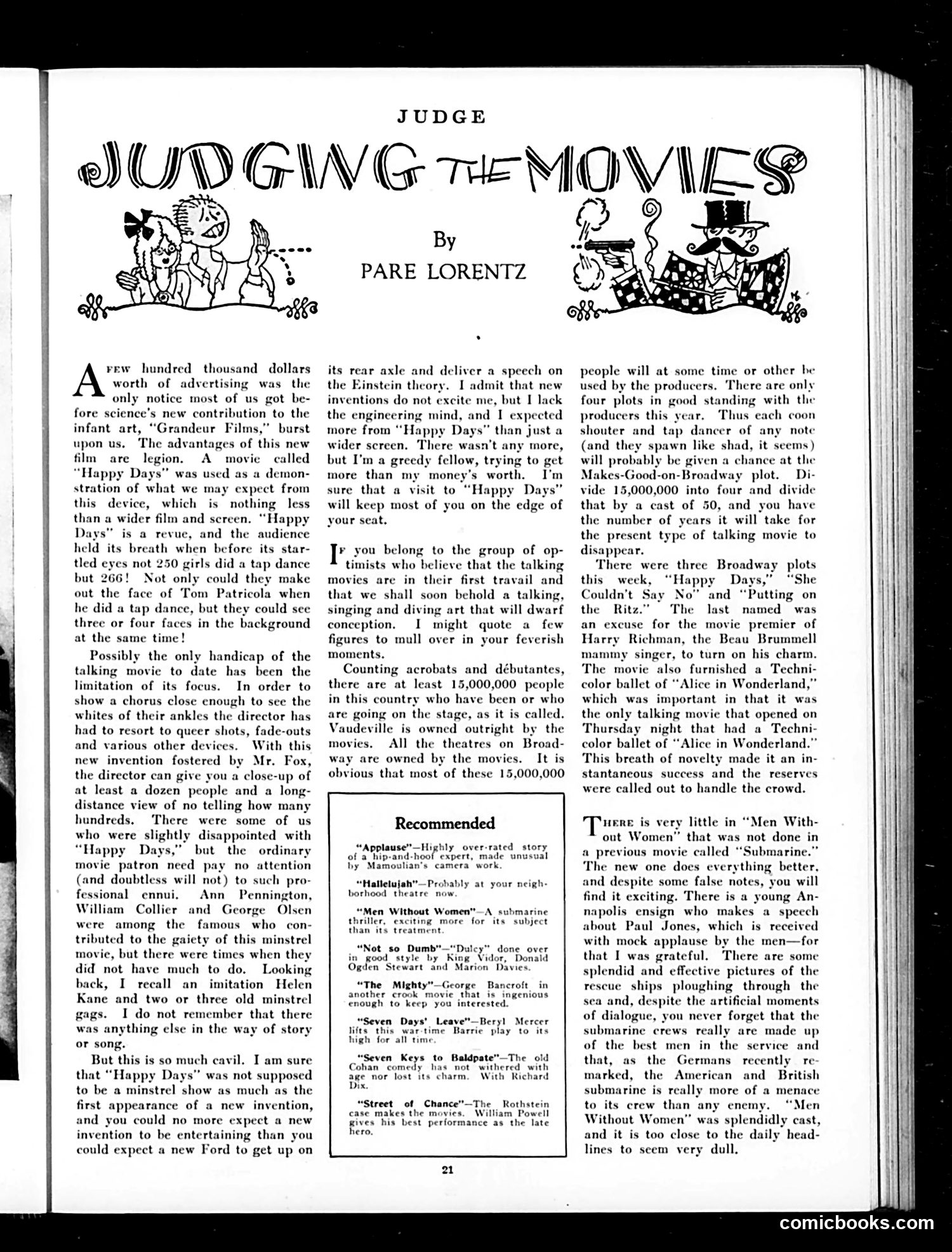
A restored page from Judge, 1930-03-08. Page through the whole issue in the reader above.
📄 Transcribed text from this page (OCR, searchable)
Machine-transcribed from the original scan — historical spelling and the odd misread are preserved.
JUDGE JUVDGWG THE MOV LS y hundred thousand dollars worth of advertising was the only notice most of us got be- fore science’s new contribution to the infant art, “Grandeur Films,” burst upon us. The advantages of this new film are legion. A movie called “Happy Days” was used as a demon- stration of what we may expect from this device, which is nothing less than a wider film and screen. “Happy Days” is a revue, and the audience held its breath when before its s' tled eyes not 250 girls did a tap dance but 266! Not only could thes out the face of Tom Patricola when he did a tap dance, but they could see three or four faces in the background at the same time! Possibly the only handicap of the talking movie to date has been the limitation of its focus. In order to show a chorus close enough to see the s of their ankles the director has had to resort to queer shots, fade-outs and various other devices. With this new invention fostered by Mr. Fox, the director can give you a close-up of at least a dozen people and a long- distance view of no telling how many hundreds. There were some of us who were slightly disappointed with “Happy Days,” but the ordinary movie patron need pay no attention (and doubtless will not) to such pro- fessional ennui, Ann Pennington, William Collier and George Olsen were among the famous who con- tributed to the gaiety of this minstrel movie, but there were times when they did not have much to do. Looking back, I recall an imitation Helen Kane and two or three old minstrel zags. I do not remember that there was anything else in the way of story or song. But this is so much cavil. I am sure that “Happy Day as not supposed to be a minstrel show as much as the first appearance of a new invention, and you could no more expect a new invention to be entertaining than you could expect a new Ford to get up on By PARE LORENTZ its rear axle and deliver a speech on the Einstein theory. I admit that new inventions do not excite me, but I lack the engineering mind, and I expected more from “Happy Days” than just a wider screen. There wasn't any more, but I'm a greedy fellow, trying to get more than my mone worth. I’m sure that a visit to “Happy Days” will keep most of you on the edge of your seat. I you belong to the group of op- timists who believe that the talking movies are in their first travail and that we shall soon behold a talking, singing and diving art that will dwarf conception. I might quote a few figures to mull over in your feverish moments. Counting acrobats and débutantes, there are at least 15,000,000 people in this country who have been or who are going on the stage, as it is called. Vaudeville is owned outright by the mov. All the theatres on Broad- are owned by the movies. It is obvious that most of these 15,000,000 Recommended “Applause”—Highly over-rated story of a hip-and-hoof expert, made unusual hy Mamoulian’s camera’ work “Hallelujah"—Probably at your neigh- borhood theatre now “Men Without Women" thriller, exciting more than its treatment. A. submarine for its subject ‘ot so Dumb"—" done over in good style by King Vidor, Donald Ogden Stewart and Marion Davies. “The Mighty"—George Bancroft in another crook movie that is ingenious enough to keep you interested. “Seven Days’ lifts this war-t high for all tim “Seven Keys to Baldpate’—The old Cohan comedy has not withered with age nor lost its charm, With Richard Dix. Leave"—Beryl Mercer Barrie play to its “Street of Chance"—The Rothstein case makes the movies. William Powell gives his best performance as the late hero. 21 people will at some time or other be used by the producers. ‘There are only four plots in good standing with the producers this year. Thus each coon shouter and tap dancer of any note (and they spawn like shad, it seems) will probably be given a chance at the Makes-Good-on-Broadway plot. Di- vide 15,000,000 into four and divide that by a cast of 50, and you have the number of years it will take for the present type of talking movie to disappear. There were three Broadway plots this week, Days,” “She Couldn't Say No” and “Putting on the Ritz.” The last named was an excuse for the movie premier of Harry Richman, the Beau Brummell mammy singer, to turn on his charm. The movie also furnished a Techni- color ballet of ‘Alice in Wonderland,” which was important in that it was the only talking movie that opened on Thurs. night that had a Techni- color ballet of “Alice in Wonderland. This breath of novelty made it an in- stantancous success and the reserves were called out to handle the crowd. uere is very little in “Men With- out Women” that was not done in a previous movie called “Submarine.” The new one does everything better, and despite some false notes, you will find it exciting. There is a young An- napolis ensign who makes a speech about Paul Jones, which is received with mock applause by the men—for that I was grateful. There are some splendid and effective pictures of the rescue ships ploughing through the sea and, despite the artificial moments of dialogue, you never forget that the submarine crews really are made up of the best men in the service and that, as the recently re marked, the American and Briti submarine is really more of a mena to its crew than any encmy. “Men Without Women” was splendidly cast, and it is too close to the daily head- lines to seem very dull. Germans comicbooks.com