
Judge, 1930-03-01 · page 15 of 36
Judge — March 1, 1930 — page 15: what you’re looking at
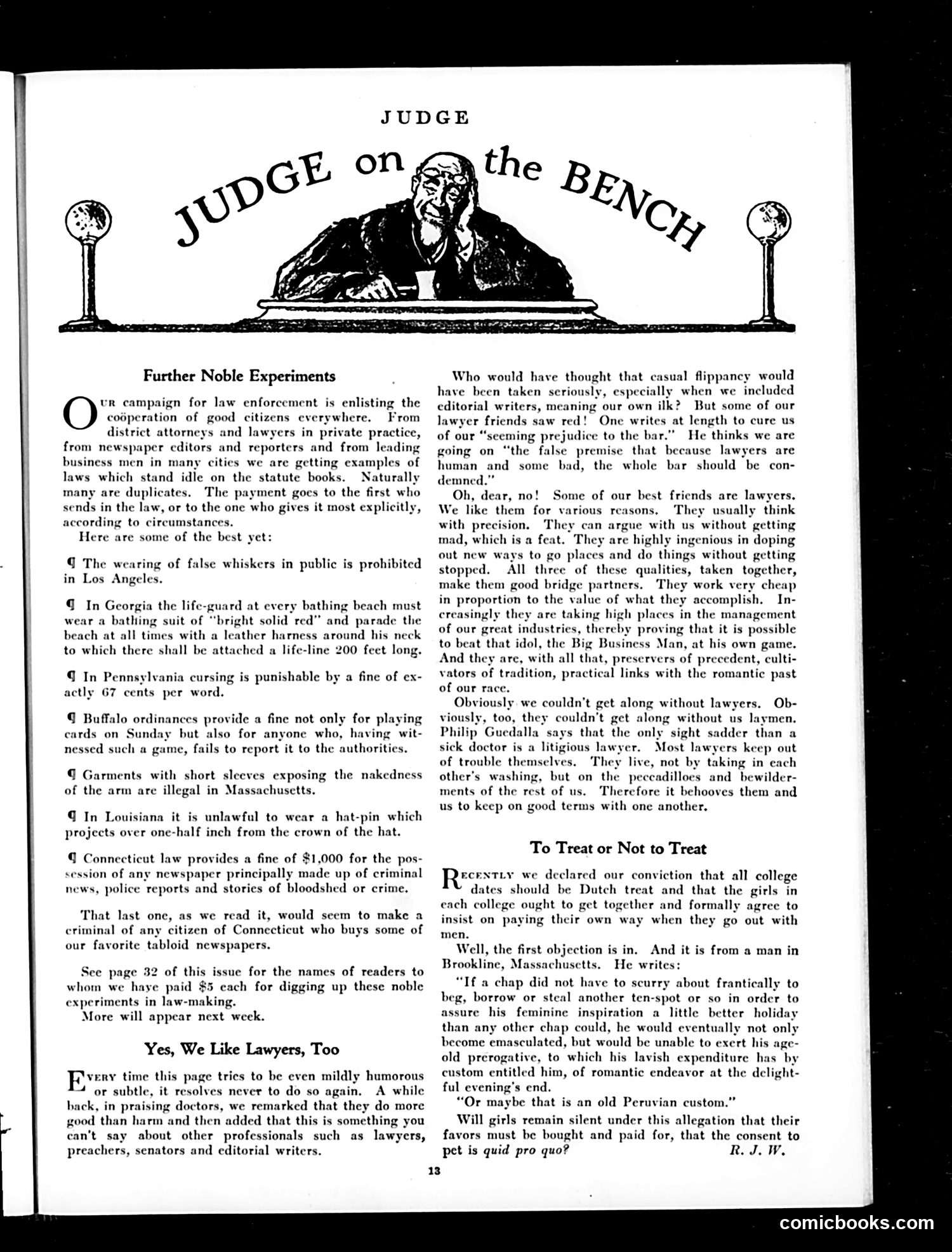
A restored page from Judge, 1930-03-01. Page through the whole issue in the reader above.
📄 Transcribed text from this page (OCR, searchable)
Machine-transcribed from the original scan — historical spelling and the odd misread are preserved.
Further Noble Experiments ur campaign for law enforcement is enlisting the codperation of good citizens everywhere. From district attorneys and lawyers in private practice, from newspaper editors and reporters and from leading business men in many cities we are getting examples of laws which stand idle on the statute books. Naturally many are duplicates. The payment goes to the first who sends in the law, or to the one who gives it most explicitly, according to circumstances. Here are some of the best yet: @ The wearing of false whiskers in public is prohibited in Los Angeles. In Georgia the life-guard at every bathing beach must wear a bathing suit of “bright solid red” and parade the beach at all times with a leather harness around his neck to which there shall be attached a life-line 200 feet long. In Pennsylvania cursing is punishable by a fine of ex- actly 67 cents per word. Buffalo ordinances provide a fine not only for pla} cards on Sunday but also for anyone who, having wit- nessed such a game, fails to report it to the authorities. G Garments with short sleeves exposing the nakedness of the arm are illegal in Massachusetts. 4 In Louisiana it is unlawful to wear a hat-pin which r projects over one-half inch from the crown of the hat. Connecticut law provides a fine of $1,000 for the pos- session of any newspaper principally made up of criminal news, police reports and stories of bloodshed or crime. That last one, as we read it, would seem to make a criminal of any citizen of Connecticut who buys some of our favorite tabloid newspapers. See page 32 of this issue for the names of readers to whom we haye paid $5 each for digging up these noble experiments in law-making. More will appear next week. Yes, We Like Lawyers, Too very time this page trics to be even mildly humorous or subtle, it resolves never to do so again. A while hack, in praising doctors, we remarked that they do more good than harm and then added that this is something you can’t say about other professionals such as lawyers, preachers, senators and editorial writers. 13 Who would have thought that casual flippancy would have been taken seriously, especially when we included editorial writers, meaning our own ilk? But some of our lawyer friends saw red! One writes at length to cure us of our “seeming prejudice to the bar.” He thinks we are going on “the false premise that because lawyers are human and some bad, the whole bar should be con- demned.” Oh, dear, no! Some of our best friends are lawyers. We like them for various reasons. They usually think with precision. They can argue with us without getting mad, which is a feat. They are highly ingenious in doping out new ways to go places and do things without getting stopped. All three of these qualities, taken together, make them good bridge partners. They work very cheap in proportion to the value of what they accomplish, In- creasingly they are taking high places in the management of our great industries, thereby proving that it is possible to beat that idol, the Big Business Man, at his own game. And they are, with all that, preservers of precedent, culti- vators of tradition, practical links with the romantic past of our race. Obviously we couldn't get along without lawyers. Ob- viously, too, they couldn't get along without us 1 Philip Guedalla says that the only sick doctor is a litigious lawyer. Most lawyers keep out of trouble themselves. They live, not by taking in each other's washing, but on the peccadilloes and bewilder- ments of the rest of us. Therefore it behooves them and us to keep on good terms with one another, men, sight sadder than a To Treat or Not to Treat Reeeste* we declared our conviction that all college dates should be Dutch treat and that the girls in rach college ought to get together and formally agree to insist on paying their own way when they go out with men. € Well, the first objection is in. Brookline, Massachusetts. And it is from a man in He writes: “If a chap did not have to scurry about frantically to beg, borrow or steal another ten-spot or so in order to assure his feminine inspiration a little better holiday than any other chap could, he would eventually not only become emasculated, but would be unable to exert his age- old prerogative, to which his lavish expenditure has by custom entitled him, of romantic endeavor at the delight- ful evening's end. “Or maybe that is an old Peruvian custom Will girls remain silent under this allegation that their favors must be bought and paid for, that the consent to pet is quid pro quo? R.JILW. comicbooks.com