
Judge, 1929-12-14 · page 15 of 36
Judge — December 14, 1929 — page 15: what you’re looking at
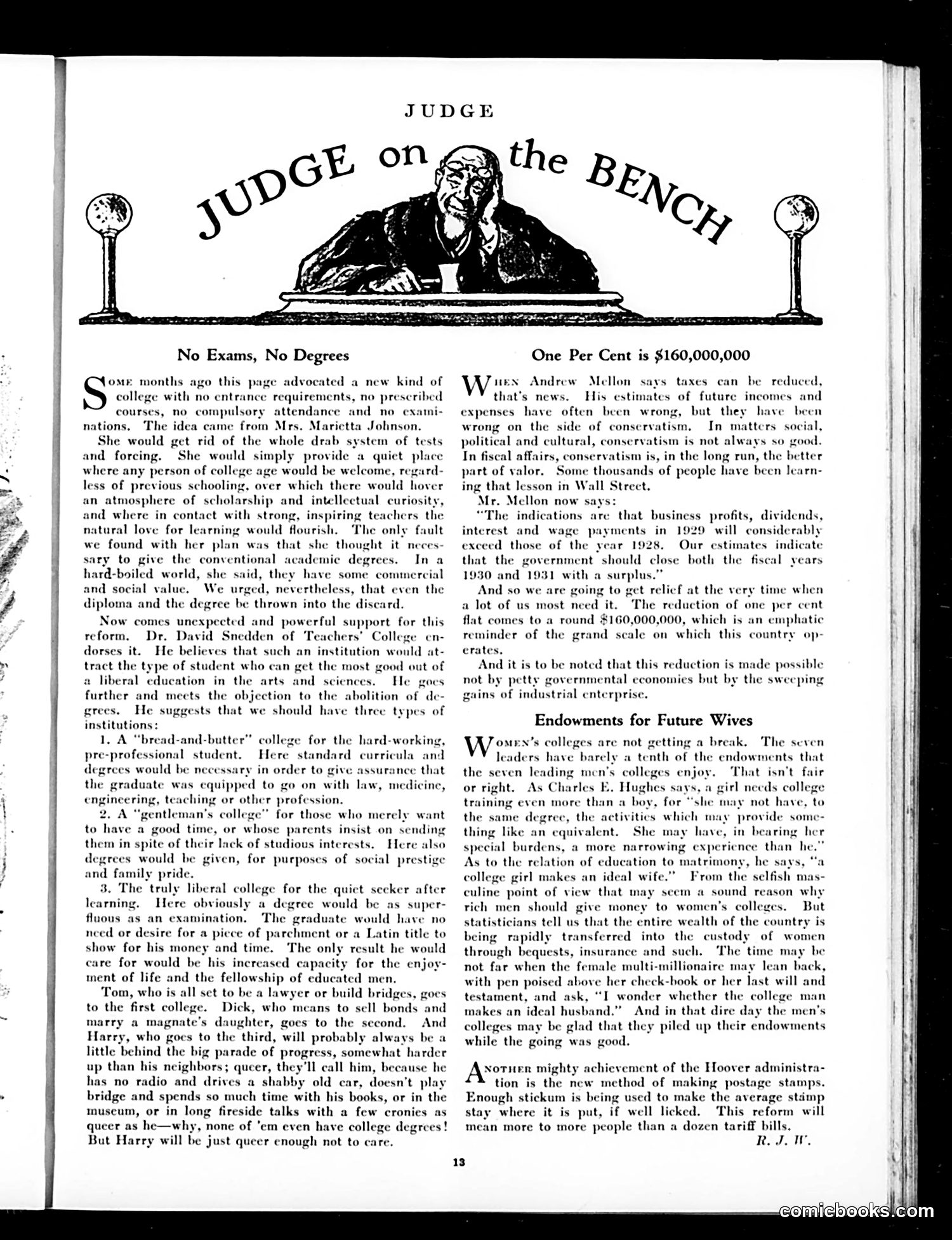
A restored page from Judge, 1929-12-14. Page through the whole issue in the reader above.
📄 Transcribed text from this page (OCR, searchable)
Machine-transcribed from the original scan — historical spelling and the odd misread are preserved.
\ i No Exams, No Degrees ome months ago this ps college with no entrance requirements, no prescribed courses, no compulsory attendance and no exatni- nations, The idea came from Mrs. Marictta Johnson. She would get rid of the whole drab system of tests and forcing. She would simply provide a quiet p where any person of college age would be welcome, re less of previous schooling, over which there would hov an atmosphere of scholarship and intellectual curiosity, and where in contact with strong, inspiring teachers the natural love for learning would flourish. The only fault we found with her plan was that she thought it neces- sary to give the conventiona demic degrees. In a hard-boiled world, she said, have some commercial and social value. We urged, nevertheless, that even the diploma and the degree be thrown into the discard. advocated a new kind of Now comes unexpe nd powerful support for this reform. Dr. David Snedden of Teachers’ College en- dorses it. He believes that such an institution would at- tract the type of student who can get the most good out of a liberal education in the arts and sciences. He goes further and mects the objection to the abolition of de- grees. He suggests that we should have three types of institutions: 1, A “bread-and-butter” college for the hard-working, pre-professional student. Here standard and degrees would be necessary in order to give a that the graduate was equipped to go on with law, medicine, engineering, teaching or other profession. A “gentl for those who merely want to have a good time, or whose parents insist on sending them in spite of their lack of studious interests. Here also degrees would be given, for purposes of social prest and family pride. The truly liberal colle for the quict seeker after learning. Here obviously a degree would be as super- fluous as an examination. The graduate would have no need or desire for a picce of parchment or a Latin title to show for his mon and time. he only result he would care for would be his increased capacity for the enjoy- ment of life and the fellowship of educated men, Tom, who is all set to be a lawyer or build bridges, goes to the first college. Dick, who means to sell bonds and y a magnate’s daughter, goes to the second. And Harry, who gocs to the third, will probably always be a little behind the big parade of progress, somewhat harder up than his neighbors; queer, they'll call him, because he has no radio and drives a shabby old car, doesn’t play bridge and spends so much time with his books, or in the museum, or in long fireside talks with a few cronies as queer as he—why, none of ‘em even have college degrees! But Harry will be just queer enough not to care. nan's college” One Per Cent is $160,000,000 Wis Andrew Mellon says taxes can be reduced, that’s news. His estimates of future incomes and expenses have often been wrong, but they have been wrong on the side of conservatism, In matters. political and cultural, conservatism is not always so In fiscal affairs, conservatism is, in the long run, the part of valor. Some thousands of people have been learn- ing that lesson in Wall Street. Mr. Mellon now says: “The indications are that business profits, interest and wage payments in 1929 will cons’ 3 excecd those of the year 1928, Our estimates indicate that the government should close both the fiscal years 1930 and 1931 with a surplus.” And so we are going +t relief at the very time when a lot of us most need it. The reduction of one per cent flat comes to a round $160,000,000, which is an emphatic reminder of the grand scale on which this country op- es. nd it is to be noted that this reduction is made possible not by petty governmental gains of industrial enterprise. mnomies but by the sweeping Endowments for Future Wives Wores’s colleges « not getting a break. ‘The seven leaders have barely a tenth of the endowments that “That isn't fair the seven leading men’s colleges enjoy. ne degree n equivalent. She 1 al burdens, a more narrowing experience than he As to the relation of education to matrimony, he says, college girl makes an ideal wife.” From the selfish mas- culine point of view that may seem a sound reason why rich men should give money to women’s colleges. But i ns tell us that the entire wealth of the country is pidly transferred into the custody of women through bequests, insurance and such, ‘The time may be not far when the female multi-millionaire may lean back, with pen poised above her check-book or her last will and testament, and ask, “I wonder whether the college man makes an ideal husband.” And in that dire day the men’s colleges may be glad that they piled up their endowments while the going ws being Axorien mighty achievement of the Hoover administra- tion is the new method of making postage stamps. Enough stickum is being used to make the average stamp stay where it is put, if well licked. This reform will mean more to more people than a dozen tariff bills. RJ. W.