
Judge, 1929-12-07 · page 26 of 36
Judge — December 7, 1929 — page 26: what you’re looking at
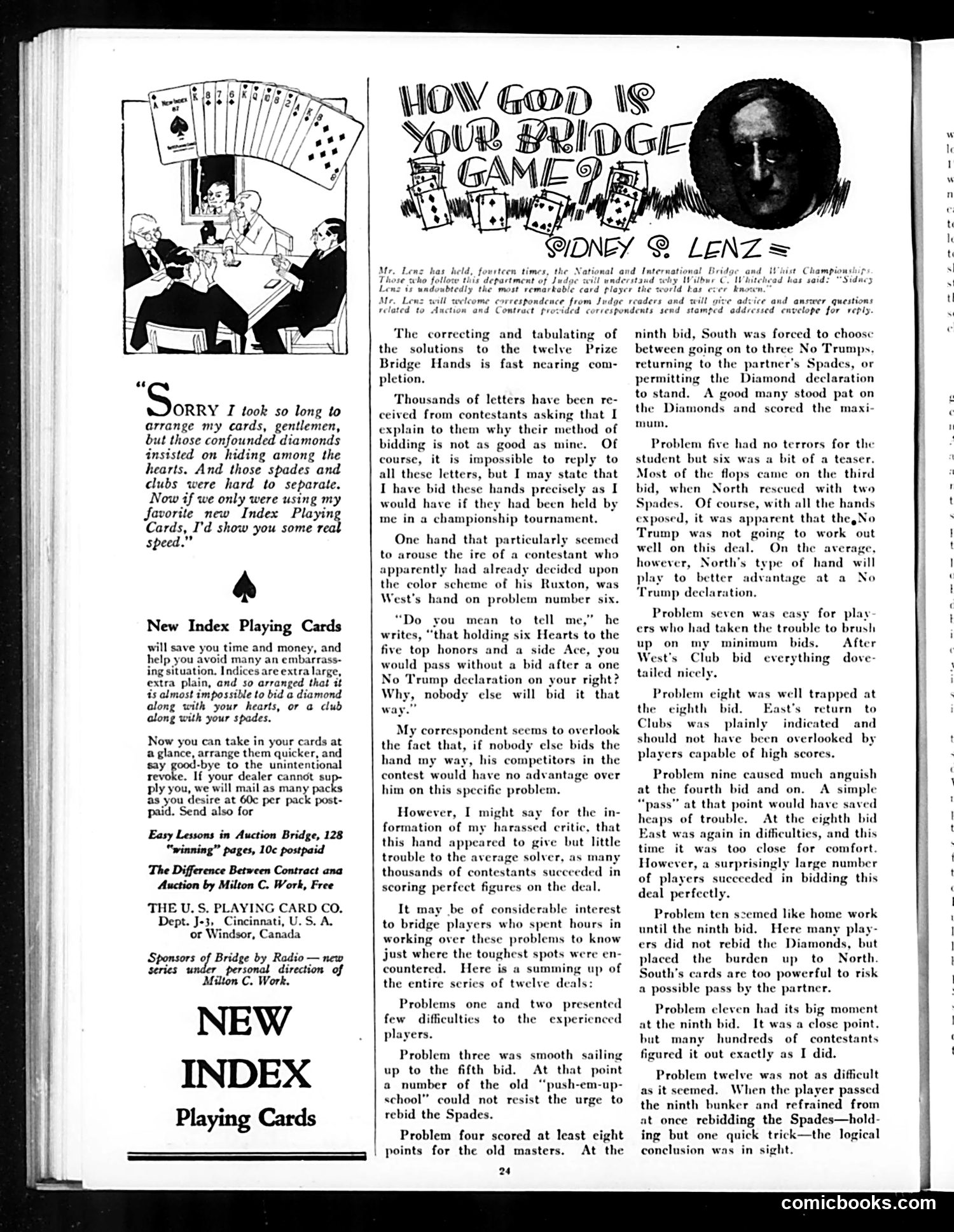
A restored page from Judge, 1929-12-07. Page through the whole issue in the reader above.
📄 Transcribed text from this page (OCR, searchable)
Machine-transcribed from the original scan — historical spelling and the odd misread are preserved.
Sorry I took so long to arrange my cards, gentlemen, but those confounded diamonds insisted on hiding among the hearts. And those spades and clubs were hard to separate. Now if we only were using my favorite new Index Playin, Cards, I'd show you some rea! speed.” & New Index Playing Cards will save you time and money, and help you avoid many an embarrass- ing situation. Indices are extra large, extra plain, and so arranged that it ts almost impossible to bid a diamond along with your hearts, or a@ club along with your spades. Now you can take in your cards at a glance, arrange them quicker, and say good-bye to the unintentional revoke. If your dealer cannot su ply you, we will mail as many packs as you desire at 60c per pack post- paid. Send also for Easy Lessons in Auction Bridge, 128 “winning” pages, 10¢ postpaid The Difference Between Contract ana Auction by Milton C. Work, Free THE U.S. PLAYING CARD CO, Dept. J-3,_ Cincinnati, U.S. A. or Windsor, Canada Sponsors of Bridge by Radio — new pliers Ah personal direction of Milton C. Work. NEW INDEX Playing Cards lepartment of J The correcting and tabulating of the solutions to the twelve Prize Bridge Hands is fast nearing com- pletion. Thousands of letters have been re- ceived from contestants asking that I explain to them why their method of bidding is not as good as mine. Of course, it is impossible to reply to all these letters, but I may state that I have bid these hands precisely as I would have if they had been held by me in a championship tournament. One hand that particularly seemed to arouse the ire of a contestant who apparently had already decided upon the color scheme of his Ruxton, was West's hand on problem number six. “Do you mean to tell me,” he writes, “that holding six Hearts to the five top honors and a side Ace, you would pass without a bid after a one No Trump declaration on your right? Why, nobody else will bid it that way. My correspondent seems to overlook the fact that, if nobody else bids the hand my way, his competitors in the contest would have no advan him on this specific problem. over However, I might say for the in- formation of my harassed critic, that this hand appeared to give but little trouble to the average solver, thousands of contestants succe scoring perfect figures on the d It may be of considerable interest to bridge players who spent hours in working over these problems to know just where the toughest spots were en- countered. Here is a summing up of the entire scries of twelve deals: Problems one and two presented few difficulties to the experienced players. Problem three was smooth sailing up to the fifth bid. At that point a number of the old “push-em-up- school” could not resist the urge to rebid the Spades. Problem four scored at least eight points for the old masters. At the 24 | WOW GWD \@ yar Be IDGE, SIDNEY ro) LENZ = urteen times, the National and Internati most remarkable card player t come correspondence from Judge readers and will and Contract provided correspondents send stamped addressed envelope for reply. al Bridge and Whist Championship Wilbur C. Whitehead has said: “Sidacy orld kas ever known advice and answer questions ninth bid, South was forced to choose between going on to three No Trumps. returning to the partner's Spades, or permitting the Diamond declaration to stand. A good many stood pat on the Diamonds and scored the maxi- mum, Problem five had no terrors for the student but six was a bit of a teaser. Most of the flops came on the third bid, when North rescued with two Spades. Of course, with all the hands exposed, it was apparent that the, Trump was not going to work out well on this deal. On the rage, however, North's type of hand will play to better advantage at a No Trump declaration, Problem seven was easy for play ers who had taken the trouble to brush up on my minimum bids. — After West's Club bid everything dove- tailed nicely. Problem eight was well trapped at the eighth bid. t's return to Clubs was plainly indicated and should not have been overlooked by players capable of high scores. Problem nine caused much anguish at the fourth bid and on. A simple ass” at that point would have saved At the eighth bid Zast was again in difficulties, and this time it was too close for comfort. However, a surprisingly large number of players succeeded in bidding this deal perfectly. Problem ten szemed like home work until the ninth bid. Here many play- ers did not rebid the Diamonds, but placed the burden up to North. South’s cards are too powerful to risk a possible pass by the partner. Problem cleven had its big moment at the ninth bid, It was a close point. but many hundreds of contestants figured it out exactly as I did. Problem twelve was not as difficult as it seemed. When the player passed the ninth bunker and refrained from at once rebidding the Spades—hold- ing but one quick trick—the logical conclusion was in sight. comicbooks.com