
Judge, 1929-12-07 · page 15 of 36
Judge — December 7, 1929 — page 15: what you’re looking at
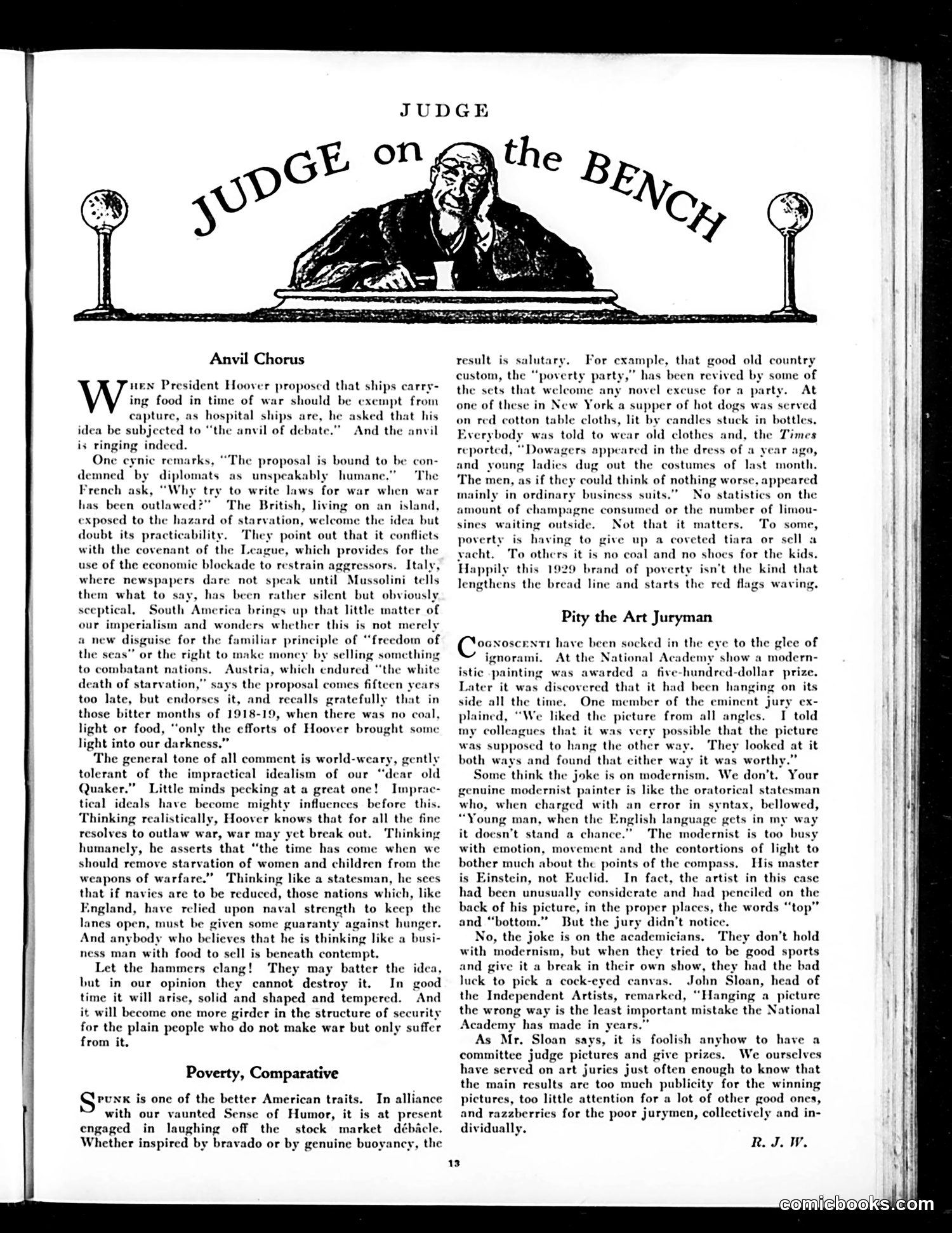
A restored page from Judge, 1929-12-07. Page through the whole issue in the reader above.
📄 Transcribed text from this page (OCR, searchable)
Machine-transcribed from the original scan — historical spelling and the odd misread are preserved.
JUDGE Anvil Chorus nen President Hoover proposed that ships carry- V V ing food in time of war should be exempt from capture, as hospital ships are, he asked that his idea be subjected to “the anvil of deba And the anvil is ringing indeed. One cynic remarks, “The proposal is bound to be ¢ demned ‘by diplomats as unspeakably humane French ask, “Why try to write laws for war when war has been outlawed?” The British, living on an island, exposed to the rd of starvation, welcome the idea but doubt its practicability. They point out that it conflicts with the covenant of the League, which provides for the use of the economic blockade to restrain aggressors. Italy, where newspapers dare not speak until Mussolini tells them what to + has been rather silent but obviously sceptical. South Ame brings up that little matter of our imperialism and wonders whether this is not merely a new disguise for the familiar principle of “freedom of the seas” or the right to make money by selling somethi to combatant nations. Austria, which endured “the white death of starvation,” says the proposal comes fifteen years too late, but endorses it, and recalls gratefully that in those bitter months of 1918-19, when there was no coal, light or food, “only the efforts of Hoover brought some light into our darkness.” The general tone of all comment is world-wear. tolerant of the impractical hae of our Quaker.” Little minds pecki tical ideals have become mighty faeces before this. Thinking realistically, Hoover knows that for all the fine resolves to outlaw war, war may yet break out. Thinking humanely, he asserts that “the time has come when we should remove starvation of women and children from the weapons of warfare.” Thinking like a statesman, he sces that if navies are to be reduced, those nations which, like England, have relied upon naval strength to keep the lanes open, must be given some guaranty against hunger. And anybody who believes that he is thinking like a busi- ness man with food to sell is beneath contempt. Let the hammers clang! They may batter the idea, but in our opinion they cannot destroy it. In good time it will arise, solid and shaped and tempered. And it will become one more girder in the structure of security for the plain people who do not make war but only suffer from it. gently ar old Inprac- Poverty, Comparative Ss’ yNK is one of the better American traits. In alliance with our vaunted Sense of Humor, it is at present engaged in laughing off the stock market débicle. Whether inspired by bravado or by genuine buoyancy, the result is salutary. For example, t custom, the “poverty party,” has been revived by some of the sets that welcome any novel excuse for a party. At one of these in New York a supper of hot dogs was served on red cotton table cloths, lit by candles stuck in bottles. Everybody was told to wear old clothes and, the Times reported, “Dowagers appeared in the dress of a year ago, and young ladies dug out the costumes of last month. " they could think of nothing worse, appeared mainly in ordinary business suits.” No statistics on the amount of champagne consumed or the number of limou- sines waiting outside. Not that it matters. To some, poverty is having to give up a coveted tiara or sells ht. To others it is no coal and no shoes for the kids. ppily this 1929 brand of poverty isn’t the kind that lengthens the bread line and starts the good old country red flags wavir Pity the Art Juryman Cooxescestt have been socked in the eye to the glee of ignorami. At the National Academy show a modern- istic _painting was awarded a five-hundred-dollar prize. Later it was discovered that it had been hanging on its side all the time. One member of the it jury. ex- plained, “We liked the picture from ngles. I told my colleagues that it was very possible that the picture was supposed to hang the other way. looked at i both ways and found that either Some think the joke is on modernism, We don’ t. Your genuine modernist rainte: r is like the oratori who, when charged with an error in. syn! “Young man, when the English language gets in my w; it doesn’t stand a chance The modernist is too busy with emotion, movement and the contortions of light to bother much about the points of the compass. His master is Einstein, not Euclid. In fact, the artist in this case had been unusually considerate and had penciled on the back of his picture, in the proper places, the words “top” and “bottom.” But the jury didn’t notice. No, the joke is on the academicians. They don’t hold with modernism, but when they tried to be good sports and give it a break in their own show, they had the bad luck to pick a cock-eyed canvas. John Sloan, head of the Independent Artists, remarked, “Hanging a picture the wrong way is the least important mistake the National Academy has made in yea As Mr. Sloan says, it is foolish anyhow to have a committee judge pictures and give prizes. We ourselves have served on art juries just often enough to know that the main results are too much publicity for the winning pictures, too little attention for a lot of other good ones, and razzberries for the poor jurymen, collectively and in- dividually, statesman » bellowed, RILW.