
Judge, 1929-11-16 · page 16 of 36
Judge — November 16, 1929 — page 16: what you’re looking at
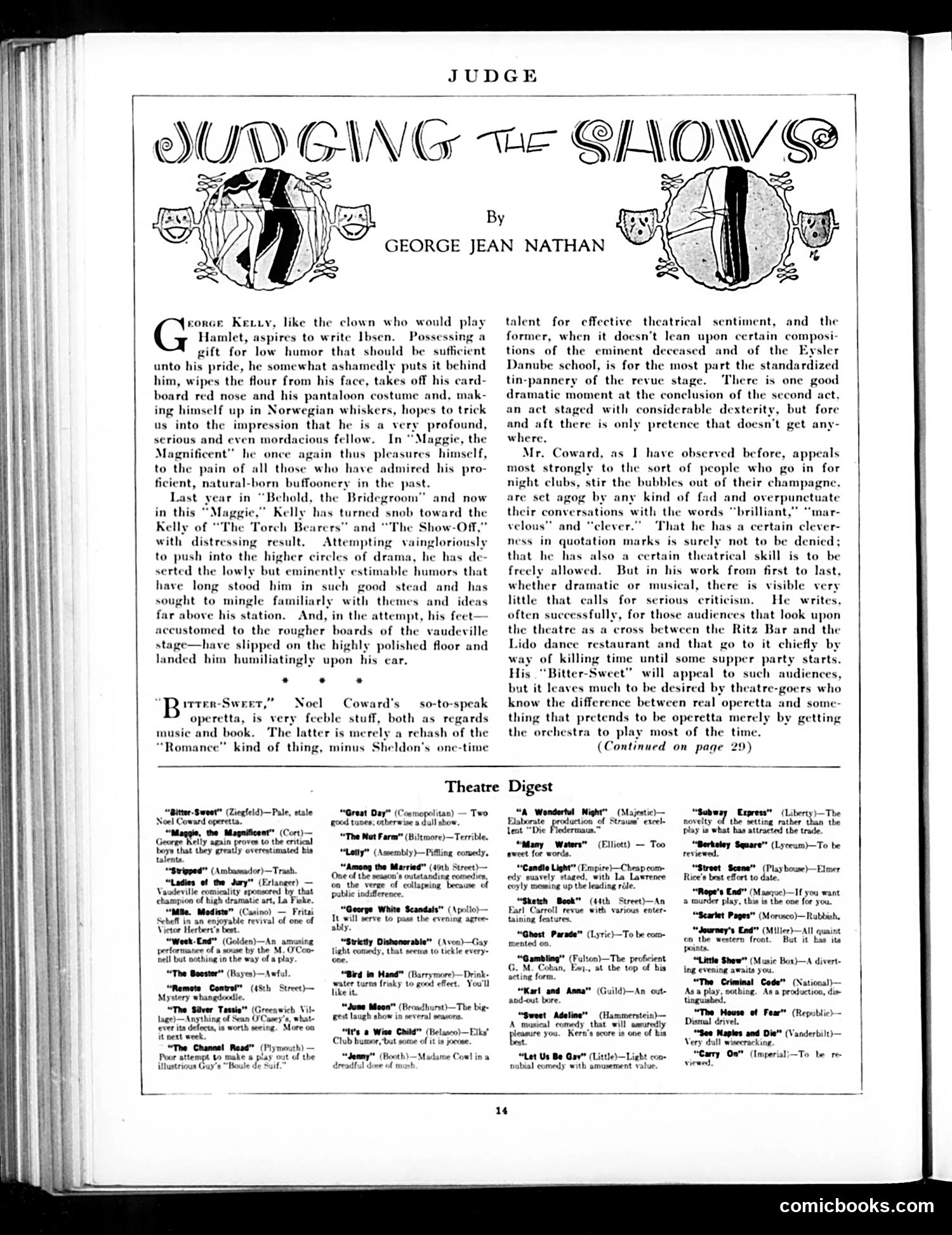
A restored page from Judge, 1929-11-16. Page through the whole issue in the reader above.
📄 Transcribed text from this page (OCR, searchable)
Machine-transcribed from the original scan — historical spelling and the odd misread are preserved.
| JUDGE Kexty, like the clown who would pl nlet , aspires to write Ibsen. t for low humor that should be sufficient unto his pride, he somewhat ashamedly him, wipes the flour from his f: board red nose and his pantaloon costume Possessing a puts it behind ¢, takes off his card- nd, mak- ing himself up in Norwegian whiskers, hopes to trick us into the impression that he serious and even mor Magnificent” he one: to the pain of ficient, Last y in this * Kelly of Torch B with distressing result. I those serted the low sought to mingle famil far above his station. nus fellow. In‘ again thus ple who atural-born buffoonery in the past. ir in “Behold, the Bridegroom” ly has turned snob toward the rer Attempting vi to push into the higher circles of dr: but eminent! have long stood him in such good stead s a very profound, Maggie, the ave admired his pro- and now nd show-Off, loriously a, he has de- humors that nd has estimab! arly with themes and ideas And, in the tempt, his feet— accustomed to the rougher boards of the vaudeville —have slipped on the highly polished floor and landed him humiliatingly upon his ear. . ’ B irter-Sw music and book. “Ror 7,” Noel operctta, is very feeble The latter ance” kind of thing, minus Sheldon’s one-time Coward's _ so-to-speak stuff, both as regards merely a rehash of the sures himself, talent for effective theatrical sentir former, when it doesn’t lean upon cer nt, and the n_composi- tions of the eminent deceased and of the Eysler Danube school, is for the most part the standardized tin-pannery of the revue stage. There is one good dramatic moment at the conclusion of the second act. an act staged with considerable d and aft there is only pretence tha where. terity, but fore t doesn’t get any- Mr. Coward, as I have observed before, appeals most strongly to the sort of people who go in for night clubs, stir the bubbles out of their cl ampagne, are set agog by any kind of fad and overpunctuate their conversations with the words clever.” T! velous” and ness in quotation ma that he has also a freely allowed. whether dra little that calls for se often successfully w His ter-Sweet” thing t the orchestra to } ious er for those aud the theatre as a cross between the F Lido dance restaurant and t pretends to be operetta merely by get y most of the time. brilliant, he has a certain clever- rks is surely not to be denied; ertain theatrical skill is to be But in his work from first to last, atic or musical, there is visible very m. He writes. nees that look upon itz Bar and the at go to it chiefly by of killing time until some supper party starts. will appeal to such audiences, but it leaves much to be de: know the difference between re ired by theatre-goers who 1 operetta and some ng (Continued on page 29) ““pitter- Sweet” (Zicgfeld)—Pale, stale Noel Coward operetta. the Magnificent” (Cort)— George Kelly again proves to the eritical boys that they greatly overestimated bis talenta. “Svipged” (Ambasador)—Trash. “Ladies of the Jury” (Erlanger) — Vaudeville comicality sponsored by that champion of high dramatic art, La Fiske. Me, Modiste” (Casino) — Fritai Scheff in an enjoyable revival of one of Vietor Herbert's beet “Week-End” (Golden)—An amusing performance of a souse by the M. O'Con- fell but nothing in the way of a play. “The Booster” (Bayes) —Awful. “Remote Control” (48th Street) Mystery whangdoodle. “The Silver Tassie” (Greenwich Vil- lage}—Anything of Sean O'Casey’s, what- ever its defects, is worth seeing. it next week. “Tee Chsneel Read” (Plymout! Pour attempt to make Theatre “Great Day” (Cosmopolitan) — Two good tunes; otherwise a dull show. “The Nat Farm” (Biltmore) —Terrible. “Letty” (Asseembly)—Pifling comedy, “Among the Married” (49th Strcet)— One of the season's outatanding comedies, on the verge of collapring because of publie indifference. “George White Scandals” (poll It will serve to past the evening agree ably. {Srttty Dinhonerable™ (Avon) —Gay ht comedy, that seta to tickle every~ “Bird in Hand” (Barrymore)—Drink- water turns {risky to good effect. You'll like it, “dune Moon” (Brondhurst)—The big- gest laugh show in several seasons. “It's a Wise Child” (Belasco)—Elks’ Club bumor, but some of it is jocose. “deamy™ (Booth) — Madame Com! in a Digest “A Wondertul Night” (Majestic)— Elaborate production of Straum’ excel- leat “Die us.” “tany Waters” (Elliott) — Too aweet for words. “Candle Light” (Empire}—Cheap com- edy suavely staged, with La Lawrence coyly meming up the leading rile. “Sketch Book™ (44th Street)—An Earl Carroll revue with various enter- taining features. “Ghost Parade” (Lyric)—To be com mented on. “Gambling” (Fulton)—The proficient G, M. Coban, Exy., at the top of bis acting form. “Kart and Anna” (Guild)—An out- and-out bore. “Sweet Adeline” (Hammerstein)— A masical comedy that will samuredty pene 2 era's score is one of Bis “Let Us Be Gav” (Little)—Liebt con- nubial comedy with amusement value. “Setwoy Express” (Liberty) —The nonelty the setting rather than the play is what has attracted the trade. “Berkeley Square” (Lyceum)—To be reviewed. “Street Scene” (Playbouse)—Elmer Rice's best effort to date. 8 End” (Masyue)—If you want a murder play, this is the one for you. “Scartet Pages” (Morosco)—Rubbish, “Journey's End” (Miller)—All quaint on the western front. But it bas ita points. “Little Show" (Music Box)—A divert- ing evening awaits you. “The Criminal Code” (National) — Asa play, pothing. As» production, dis Uinguisbed, “The House of Fear” (Republicd— Dismal drivel. “See Naples and Die” (Vanderbilt) — Very dull wisecracking “Carry On" (Imperial)—To be re viewed. comicbooks.com