
Judge, 1929-11-16 · page 15 of 36
Judge — November 16, 1929 — page 15: what you’re looking at
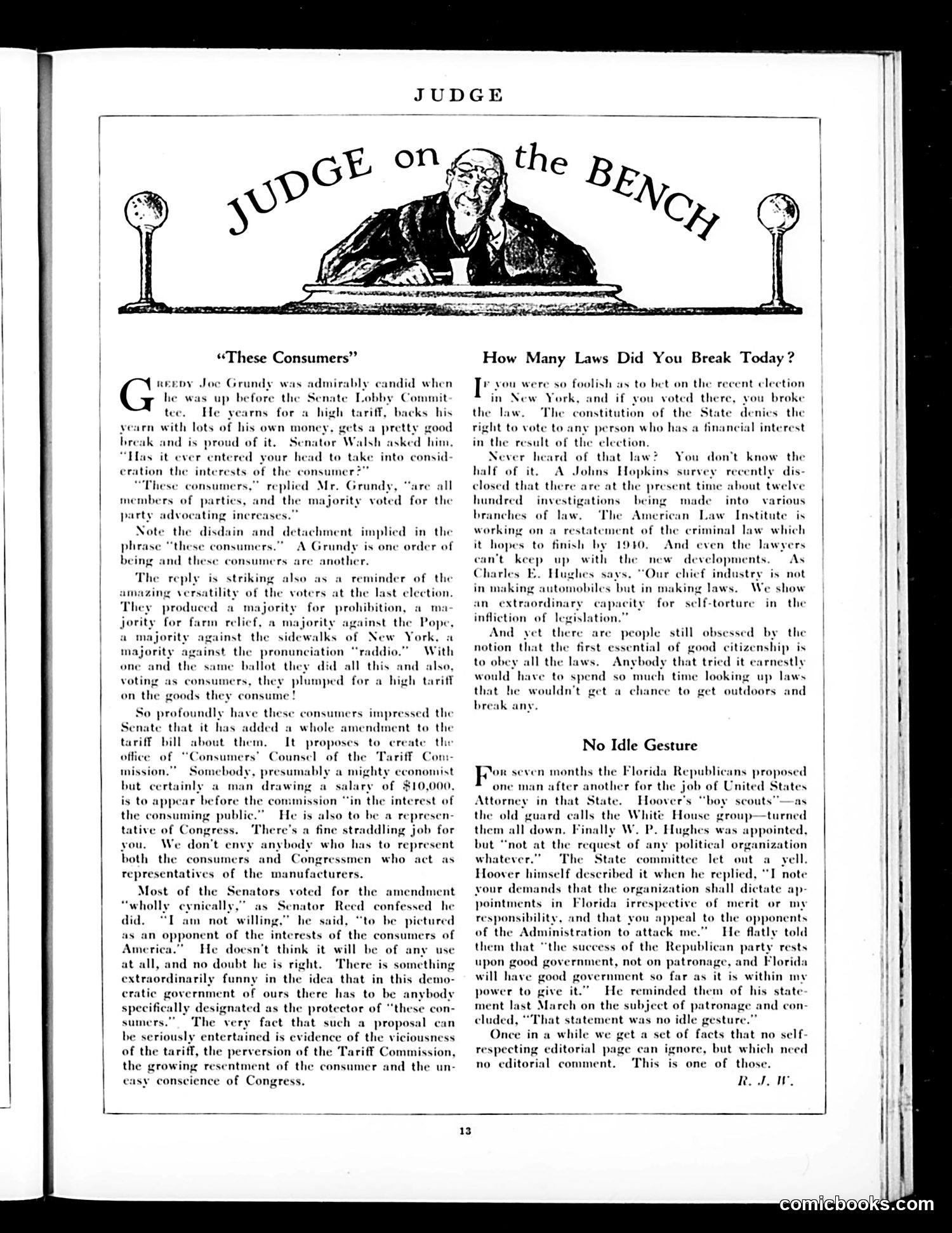
A restored page from Judge, 1929-11-16. Page through the whole issue in the reader above.
📄 Transcribed text from this page (OCR, searchable)
Machine-transcribed from the original scan — historical spelling and the odd misread are preserved.
“These Consumers” neepy Joc Grundy was admirably candid when he was up before the Senate Lobby Commit tee. He yearns for a high tariff, backs his yearn with lots of his own money, gets a pretty good uk and is proud of it. Senator Walsh asked him, as it ever entered your head to take into consid ion the interests of th hese consumers,” members of consumer ? replied Mr. Grundy, “are all arties, and the majority voted for the party advocating increases.” Note the disdain and detachment implied in the phrase “these consumers.” A Grundy is one order of being and these consumers are another. The reply is striking also as a reminder of the amazing versatility of the voters at the last election. They produced a majority for prohibition, a ma jority for farm relicf, a majority against the Pope, ma jorit gainst the side ks of New York, a majority against the pronunciation “raddi With one and the same ballot they did all this and also, voting as consumers, they plumped for a high tariff on the goods they consume! So profoundly have these consumers impressed the Senate that it has added a whole amendment to the tariff bill about them, It proposes to create th: office of nsumers’ Counsel of the Tariff Cor omebody, presumably a mighty economist ry of $10,000, the interest of the consuming public. Iso to be a represen- tative of Congress. There's a fine straddling job for you, We don't ¢ body who has to represent both the consumers and Congressmen who act as representatives of the manufacturers. Most of the Senators voted for the amendment “wholly cynically, Senator Reed confessed he did. “I am not willing.” he said, “to be pictured n opponent of the interests of the consumers of America.” He doesn’t think it will be of any use at all, and no doubt he is right. There is something extraordinarily funny in the idea that in this demo- government of ours there has to be anybody specifically designated as the protector of “these con- sumers.”." The very fact that such a proposal can iously entertained is evidence of the viciousness of the tariff, the perversion of the Tariff Commission, the growing resentment of the consumer and the un- easy conscience of Congress. missior but. certa he se How Many Laws Did You Break Today ? you were so foolish ay to bet on the recent clection in New York, and if you voted there, you broke law. The constitution of the State denies the t to vote to any person who has a financial interest in the result of the election. Never heard of that law? You don’t know the half of it. A Johns Hopkins survey recently dis- closed that there are at the present time about twelve hundred investigations being made into various branches of law. ‘The American Law Institute is working on a restatement of the criminal law which it hopes to finish by 1940. And even the lawyers can't keep up with the new developments. | As Charles E. Hughes says, “Our chief industry is not in making automobiles but in making laws. We show an extraordinary capacity for self-torture in’ the infliction of legislation. And yet there are people still obsessed by the notion that the first essential of good citizenship is to obey all the laws. Anybody that tried it earnestly would have to spend so much time looking up laws wouldn't get a chance to get outdoors and No Idle Gesture Free seven months the Florida Republicans proposed one man after another for the job of United States Attorney in that State. the old guard Hoover's “boy scouts” Ils the White House group—turned them all down, Finally W. P. Hughes was appointed, but “not at the request of any political organization whatever.” The committee let out yell. your dem: pointments in Florid: ive of responsibility, and that you appeal to the opponents of the Administration to attack me.” He flatly told them that “the success of the Republican party rests upon good government, not on patronage, and Florida will have good government so far as it is within my power to give it.” He reminded them of his state irch on the subject of patrons nd con- at statement was no idle gesture in a while we get a set of facts that no self. respecting editorial page can ignore, but which ne no editorial comment. This is one of those. Re Jed, merit or my