
Judge, 1929-11-02 · page 25 of 36
Judge — November 2, 1929 — page 25: what you’re looking at
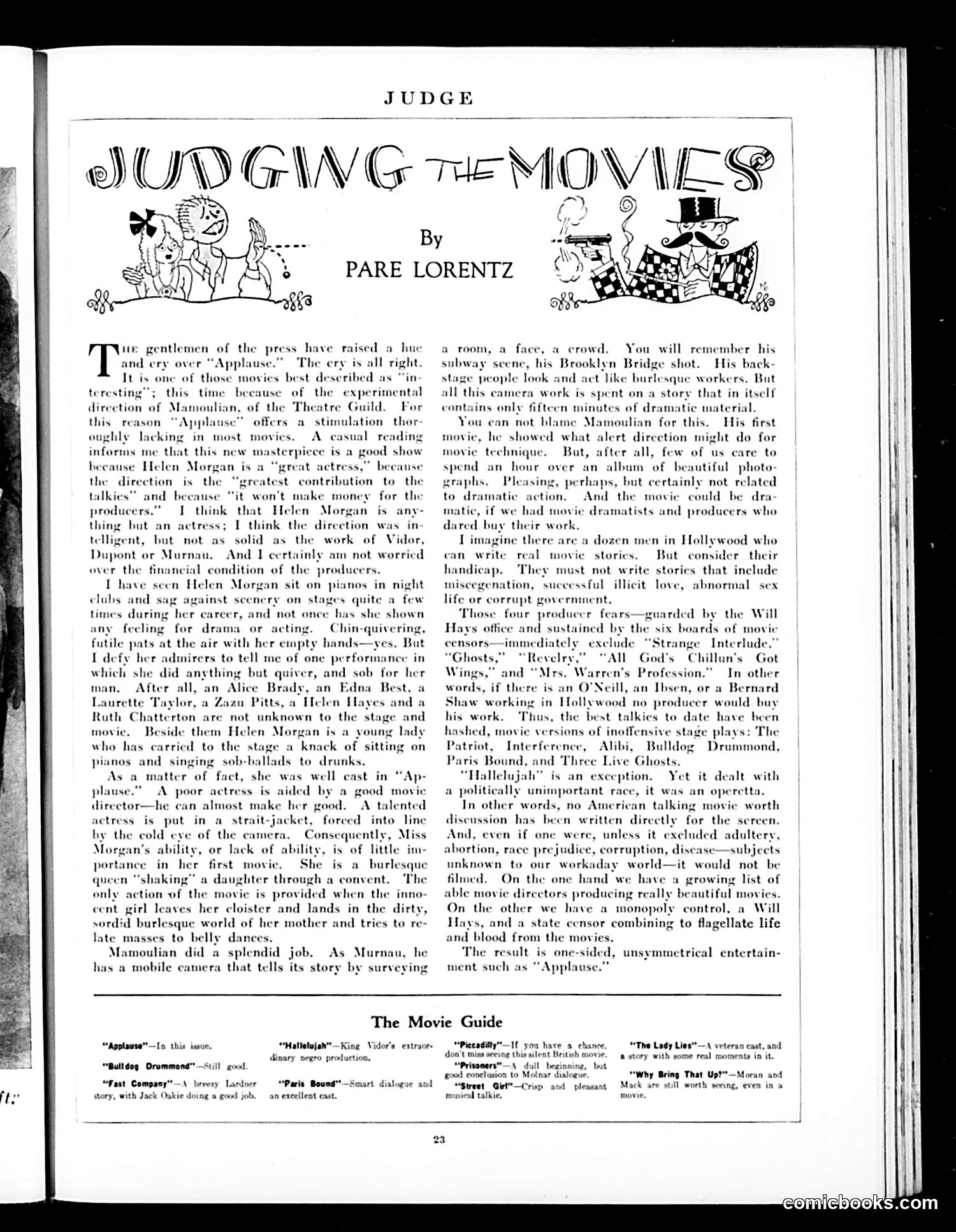
A restored page from Judge, 1929-11-02. Page through the whole issue in the reader above.
📄 Transcribed text from this page (OCR, searchable)
Machine-transcribed from the original scan — historical spelling and the odd misread are preserved.
JUDG E — JUDGWG T=MOVIES | By PARE LORENTZ uur gentlemen of the press have raised a hue nd ery over “Applause.” The cry is all right. It is one of those movies best described as “in teresting’; this time because of the experimental direction of Mamoulian, of the Theatre Guild. For this reason “Applause” offers a stimulation thor- oughly lacking in most movies. A- casual readi informs me that this new masterpicce is a good show because Helen Morgan “great actress,” the direction is the “greatest contribution to the talkies” and because “it won't make money for the producers.” I think that Helen Morgan is any- thing but an actre I think the direction was in but not solid the work of Vidor, Dupont or Murnau. And I certainly am not worried over the financial condition of the producers. I have seen Helen Morgan sit on pianos in night clubs inst scenery on st a few times during her career, and not once has she shown any feeling for drama or acting. Chin-quiv futile pats at the air with her empty hands— I defy her admirers to tell me of one perform in which she did anything but quiver, and sob for her man, After all, an Alice Brady, an Edna Best. a Laurette Taylor, a Zazu Pitts, a Helen Hayes and a Ruth Chatterton > not unknown to the nd movie. Beside them Helen Morgan is who has carricd to the pianos and singing sob-ballads to drunks. matter of fact, she st in “Ap- A poor actress is aided by a good movie director— he can almost make her 1. A talented actress is put in a strait-jacket, forced into line by the cold cve of the camera. Consequently, Miss Morgan’s ability, or lack of ability, is of little portance in her’ first She is a burlesque q shaking” a daughter through a convent. The ily action vf the movie is provided when the inno- cent girl leaves her cloister and lands in the dirty, sordid burlesque world of her mother and tries to re- late masses to belly dances. Mamoulian did a splendid job. As Murnau, he has a mobile camera that tells its story by surveying is a because and sag ay s quite was well c im- movie. a room, 4 a crowd. You will remember his his Brooklyn Bridge shot. His back- » people look and act like burlesque workers. But all this camera work is spent on a story that in itself ns only fifteen minutes of dramatic material. You can not blame Mamoulian for this. His first movie, he showed what alert direction might do for movie technique. But, after all, few of us care to spend an hour over an album of beautiful photo- graphs. Pleasing, perhaps, but certainly not related to dramatic action, And the movie could be dra matic, if we had movie dramatists and producers who dared buy their work I imagine there are subway 5 a dozen men in Hollywood who can write real stories. But consider their They must not write stories that include enation, successful illicit love, abnormal sex life or corrupt government, Those four producer fears Hays office and sustained by the censors—immediat exclude “Ghosts,” “Revelry.” “All God's Chillun’s t Wings,” and “Mrs, Warren's Profession.” In other words, if there is an O'Neill, an Ibsen, or a Bernard Shaw working in Hollywood no producer would buy his work. Thus, the best talkies to d: hashed, movie versions of inoffensive sta Patriot, Interferen Alibi, Bullde Paris Bound, and Three Live Ghosts. “Hallelujah” is an exception. Yet it dealt with 1 politically unimportant race, it an operetta. In other words, no American talking movie worth discussion has been written directly for the screen. And, even if one were, unless it excluded adultery, abortion, race prejudice, corruption, dist unknown to our workaday world—it would not be filmed. On the one hand we have a growing list of able movie directors producing really beautiful movies. On the other we a monopoly control, a Will Hays, state censor combining to flagellate life and blood from the movies. The result is one-sided, unsymmetrical entertain- ment such as “Applause.” movie uarded by the Will six boards of movie “Strange Interlude,” been The Drummond, have » plays: -—subjects have The Movie Guide “Agplause”—In this issue, “Bulldog Orummend”—Siil! goo “Hallelujah” dinary negro production. “Fast Company” story, with Jack Oakie doing a good A breety Lardner “Paris Bound’ an excellent cast. King Vidor's extraor- mart dialogue and “The Lady Lit a story with —A veteran cast, and “Piceadilly”—If you have a chance, ie. real moments in it. don’t miss seeing this silent British “Prisoners”—A dull beginning, by good conclusion to Molnar dialogue. “Why Bring That Up?" —Moran and “Street Girt™—Crisp and pleasant Mack are still worth scring, even in a 1 rmusical talkie, movie,