A complete issue · 51 pages · 1933
Life — December 1933
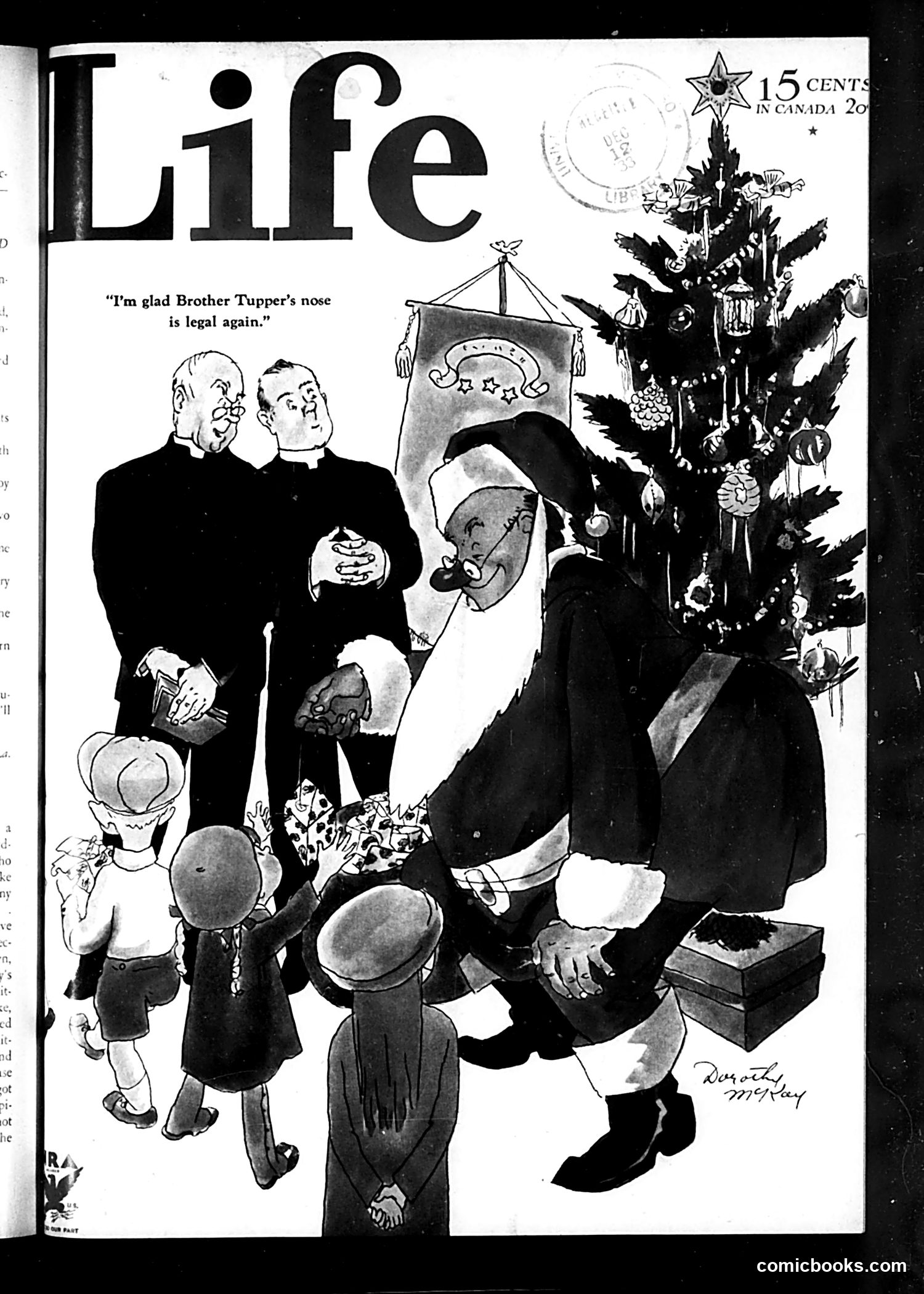
# Analysis of Life Magazine Cover This satirical Christmas cartoon depicts Santa Claus distributing gifts to children while two well-dressed men in the background discuss legal matters. The caption reads: "I'm glad Brother Tupper's nose is legal again." The joke references "Brother Tupper," likely a public figure of the era whose nose was apparently subject to legal dispute or controversy—the specific nature of which isn't clear from this image alone. The satire suggests absurd legal cases, possibly mocking frivolous lawsuits or regulatory overreach. Santa's presence transforms this into holiday-themed social commentary, where even Christmas gift-giving becomes backdrop for poking fun at legal absurdities affecting prominent citizens. The 15-cent Canadian price indicates this is from Life magazine's early-to-mid 20th-century period.
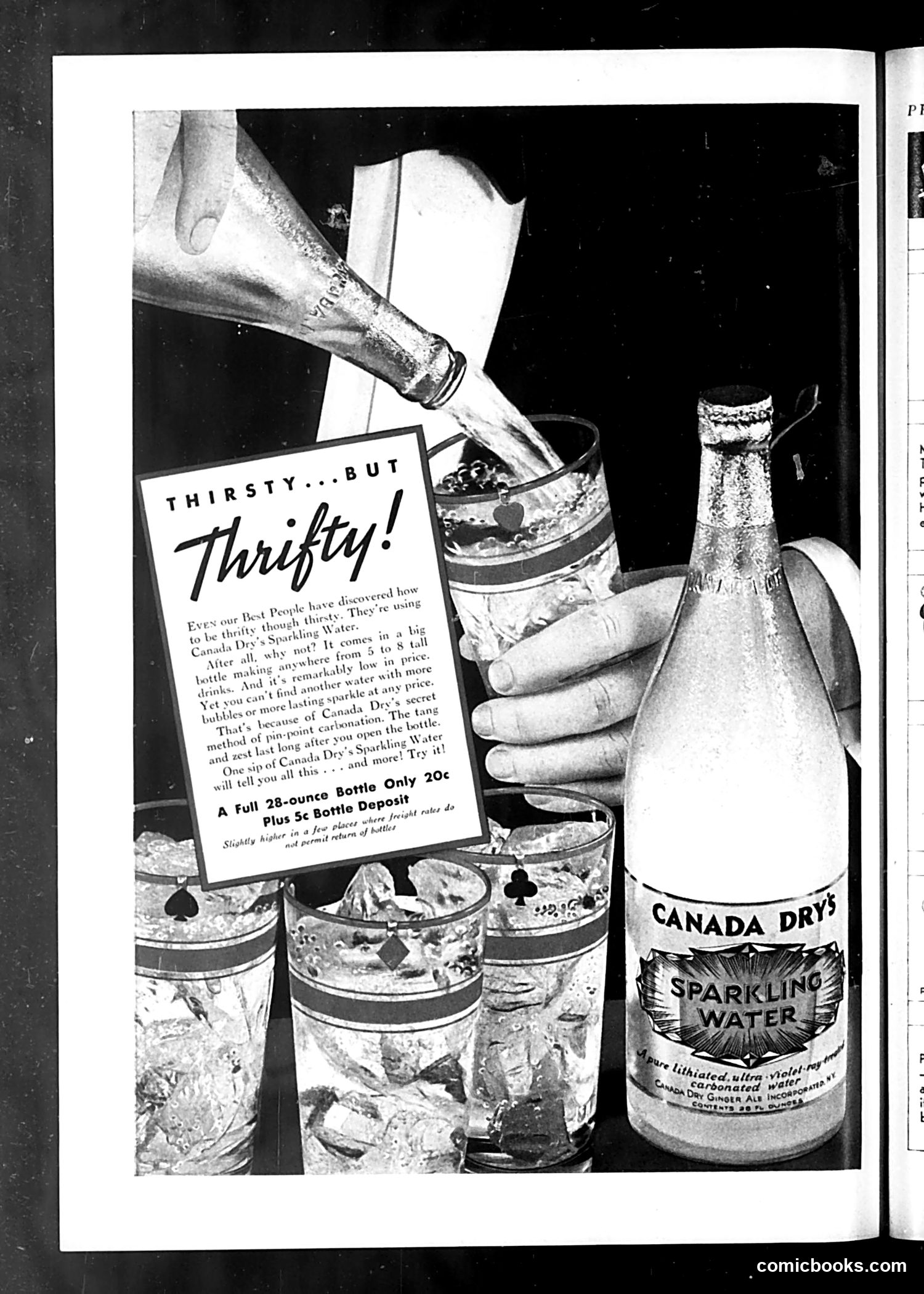
# Analysis This is a **Canada Dry's Sparkling Water advertisement**, not political satire. The ad uses the slogan "THIRSTY...BUT Thrifty!" to market the product during what appears to be the Depression or wartime era when economizing was important. The ad's humor targets budget-conscious consumers: it claims Canada Dry's sparkling water offers more value than competitors because a single 28-ounce bottle (20¢ plus 5¢ deposit) provides multiple servings. The copywriting emphasizes the product's "remarkable low price" and longevity—you get "more lasting value" than buying separate drinks. The visual shows someone pouring the beverage into glasses filled with ice, demonstrating its appeal as an affordable refreshment. This is straightforward consumer advertising, not editorial commentary or political cartooning.
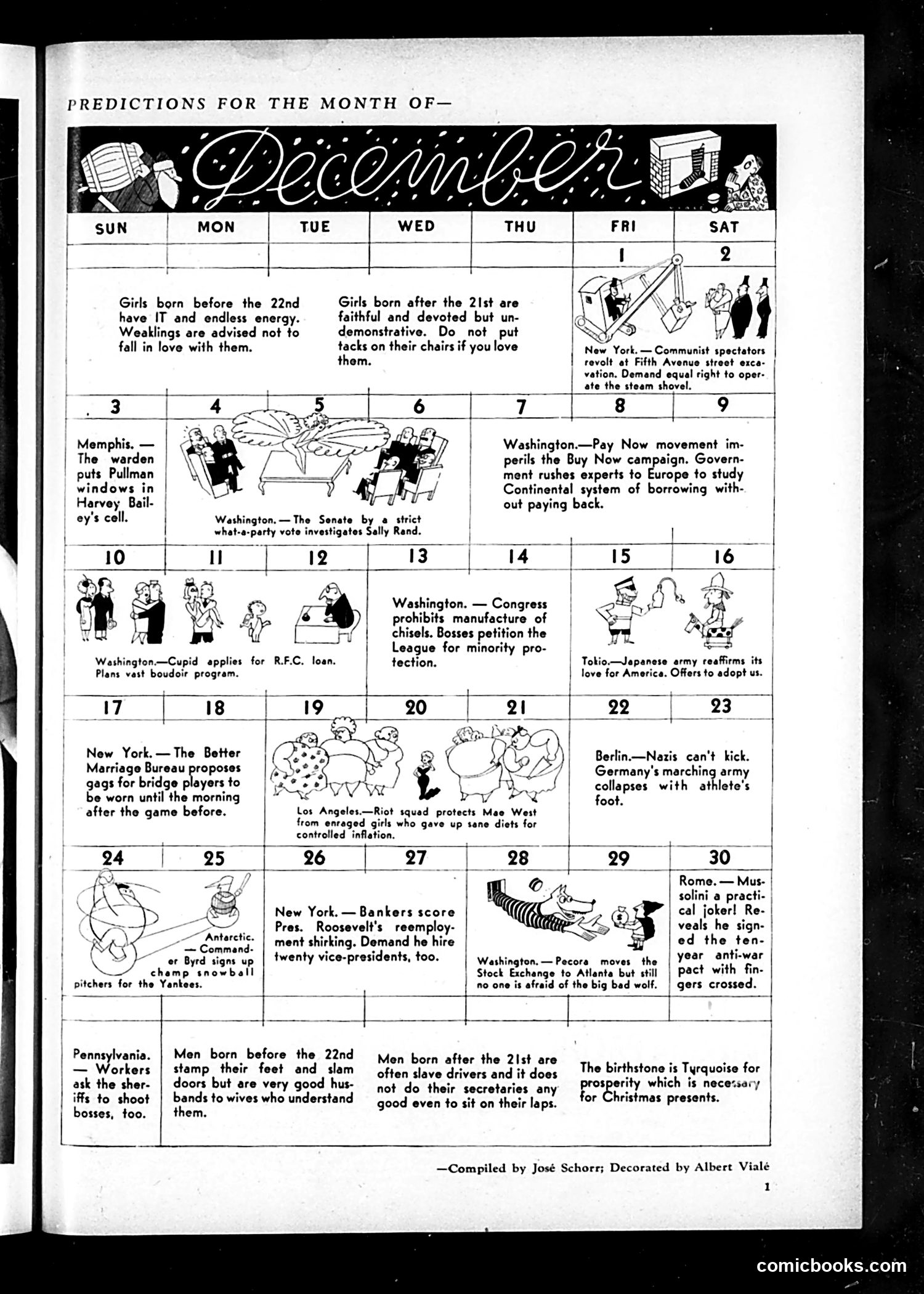
# December 1934 Predictions Calendar This satirical calendar mocks contemporary political and social events with caustic humor typical of Life magazine's style. **Key references include:** - **December 1-2**: Communist agitation in New York, demanding equal rights to operate steam shovels - **December 7-8**: The "Pay Now" movement criticizing government spending and the "Buy Now" campaign - **December 13-14**: Congress prohibiting manufacture of chisels (unclear reference, possibly satirizing regulatory overreach) - **December 20-22**: A squad protecting Mass West from "enraged girls" who gave up lane diets for controlled inflation - **December 26-28**: Banking/stock market satire regarding FDR's reemployment policies and vice-presidents - **December 30**: Mussolini portrayed as a "practical joker" signing anti-war pacts The calendar combines domestic New Deal criticism with international commentary on fascism, using crude caricature to mock 1930s politics. The astrology-inspired format allows rapid-fire jabs at various targets.
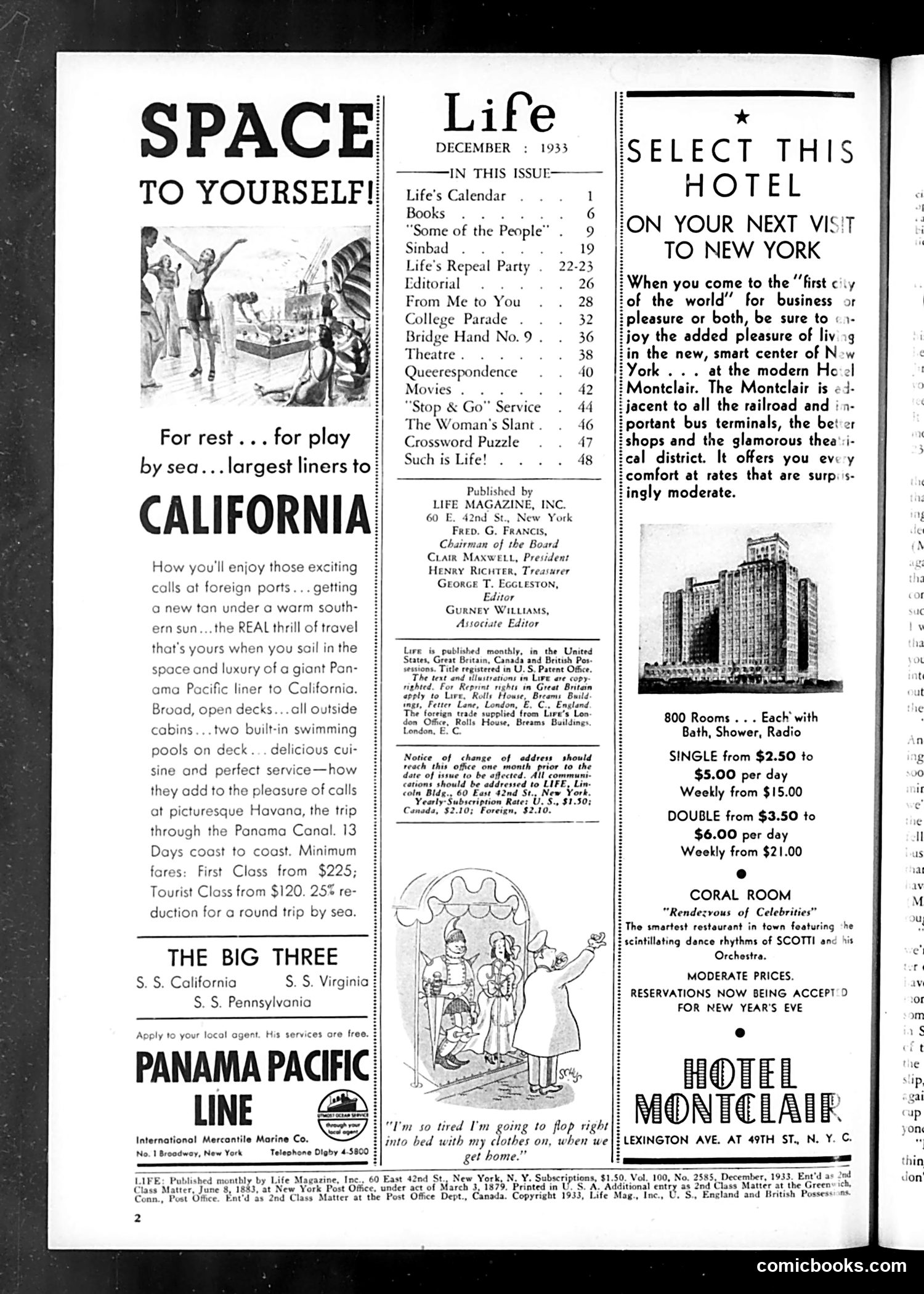
# Analysis of Life Magazine December 1933 Page This is primarily a **table of contents and advertising page**, not a political cartoon. The left side advertises Panama Pacific Line steamship travel to California, promoting leisure cruises with amenities like swimming pools and calls at ports including Havana. The right side advertises **Hotel Montclair** in New York, featuring the Coral Room restaurant with "SCOTTI and his Orchestra" and noting "RESERVATIONS NOW BEING ACCEPTED FOR NEW YEAR'S EVE"—indicating this is December 1933, during Prohibition's final year. The small cartoon near the center depicts a child speaking to adults, with the caption referencing holiday travel ("I'm so tired I'm going to flop right into bed with my clothes on, when we get home"), a relatable domestic humor piece about holiday fatigue rather than political satire.
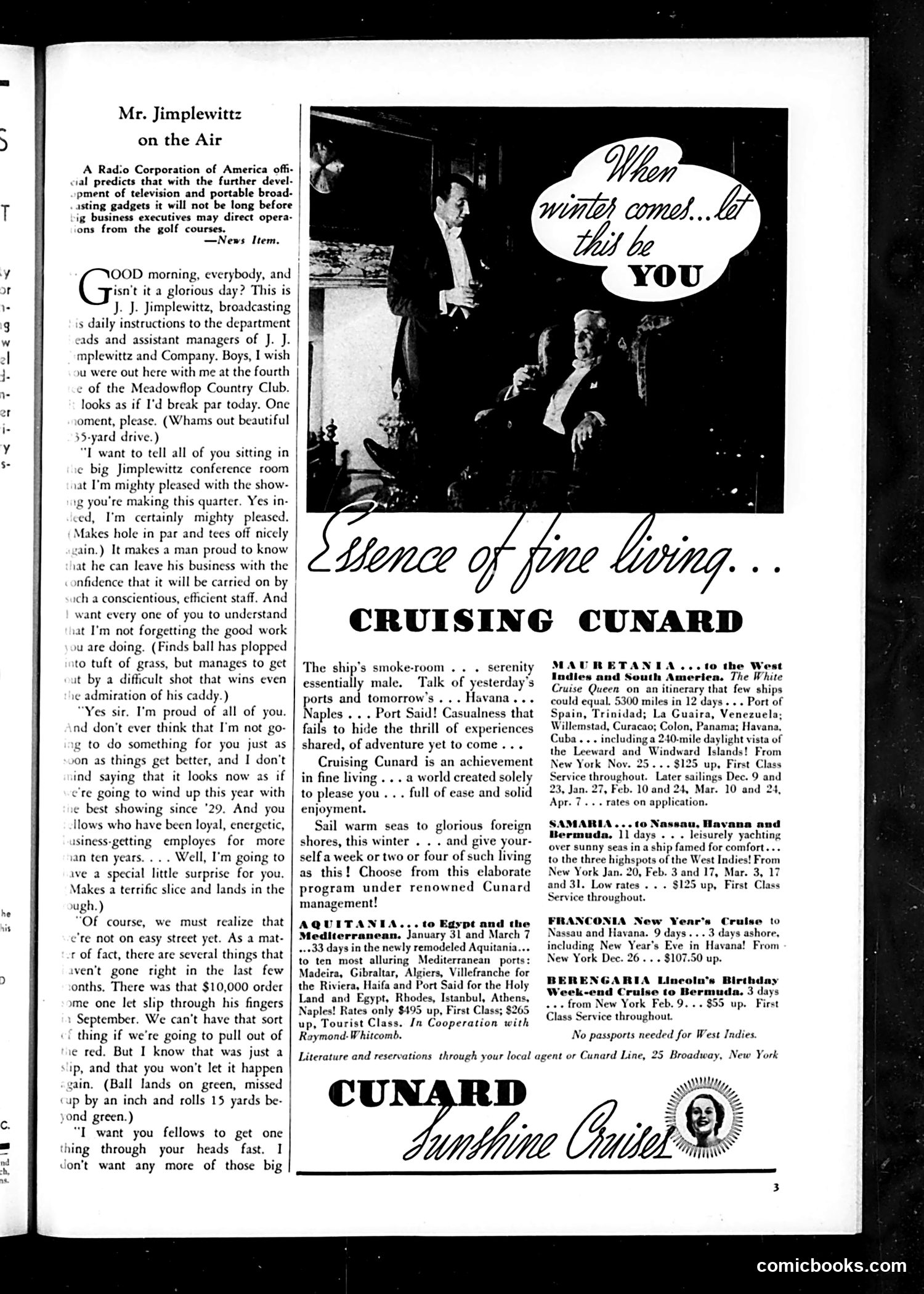
# Page Analysis: "Mr. Jimplewittz on the Air" This page contains a satirical piece about J.J. Jimplewittz, apparently a radio broadcaster for RCA who gives daily instructions to business executives. The main text is a mock-heroic monologue where Jimplewittz addresses subordinates at a country club, boasting about his influence and importance while inadvertently revealing his own self-importance and obliviousness. The satire targets corporate radio personalities of the era who positioned themselves as authority figures dispensing business wisdom. The humor comes from the gap between Jimplewittz's self-perception (indispensable leader) and his actual behavior (self-aggrandizing, slightly absurd). The page's right side contains Cunard cruise ship advertisements—standard commercial content mixed with editorial matter, typical of Life magazine's format.
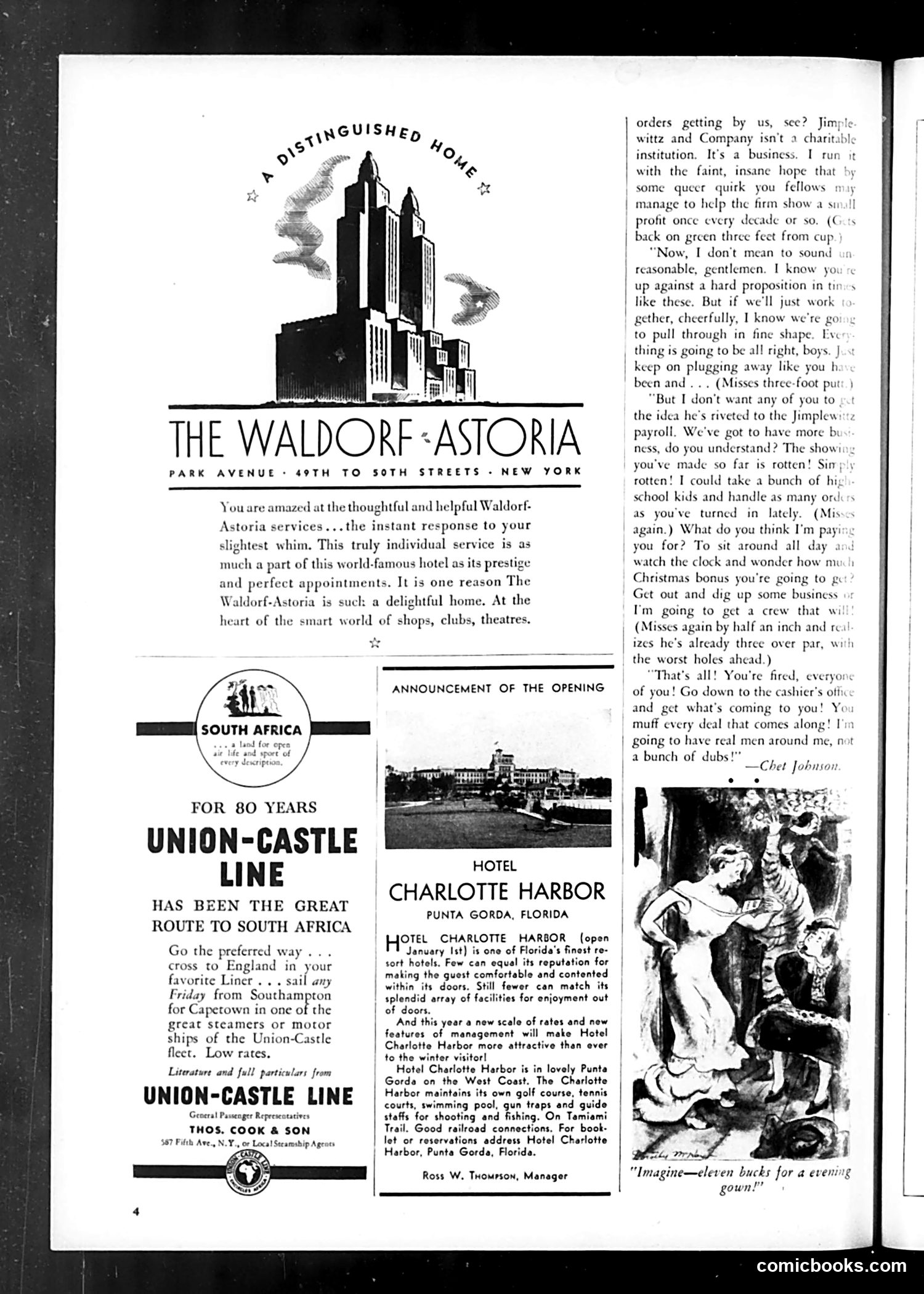
This page is primarily **advertising**, not satire or editorial content. It contains three ads: 1. **The Waldorf-Astoria Hotel** (top) — a prestigious NYC hotel advertising its distinguished service and location "at the heart of the smart world of shops, clubs, theatres." 2. **Union-Castle Line** (bottom left) — a shipping company promoting 80 years of service as "the great route to South Africa," offering passage via England to Capetown. 3. **Hotel Charlotte Harbor** (center-right) — a Florida resort advertising amenities like golf, tennis, and swimming pools for winter visitors. The right column contains what appears to be **humorous office correspondence** (attributed to "Chet Johnson") about staff discipline and holiday bonuses — likely satirical workplace commentary rather than political content. No political cartoons are present on this page.
# Page Analysis This page contains a brief satirical anecdote rather than a cartoon. The text describes the Governor of North Carolina proposing to the Governor of South Carolina that they jointly vote to prevent a liquor advertisement from appearing in LIFE magazine's December issue (page 5). The satire targets the Prohibition era (when alcohol was illegal in the US). The joke is that two state governors—presumably supporters of Prohibition—want to censor alcohol advertising in a popular magazine. The humor lies in their futile gesture: even if they "vote" together, they cannot actually control what a private magazine publishes. The decorative rooster illustration at top is likely LIFE's recurring mascot/logo. The page urges readers: "Read LIFE Regularly!"
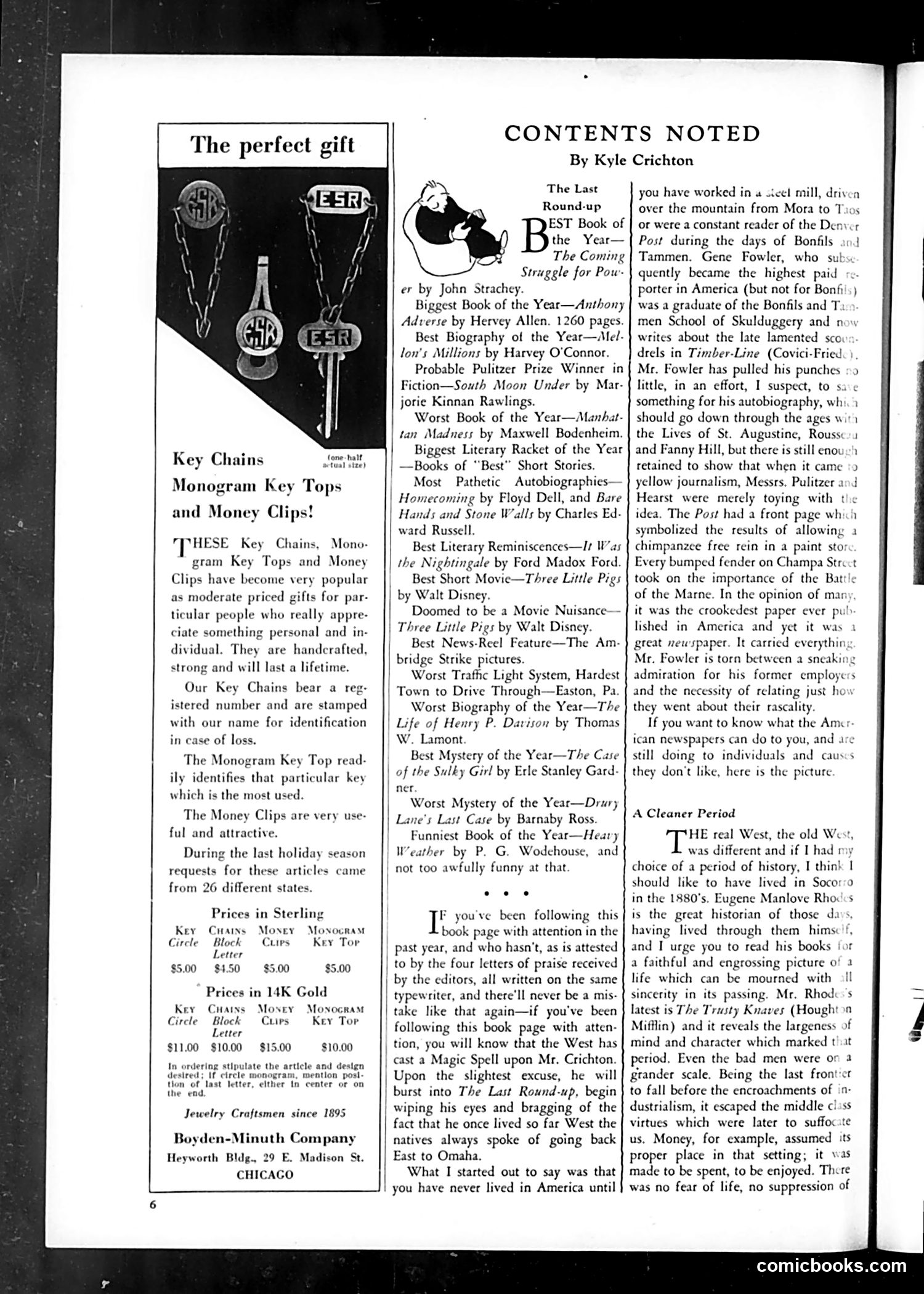
# Analysis This page is primarily **advertising and editorial content**, not political satire. The left side features an advertisement for the **Boyden-Minuth Company** promoting key chains, monogram key tops, and money clips as gifts. The image shows four decorative items featuring monogram designs. The right side contains **"Contents Noted," a book review column by Kyle Crichton**. It summarizes recently published books and awards, including references to works by John Strachey, Harvey Allen, and Marjorie Kinnan Rawlings. The column also includes a brief essay titled "A Cleaner Period" discussing 1880s American history. There is **no political cartoon or satire** on this page. The content is straightforward commercial advertising combined with contemporary literary criticism and commentary typical of *Life* magazine's mixed format.
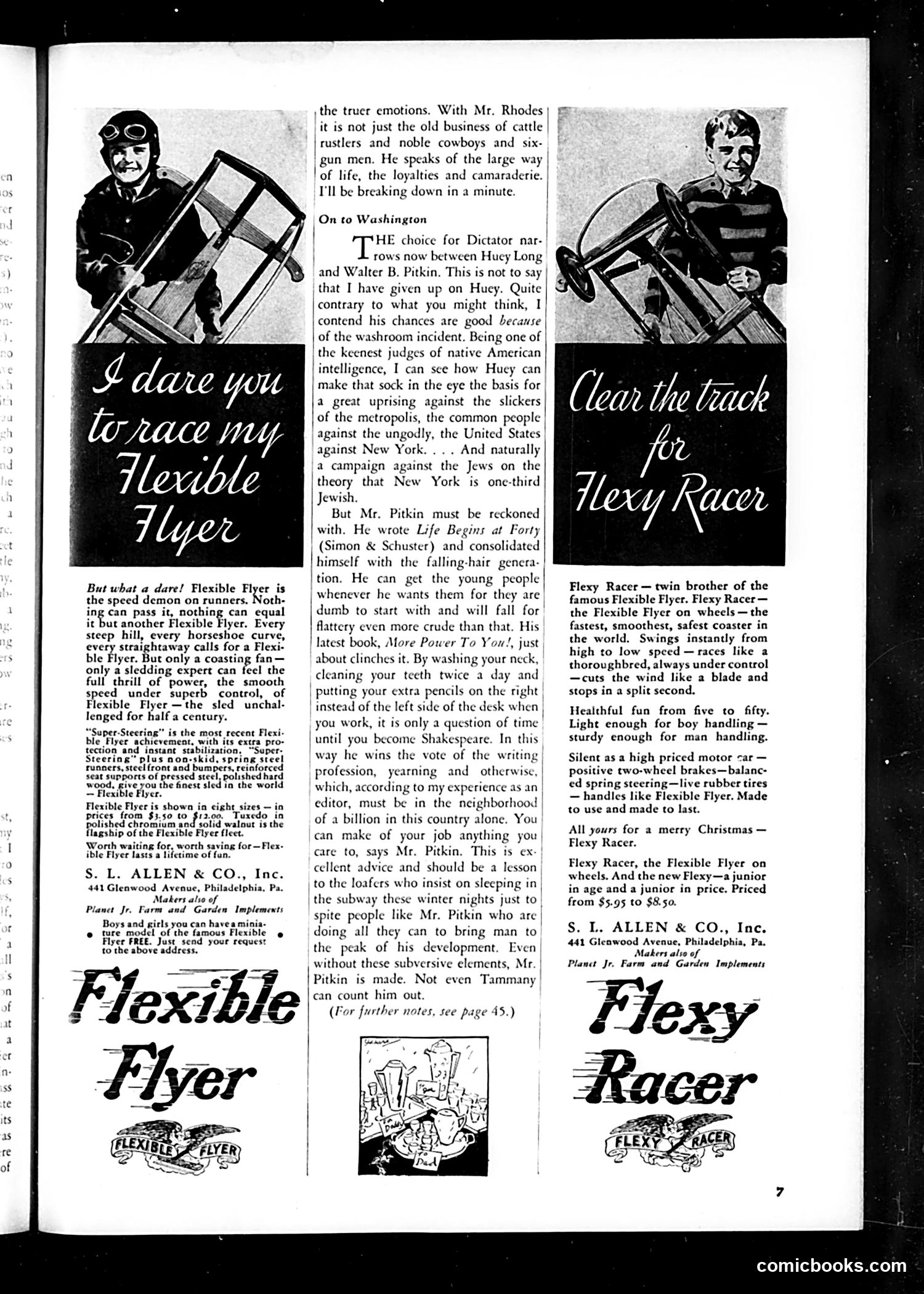
# Analysis of Life Magazine Page This page contains **advertisements for children's toys** (Flexible Flyer sleds and Flexy Racer) rather than political cartoons. The middle column includes an essay titled "On Washington" discussing potential candidates for "Dictator"—specifically Huey Long and Walter Pitkin—in a clearly satirical tone. The author argues that Pitkin (who wrote *Life Begins at Forty*) has better chances than Long for leading a popular uprising against "the slickers of the metropolis" and "the ungodly." The piece sarcastically suggests Pitkin could manipulate young people through self-help philosophy. This appears to be 1930s-era satire about American populism and the appeal of authoritarian figures during economically troubled times, though the exact publication date isn't visible.
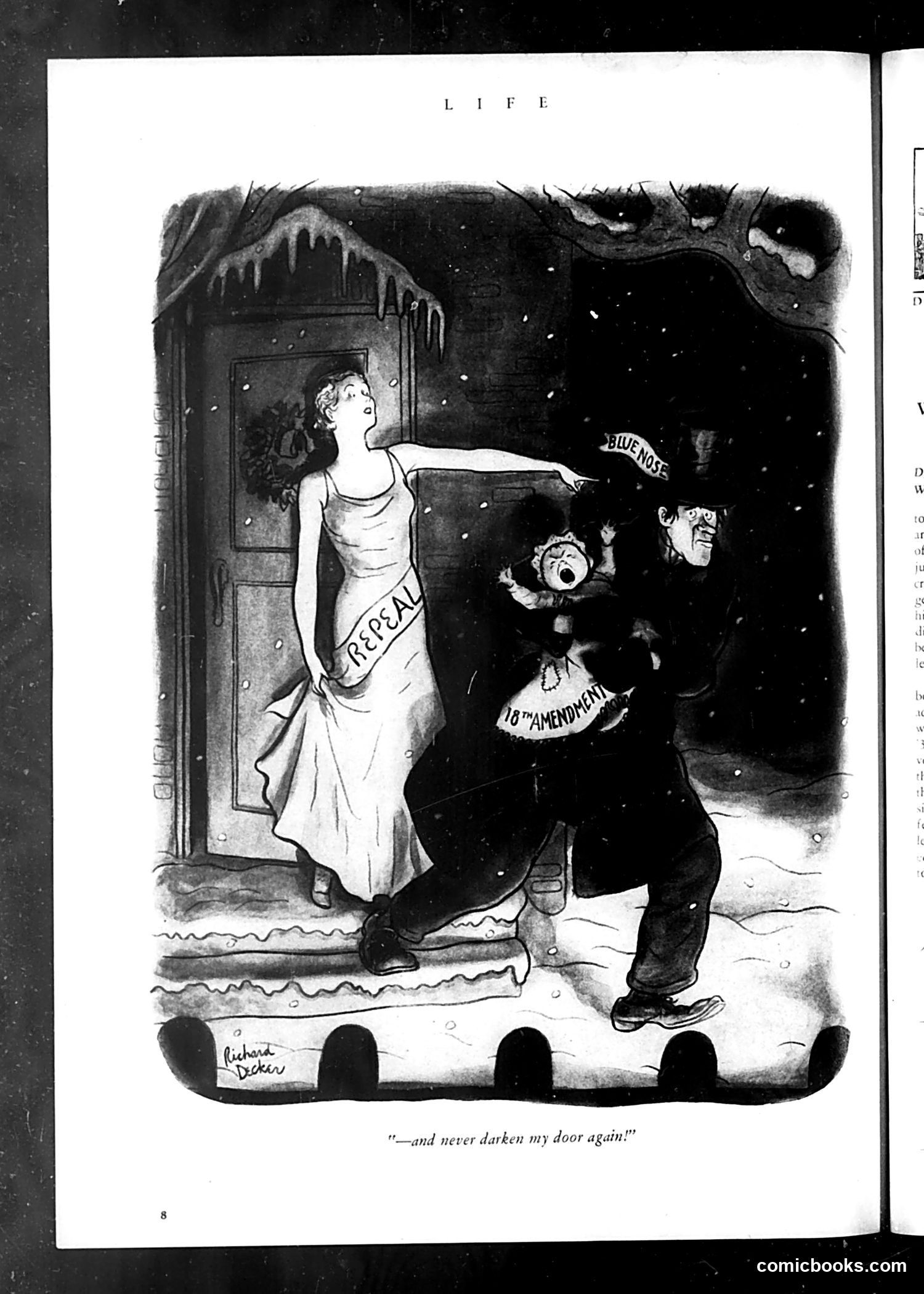
# Cartoon Analysis This Richard Decker cartoon satirizes Prohibition enforcement. A woman labeled "REPEAL" stands at her doorway, looking upward hopefully. Two law enforcement figures—one wearing a "BLUE NOSE" band (slang for an overzealous moralist) and another labeled "18TH AMENDMENT"—approach menacingly in snowy conditions. The joke plays on the woman's caption: "and never darken my door again!" She's wishing these Prohibition enforcers away. "Blue nose" mocks self-righteous temperance advocates, while the 18th Amendment reference identifies the constitutional basis for Prohibition. The cartoon reflects public frustration with Prohibition enforcement during the 1920s-early 1930s, when many Americans viewed the law as intrusive government overreach and supported its repeal—which occurred in 1933.
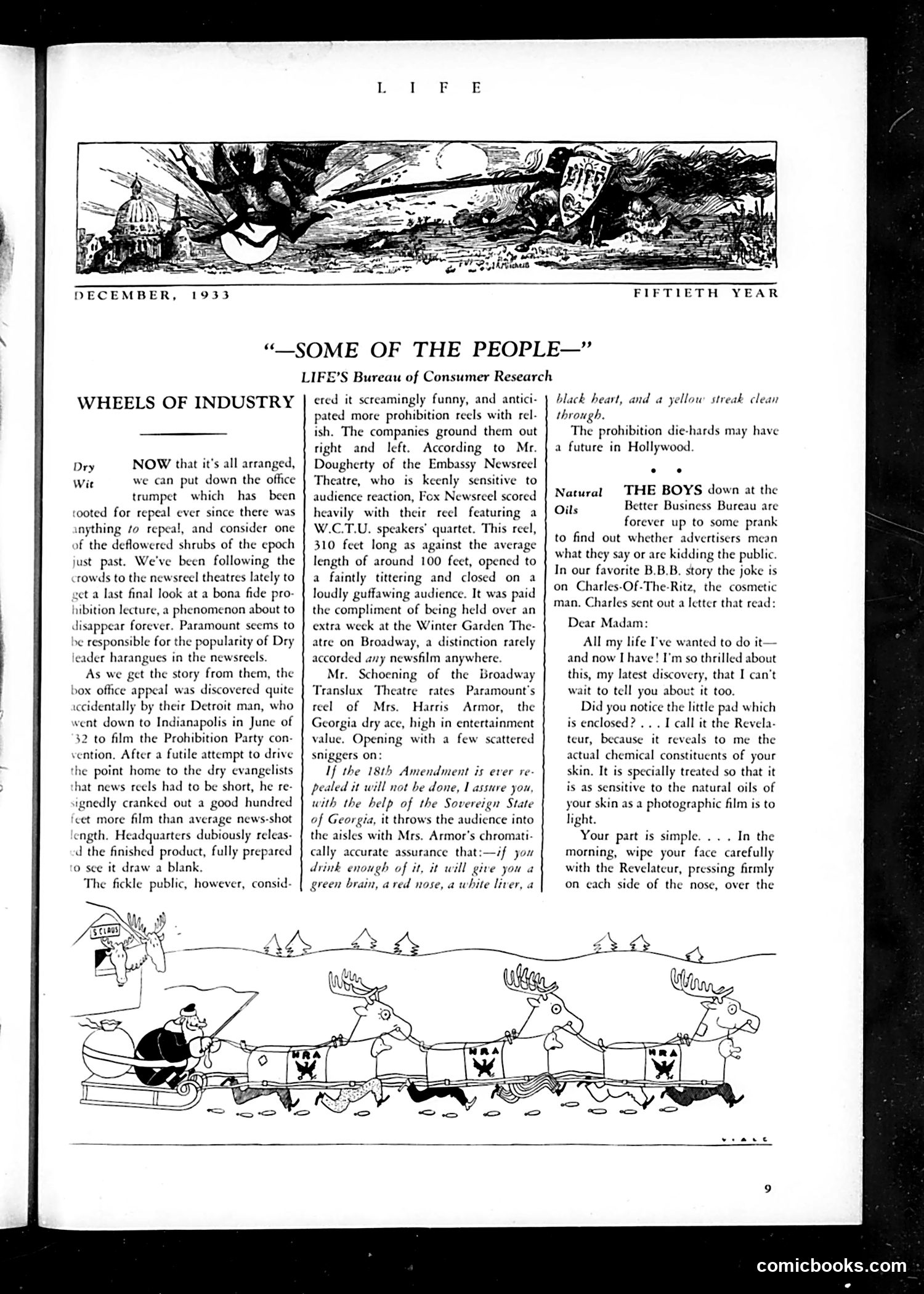
# Analysis of Life Magazine, December 1933 This page satirizes **Prohibition enforcement** during its final year (repealed in December 1933). The "Wheels of Industry" cartoon depicts **Santa's sleigh pulled by reindeer labeled "NAA"** (likely representing the National Association Against the Prohibition Amendment). The satirical point: Prohibition enforcement had become an absurd industrial operation, grinding away pointlessly. The text mocks Prohibition's failures—newsreels showing confiscated alcohol, theatrical productions about it, and the futile attempt to prevent drinking. References to Fox Newsreel's coverage and a Broadway play about "Mrs. Harris Armor" indicate Prohibition had become entertainment fodder. The "Natural Oils" advertisement parody suggests Prohibition hypocrites were buying cosmetics containing alcohol under the guise of "natural oils." The overall message: Prohibition is dying and ridiculous.
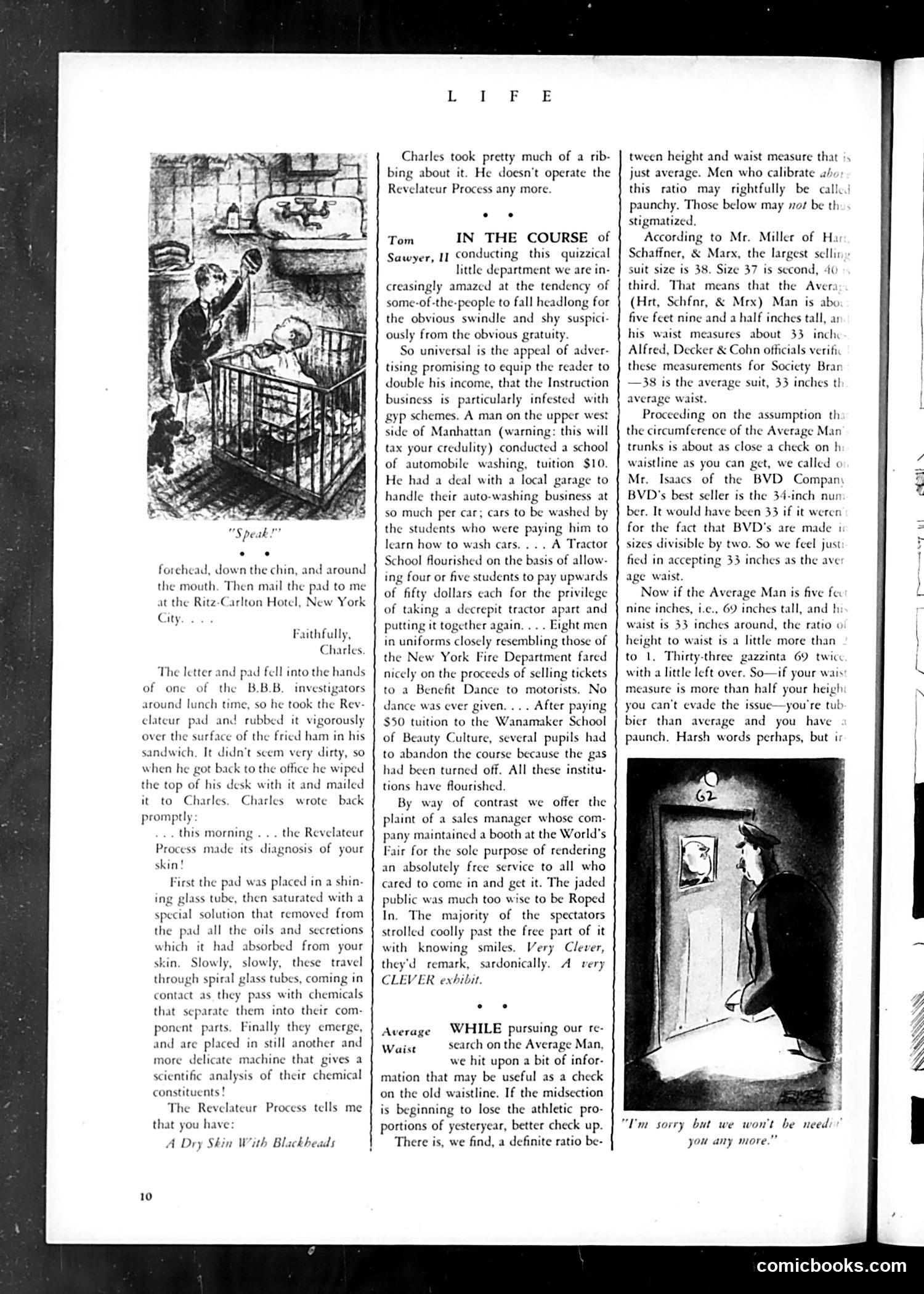
# Analysis of Life Magazine Page This page contains satirical commentary on advertising and consumer culture, specifically mocking the "Revelateur Process"—apparently a dubious beauty/skin treatment marketed through exaggerated scientific claims. The left illustration shows a man at his desk receiving a suspicious promotional pad. The accompanying text (attributed to "Charles") humorously describes how the pad's supposed chemical analysis works through "spiral glass tubes," suggesting the whole thing is pseudoscientific nonsense. The right cartoon depicts a door-to-door salesman being rejected with the caption "I'm sorry but we won't be needing you any more." This satirizes the aggressive marketing tactics and door-to-door sales culture of the era. The "Average Waist" section mocks commercial size standardization and the exploitation of body-consciousness in advertising. The satire targets both fraudulent products and the hard-sell salesmanship methods common to interwar America.