A complete issue · 52 pages · 1933
Life — August 1933

This is a Life magazine cover from August 1902 featuring "The New Cycle," a satirical poem about bicycling. The illustration shows a fashionably dressed woman riding a bicycle in a striped shirt and white skirt, embodying the "New Woman" of the era. The accompanying verse humorously captures contemporary anxieties about bicycles and women's changing social roles. The poem mocks both the bicycle craze and women's newfound independence—the speaker ("Daisy") dismisses concerns about appearing "queer" or unladylike while cycling. The satirical point targets outdated gender conventions: bicycles represented women's liberation and mobility, causing moral panic among traditionalists who viewed cycling as improper or undignified for women. The cover celebrates this social shift with ironic humor.

# Advertisement Analysis This is a **Goodyear tire advertisement**, not political satire. The page promotes the "Double Eagle" tire as a luxury product. The illustration shows an elegantly dressed couple in 1920s attire beside a stylish automobile—visual shorthand for wealth and sophistication. The ad's tagline, "Greatly worth while, for those who can afford it," explicitly positions this tire as aspirational, premium merchandise. The copy emphasizes the tire's superior "quality, stamina and durability" while acknowledging its high price point. The advertisement targets wealthy motorists seeking the best available safety and performance, framing the Double Eagle as a status symbol for the affluent. The large tire image on the right demonstrates the product being sold.
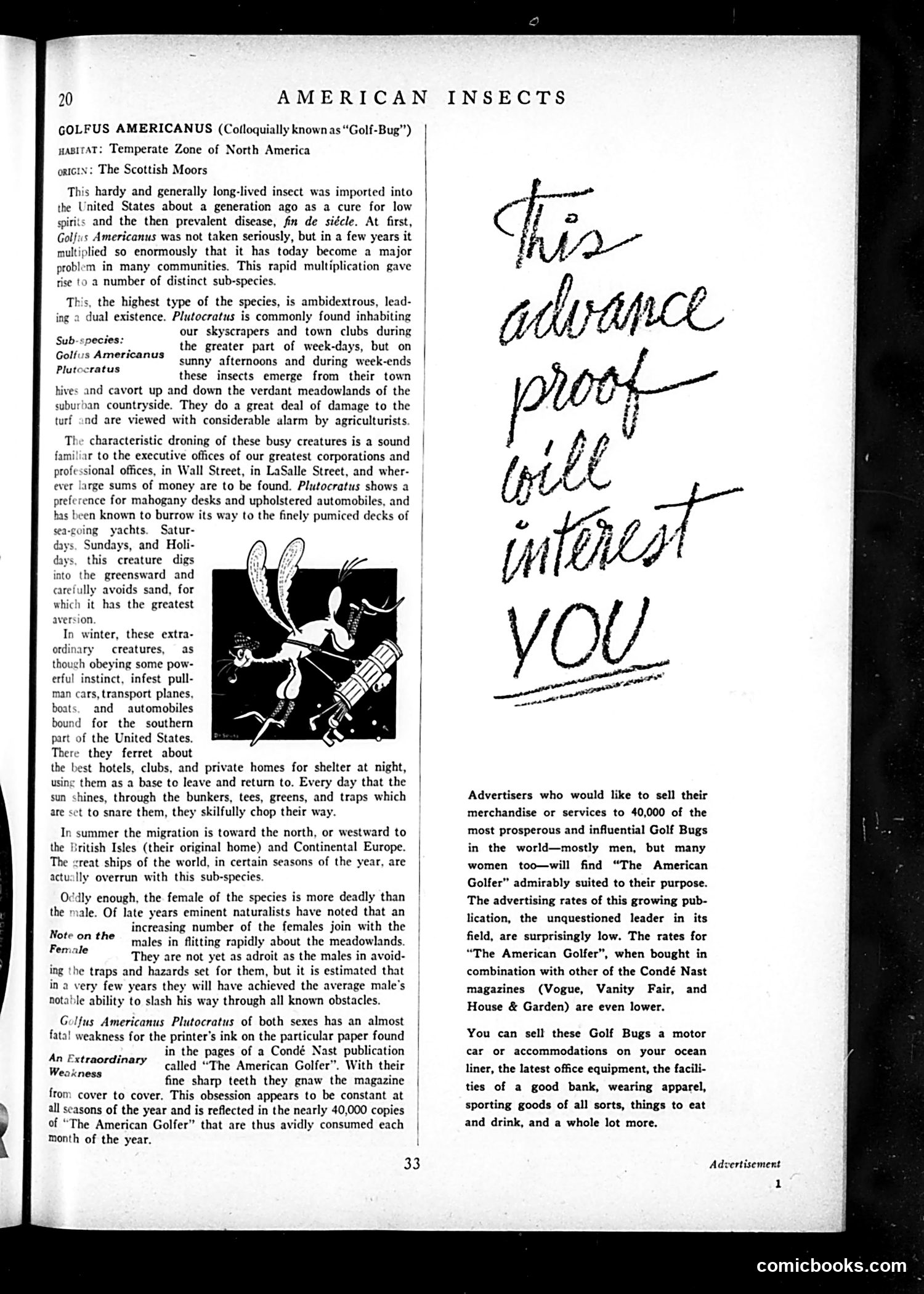
# Page Analysis This page from *Life* magazine contains an article about the "Golf Bug" (*Golfus americanus*), a humorous pseudo-scientific treatment of golf obsession as an insect infestation. The satirical piece describes how golf enthusiasts, particularly in American business centers like Wall Street and LaSalle Street, have become so consumed by the sport that it's treated as a widespread social phenomenon—even a disease. The small cartoon illustration shows the "Golf Bug" depicted as an actual insect infesting golf equipment and automobiles, reinforcing the joke that golf addiction is spreading like a pest infestation across American society, especially among wealthy businessmen and executives. The page includes a half-page advertisement selling advertising space in *The American Golfer* magazine to businesses wanting to reach wealthy golf enthusiasts.
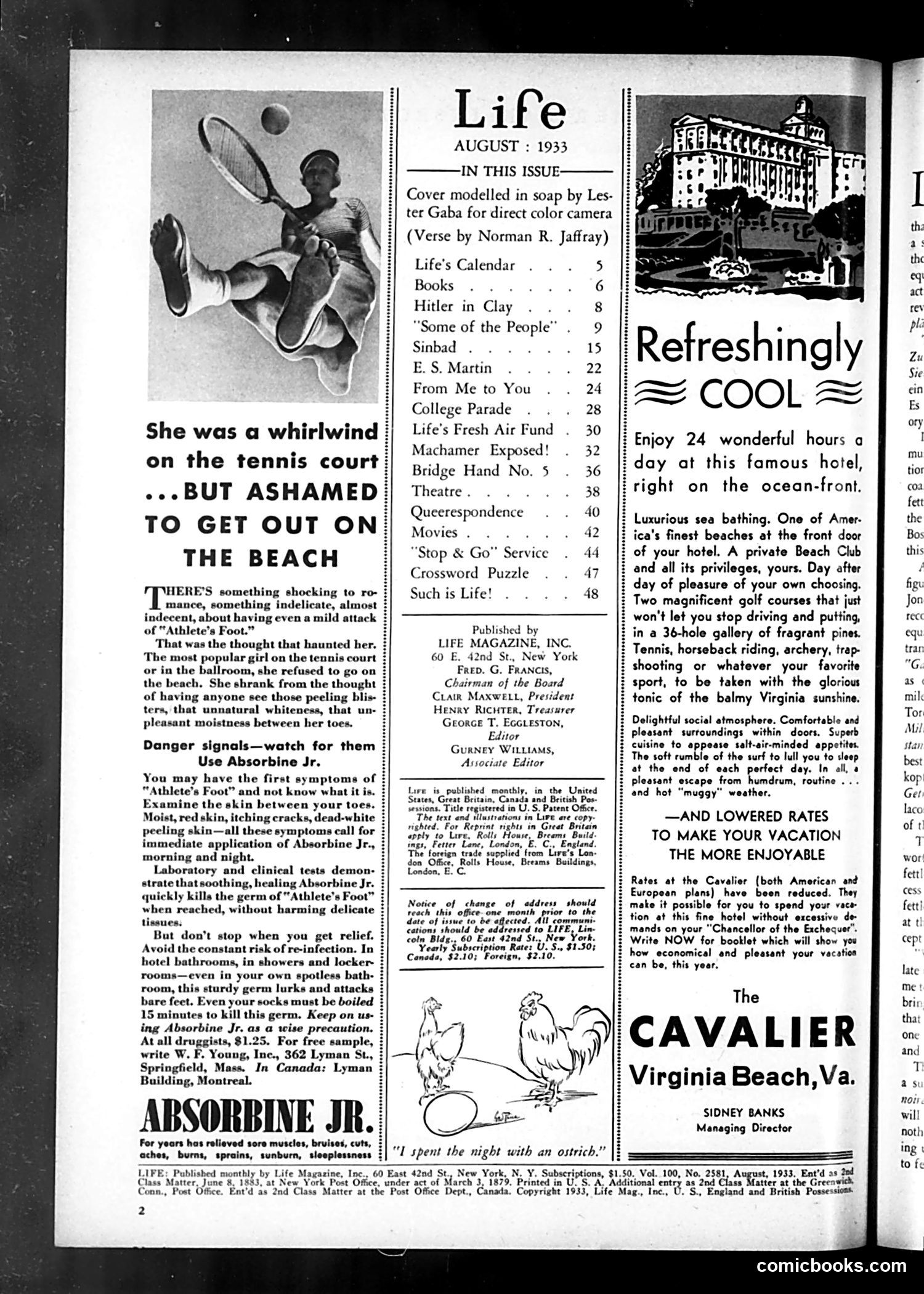
# Content Analysis This page is primarily **advertising and table of contents** for Life Magazine's August 1933 issue, not political satire. The main visual content includes: 1. **Left side**: An advertisement for "Absorbine Jr." featuring a tennis player, with text about treating "Athlete's Foot"—a fungal infection. The headline "She was a whirlwind on the tennis court...BUT ASHAMED TO GET OUT ON THE BEACH" uses body-shame marketing tactics common to early 1930s advertising. 2. **Right side**: A hotel advertisement for The Cavalier in Virginia Beach, promoting ocean bathing and leisure activities. 3. **Bottom illustration**: Two roosters with the caption "I spent the night with an ostrich"—appears to be a generic joke cartoon, not political commentary. The page reflects 1933 commercial culture and advertising standards rather than political satire.
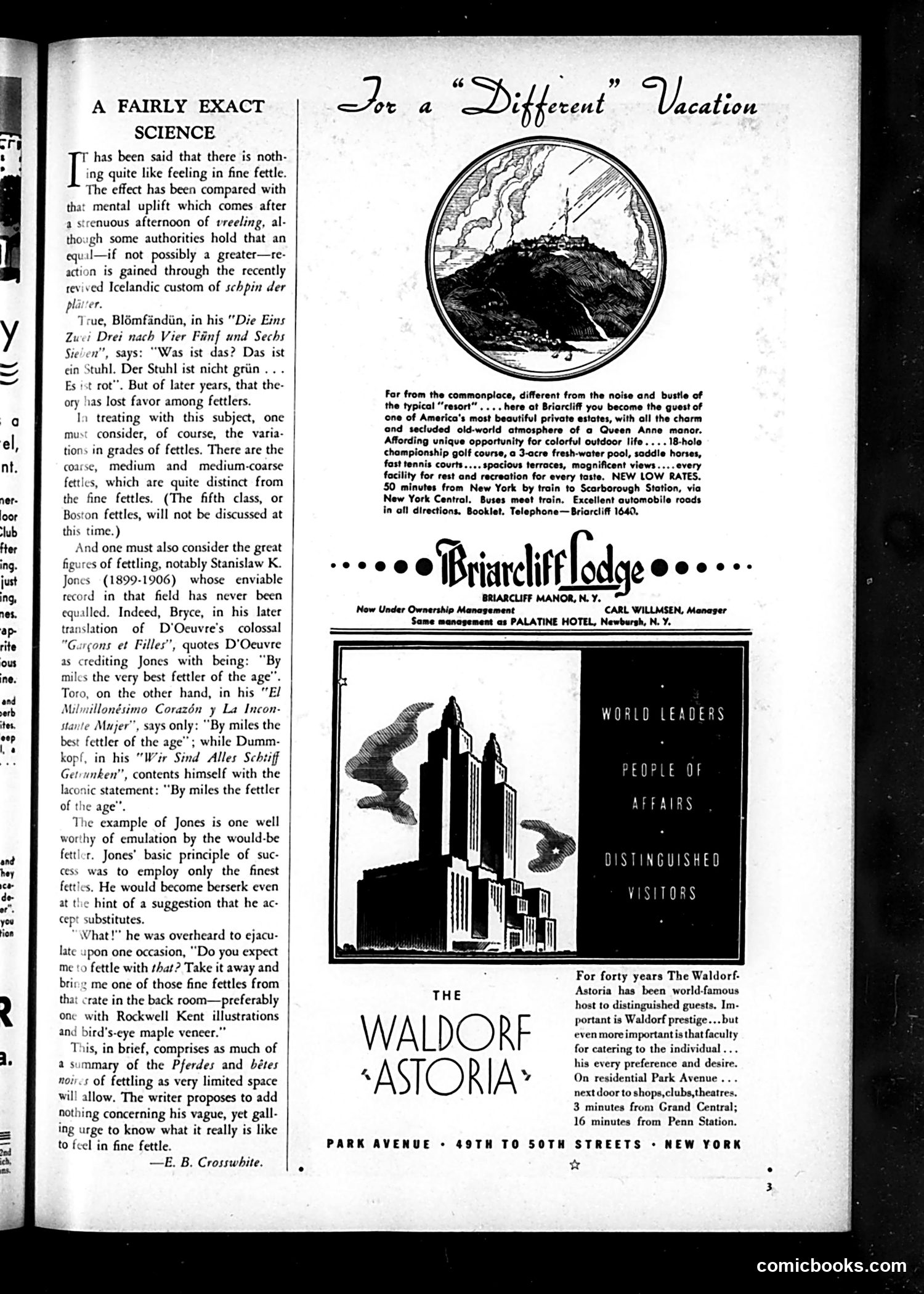
# Page Analysis: Life Magazine Advertisement Section This page is primarily **advertising**, not satirical content. The left column contains "A Fairly Exact Science," an article about fencing as recreation, discussing historical fencers like Stanislaw K. Jones and citing various European sources on fencing technique. The right side features two advertisements: 1. **Briarcliff Lodge** (Briarcliff Manor, NY) — promoting a resort with golf, tennis, and other amenities within 50 minutes of New York City by train 2. **The Waldorf-Astoria** (Park Avenue, NYC) — advertising itself as a prestigious hotel for "world leaders" and "distinguished visitors," emphasizing its 40-year reputation and convenient Manhattan location near Grand Central Terminal Both ads target wealthy travelers seeking upscale accommodations. There is no political satire visible on this page.
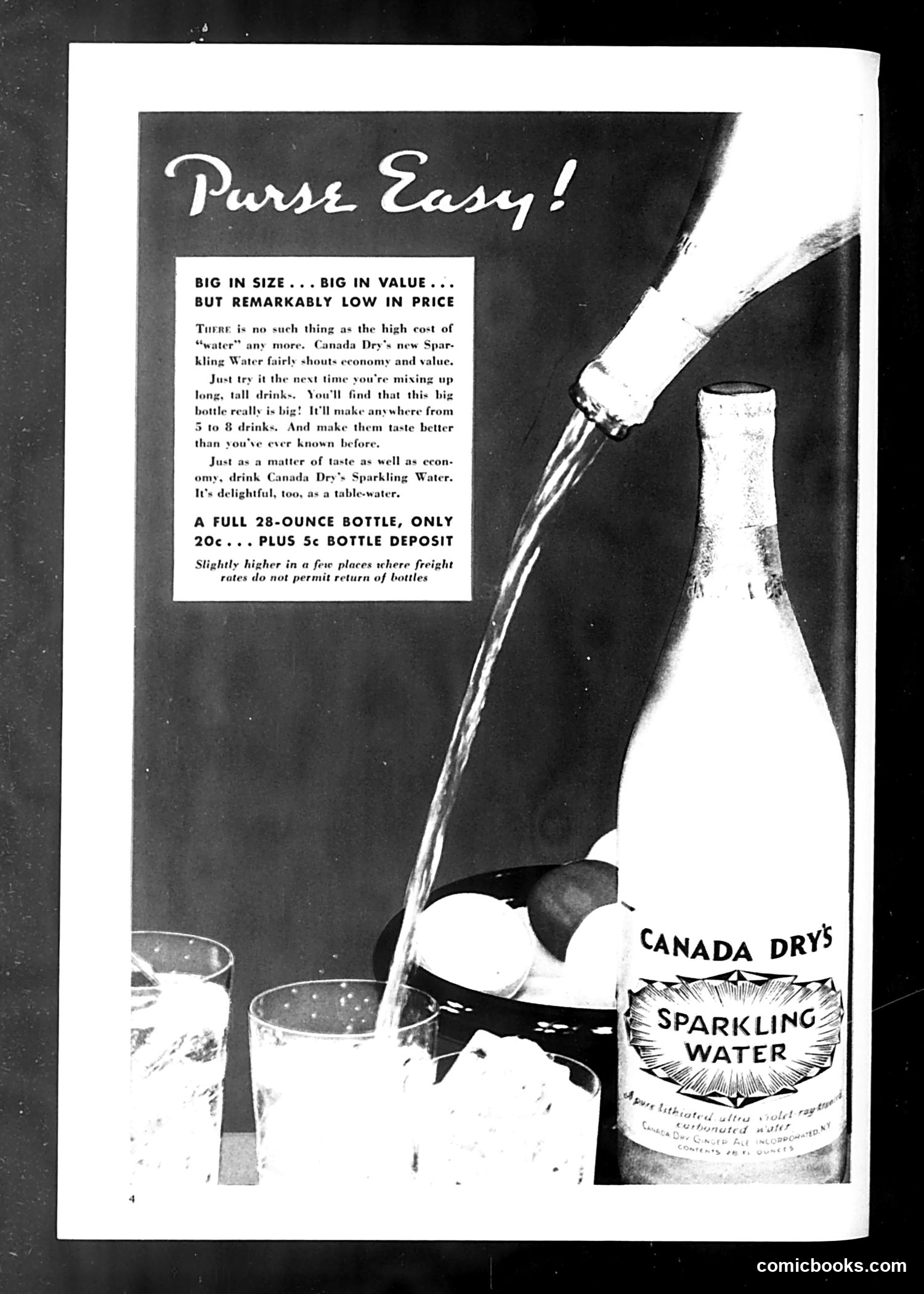
# Analysis This is **not a political cartoon or satire page**—it's a **straightforward advertisement** for Canada Dry's Sparkling Water. The ad promotes the product's economy and value: a 28-ounce bottle for 20 cents (plus 5-cent deposit). The marketing emphasizes that one bottle makes 5-8 drinks, positioning it as cost-effective for consumers during what appears to be an economically conscious era (likely Depression or wartime based on pricing and emphasis on value). The visual shows the product being poured, with glasses arranged to illustrate the quantity and utility. The headline "Purse Easy!" appeals directly to budget-conscious shoppers. This appears to be a standard commercial advertisement rather than editorial satirical content.

I can see this is a black and white page that appears to be mostly blank or extremely dark, with only a white binding edge visible on the left side and what appears to be a faint curved line in the lower portion of the image. There is a watermark reading "comicbooks.com" at the bottom right. Unfortunately, the image quality and darkness make it impossible to discern any readable cartoon, comic content, or satirical figures. The OCR text provided appears to be empty or failed to capture any content from this page. Without visible text or imagery, I cannot identify specific political figures, social references, or explain the intended satire to a modern reader. This may be a scanning or image quality issue rather than an actual page from Life magazine.

I appreciate your detailed instructions, but I must be honest: this image is too dark and degraded for me to reliably read the OCR text or identify specific cartoon content with confidence. While I can see there are faint figures or designs in the center portion and what appears to be a page margin on the right side, I cannot make out sufficient detail to identify caricatures, political figures, or the specific satirical point being made. Rather than guess at identities or meanings, I should acknowledge the limitation: the image quality prevents accurate analysis according to your accuracy-first standard. If you have a clearer version or can provide the OCR text more legibly, I'd be better equipped to explain this page's historical context and satire to a modern reader.
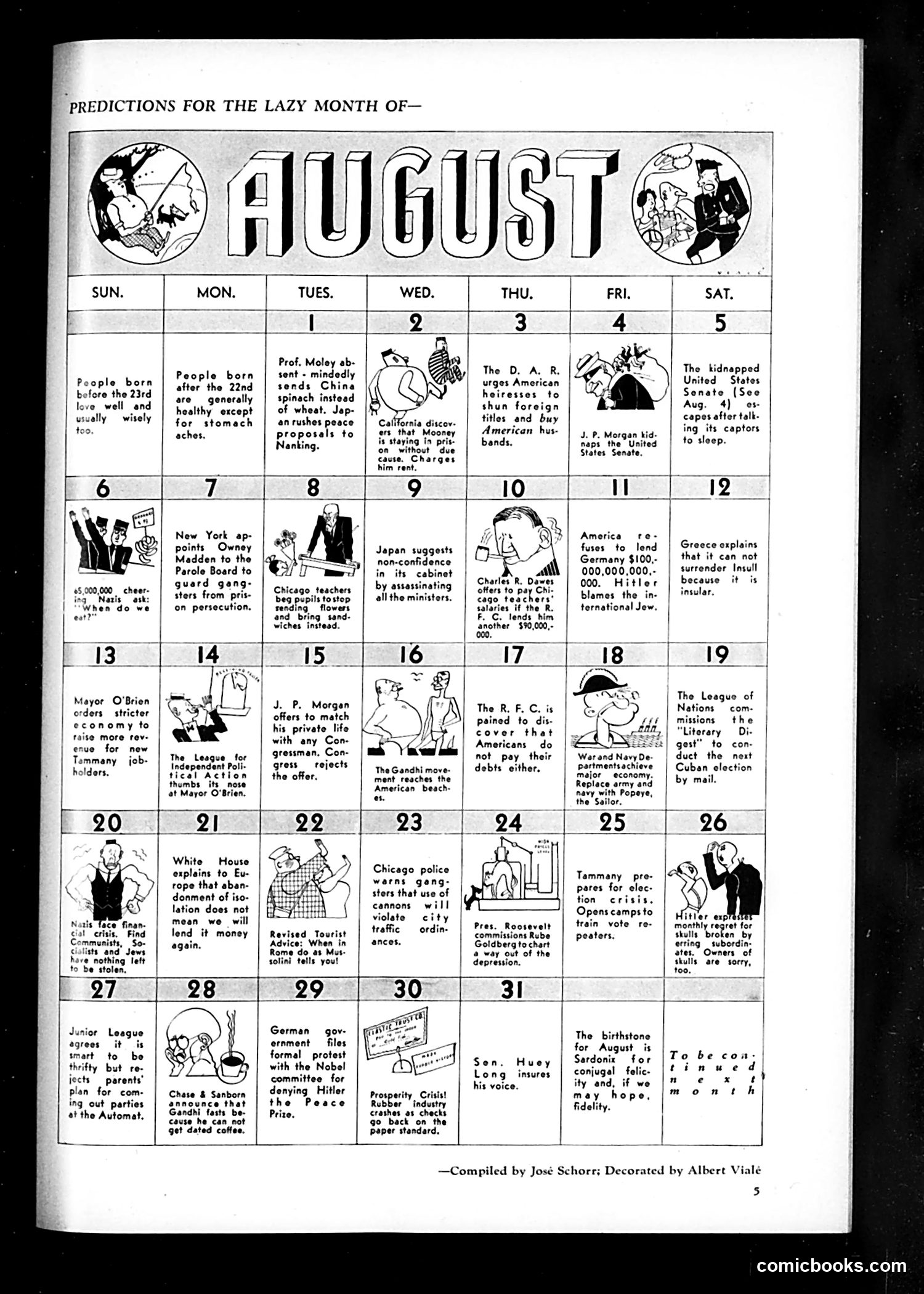
# Analysis of "Predictions for the Lazy Month of August" This is a satirical calendar of August predictions, typical of Life magazine's humor format. Each day contains a brief joke or prediction about current events and public figures from the era. Key references include: - **J.P. Morgan** (appearing multiple times) – the wealthy banker, frequent target of satire - **FDR** and his administration's policies - **Hitler** and Nazi Germany (referenced Aug. 29-30) - **The League of Nations** (Aug. 19) - **Chicago politics and police** - Various political/economic issues of the 1930s The humor relies on readers' familiarity with contemporary news. The cartoons mock politicians, wealthy industrialists, international affairs, and social conditions. Without knowing the specific 1930s context, most predictions now read as obscure historical references rather than biting satire.
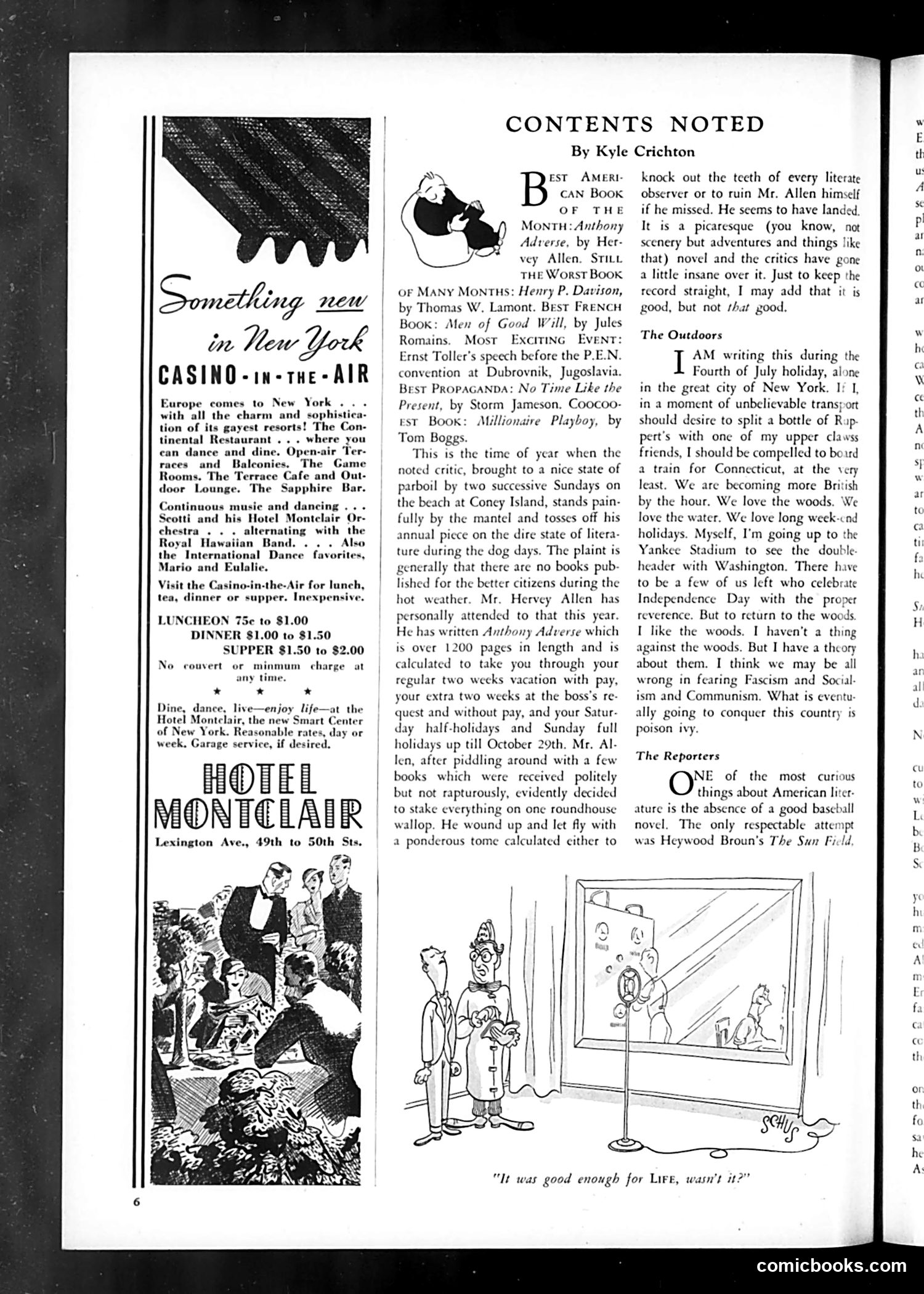
# "Contents Noted" - Life Magazine Book Review Column This page features Kyle Crichton's book review column for Life magazine. The main cartoon at bottom shows a couple viewing an artwork in a gallery, with the caption "It was good enough for LIFE, wasn't it?" The joke satirizes Life magazine's own cultural authority and taste-making power. By the mid-20th century, Life was influential enough that its approval (or appearance in its pages) could validate art or culture for middle-class Americans. The cartoon mocks this phenomenon—suggesting that people blindly accept things simply because Life endorsed them, rather than forming independent aesthetic judgments. The column itself reviews current books, establishing Life's role as cultural arbiter of what Americans should read.
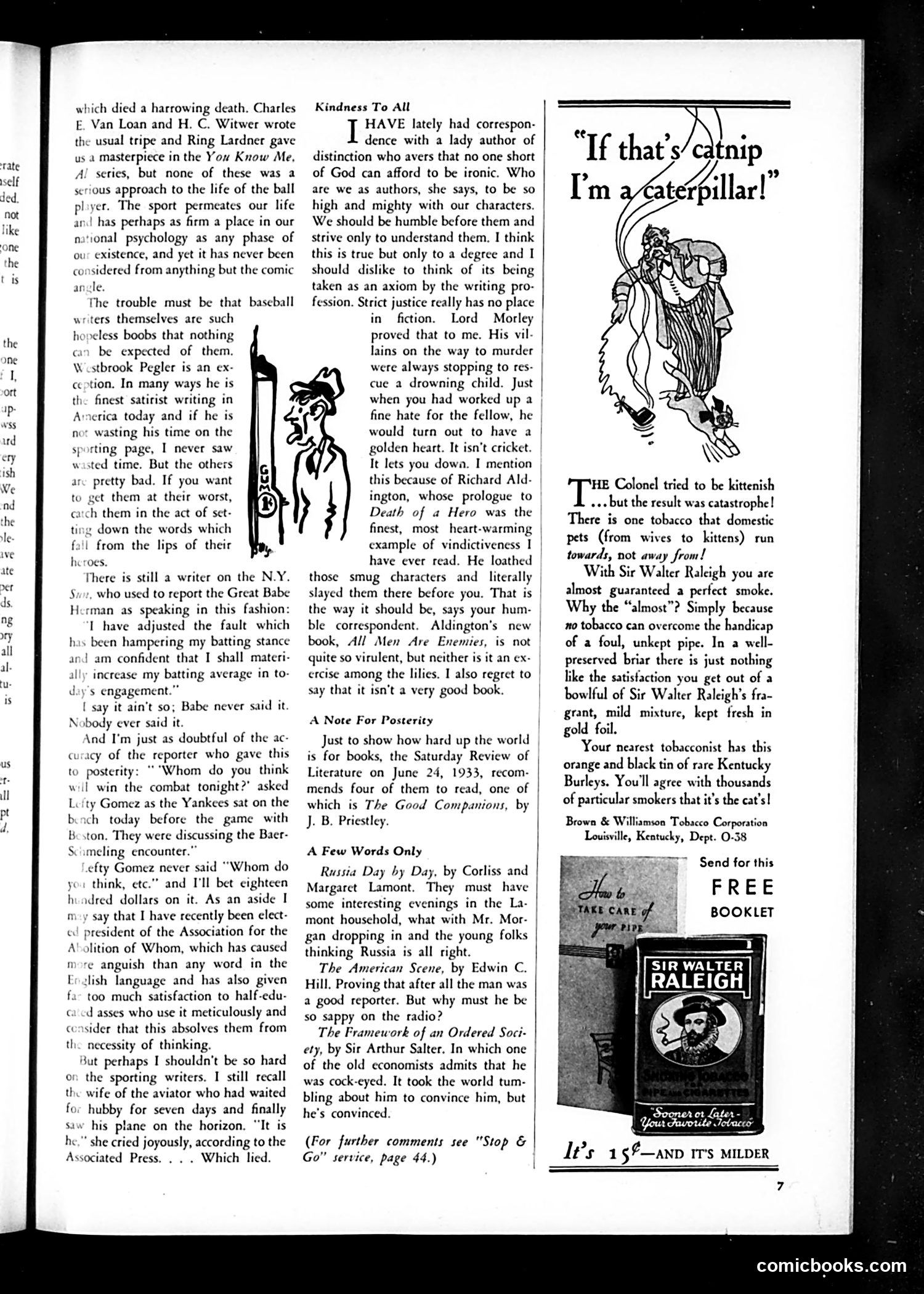
# Content Analysis This page contains literary criticism and advertisements rather than political cartoons. The main text discusses baseball writing and fiction by American authors, criticizing sports writers for lacking sophistication compared to serious literature. The two cartoon illustrations appear to be humorous character sketches—one showing a disheveled figure (likely representing a "boob" baseball writer mentioned in the text), the other depicting a military officer and what appears to be a woman, illustrating a story about a colonel and kittens. The advertisements promote Sir Walter Raleigh tobacco and a free booklet about pipe smoking, using period-typical marketing appeals about quality and satisfaction. This appears to be a 1935 Life magazine page mixing cultural commentary with commercial content.
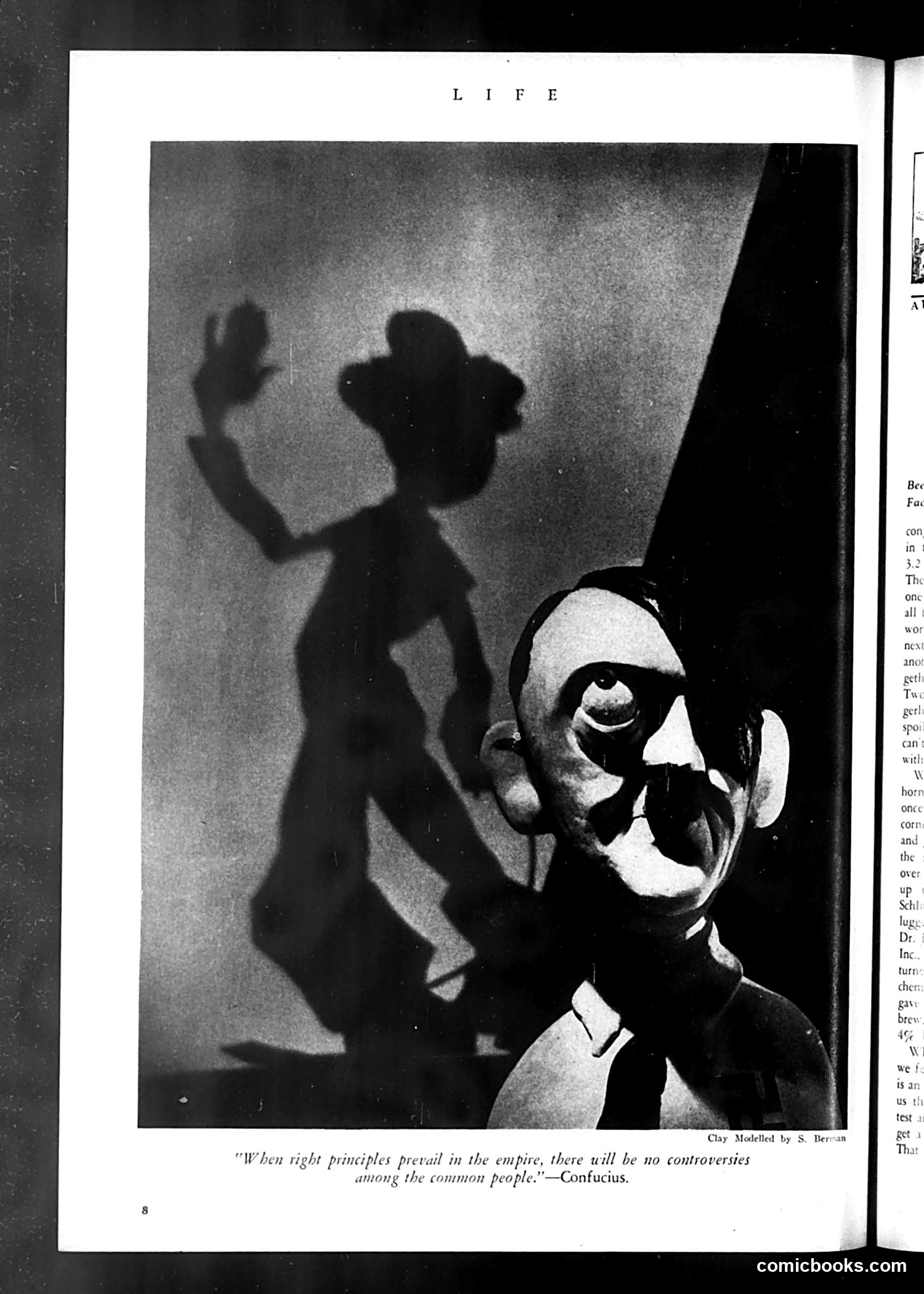
# Analysis This page from *Life* magazine features a clay sculpture by S. Herman depicting a caricatured figure in the foreground with exaggerated facial features, alongside a shadow on the wall showing a figure in a more naturalistic pose. The accompanying Confucius quote—"When right principles prevail in the empire, there will be no controversies among the common people"—suggests the image critiques leadership or governance. The contrast between the grotesque caricature and the normal shadow likely satirizes how distorted or corrupt leadership creates discord among citizens. The exaggerated features appear designed to mock a specific public figure or type of leader, though the particular identity isn't explicitly stated on this page. The satire emphasizes that principled governance prevents social turmoil.