A complete issue · 37 pages · 1931
Life — November 27, 1931
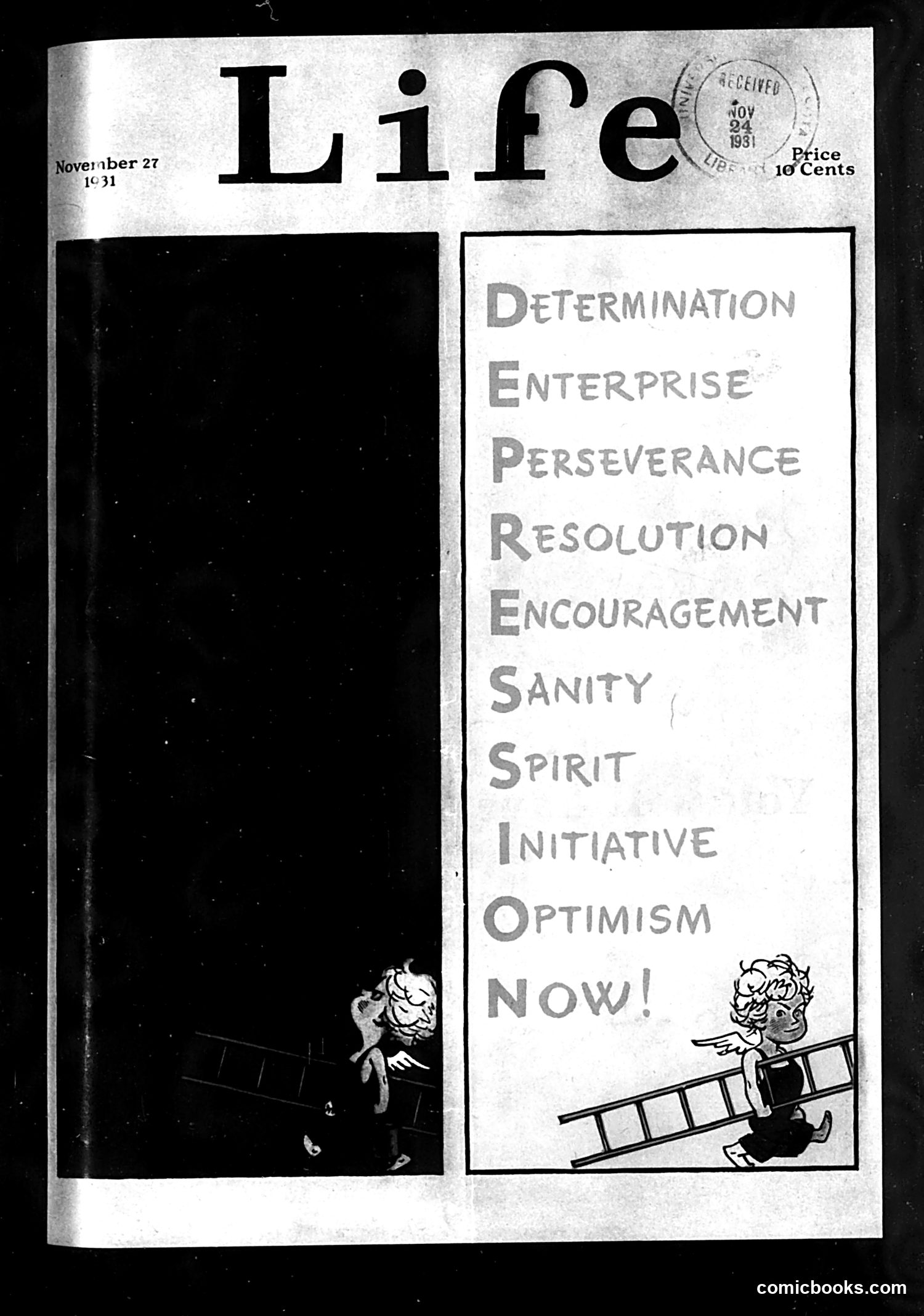
# Life Magazine, November 27, 1931 This appears to be a title page or cover featuring an acrostic poem spelling "DEPRESSION NOW!" using words like Determination, Enterprise, Perseverance, Resolution, Encouragement, Sanity, Spirit, Initiative, Optimism. The left side shows a dark, mostly black panel with small cartoon figures at the bottom. The right panel contains the motivational acrostic with illustrated cherubs or cupids at the corners carrying a ladder. **Context:** Published during the Great Depression (1929-1939), this is satirical commentary on American optimism and self-help rhetoric during economic crisis. The contrast between the dark left panel and the cheerful right side—with its earnest list of virtues—appears to mock the gap between official encouragement and harsh economic reality. The magazine uses irony to critique hollow motivational messaging when people were genuinely suffering.
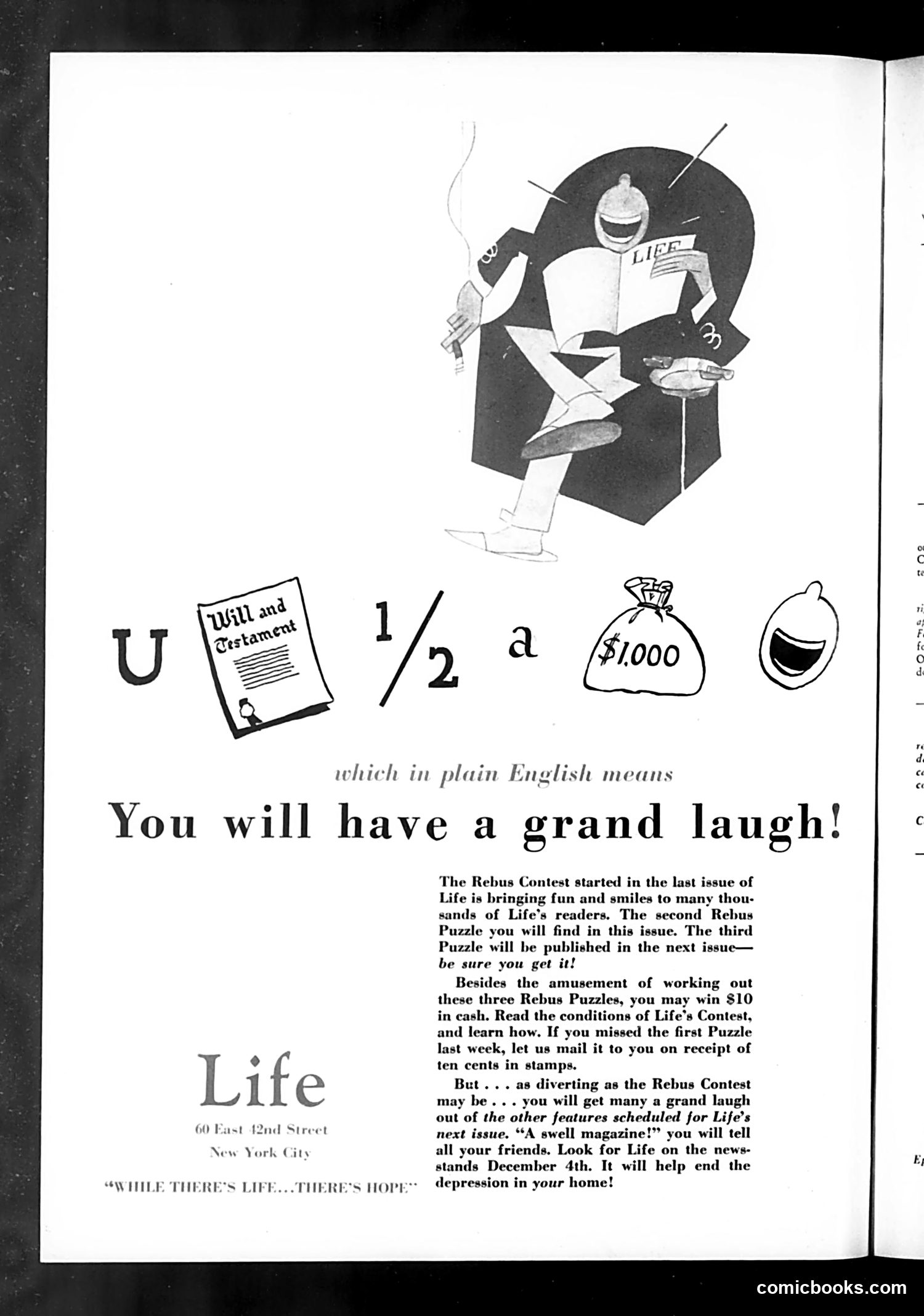
# Analysis This is a rebus puzzle advertisement for *Life* magazine's contest. The visual riddle reads: "U [Will and Testament] 1/2 a [$1000 money bag] [laughing face]" The solution translates to: "You will have a grand laugh!" (as the text confirms). The cartoon above shows a well-dressed gentleman in a chair smoking, reading a newspaper labeled "LIFE," embodying the magazine's target affluent audience. The rebus puzzle itself uses visual symbols instead of words—a common 1930s-40s parlor game format. The contest promised $10 cash prizes and positioned *Life* as sophisticated entertainment to "end the depression in your home." This reflects the magazine's role as humorous escape during economic hardship, appealing to middle and upper-class readers seeking genteel amusement.
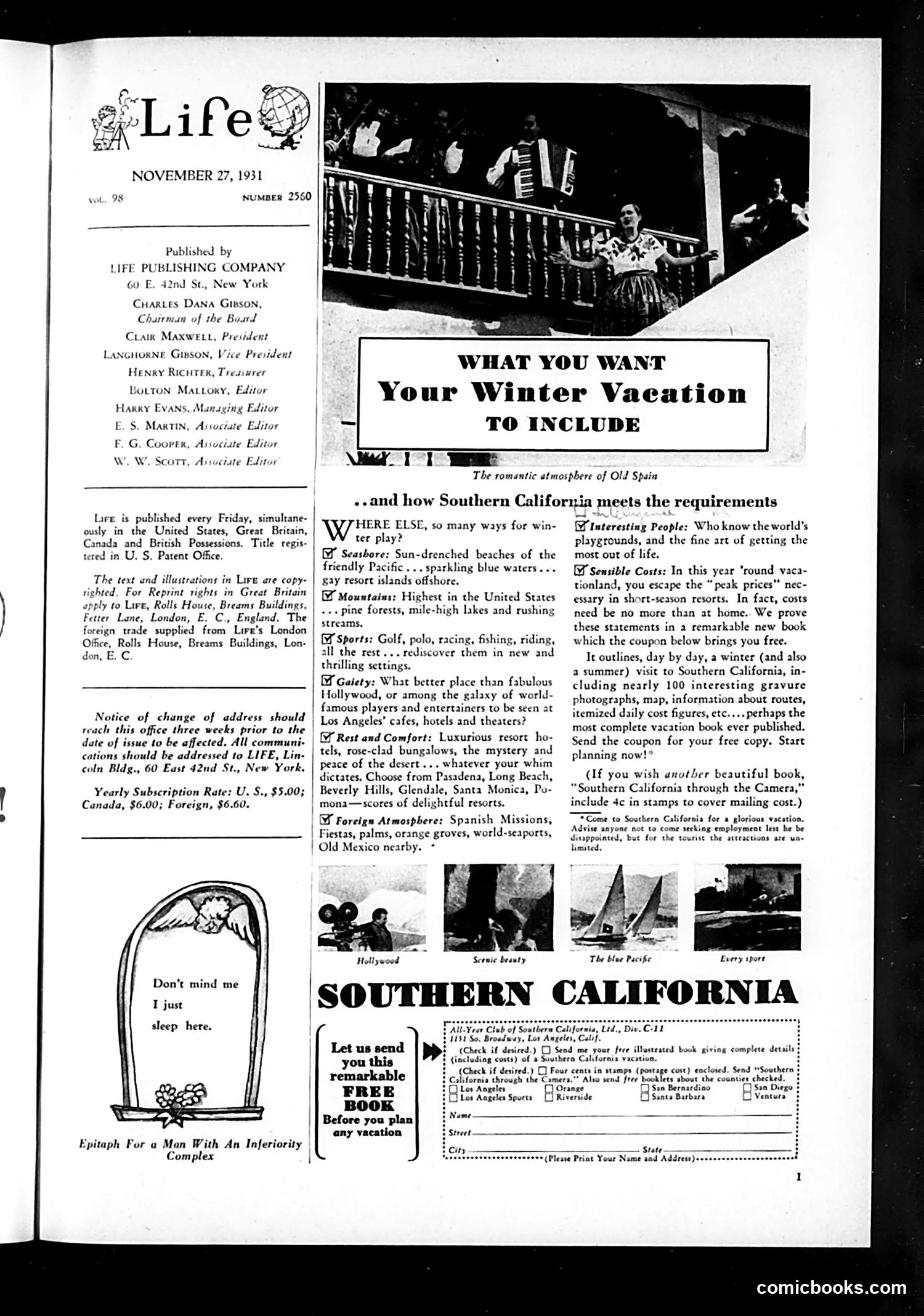
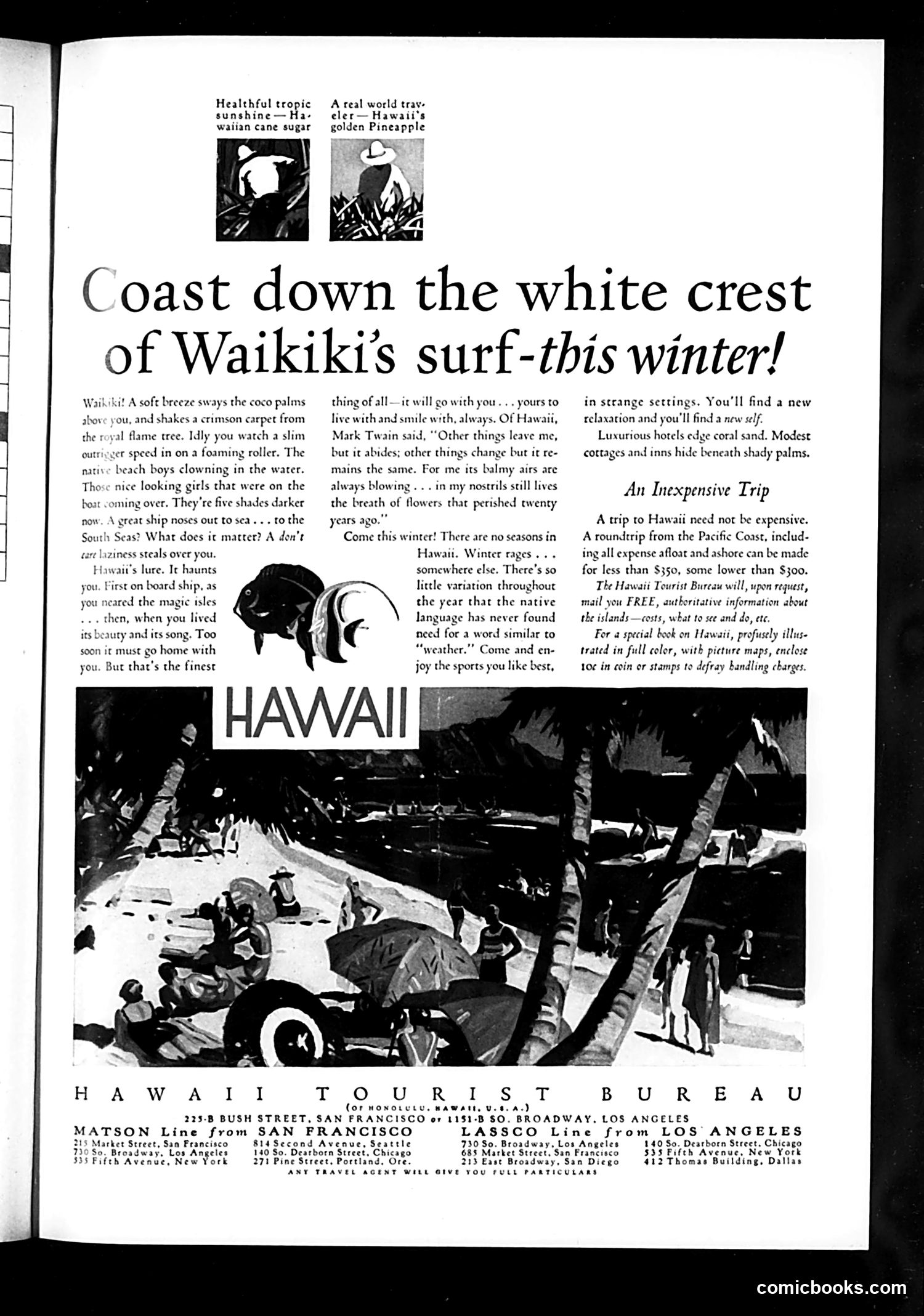
# Analysis This page is primarily **advertising content** for Southern California tourism, not political satire. The main feature is a travel advertisement promoting winter vacations to Southern California, highlighting beaches, mountains, golf, entertainment venues (Hollywood), and Spanish colonial missions. The only cartoon on the page is a small, unrelated sketch at bottom left: a coffin with the epitaph "Epitaph For a Man With An Inferiority Complex" and the figure inside saying "Don't mind me I just sleep here." This is a generic joke about self-deprecation, not political commentary. The page reflects 1931 tourism marketing and leisure culture during the Great Depression era, offering escape through vacation planning.
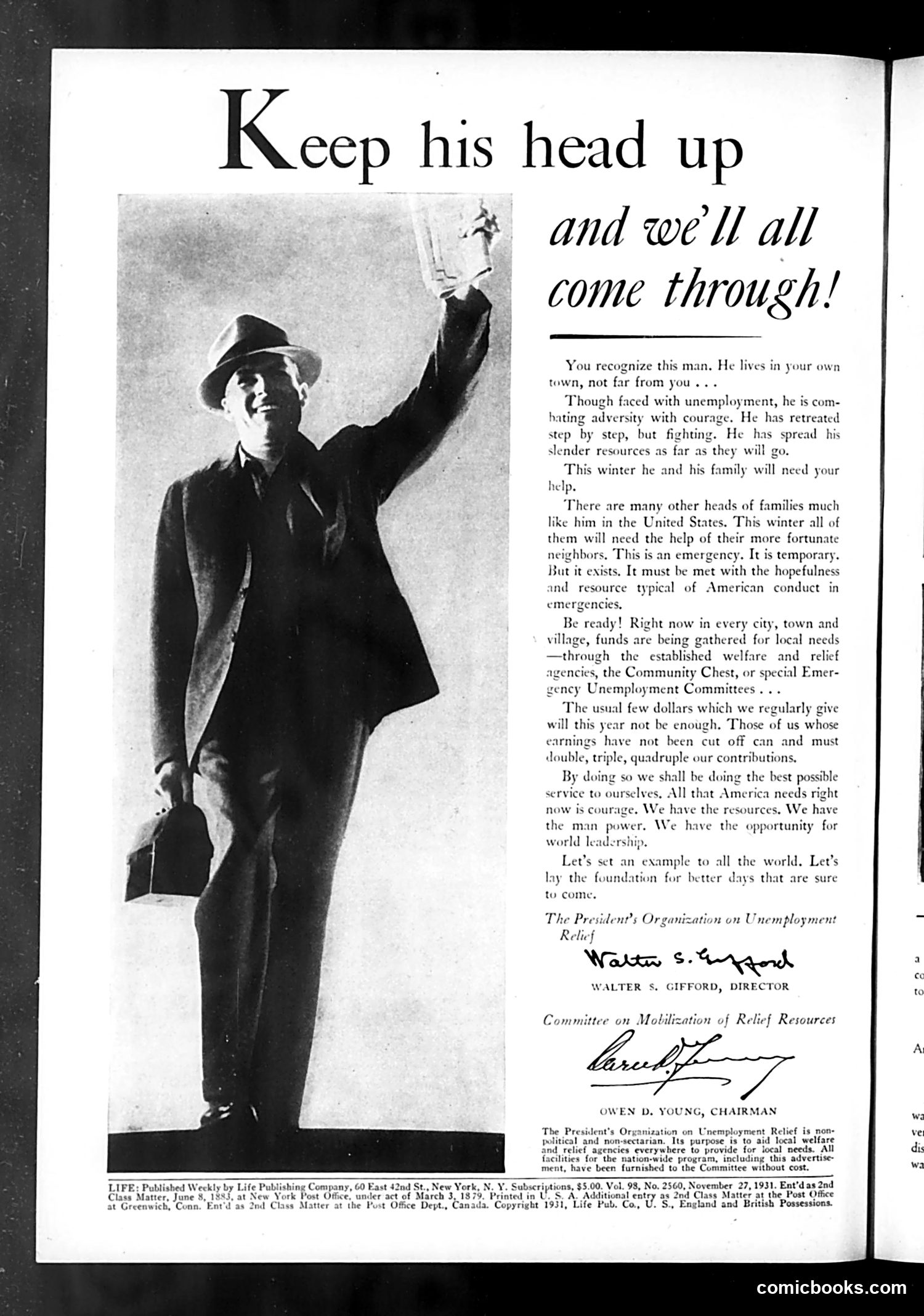
# Analysis: "Keep His Head Up" (Life Magazine, November 27, 1931) This is **not satire**—it's a earnest relief appeal during the Great Depression. The image shows an unemployed man with fist raised in determined resolve, symbolizing resilience during economic crisis. The text, signed by Walter S. Gifford (Director of the President's Organization on Unemployment Relief) and Owen D. Young (Chairman), urges Americans to dramatically increase charitable donations. It acknowledges widespread unemployment and argues that regular contributions won't suffice—those with stable incomes must "double, triple, quadruple" their giving. The appeal frames Depression relief as a patriotic duty and moral emergency requiring community support through established welfare agencies, emphasizing American resourcefulness and leadership. This predates federal welfare programs, relying on voluntary charitable action.
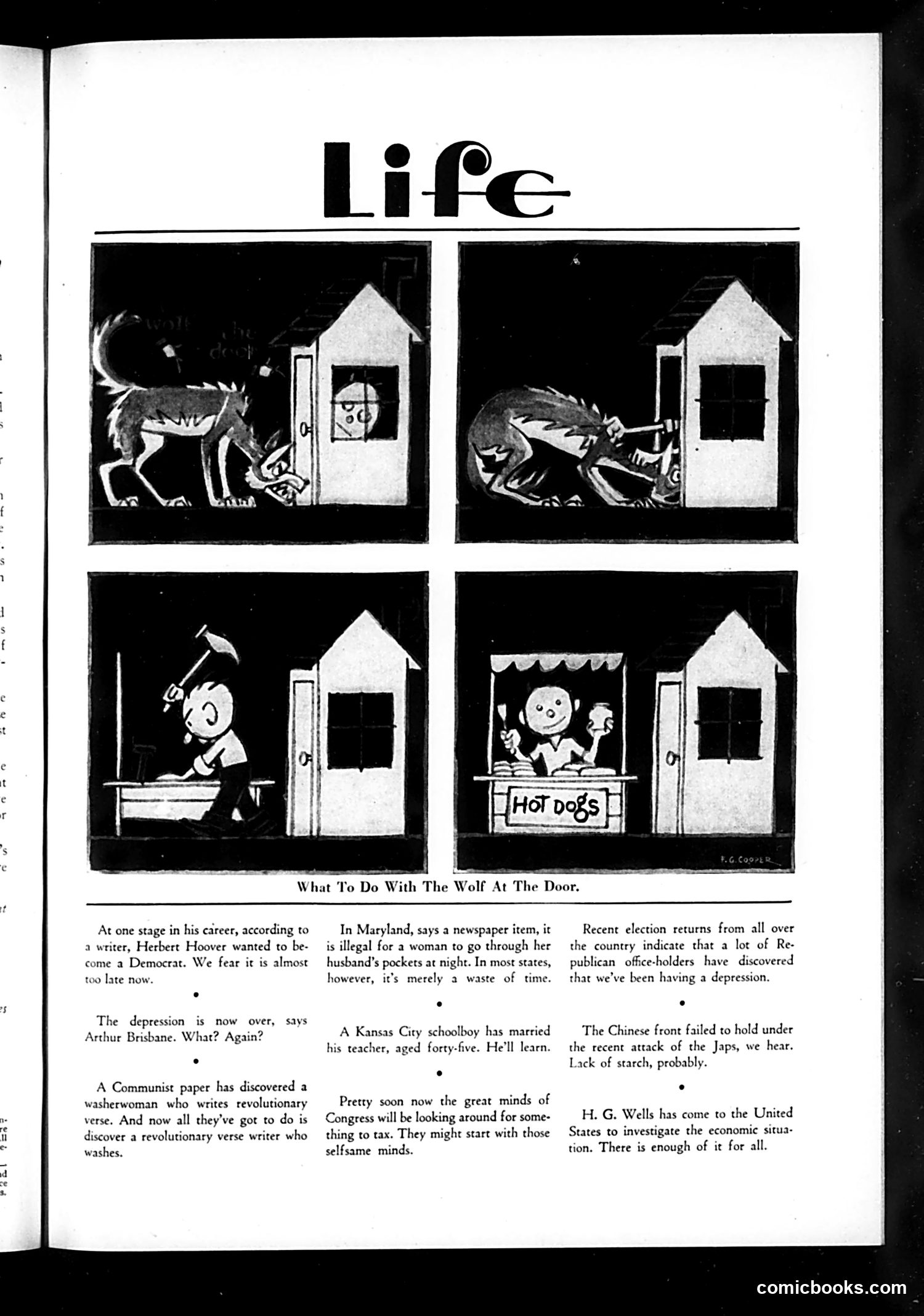
# "What To Do With The Wolf At The Door" This four-panel comic satirizes responses to economic hardship. The sequence shows a man confronting a threatening wolf (representing poverty/financial crisis) outside a small house: **Panel 1-2:** The man tries to fight the wolf off with increasingly desperate measures. **Panel 3:** He attempts to ignore it through distraction (shown bathing). **Panel 4:** He opens a "Hot Dogs" stand, suggesting entrepreneurial escape from poverty. The accompanying text references the Great Depression's aftermath with dark humor—joking that Herbert Hoover wanted to become a Democrat because it's "almost too late now," and mocking political responses to economic suffering. The overall message critiques inadequate solutions to widespread want during this economically turbulent period.
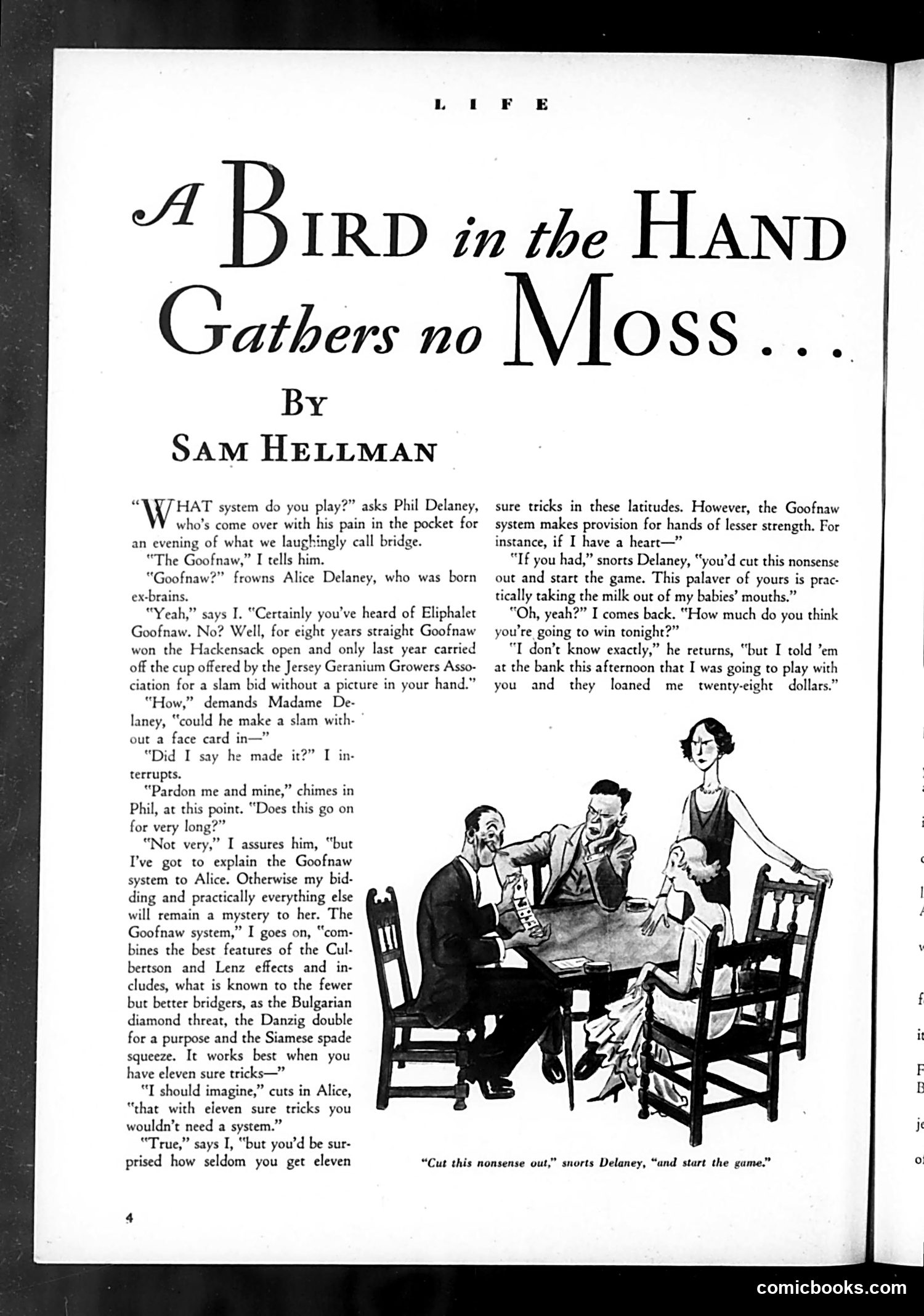
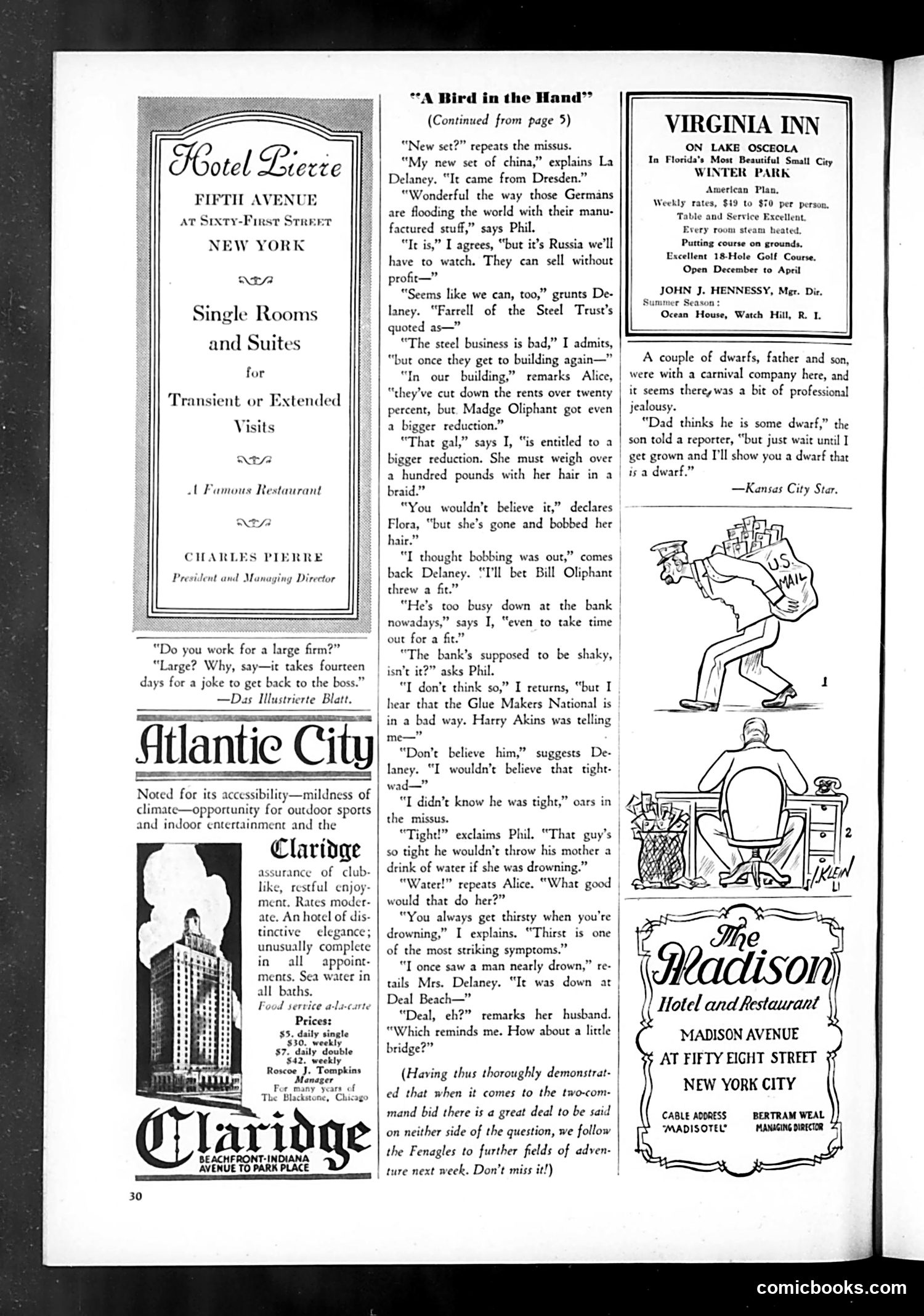
# "A Bird in the Hand Gathers no Moss" This is a humorous article by Sam Hellman about bridge card game strategy, specifically the "Goofnaw" system. The illustration shows three men and a woman at a card table engaged in bridge. The satire targets the proliferation of complex bridge systems and bidding conventions popular in the 1920s-30s. Phil Delaney is trying to explain the Goofnaw system—which absurdly combines features of various established systems (Culbertson, Lenz effects, Bulgarian diamond threat, Danzig double, Siamese spade squeeze)—to his wife Alice. The joke is that bridge had become so complicated with competing methodologies that players needed elaborate systems just to play socially. The humor mocks both pretentious bridge enthusiasts and the snake-oil-like promotion of competing systems.
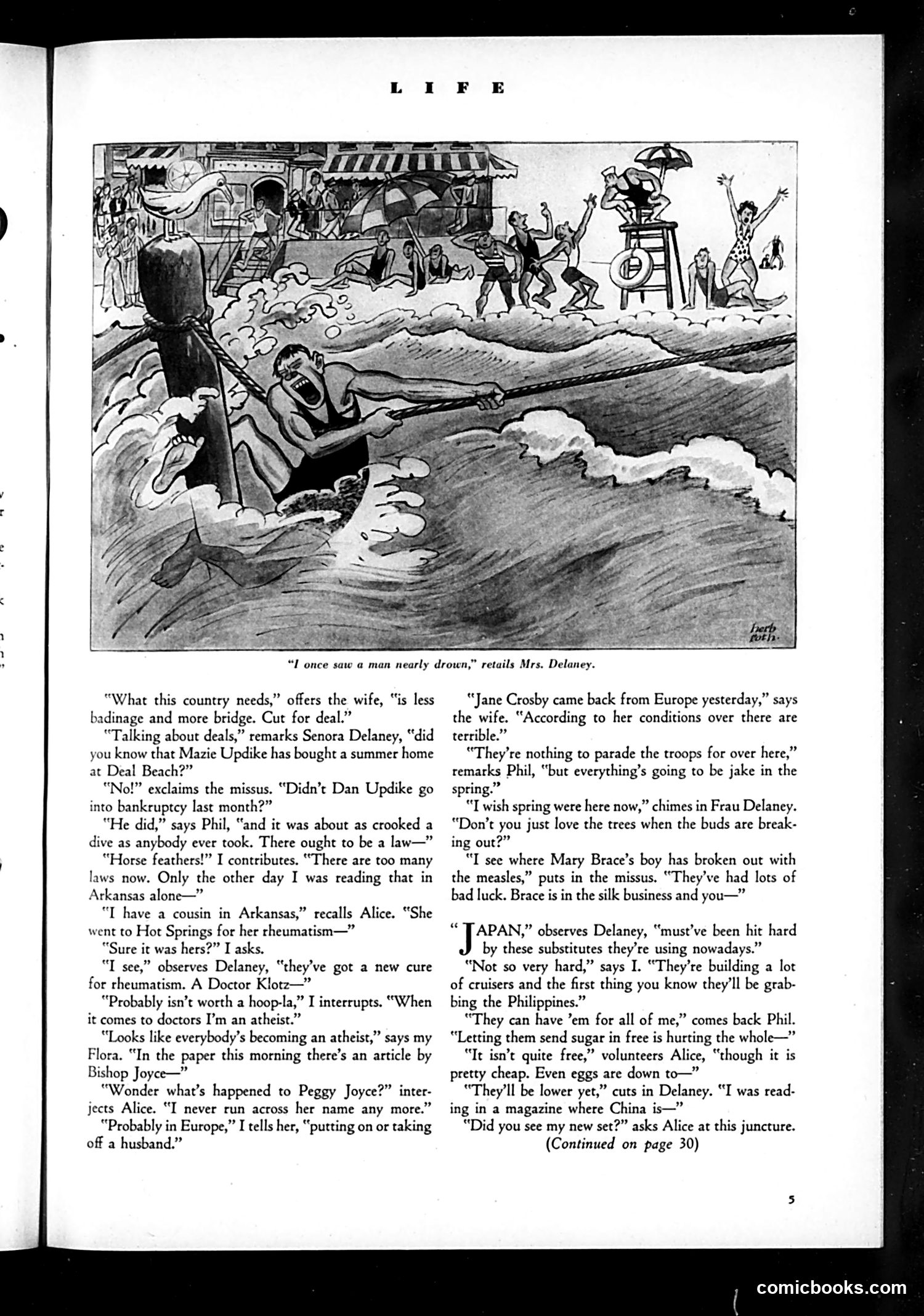
# Analysis of Life Magazine Page This page features a cartoon and accompanying gossip column showcasing early 20th-century American social commentary. The cartoon depicts a man nearly drowning while beachgoers enjoy themselves above—illustrating the disconnect between leisure and crisis, likely satirizing class indifference or social apathy. The column comprises domestic chatter among women discussing neighbors: failed business ventures (Dan Updike's bankruptcy), travel (Hot Springs for rheumatism), medical treatments, and romantic gossip. References to "Japan," building cruisers, and the Philippines suggest contemporary imperial anxieties. The satire targets the trivial preoccupations of the leisure class—bridge games and rheumatism cures—while global affairs proceed. The tone is characteristically arch, mocking both provincial small-talk and the speakers' obliviousness to larger world events.
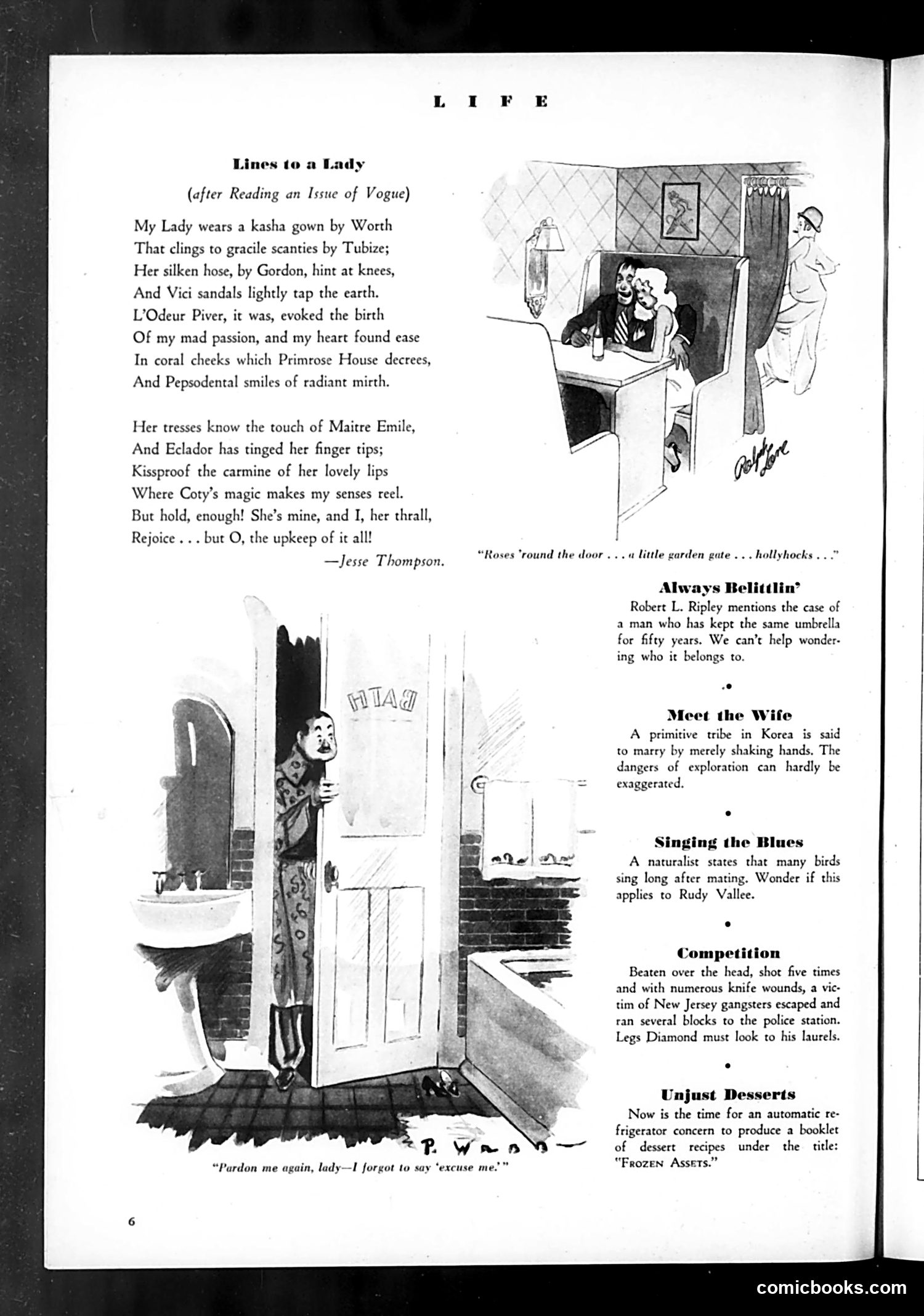
# Analysis: Life Magazine Page (Fashion & Humor Section) The page features "Lines to a Lady" by Jesse Thompson, a poem celebrating a fashionable woman wearing luxury brands (Worth gown, Tubize fabrics, Gordon stockings, Vici sandals, Primrose House cosmetics, Pepsodent toothpaste). The poem humorously catalogs high-end products while affecting romantic passion. Two cartoons accompany this: 1. **Upper right**: A couple in what appears to be a bedroom or dressing room, with suggestive positioning and the caption about "roses 'round the door." 2. **Lower left**: A woman in a bathtub, with a man peering from behind a door, captioned "Pardon me again, lady—I forgot to say 'excuse me.'" Both cartoons use bathroom/bedroom settings for mild innuendo—typical of 1920s-era Life magazine's sophisticated humor targeting middle-class readers.
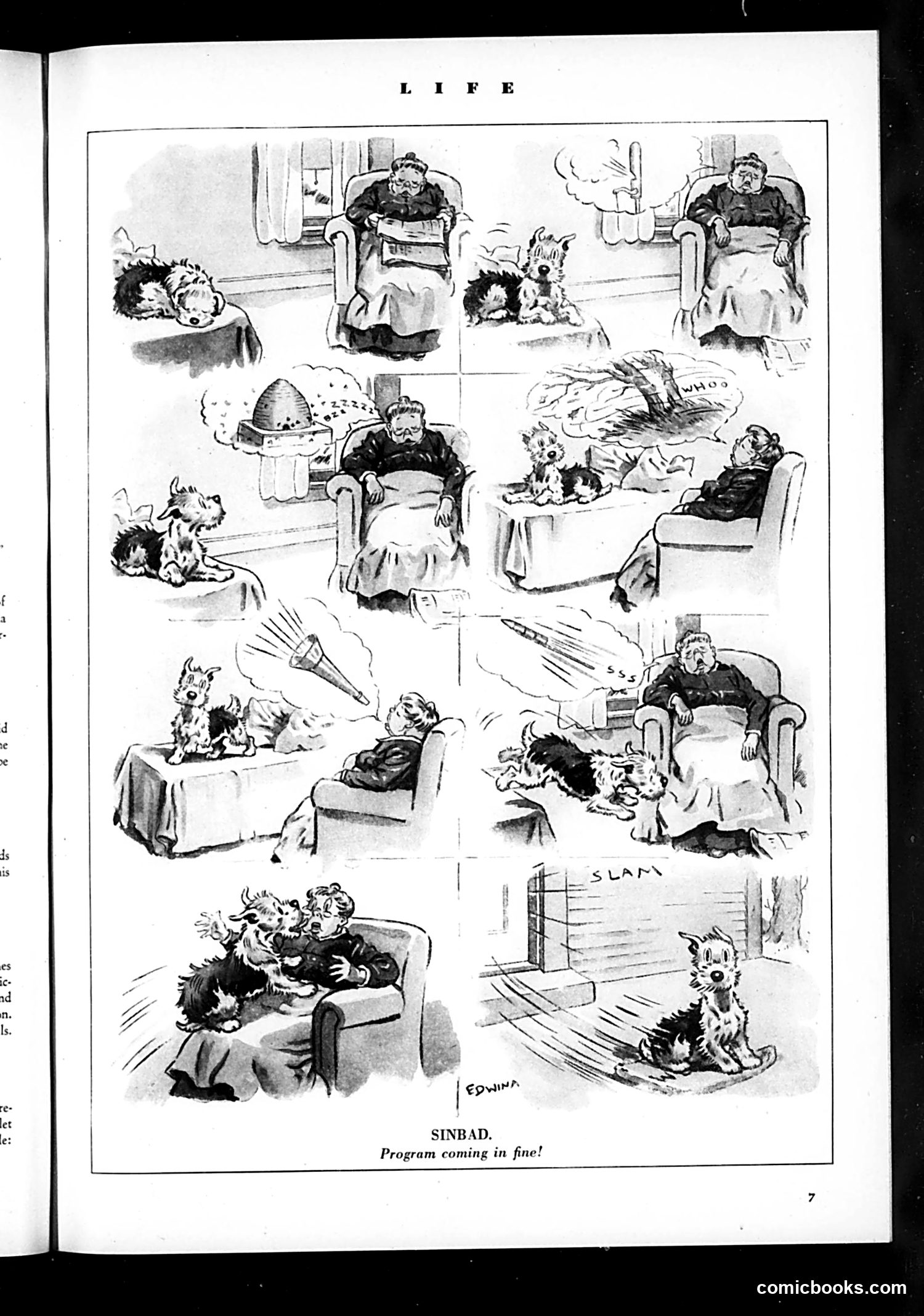
# Analysis of "Sinbad" Cartoon This is a comic strip satirizing domestic life with a woman and small dogs. The repeated sequence shows an elderly woman in a chair with mischievous terriers causing increasingly chaotic situations—jumping on furniture, creating mess, and generally disrupting the household. The caption "Sinbad. Program coming in fine!" suggests she's listening to a radio program (likely the adventure serial "Sinbad") while the dogs wreak havoc around her. The humor lies in the contrast between her calm attention to entertainment and the destructive animal antics surrounding her. This reflects early 20th-century American humor about domestic pets as uncontrollable household nuisances, played for visual comedy through the sequential panel format.
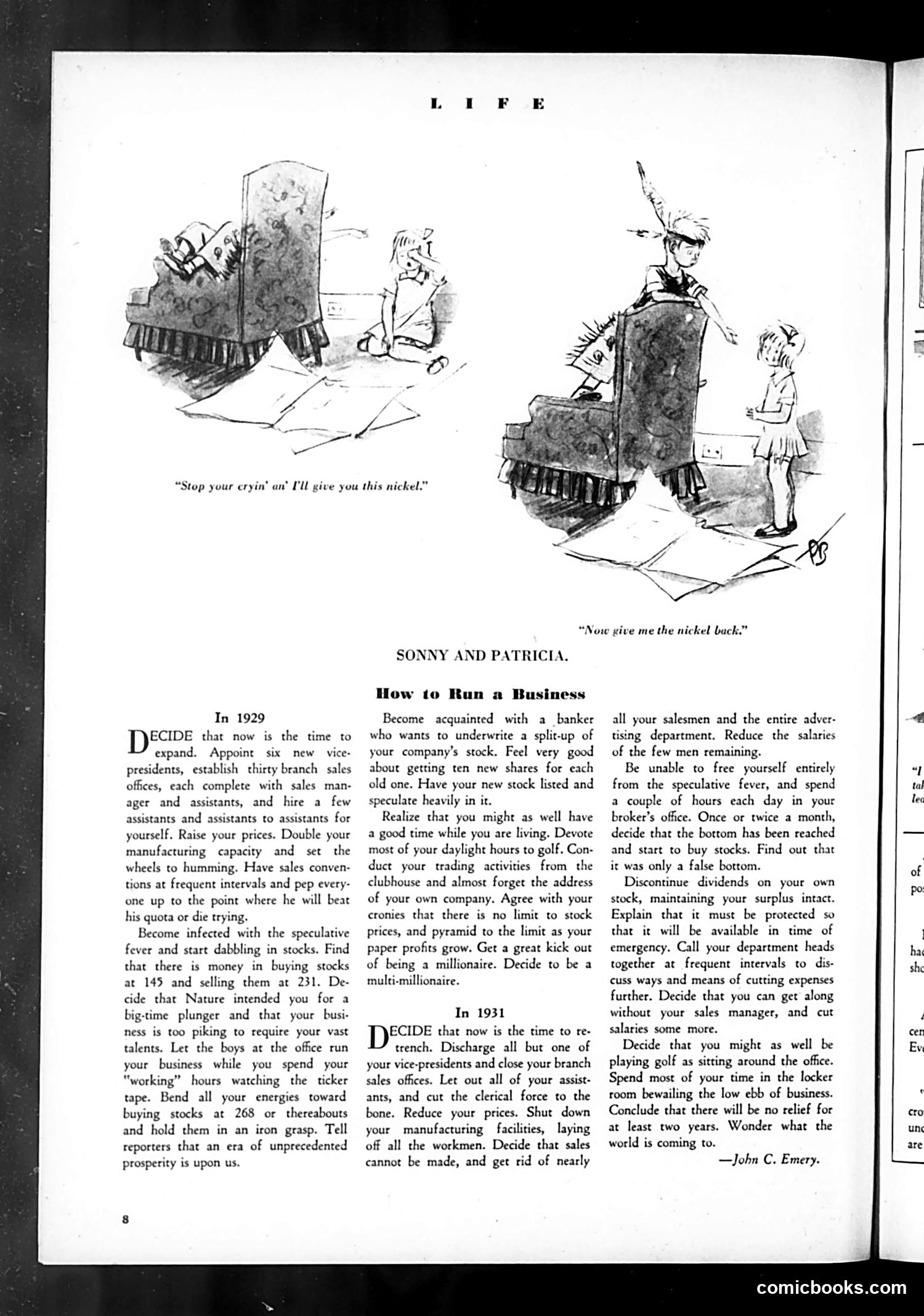
# Analysis of Life Magazine Page This page contains two cartoon panels titled "Sonny and Patricia" showing a child negotiating with an adult (likely a parent) over money. The first panel depicts the child crying, saying "Stop your cryin' an' I'll give you this nickel." The second shows the child returning the nickel, saying "Now give me the nickel back." The satire mocks childhood manipulation tactics and parental weakness—the joke being the child's successful strategy of theatrical distress to extract payment, then reclaiming the bribe. Below the cartoon is "How to Run a Business," a satirical article with separate 1929 and 1931 sections. It mocks business practices during the economic boom and subsequent Great Depression collapse through mock-advice: expanding recklessly, stock speculation, and then the opposite during the crash—cutting staff, closing offices, and abandoning workers.
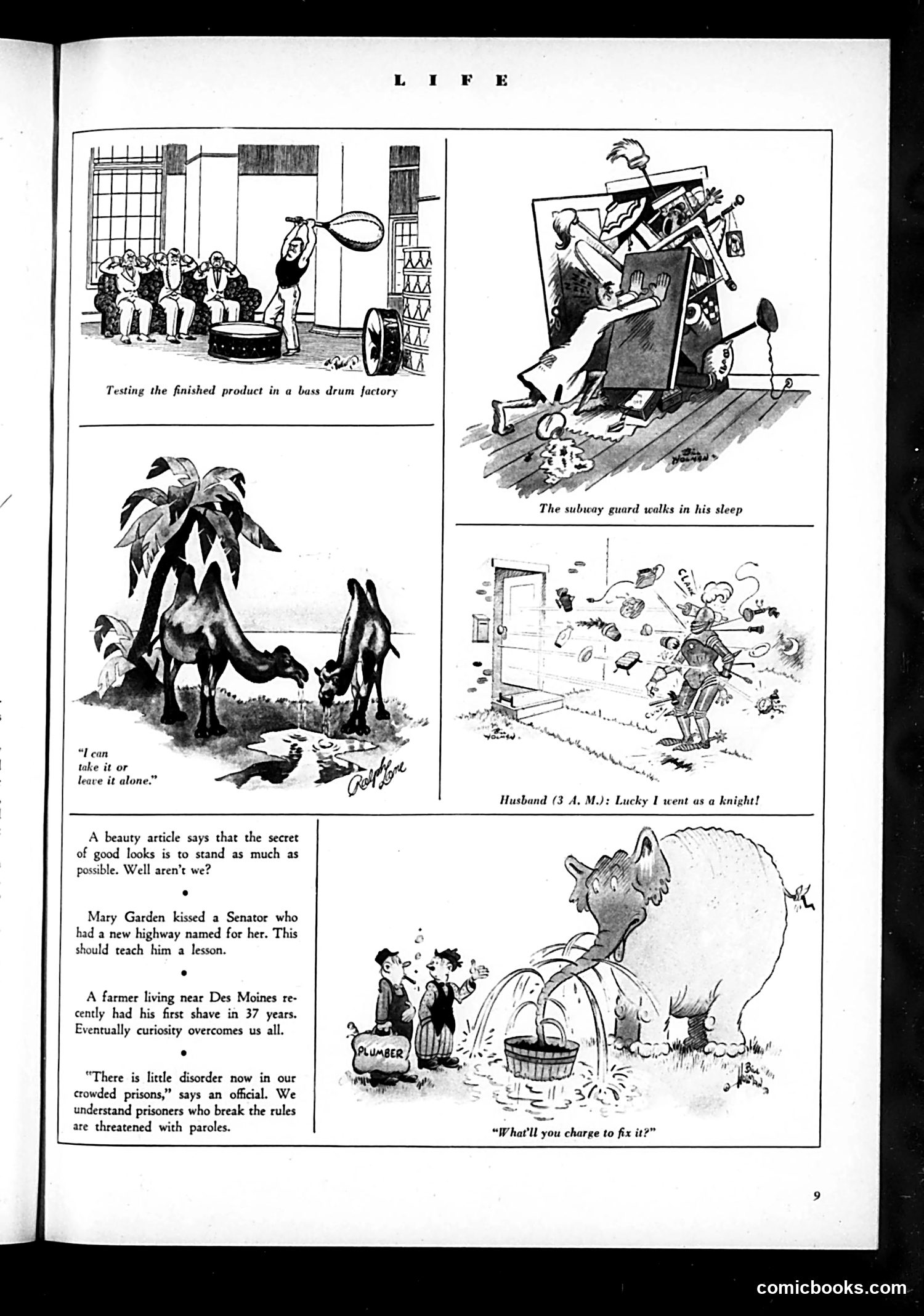
# Analysis of Life Magazine Page 9 This page contains six separate humor cartoons and brief satirical items typical of Life magazine's format: 1. **Bass drum factory scene**: Tests a finished product by having someone play it violently while seated figures observe—satirizing product quality testing. 2. **Subway guard sleeping**: Shows a guard asleep while chaos erupts around him—mocking negligent security. 3. **"I can take it or leave it alone"**: A domestic scene with unclear specific reference, though the quoted phrase suggests someone's indifference. 4. **Husband as knight**: Wife sends husband out unprepared, satirizing modern marriage dynamics. 5. **Elephant plumber**: A humorous scenario about repair costs. The text items mock beauty standards, political corruption (Mary Garden/Senator reference), rural life, and prison conditions. These represent typical 1920s-era American social satire targeting contemporary manners and politics.
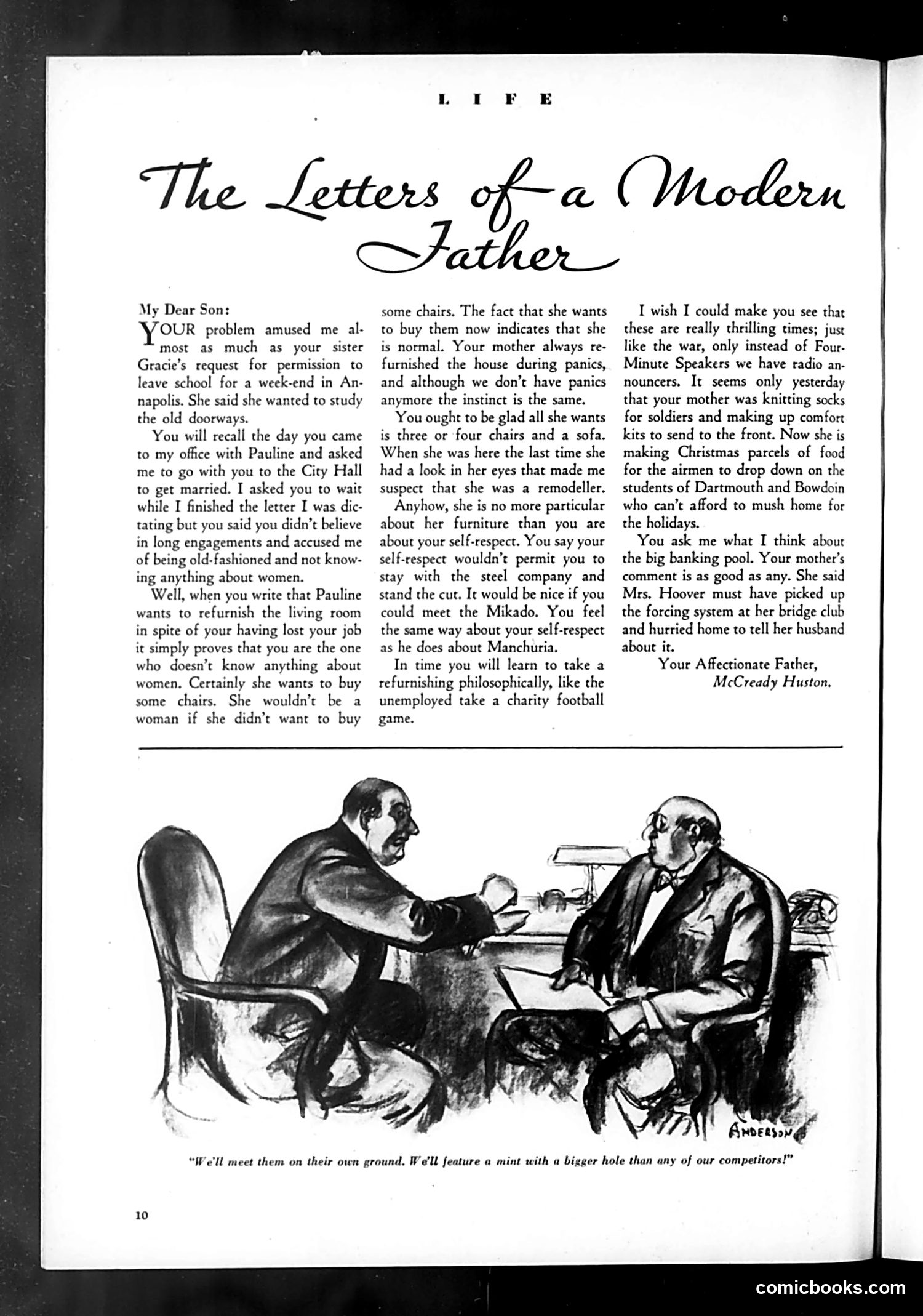
# "The Letters of a Modern Father" This satirical advice column depicts a father (McCready Huston) responding to his son's complaint about the son's fiancée Pauline wanting to refurnish their living room. The father's response is gently mocking: he argues that the son's objection reveals ignorance about women. The father suggests that wanting to improve the home is normal feminine behavior, and the son should accept it—even comparing refusing her wishes to being "old-fashioned." The accompanying cartoon shows two businessmen in discussion, with one saying they'll "meet them on their own ground" and "feature a mint with a bigger hole than any of our competitors!"—likely satirizing absurd corporate competition strategies. The piece humorously skewers both masculine stubbornness about domestic matters and commercial absurdity.