A complete issue · 36 pages · 1931
Life — September 4, 1931
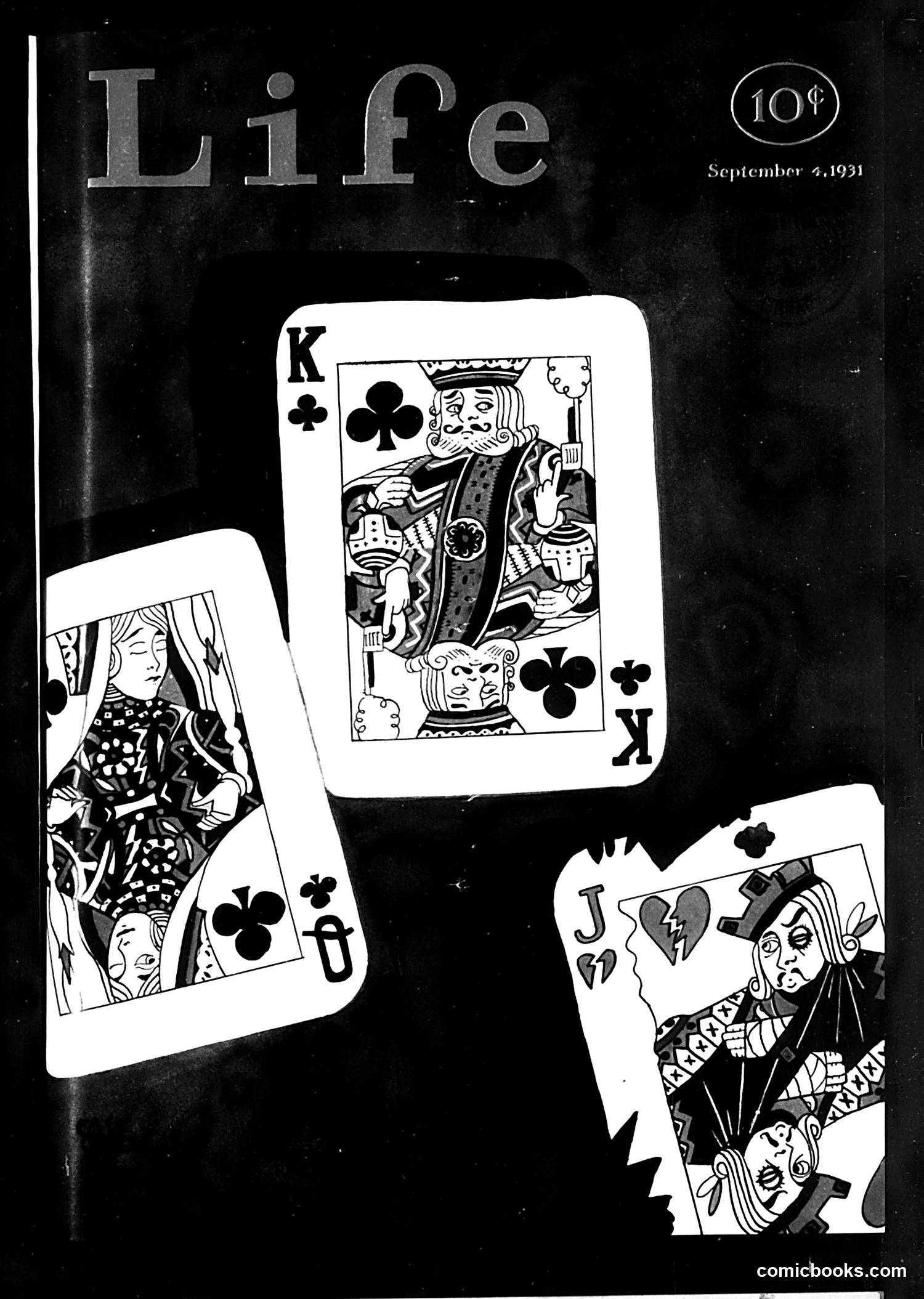
# Life Magazine Cover - September 4, 1931 This cover features playing cards arranged on a black background, displaying clubs suit cards: a Queen, King, and Jack. The artwork is a straightforward visual pun playing on the magazine's title "Life." The cover appears to be purely illustrative rather than political commentary. It's a clever graphic design using traditional playing card imagery—the ornate royal figures typical of standard decks—to create visual interest. The 10¢ price point indicates this was during the Great Depression era. Without additional context or OCR text content describing specific satirical targets, this appears to be primarily a design-focused cover emphasizing the aesthetic appeal of classic card illustrations rather than containing political or social satire.
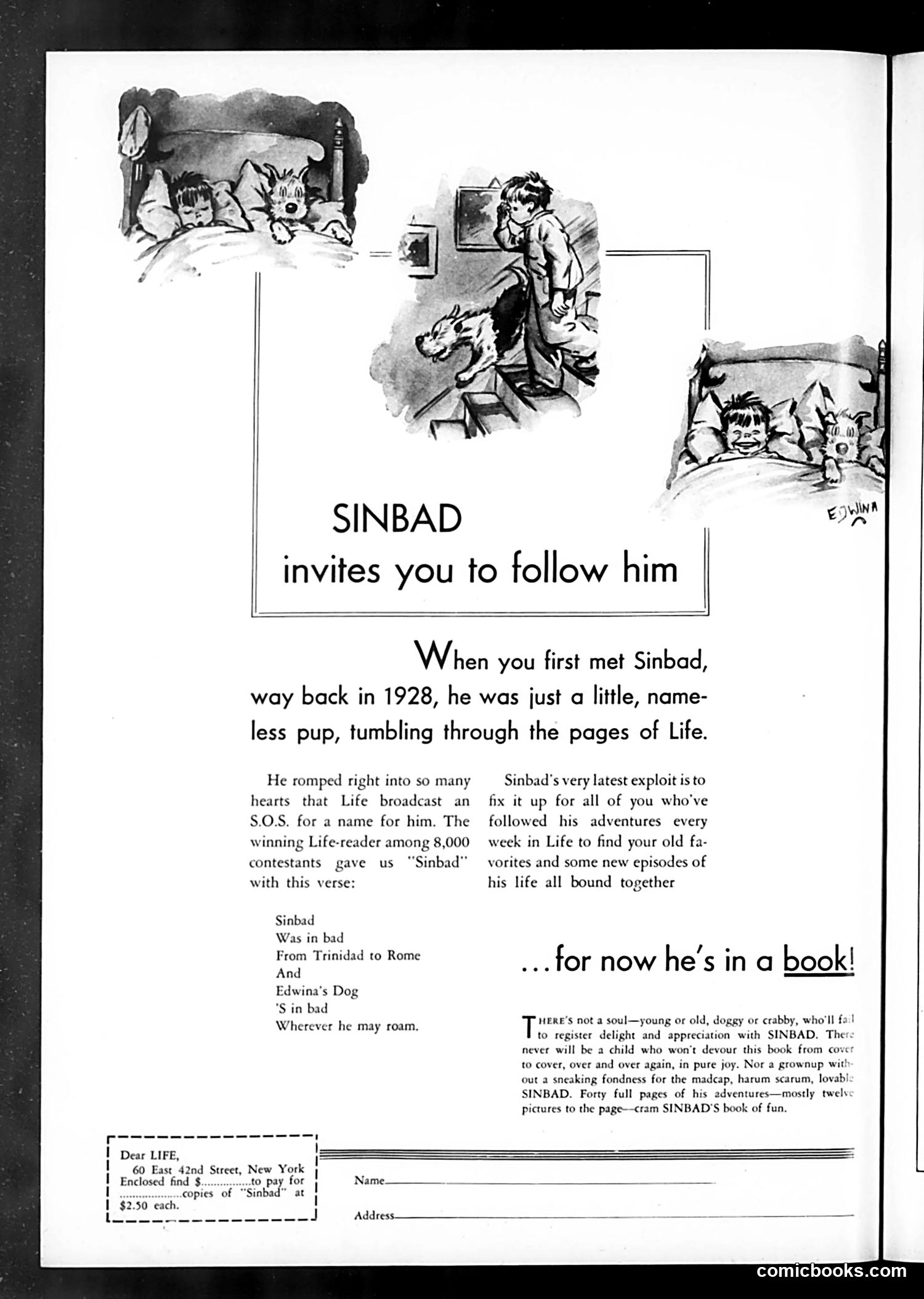
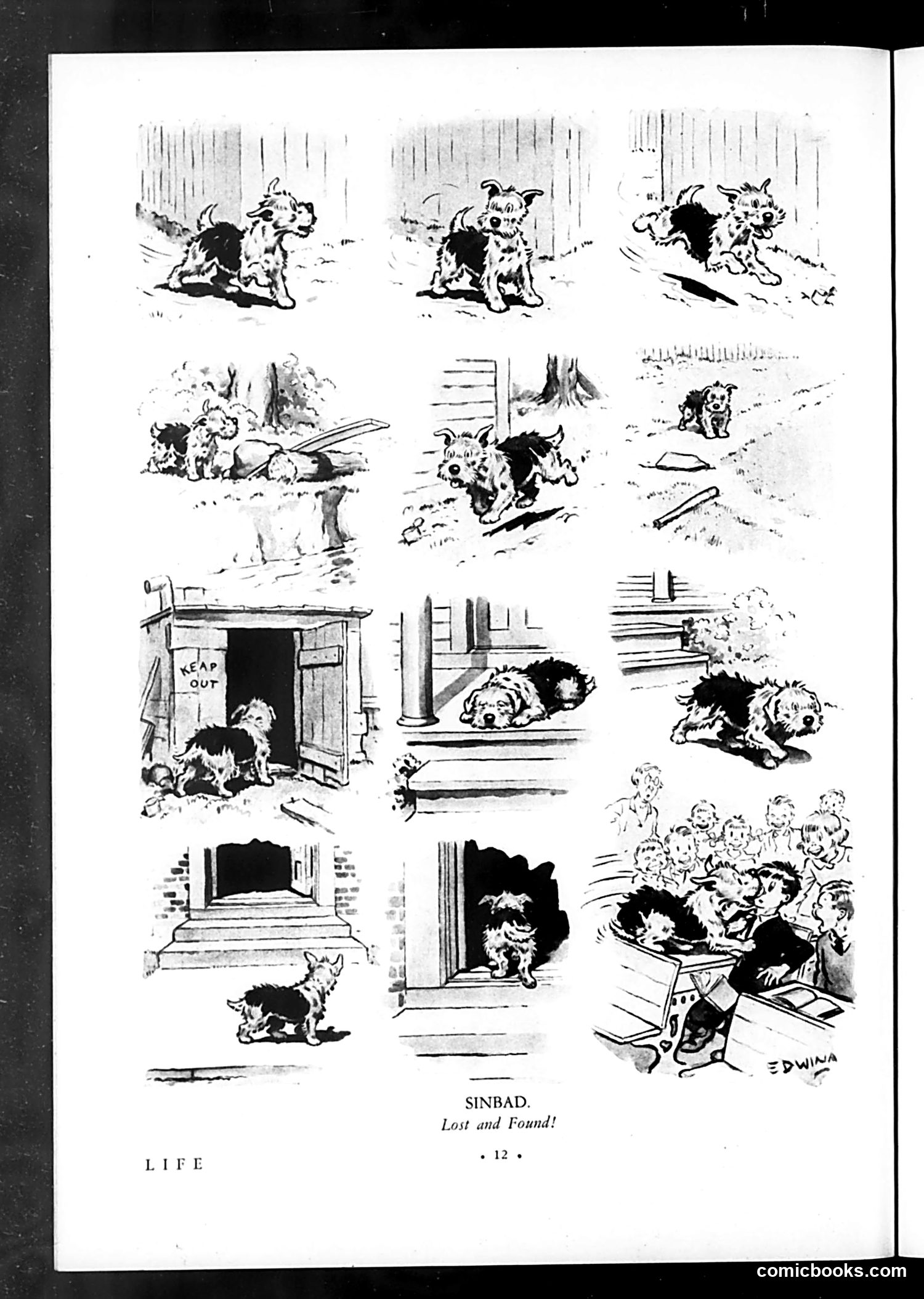
# Analysis This is a **book advertisement**, not political satire. The page promotes "Sinbad," a children's book featuring illustrations of a mischievous dog character. The ad references Sinbad's origins in *Life* magazine from 1928, when readers voted to name an unnamed puppy character appearing in the publication. The cartoon panels show the dog's various adventures—getting into bed with a child, interacting with people, and causing minor chaos. The advertisement appeals to *Life* readers' nostalgia, inviting them to purchase a compiled book collecting Sinbad's adventures. At $2.50 per copy, it promises "forty full pages" of "mostly twelve-picture[s] to the page." This reflects early 20th-century merchandising: converting popular magazine content into bound books for commercial sale.
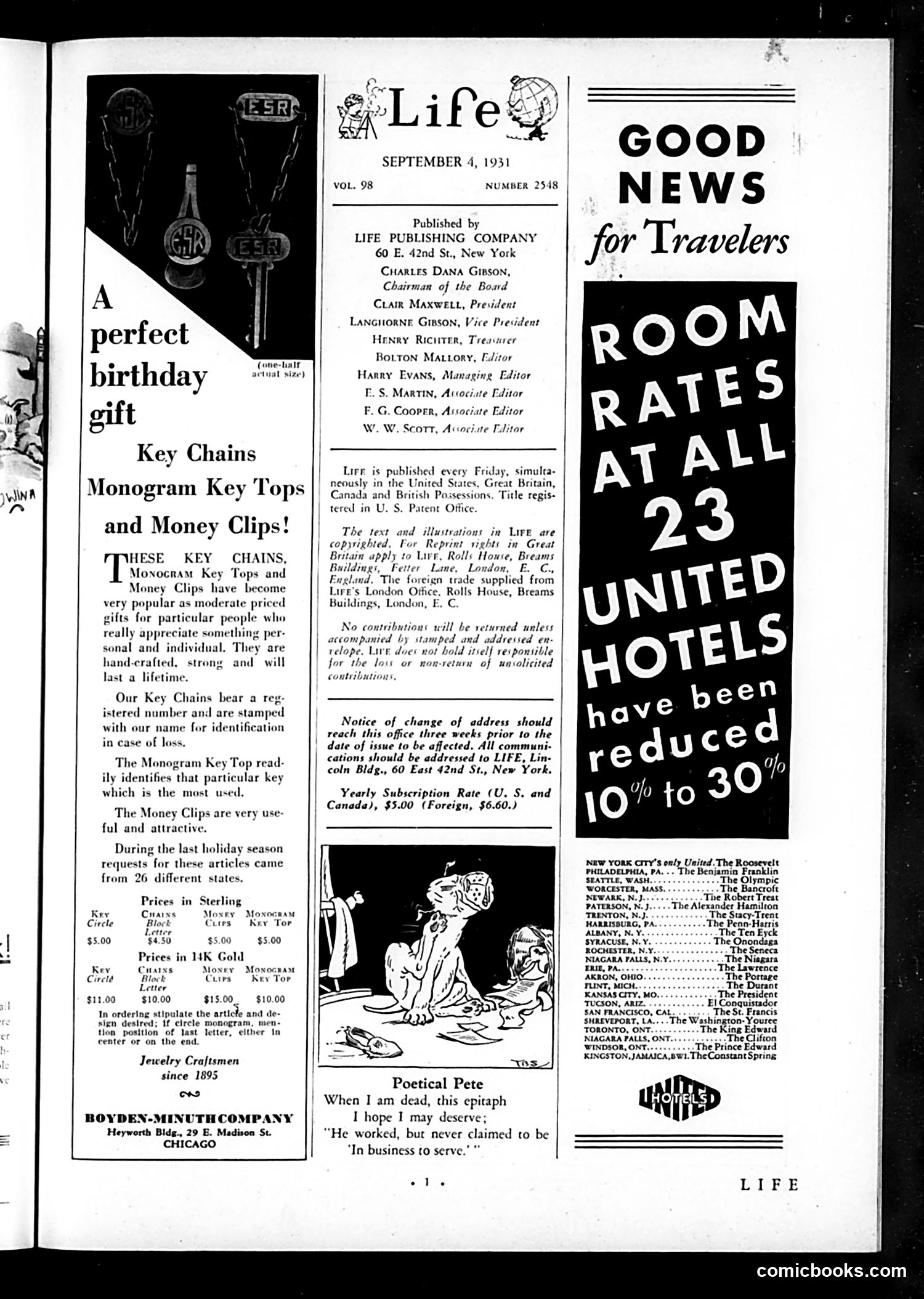
# "Poetical Pete" Cartoon Analysis This page is primarily **advertising and masthead content** from Life magazine (September 4, 1931). The main cartoon, titled "Poetical Pete," depicts a dog sitting with an anthropomorphic figure, likely the dog's owner or a vagrant character. The cartoon illustrates Pete's epitaph: "He worked, but never claimed to be / In business to serve." The joke appears to be **satirical commentary on work ethic and business cynicism during the Great Depression era**—contrasting honest labor with the period's widespread business failures and fraud. Pete's epitaph humorously suggests he was content with simple work without pretentious claims about serving others, a mild jab at corporate hypocrisy common to 1930s satire. The remainder of the page contains travel advertisements and publication information.
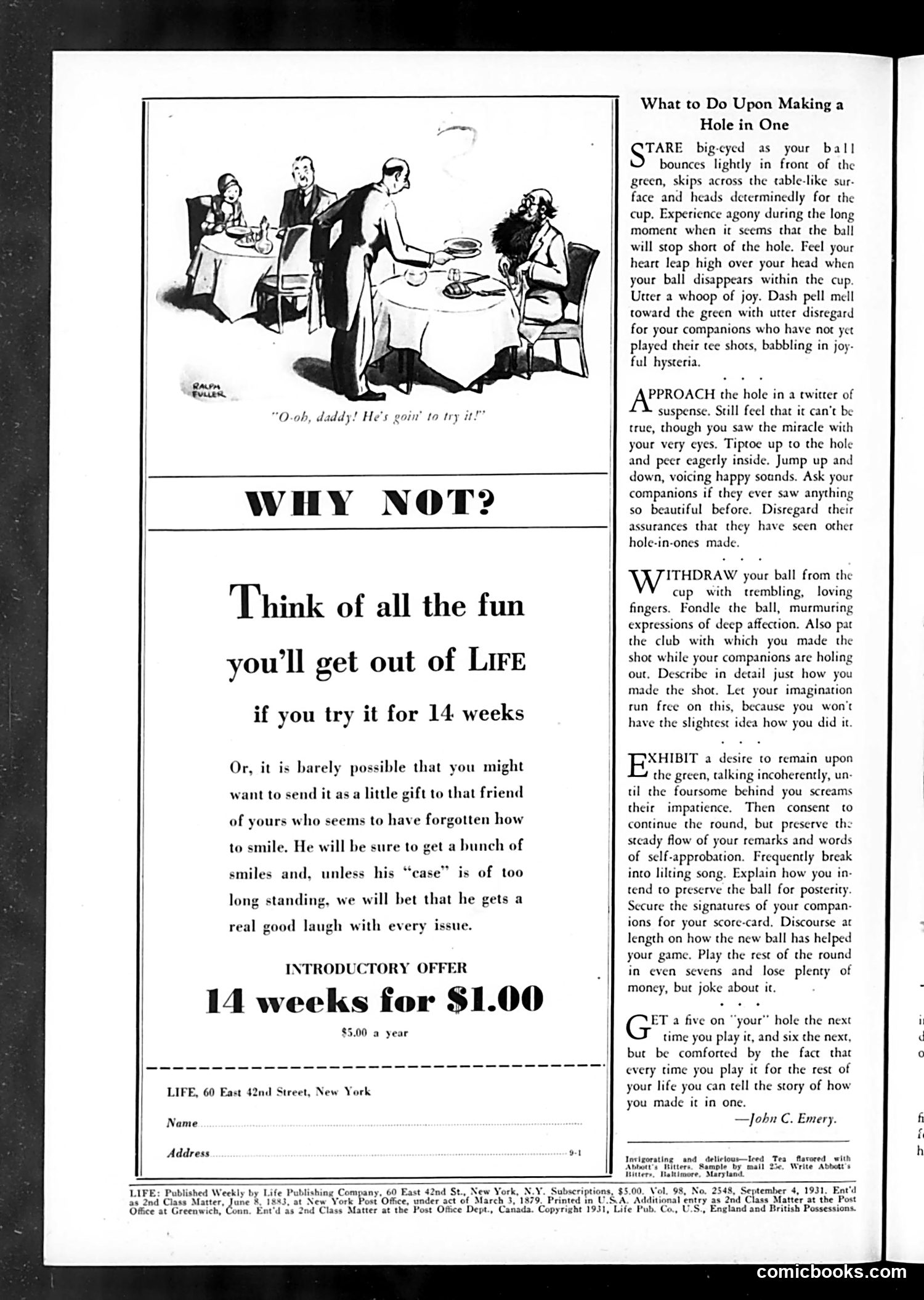
# Analysis This page is primarily an **advertisement for LIFE magazine itself**, not political satire. The central cartoon shows well-dressed diners at a restaurant table, with the caption "O oh, daddy! He's goin' to try it!" The joke appears to reference golf's hole-in-one—a rare achievement. The ad promotes a 14-week subscription for $1.00, using the hole-in-one as an extended metaphor: readers will experience "fun" and "life" if they subscribe. The accompanying article "What to Do Upon Making a Hole in One" humorously describes the emotional and social spectacle of achieving this golf feat. The satire is gentle and self-promotional rather than political—it's LIFE magazine marketing itself through relatable humor about golf culture and social aspiration common to the magazine's middle-to-upper-class readership.
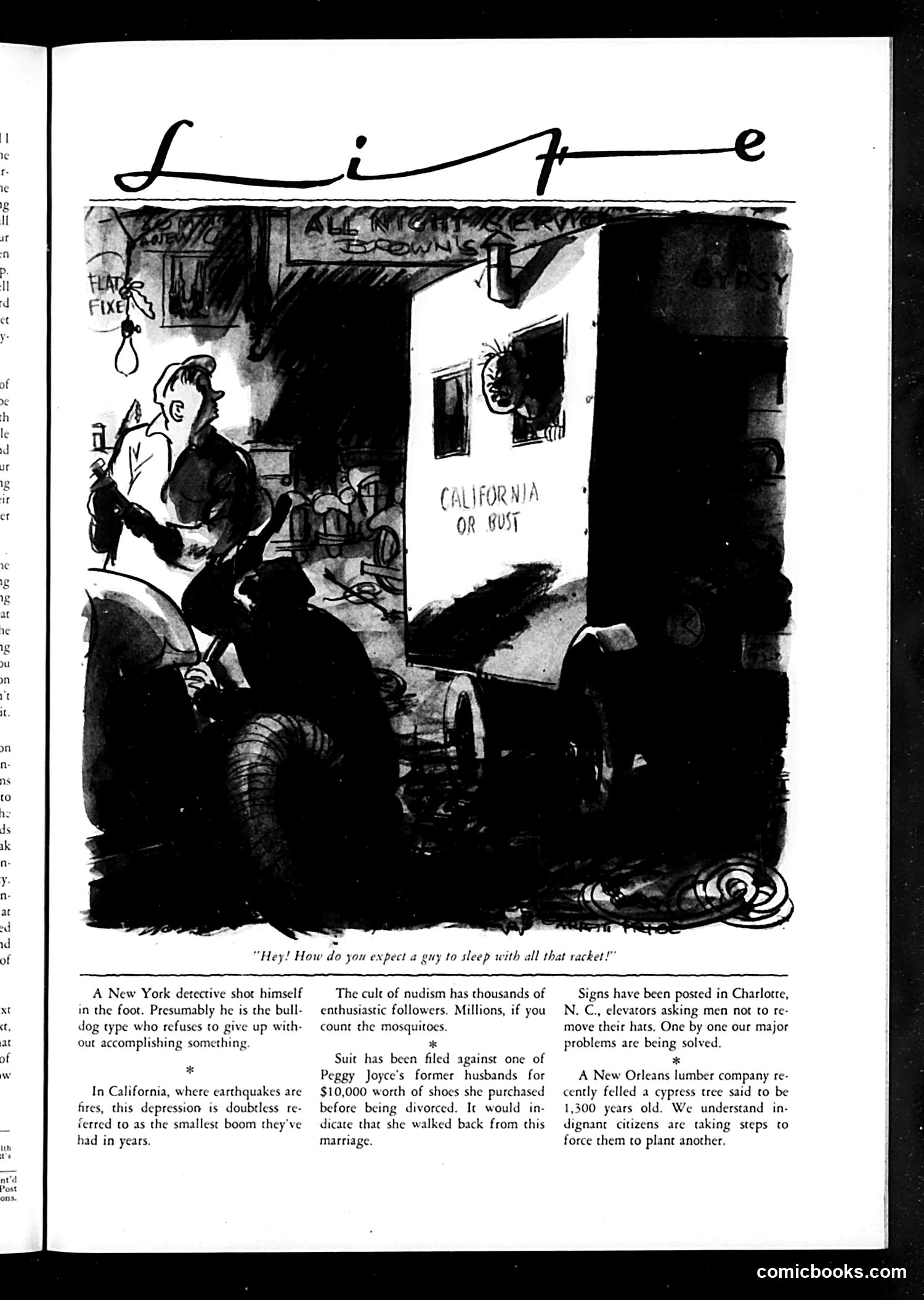
# Analysis of "Life" Magazine Page **The Main Cartoon:** The illustration depicts two men in what appears to be a seedy room with a noose visible. One man asks the other: "Hey! How do you expect a guy to sleep with all that racket?" The sign on the wall reads "CALIFORNIA OR BUST." **The Satire:** This cartoon satirizes the noise and chaos of the California Gold Rush or migration period. The dark humor suggests the desperation and dangerous conditions faced by those seeking fortune in California. The noose foreshadows potential suicide—a commentary on the often-grim reality behind the "California Dream" mythology. **Supporting Text:** The page includes brief news items about earthquakes in California (described as "the smallest boom"), a nudism cult, a detective's suicide, and Peggy Joyce's divorce suit—all contemporary scandals providing context for the era's social commentary.
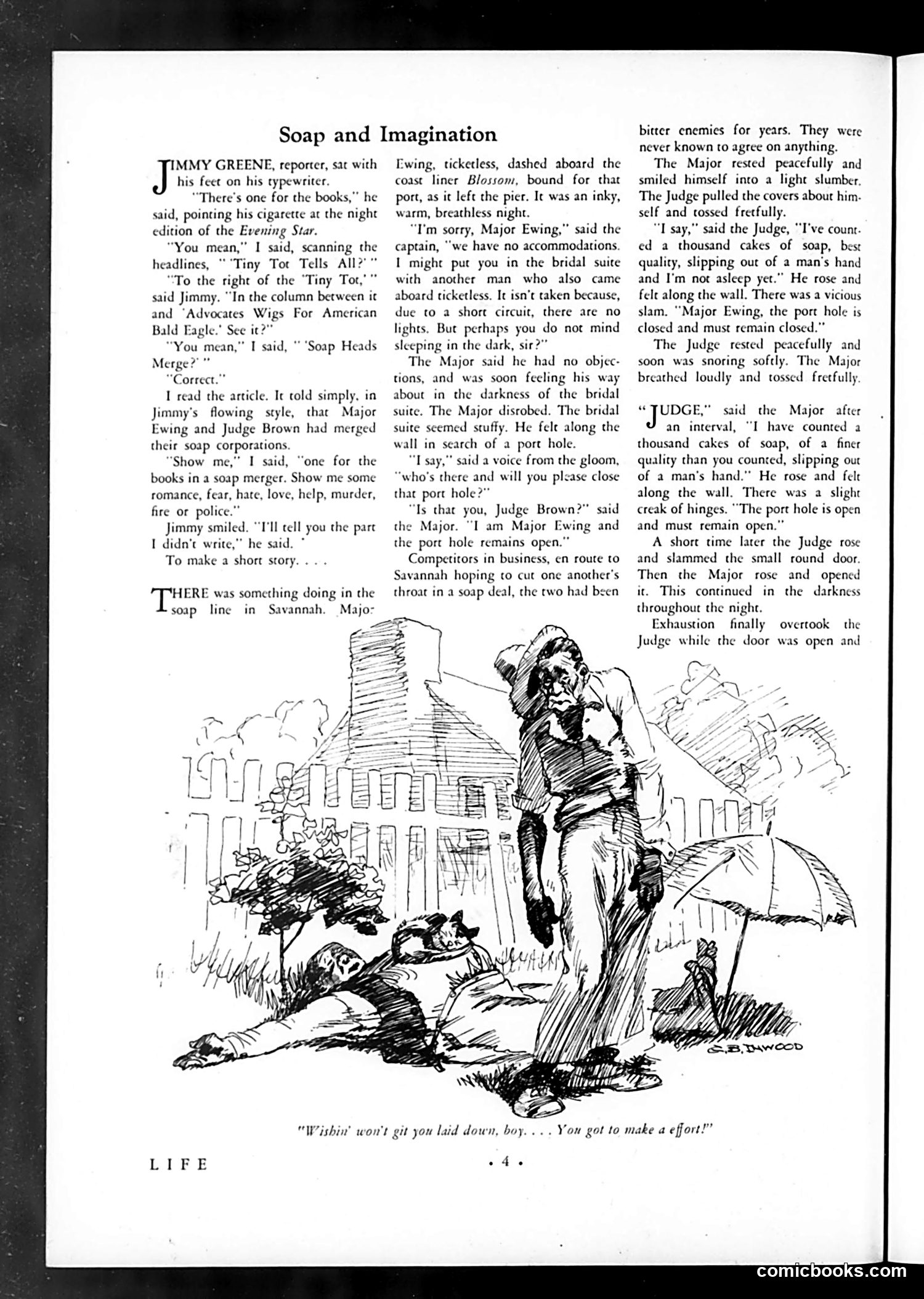
# "Soap and Imagination" Analysis This is a humorous story about Major Ewing and Judge Brown, who merged their soap corporations. The narrative describes their business rivalry and an awkward night aboard a ship (the *Blossom*) where they share inadequate accommodations—specifically a bridal suite and sleeping in darkness due to "no lights." The illustration shows a tall man struggling to keep another man (lying on the ground) from leaving through an open door, with the caption: "Wishin' won't git you laid down, boy. . . . You got to make a effort!" The joke appears to satirize both business competition and the absurd situation of forced proximity. The humor relies on innuendo about the cramped quarters and the physical struggle depicted, typical of early-20th-century magazine comedy.
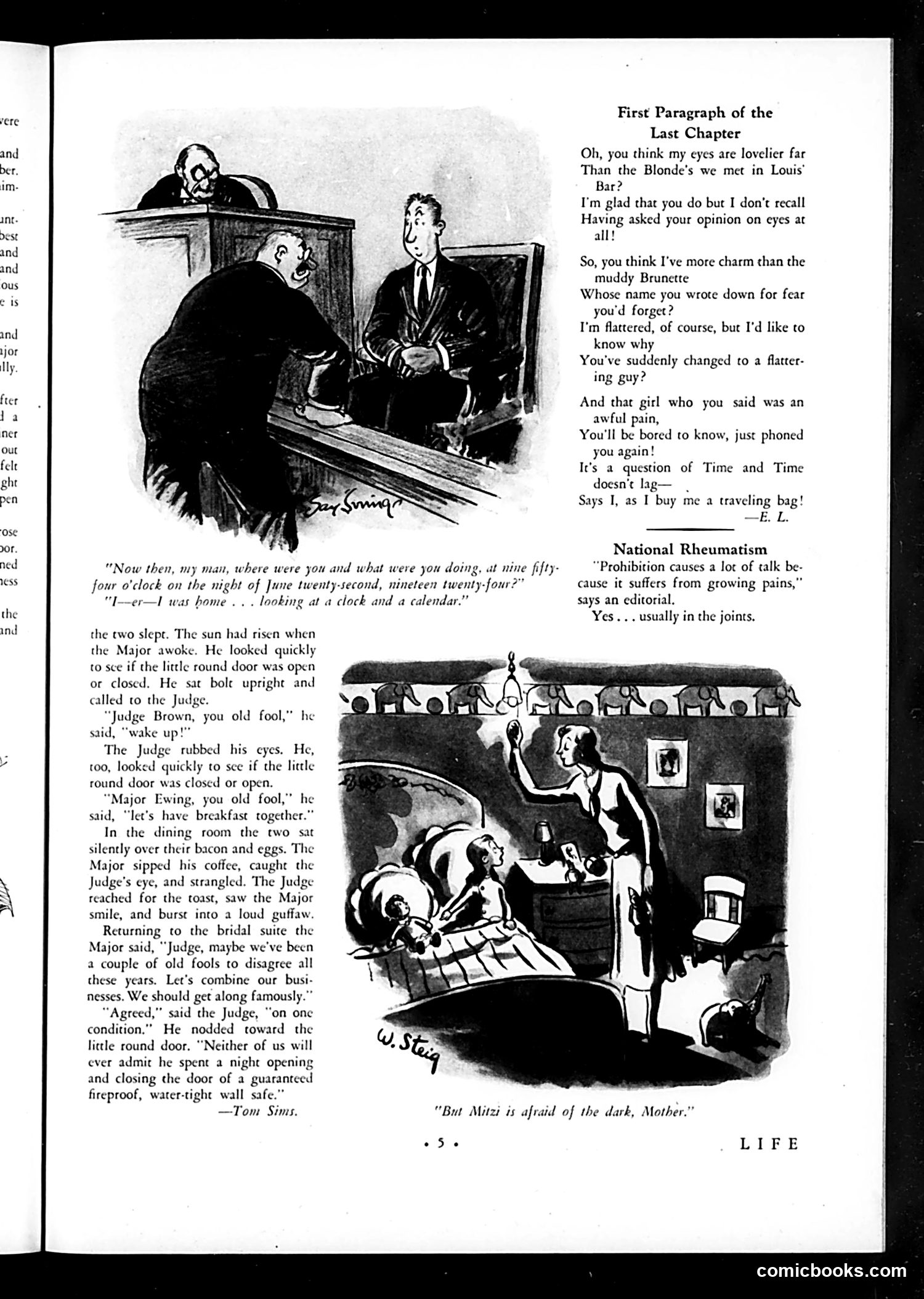
# Analysis of Life Magazine Page This page contains two distinct cartoons: **Top cartoon**: A courtroom scene where a judge questions a man about his whereabouts at a specific time. The humor appears to rely on the man's confused response about "looking at a clock and a calendar"—suggesting he's either lying or absurdly literal-minded when asked to account for his time. **Bottom cartoon**: Shows a mother and child in bed; the child says "But Mitzi is afraid of the dark, Mother." The joke plays on anthropomorphizing a pet (likely a dog or cat named Mitzi) as if it were a person needing reassurance—a gentle domestic humor about children attributing human emotions to animals. Both cartoons represent typical early-to-mid 20th century American domestic and legal satire found in Life magazine.
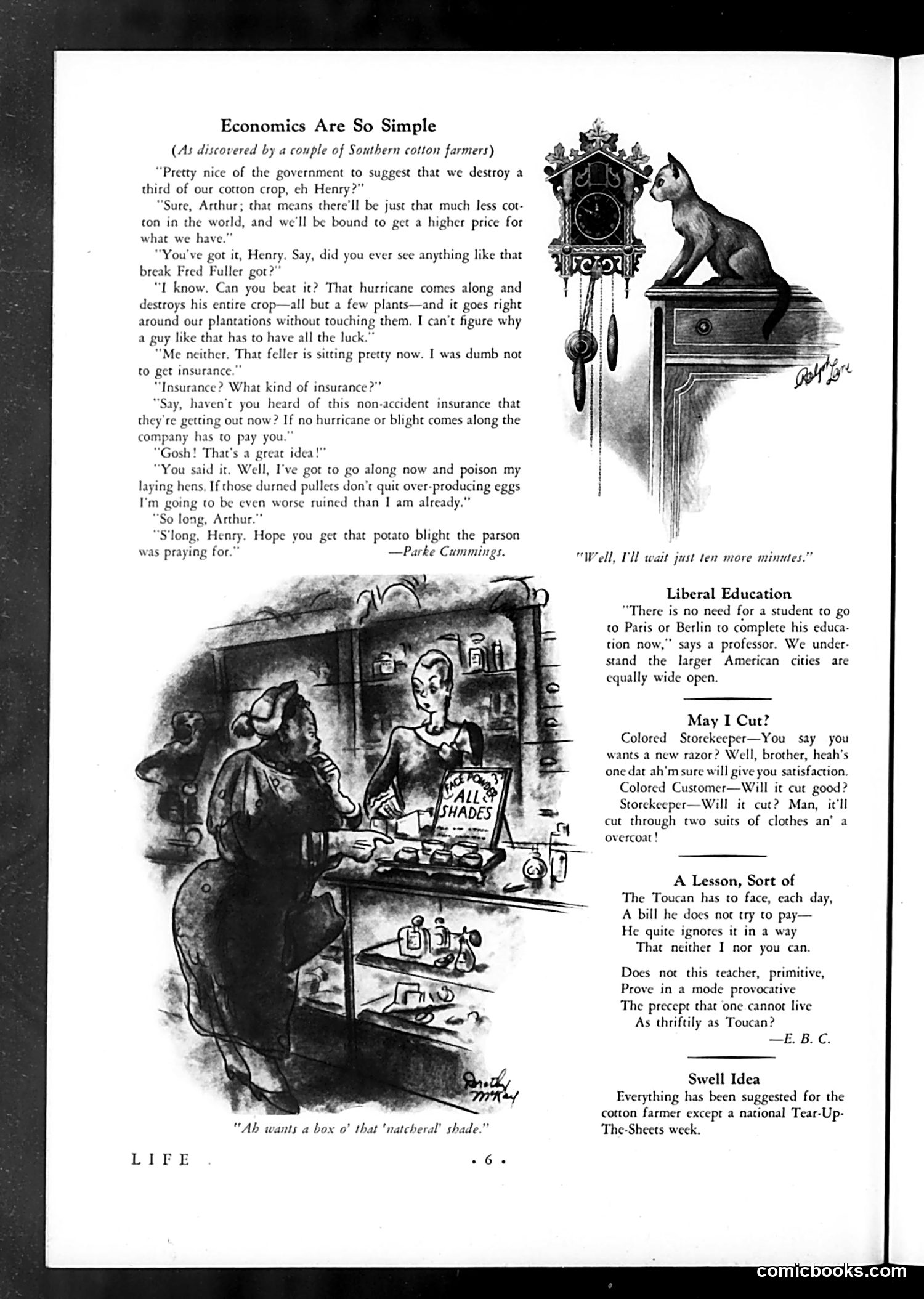
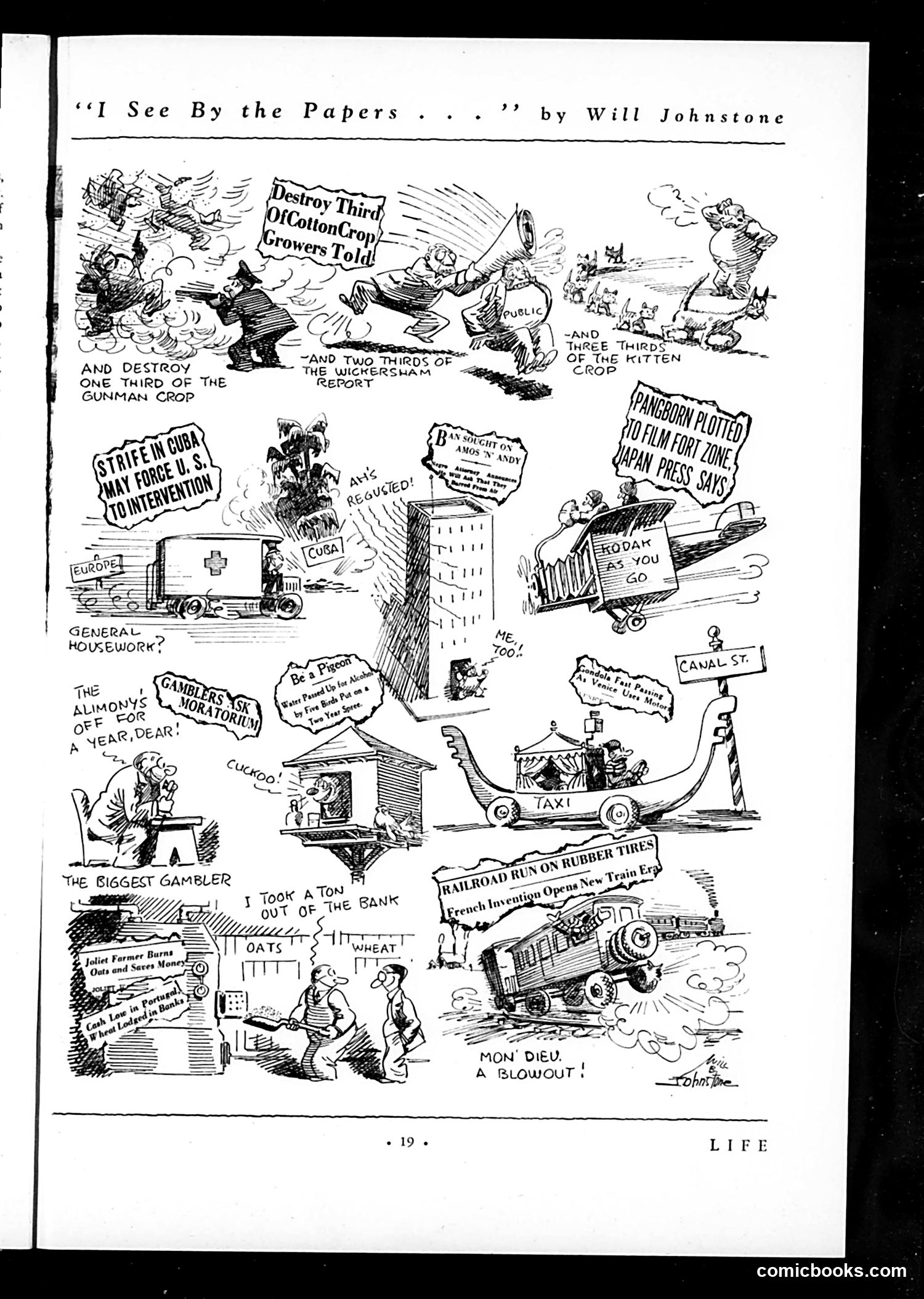
# "Economics Are So Simple" - Life Magazine Satire This page satirizes New Deal agricultural policy, likely from the 1930s. Two Southern cotton farmers discuss the government's crop destruction program (probably the Agricultural Adjustment Act), which paid farmers to reduce cotton production to raise prices. The satire mocks the policy's circular logic: destroying crops to create scarcity and higher prices seems absurd when one farmer gets wiped out by hurricane while another faces insurance schemes and egg-production problems—demonstrating how government intervention creates unintended consequences. The accompanying cartoons and brief humor pieces on education, barbering, and toucan economics reinforce the theme that "simple" economic solutions often backfire or ignore real human complexity.
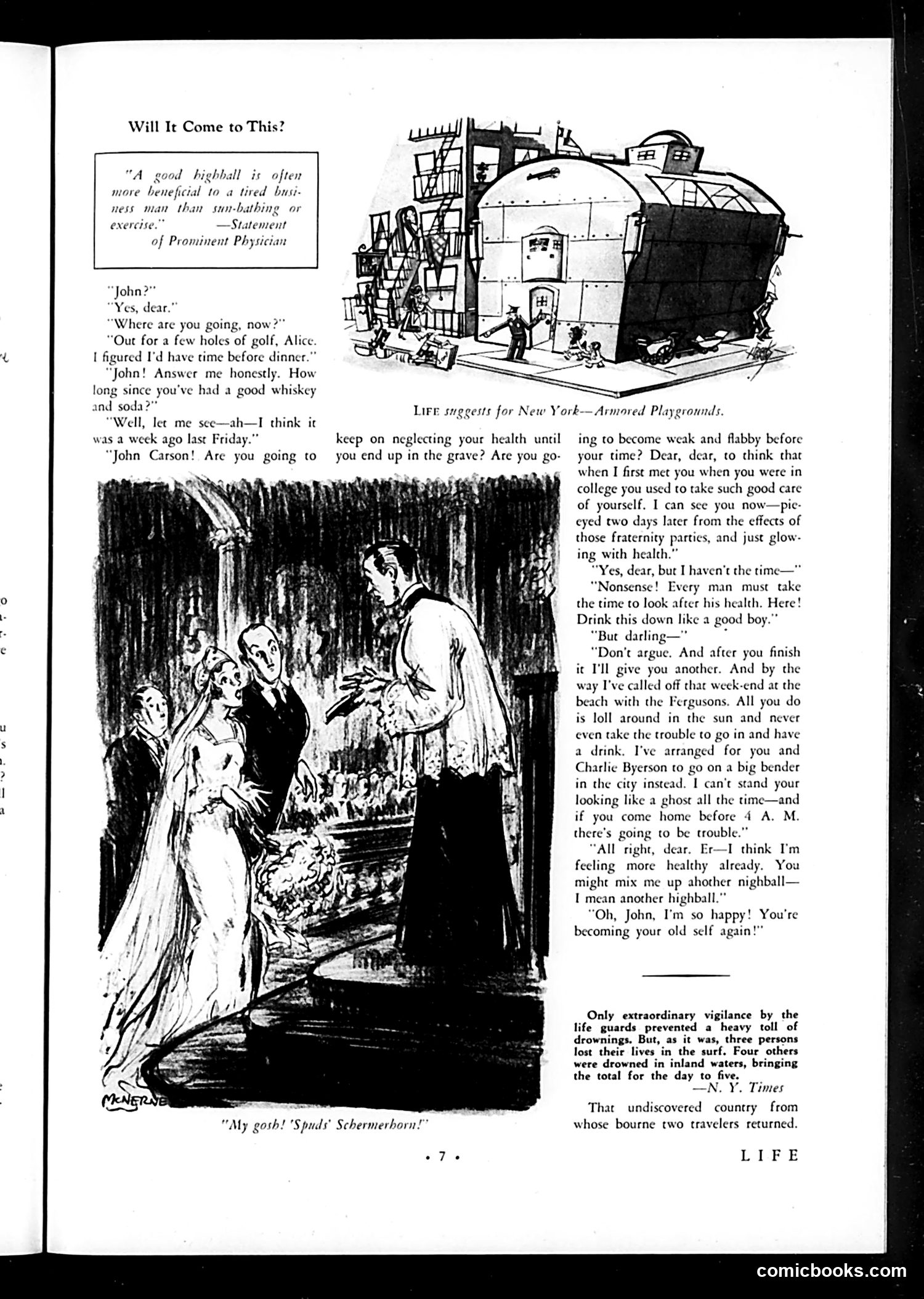
# Analysis of "Will It Come to This?" This page satirizes **health neglect among men**, particularly young professionals. The dialogue shows "John," a man who admits he hasn't had whiskey and soda "in a week ago last Friday"—suggesting he drinks regularly despite his wife's concerns about his health deteriorating. The cartoon (captioned "My gosh! 'Spuds' Schermerhorn!") depicts a dramatically weakened man, implying this is John's future if he continues neglecting health. The accompanying illustration labeled "Life suggests for New York—Armored Playgrounds" shows a protective capsule-like structure, sarcastically proposing that weak, sickly men need physical protection rather than simply exercising and maintaining health. The satire targets masculine negligence toward personal wellness and the era's broader health-consciousness movement.
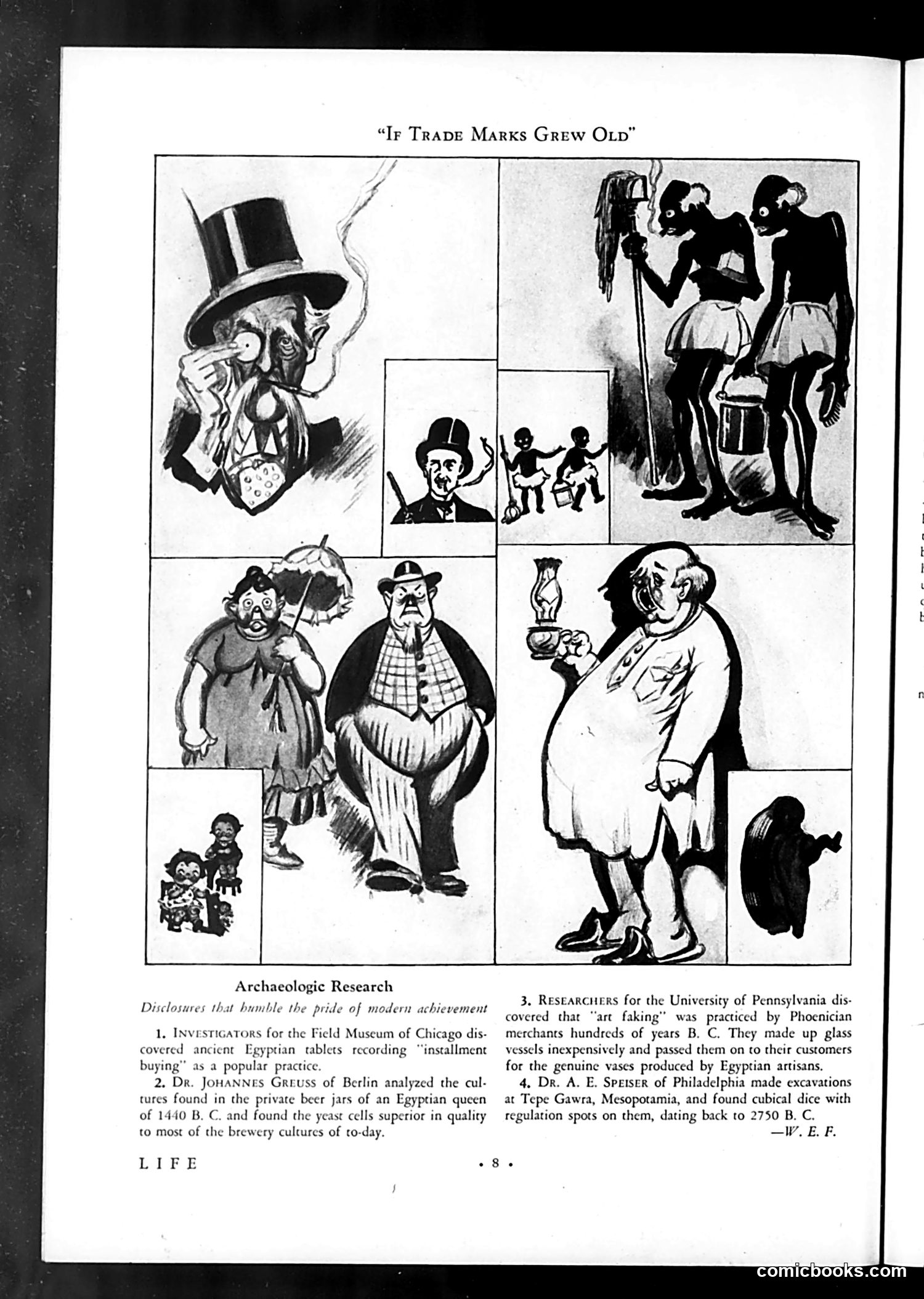
# "If Trade Marks Grew Old" This satirical comic imagines what would happen if famous commercial brands and logos aged like people. The progression shows iconic symbols deteriorating over time—a well-dressed gentleman trademark becoming increasingly decrepit, worn, and feeble in successive panels. The accompanying text discusses archaeological research into ancient "faking" practices, citing examples like Egyptian art forgery and beer production. The satire appears to comment on how established brands and commercial marks, once symbols of quality and pride, eventually become obsolete or lose their prestige as newer competitors emerge or consumer tastes change. The joke is that even the most successful trademarks are vulnerable to age and irrelevance—they cannot escape the human condition of decline.
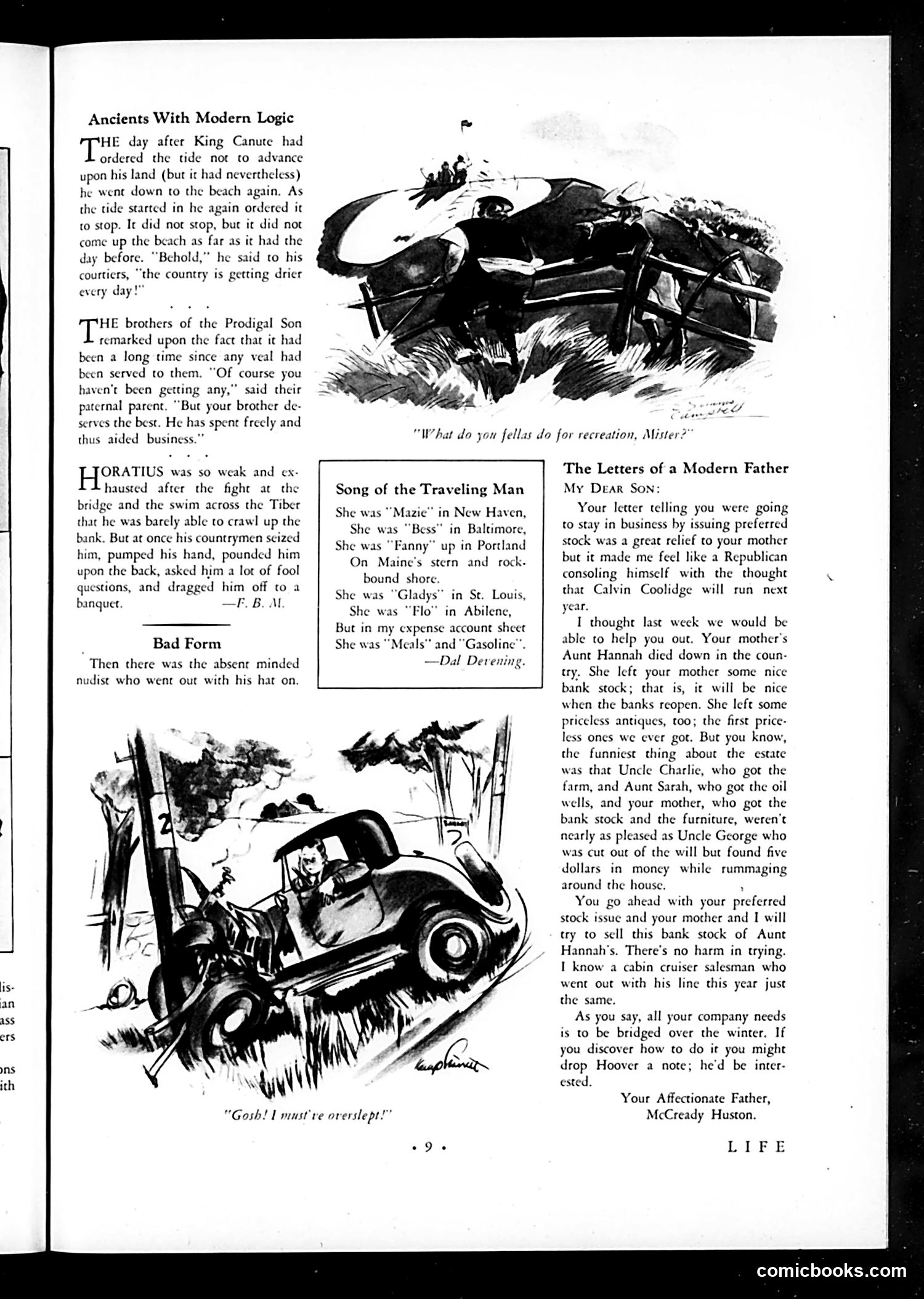
# Analysis of Life Magazine Page This page contains three separate pieces of light humor, not political cartoons. **"Ancients With Modern Logic"** presents brief anecdotes about historical figures applying contemporary reasoning—King Canute ordering the tide to stop, the Prodigal Son's brothers complaining about lack of wages, and Horatius exhausted after fighting at the bridge. **"Bad Form"** is a single-panel cartoon showing a car crash with the caption "Gosh! I must've overslept!"—humor based on absent-mindedness. **"Song of the Traveling Man"** is a poem listing nicknames a woman had in various cities. **"The Letters of a Modern Father"** presents advice about stock investments and family finances, treating serious economic matters with mild satire about inheritance and selling bank stock. The page reflects 1920s-30s domestic humor and economic preoccupations.
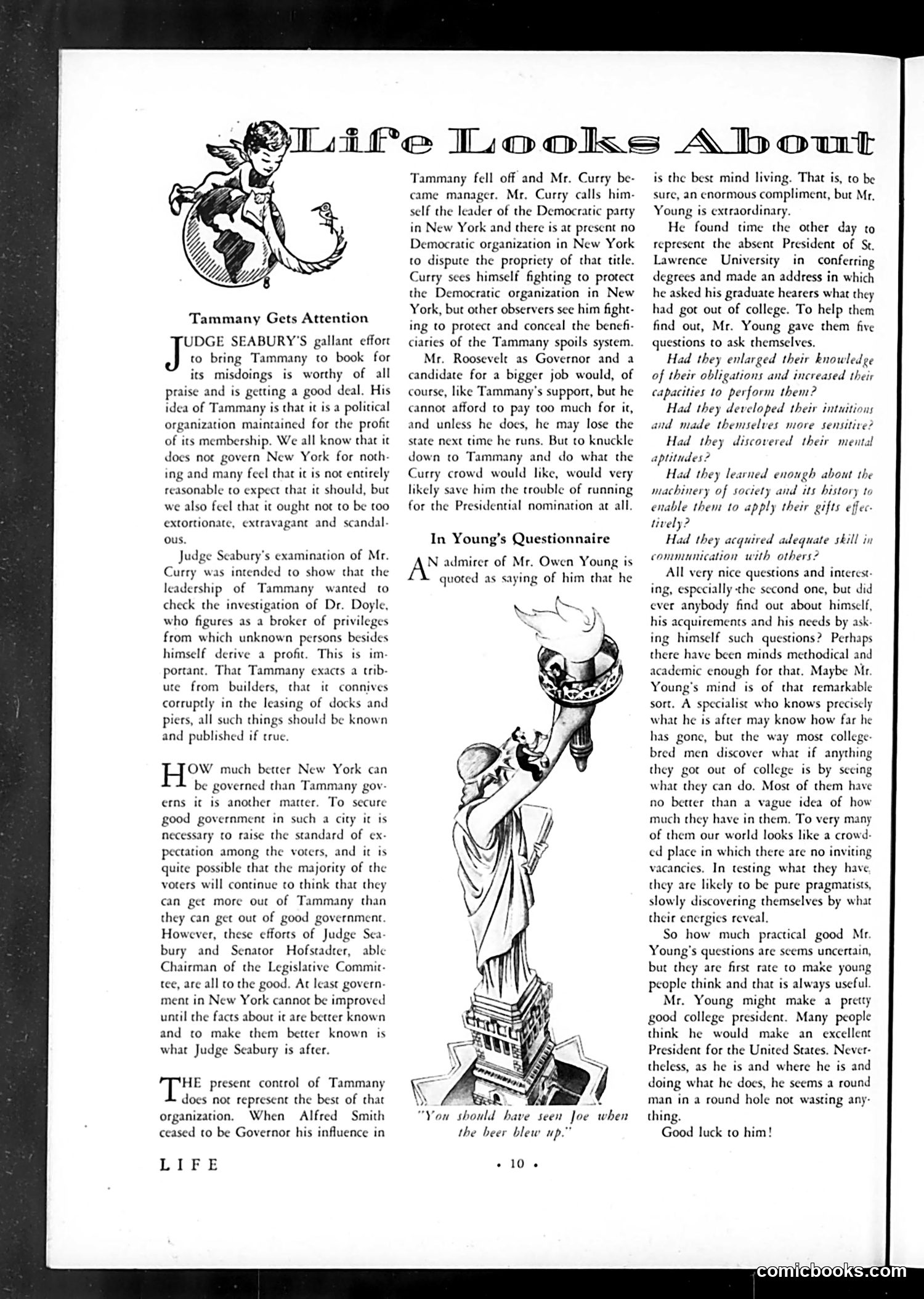
# Political Commentary on Tammany Hall This page critiques **Tammany Hall**, New York's Democratic political machine, through commentary attributed to Judge Seabury (who conducted real anti-corruption investigations). The text attacks **Mr. Curry**, Tammany's leader, for corrupt control of the organization and warns that supporting him could damage **Mr. Owen Young's** (an industrial leader) potential presidential prospects. Young is praised as having an exceptional mind suited for the presidency. The accompanying illustration depicts **Lady Justice** or Liberty, suggesting the contrast between ideals of fair governance and Tammany's actual corrupt practices in New York politics. The satire argues that good government requires exposing Tammany's misdeeds—particularly their manipulation of construction contracts and docks—as essential to cleaning up New York City politics.