A complete issue · 37 pages · 1931
Life — February 27, 1931
# Analysis This appears to be a satirical illustration from Life magazine showing a formally dressed figure (wearing a bow tie and formal jacket) whose head is replaced by or emerging from a circular portrait. The circular inset depicts a figure in a dynamic pose. The composition uses stark black-and-white contrast typical of early-to-mid 20th century satirical cartooning. The formal attire suggests this targets a public figure or type—possibly a politician or society figure being critiqued for having their public persona (the formal dress) misaligned with their actual character or actions (depicted in the circular portrait). However, without visible text identifying the subject or clearer context clues, I cannot definitively state who is being satirized or what specific event or social commentary this addresses. The style suggests pre-1950s publication.
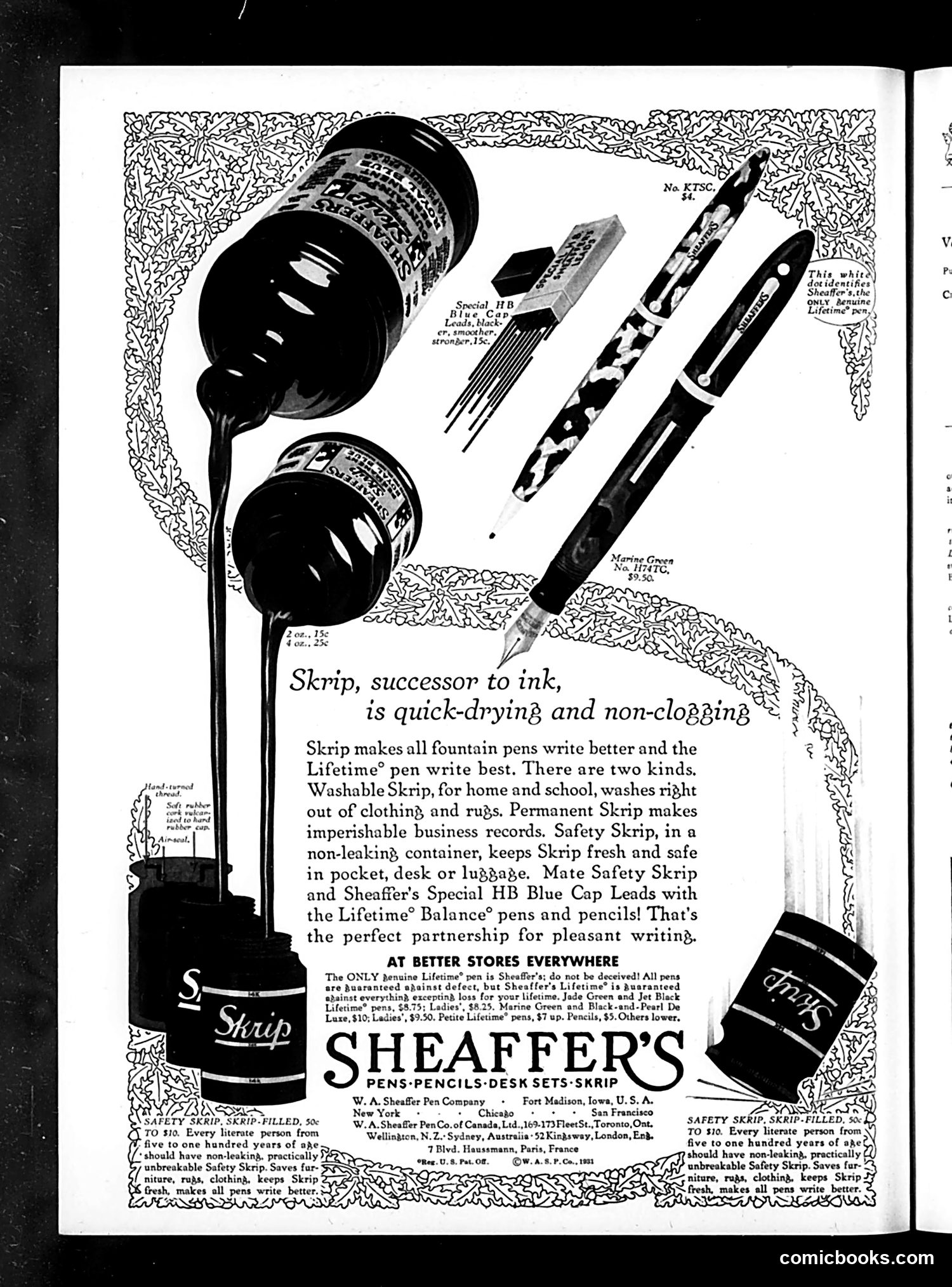
# Sheaffer's Skrip Advertisement This is a **product advertisement**, not a political cartoon. It promotes Skrip ink and related writing products from the W.A. Sheaffer Pen Company (Fort Madison, Iowa). The ad emphasizes that Skrip is "quick-drying and non-clogging," positioning it as superior to traditional ink. It highlights two variants: Washable Skrip for home/school use (washes from clothing), and Permanent Skrip for business records. The ad also promotes Sheaffer's Lifetime® pens as the ideal pairing with Skrip. The decorative border and illustrated bottles/pens are typical 1920s-30s advertising design. There is no satire or political content—this is straightforward commercial messaging appearing in *Life* magazine.
# "Poetical Pete" Cartoon Analysis This small cartoon depicts a figure labeled "Poetical Pete" with an accompanying verse by Thomas L. Mason. The illustration shows a portly man in what appears to be Victorian-era dress, depicted in a humorous, somewhat unflattering style typical of Life magazine's satirical approach. The accompanying quatrain is self-deprecating doggerel about Pete's modest stature and humble status, ending with the ironic advice to "Be good, but don't get holy." The satire appears to target pretentious or affected poetic affectation—mocking someone who fancies himself a poet despite lacking genuine talent or distinction. The crude verse and caricature work together to undercut any literary pretensions Pete might harbor.
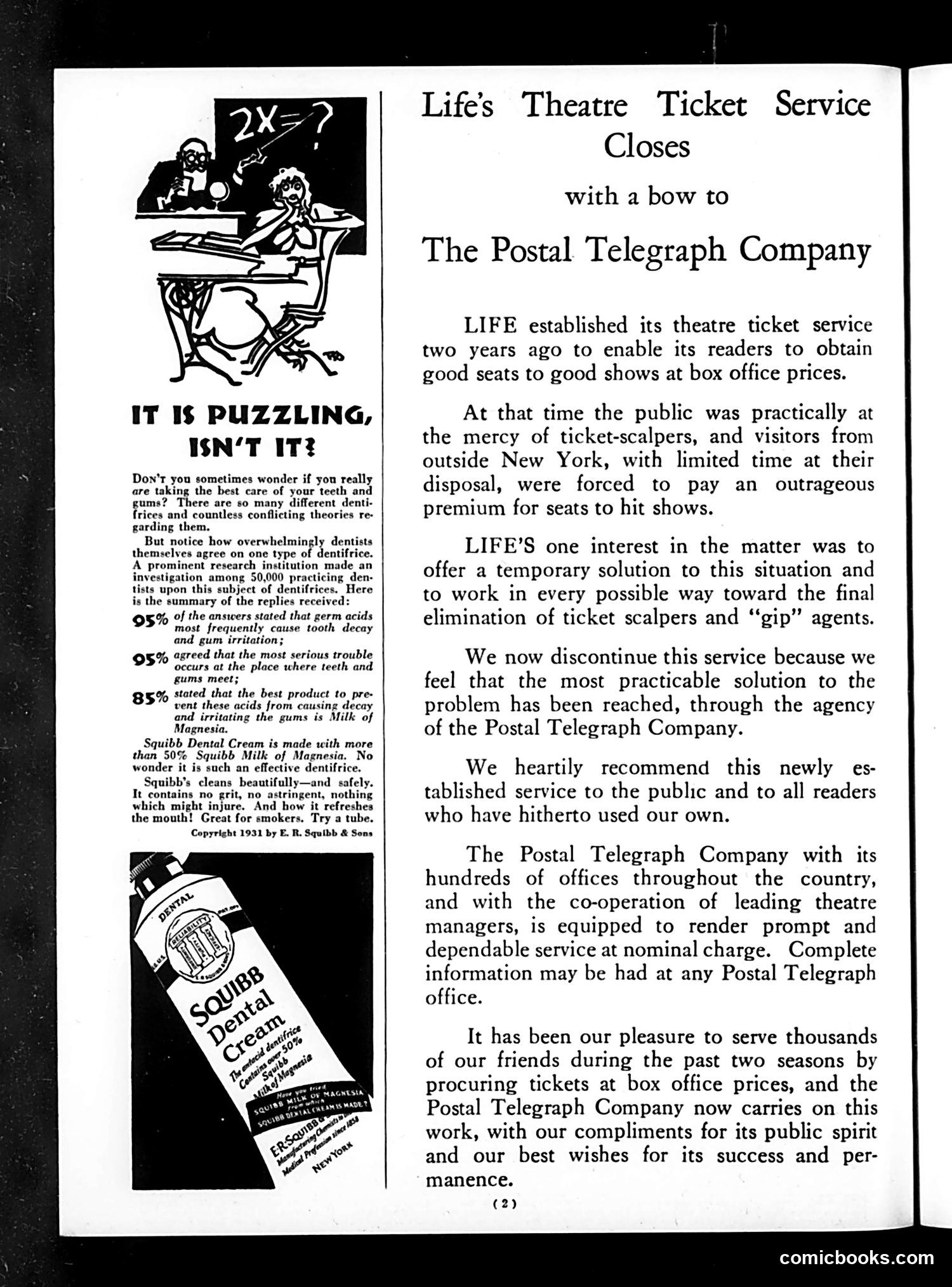
# Analysis This page announces Life magazine's closure of its theater ticket service, transferring it to the Postal Telegraph Company. The left side contains two advertisements unrelated to the main announcement: 1. **Top ad**: A satirical dental hygiene piece showing a confused student at a blackboard ("2X=?"), mocking conflicting dentistry theories. It promotes Squibb Dental Cream, claiming 95% of dentists agree it prevents decay—a common advertising trope of the era using dubious statistical claims. 2. **Bottom ad**: A Squibb Dental Cream tube advertisement, emphasizing it contains no grit or astringents. The main text explains Life created its ticket service two years prior to combat ticket scalpers exploiting theater-goers, particularly out-of-town visitors. Having achieved this goal through Postal Telegraph's intervention, Life now discontinues its own service, endorsing the telegraph company's superior nationwide infrastructure for this purpose.
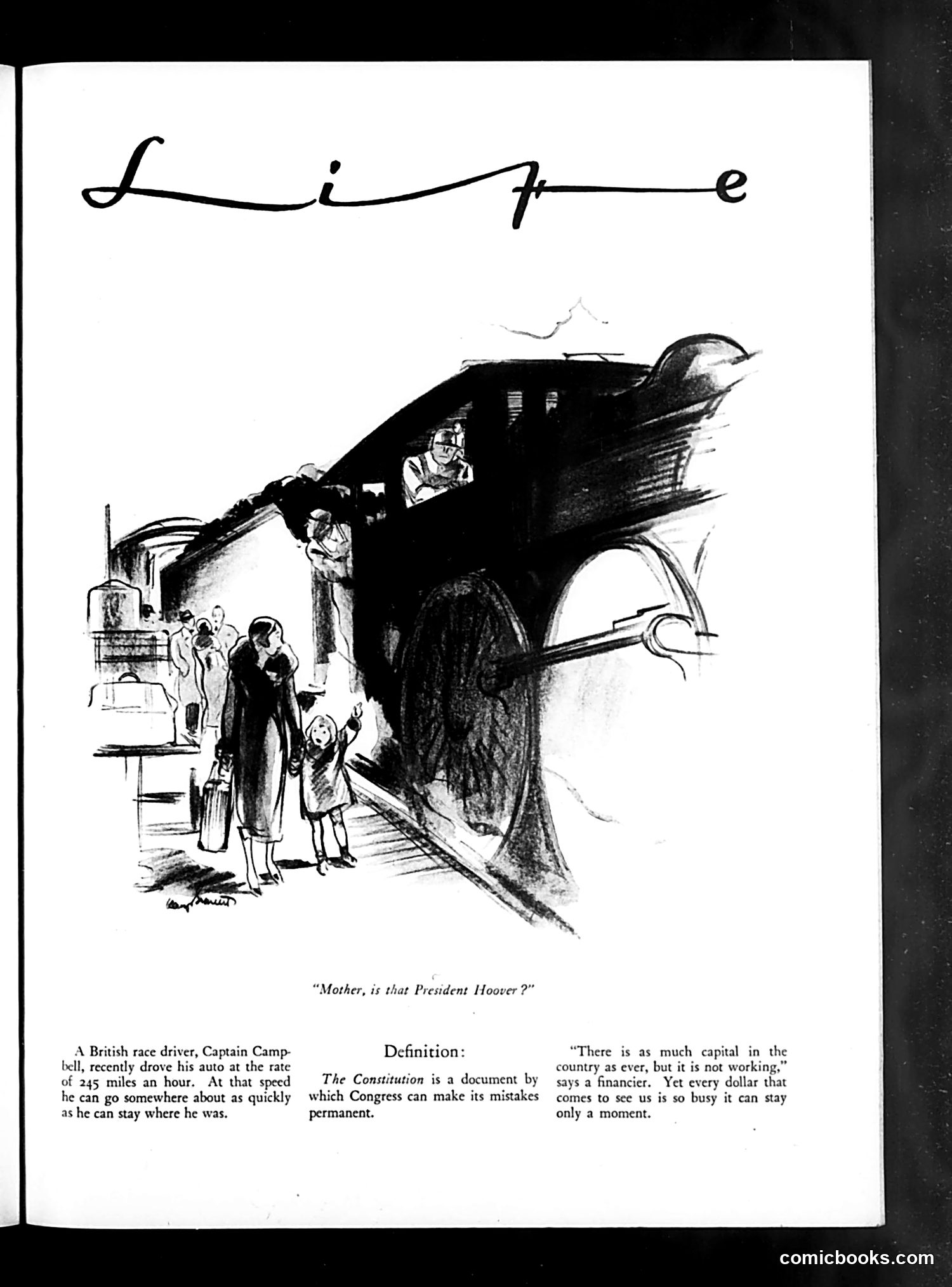
# Analysis of "Life" Magazine Page This page contains a political cartoon captioned "Mother, is that President Hoover?" showing a large airplane with passengers boarding. The satire appears to reference President Herbert Hoover's response to the Great Depression. The accompanying text mentions a British race driver exceeding safe speed limits, paired with a definition mocking the Constitution as "a document by which Congress can make its mistakes permanent." The cartoon likely satirizes Hoover's rapid policy responses or escapes during the Depression crisis—the "speed" motif connecting the reckless driver story to Hoover's administration. The financial quote about idle capital suggests criticism of economic mismanagement during this economic crisis.
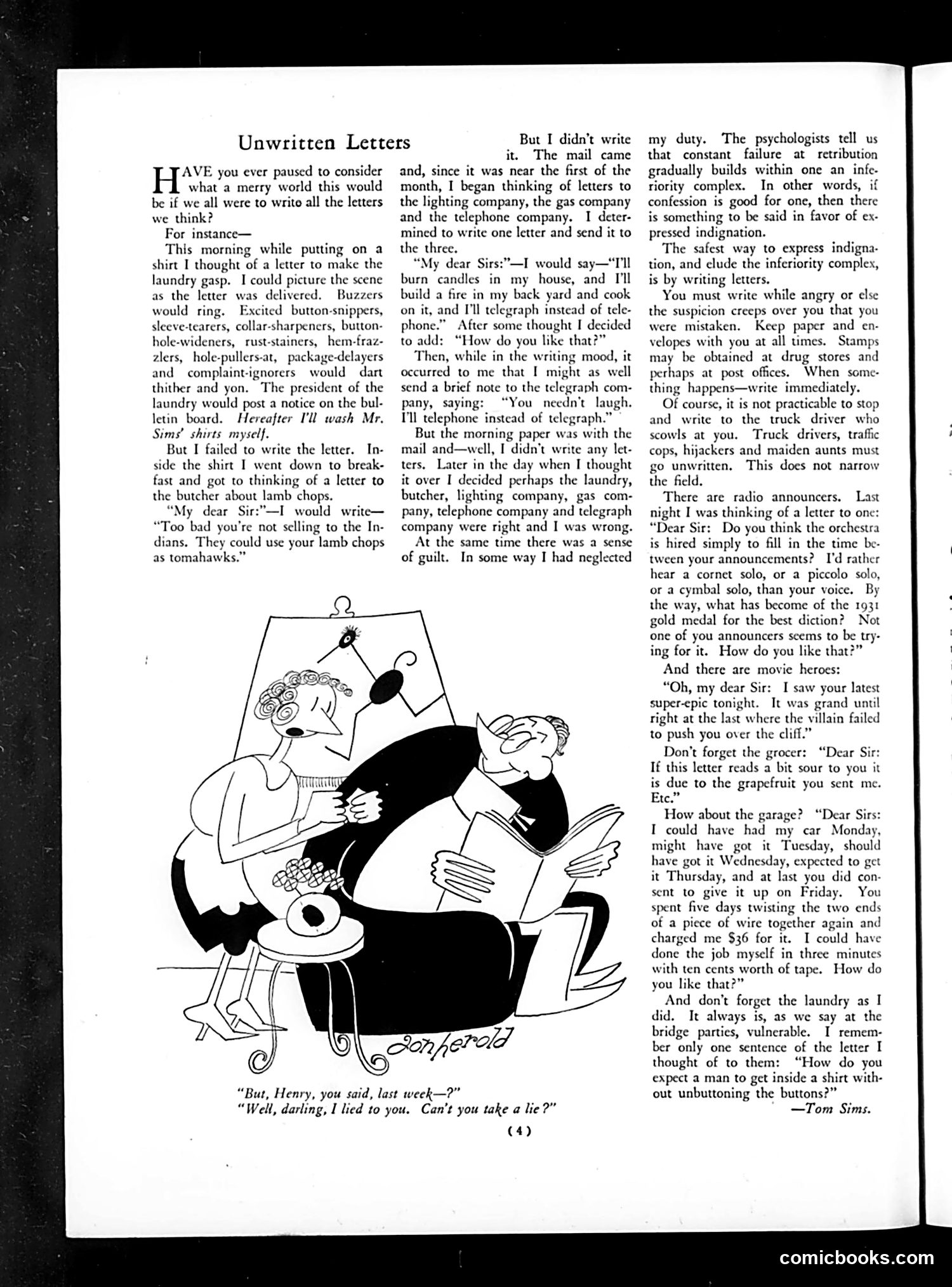
# "Unwritten Letters" by Tom Simi This satirical article humorously catalogs the letters the author *meant* to write but never did—complaints to various utilities and service providers (laundry, gas, telephone, telegraph companies, garages, radio stations). The accompanying cartoon depicts a couple in a domestic setting, with the caption: "But, Henry, you said, last week—? Well, darling, I lied to you. Can't you take a lie?" The satire targets the gap between intention and action—how people frequently *plan* to lodge complaints or have difficult conversations but avoid the actual effort. The cartoon's punchline about a lie reinforces this theme of avoidance and marital accommodation. It's commentary on everyday procrastination and conflict-avoidance in both professional consumer interactions and personal relationships.
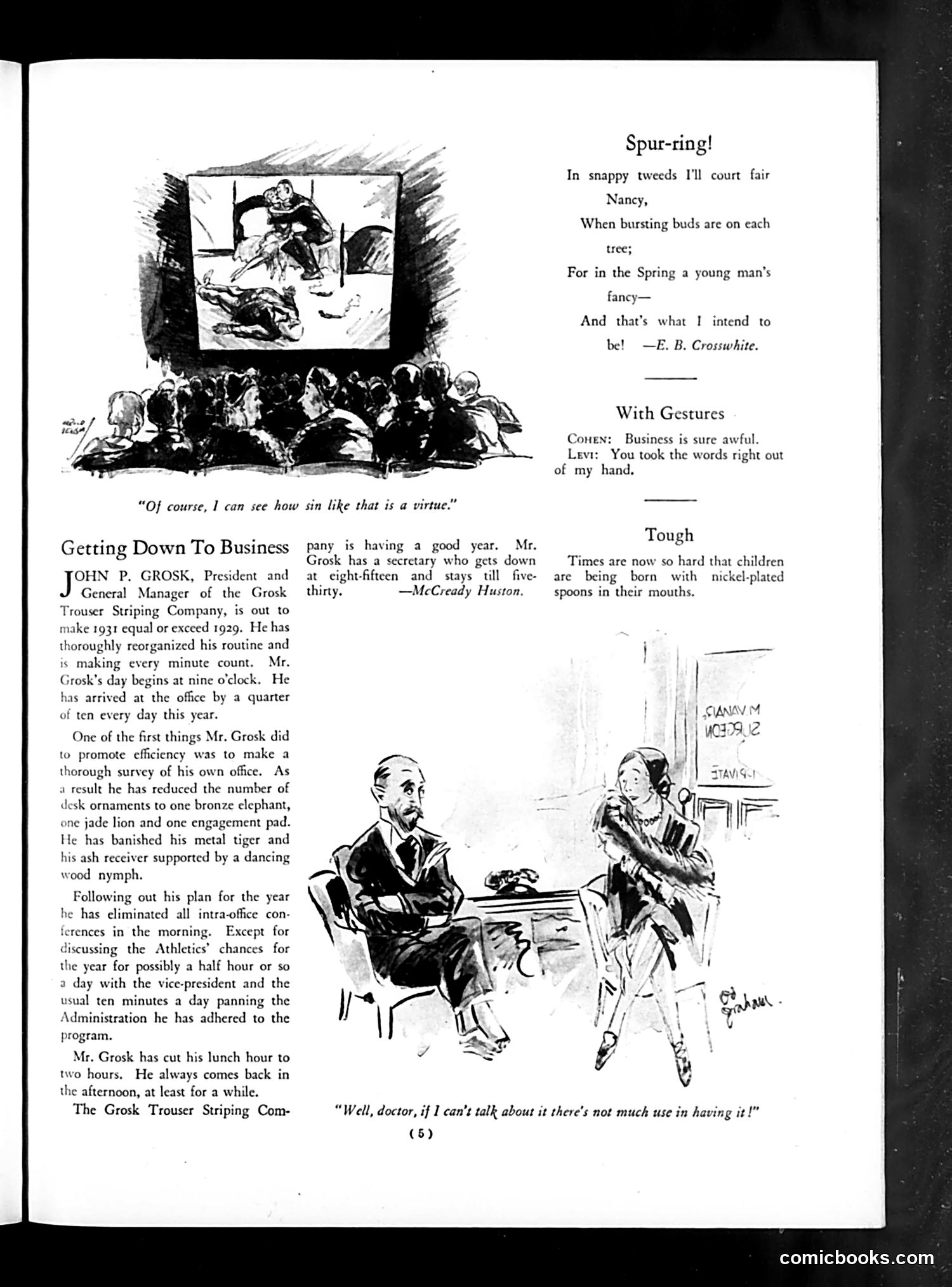
# Analysis of Life Magazine Page This page contains three distinct items: 1. **"Spur-ring!"** — A brief poem by E.B. Croswhite about courting a woman named Nancy in spring, with an illustration of a couple in a window. 2. **"Getting Down To Business"** — An article about John P. Grosk, president of the Grosk Trouser Striping Company, describing his efficiency methods for running his business. The article highlights how he's streamlined operations by eliminating desk ornaments and cutting his lunch hour. 3. **"With Gestures" and "Tough"** — Two single-panel cartoons with brief humorous captions about everyday situations (business stress and children with spoons). The page represents typical Life magazine content: light humor, social commentary, and business-world satire presented through text and illustration rather than hard political commentary.
# "Life Looks About" — Page Analysis This page contains three editorial sections without illustrated cartoons, but rather written commentary on contemporary issues. **"Confusion In Relief"** discusses Congressional assistance for unemployed veterans and drought sufferers, praising the Red Cross's work while questioning the government's approach. **"Acquittals"** addresses recent court cases involving Bishop Cannon (Methodist leader), another bishop, and General Smedley Butler, arguing that mercy was inappropriately shown in these trials. **"General Wood"** and **"More Feet of Clay"** discuss General Leonard Wood's autobiography and Edgar Lee Masters's biography of Lincoln, examining how public figures' legacies are constructed and sometimes diminished by biographical revelation. The page reflects 1920s-30s concerns with veteran welfare, religious scandal, and how historical figures are remembered.
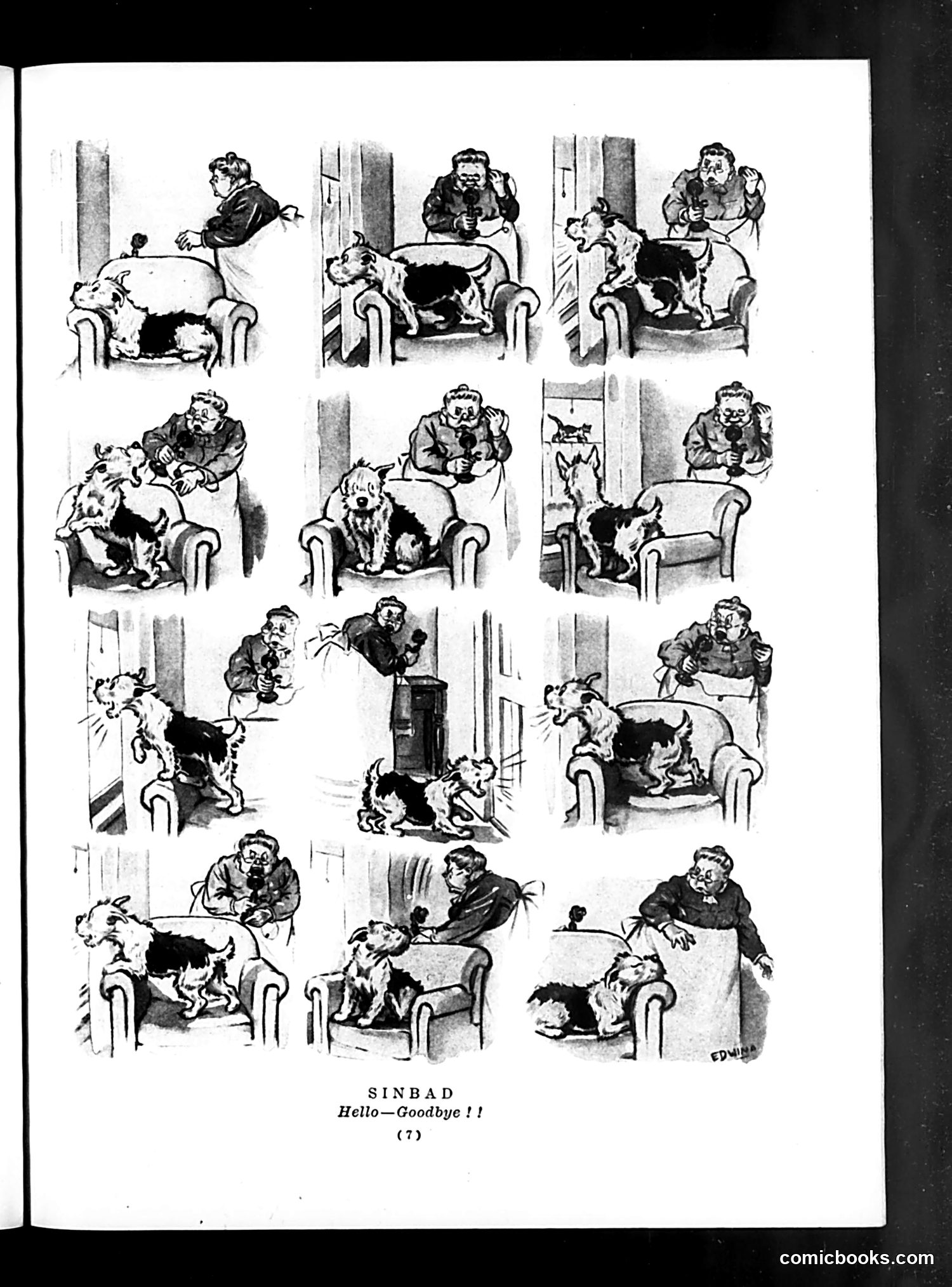
# "Sinbad: Hello—Goodbye!!!" This is a sequential comic strip showing a man repeatedly encountering a small dog in his armchair. The strip depicts a cycle: the man discovers the dog sitting in his chair, attempts to remove or shoo it away through various methods (pointing, chasing, using a broom or newspaper), but the dog persistently returns to the same spot. The humor derives from the futile repetition—the man's escalating frustration contrasts with the dog's stubborn refusal to stay gone. The title "Hello—Goodbye" suggests the man's greeting is immediately followed by the dog's reappearance, creating an endless, comedic loop. This likely satirizes domestic annoyances or the impossibility of training a stubborn pet, resonating with early 20th-century American household humor.
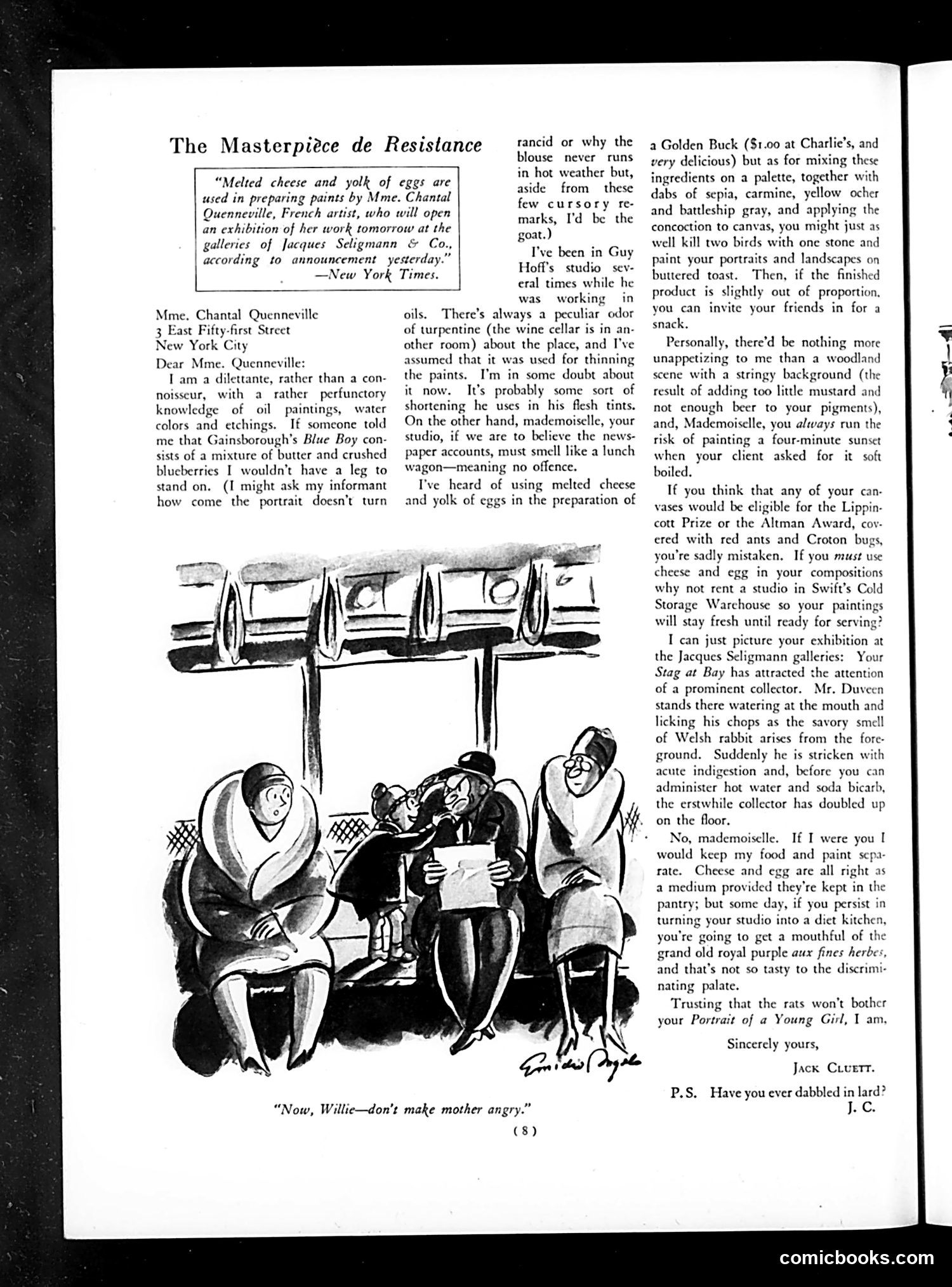
# Analysis of "The Masterpiece de Resistance" This is a satirical letter to painter Mme. Chantal Quenneville, who apparently uses unconventional ingredients—melted cheese and egg yolks—in her paintings. The writer, Jack Cluett, humorously critiques her work and artistic pretensions. The cartoon below depicts three bundled figures on what appears to be a train or trolley, with the caption "Now, Willie—don't make mother angry." The specific reference is unclear without additional context, but the bundled appearance and domestic drama suggest social satire about class, family dynamics, or travel conditions. The broader satire mocks avant-garde or experimental artists and their questionable techniques, while also poking fun at art world pretension and collectors' gullibility regarding unconventional materials and methods.
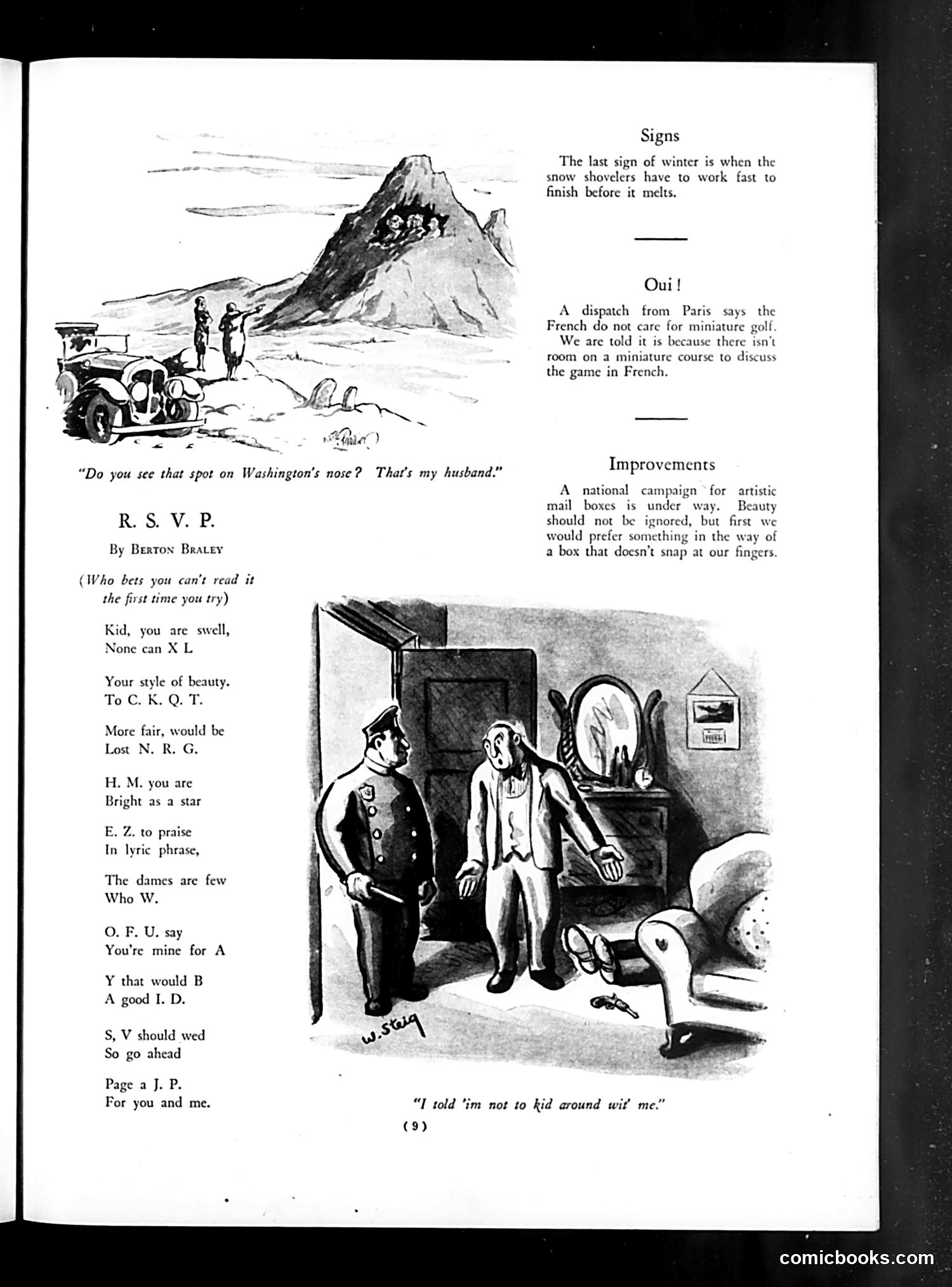
# Analysis of Life Magazine Page This page contains three distinct pieces: 1. **Top cartoon**: A woman points to a snow-capped mountain peak, claiming it's her husband's nose—a visual gag about Washington's Monument or a caricatured politician with an exaggerated nose. 2. **"R.S.V.P." poem** by Berton Braley: A playful verse using abbreviations and acronyms as punchlines (X L, C.K.Q.T., Lost N.R.G., etc.), creating double meanings. It's lighthearted wordplay mocking formal invitation responses. 3. **Bottom cartoon**: Shows two men examining what appears to be broken/damaged mail boxes or postal equipment, with the caption "I told 'im not to kid around wif me." This satirizes the proposed campaign for artistic mail boxes mentioned in the "Improvements" section—implying resistance to aesthetic changes in utility items. The page reflects 1920s-era American humor and social commentary.
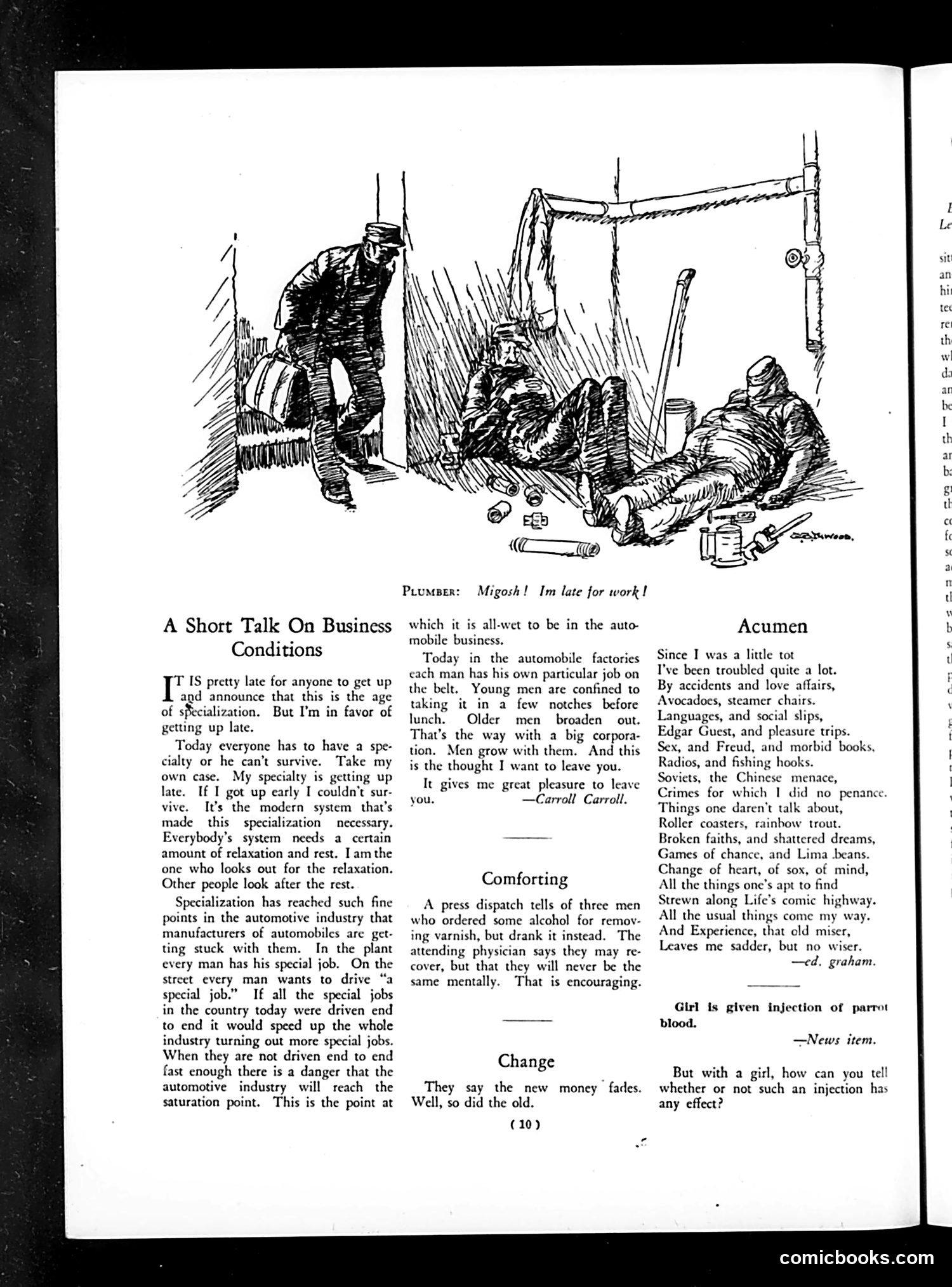
# Analysis The cartoon at top shows a plumber arriving late to work, with the caption "Migosh! I'm late for work!" This illustrates the article "A Short Talk On Business Conditions" below it. The article argues that modern specialization in industries like automobiles has created a saturation problem. The author contends that when every worker specializes in one narrow task, the entire system depends on everyone doing their job on time. The plumber's tardiness becomes emblematic of this vulnerability—if specialized workers don't arrive when expected, the whole operation fails. The satire critiques both industrial efficiency obsession and the precarious interdependence it creates. Rather than celebrating specialization's supposed progress, the piece suggests it makes business conditions fragile and dependent on perfect punctuality from every participant.