A complete issue · 36 pages · 1930
Life — November 14, 1930
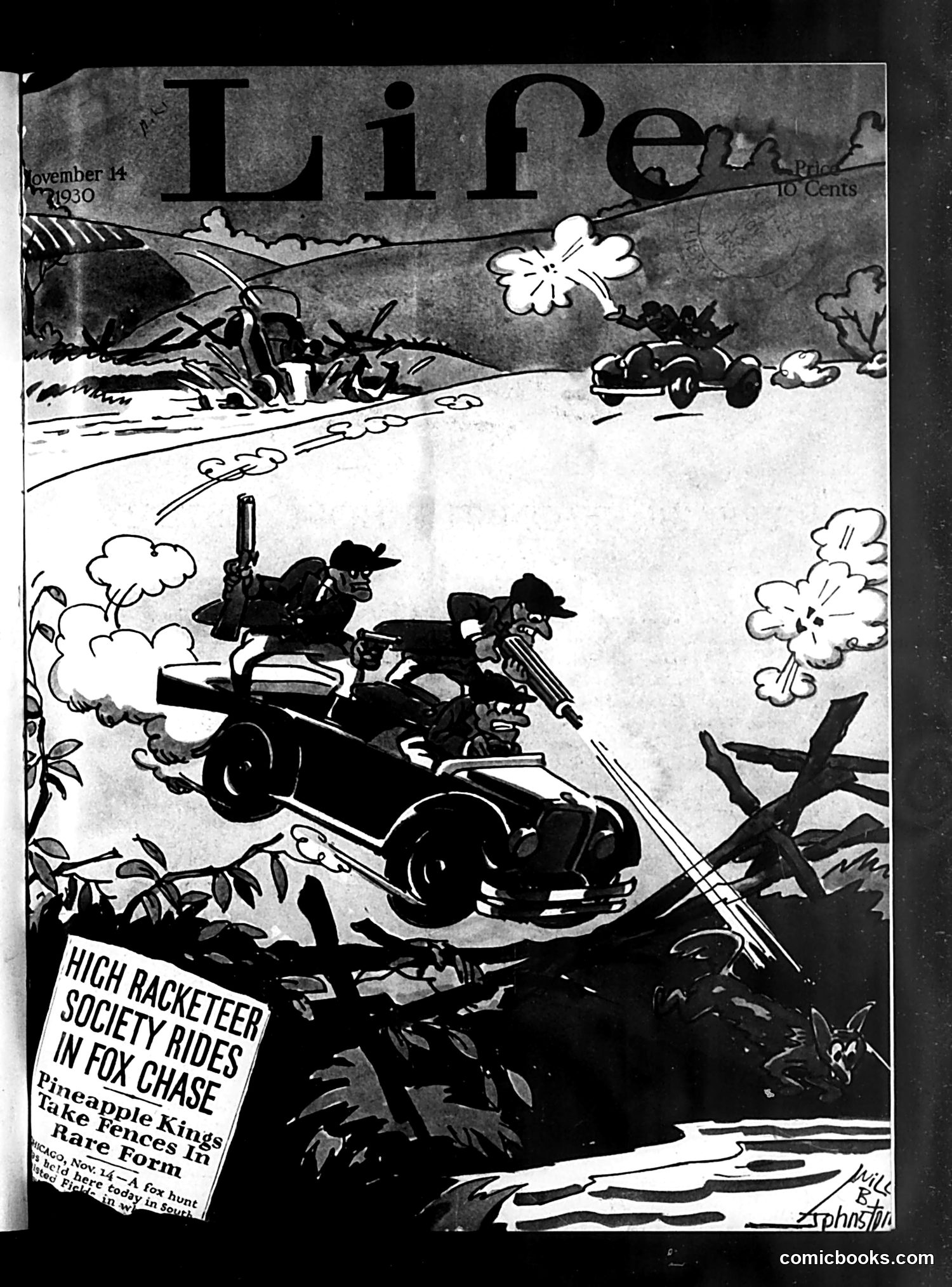
# Life Magazine Cover - November 14, 1930 This is the cover of Life magazine's satirical issue. The main illustration depicts a chaotic car chase scene with figures in a vehicle firing weapons while pursuing what appears to be a fox (visible in the lower right). The headline reads "HIGH RACKETEER SOCIETY RIDES IN FOX CHASE" with additional text mentioning "Pineapple Kings," "Fence In," and "Rare Form." The satire appears to conflate traditional fox hunting (an upper-class sport) with 1920s-30s gangster activity and "racketeering" (organized crime). The "pineapples" likely refers to grenades, a period slang term. The joke suggests wealthy "high society" individuals are indistinguishable from violent criminals in their behavior—treating hunting like a mob hit, complete with firearms and explosives.
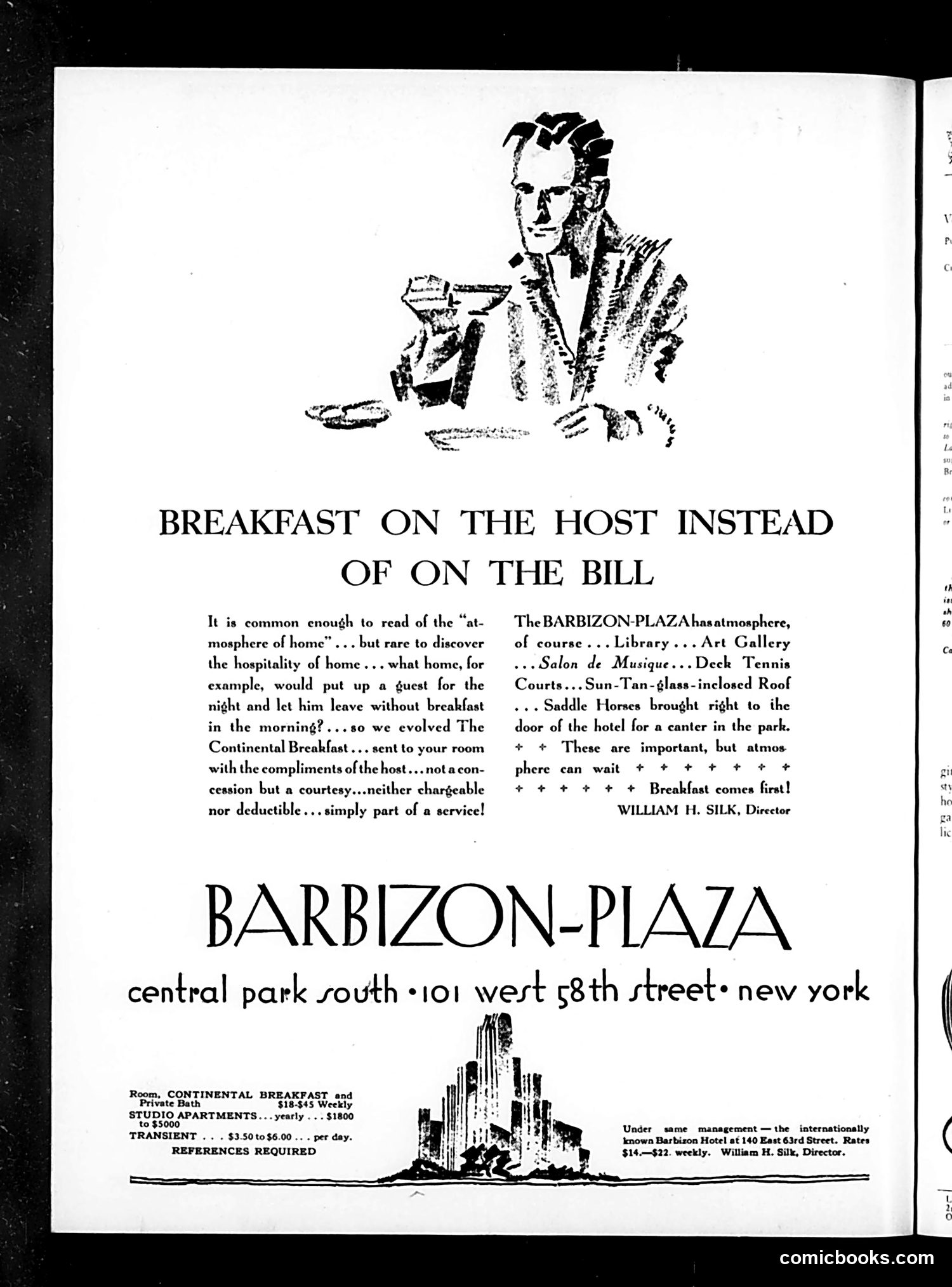
# Barbizon Plaza Hotel Advertisement This is primarily a **hotel advertisement**, not political satire. It promotes the Barbizon-Plaza on Central Park South in New York City. The sketch depicts a man at breakfast—the advertisement's central concept. The copy humorously addresses a practical hospitality issue: guests were sometimes sent to their rooms without complimentary breakfast, then charged for it separately. The Barbizon-Plaza positions its "Continental Breakfast" as a courteous service included with accommodation, not an additional bill. The hotel highlights amenities (library, art gallery, tennis courts, saddle horses) and quotes Director William H. Silk emphasizing that "Breakfast comes first!"—a tongue-in-cheek promise that hospitality begins with feeding guests. Room rates and references are listed at bottom. This reflects early-20th-century luxury hotel marketing strategies.
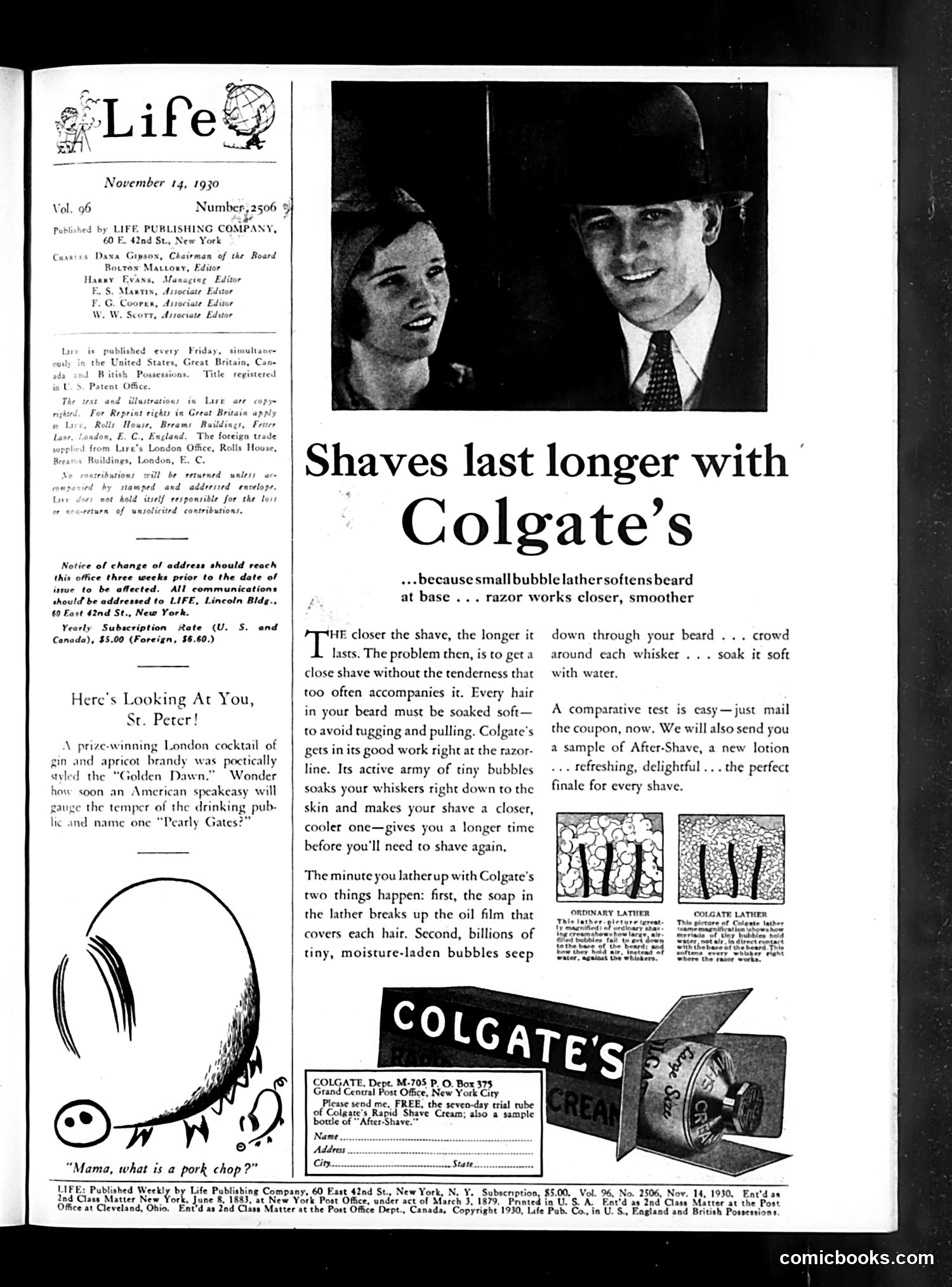
# Analysis: Colgate's Shaving Cream Advertisement This page is primarily a **Colgate's shaving cream advertisement** with minimal satire content. The main visual shows a couple (woman on left, man on right in hat) above the headline "Shaves last longer with Colgate's." The ad's central claim is that Colgate's lather softens beard hair at the base, allowing razors to work more closely and smoothly, resulting in longer-lasting shaves. The only cartoonish satire appears at bottom left: a simple sketch of a face with exaggerated stubble and the caption "Mama, what is a pork chop?" — a mild joke suggesting the unshaven beard resembles the coarse texture of a pork chop. The page includes comparative diagrams of ordinary versus Colgate lather, a mail-in coupon, and product images. This is essentially **commercial content**, not political satire.
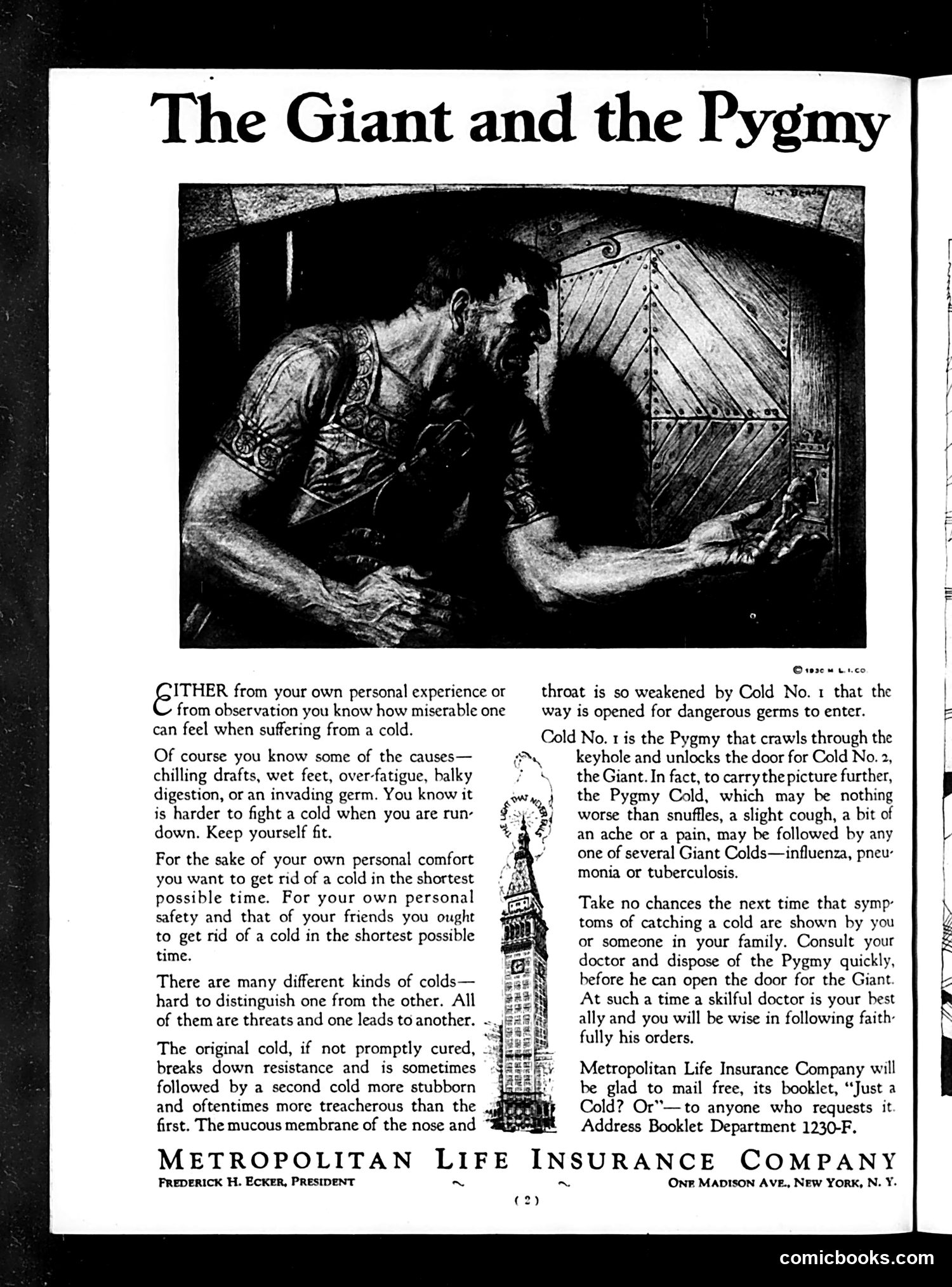
# "The Giant and the Pygmy" - Medical Allegory Advertisement This is a Metropolitan Life Insurance Company advertisement using medical allegory. The illustration depicts a large bearded man (the "Giant") being menaced by a tiny figure (the "Pygmy"), representing how a small, initial cold can lead to serious illness. The satire works by inverting normal power dynamics: the tiny "Pygmy Cold" is portrayed as dangerously deceptive, potentially opening the door to more severe infections like influenza, pneumonia, or tuberculosis (the "Giant Colds"). The text warns readers not to dismiss minor cold symptoms, advising prompt medical consultation. This reflects early 20th-century health messaging when infectious diseases were serious threats. The advertisement uses dramatic narrative to encourage life insurance customers to prioritize preventive health care and doctor visits.
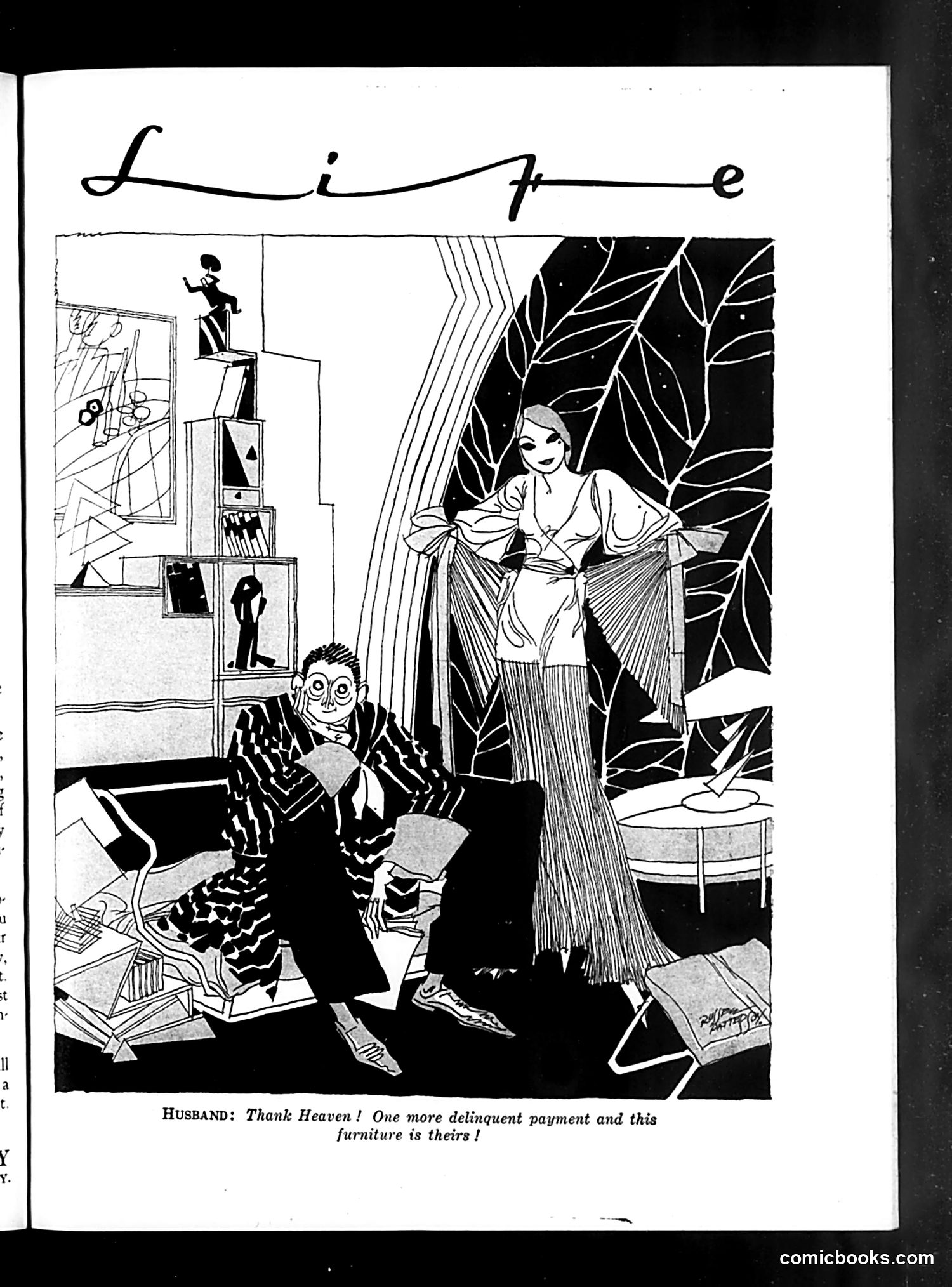
# "Life" Cartoon Analysis This cartoon satirizes marital financial struggles during what appears to be the early-to-mid 20th century. The husband, dressed formally and wearing glasses, sits surrounded by bills and financial documents, expressing relief that "one more delinquent payment" will result in creditors taking the furniture—implying he welcomes losing possessions to escape debt obligations. The wife stands elegantly in an elaborate interior with fashionable curtains and decorative plants, seemingly oblivious to or unconcerned with the family's financial crisis. The contrast between her refined appearance and the husband's stress highlights the satire: the wife's expensive tastes and home furnishings have contributed to the family's debt problems, yet she remains detached from the consequences. The joke reflects contemporary anxieties about consumer debt and marital discord over spending habits.
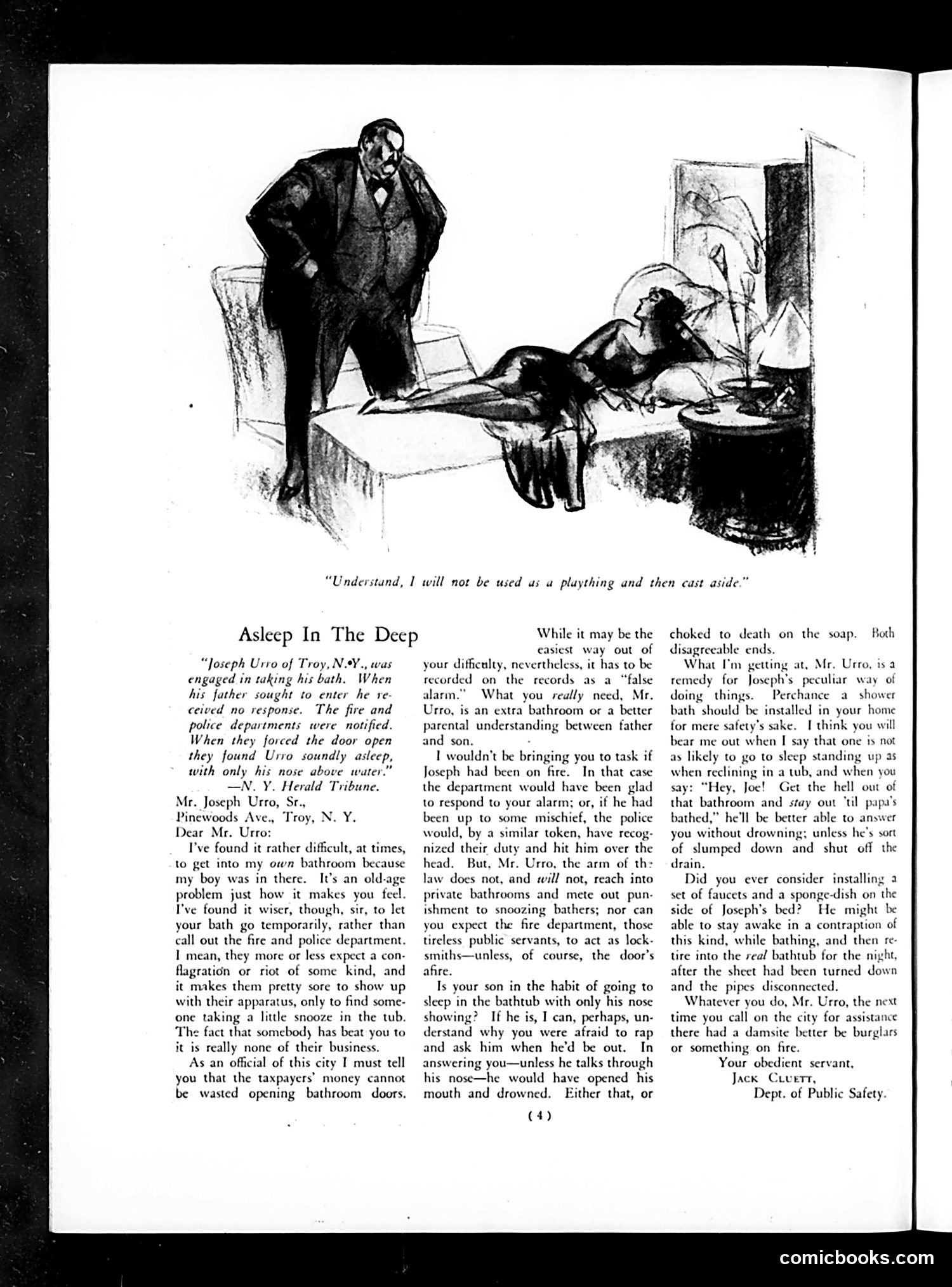
# "Asleep in the Deep" This satirical piece mocks a real incident involving Joseph Urro of Troy, New York, whose father couldn't wake him to exit the bathtub. The illustration shows a man standing over someone asleep in a bathtub—the dangerous situation referenced. The satire targets bureaucratic absurdity: when authorities investigated, they blamed Urro's "deep sleep" rather than addressing the genuine hazard. Jack Cluett from the Department of Public Safety responds with tongue-in-cheek advice, essentially refusing city responsibility for bathroom safety by suggesting private solutions (extra bathrooms, faucets, sponges). The joke is that officials deflect from a legitimate public safety concern through ridicule and circular logic, protecting taxpayer money while ignoring obvious dangers of unresponsive sleepers in bathtubs.
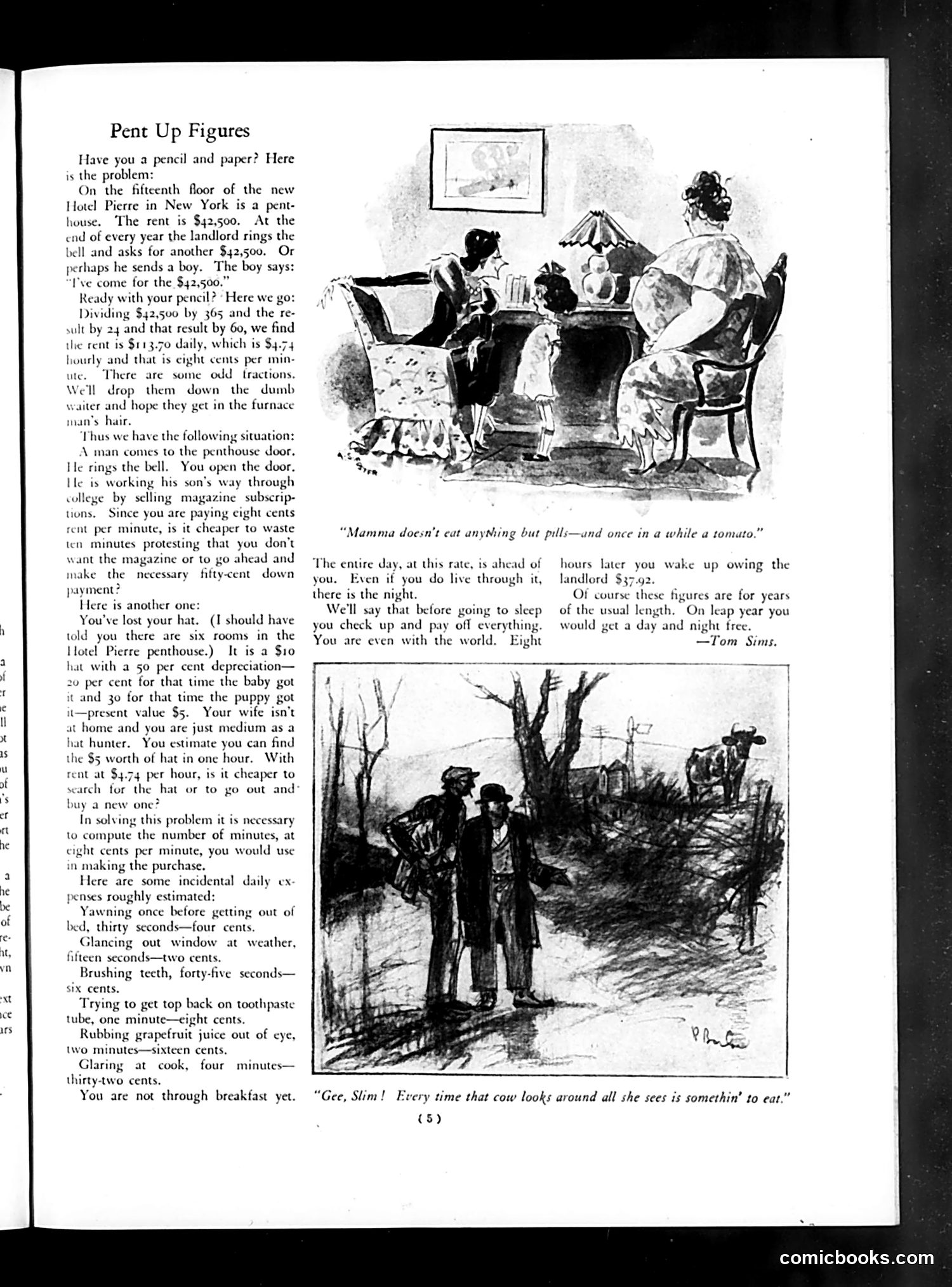
# "Pent Up Figures" - Life Magazine Satire This page presents mathematical puzzles about household economics disguised as humor. The main scenario concerns a penthouse tenant at New York's Hotel Pierre paying $12,500 yearly rent—an astronomical sum for the era. The satire targets **wealth inequality and the cost of living**. The article mocks the absurdity of calculating daily expenses (rent breaks down to $34.24 daily) while listing incidental costs like toothpaste and grapefruit juice. The cartoon shows a wealthy woman telling her cook "Mamma doesn't eat anything but pills—and once in a while a tomato," sardonically suggesting the rich must economize despite obscene housing costs. The lower cartoon's caption about a cow is unrelated commentary on rural life.
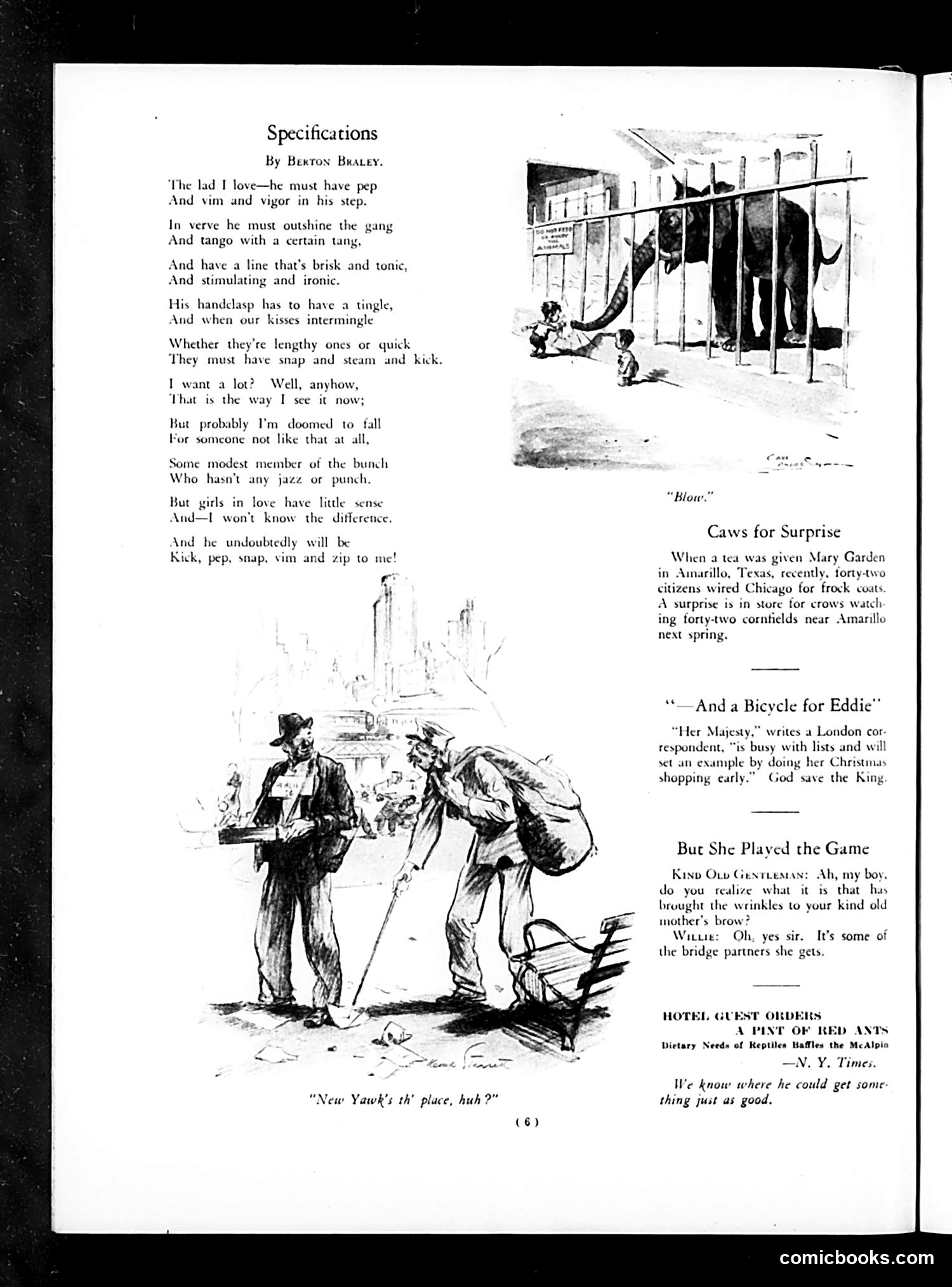
# Analysis of Life Magazine Page This page contains a poem titled "Specifications" by Berton Braley describing idealized masculine qualities in a romantic partner—someone with "pep," "vim and vigor," wit, and physical affection ("kick, pep, snap, vim and zip"). The accompanying sketch depicts two men in conversation, captioned "New Yawk's th' place, huh?" The cartoon satirizes masculine braggadocio and male bonding, likely mocking exaggerated expectations about finding ideal romantic partners. The right column contains brief humorous anecdotes unrelated to the cartoon: one about cattle sent to Texas, another about Christmas shopping, and a dialogue about bridge game difficulties. The overall page reflects early-20th-century American humor about dating, masculinity, and domestic life, targeting middle-class expectations.
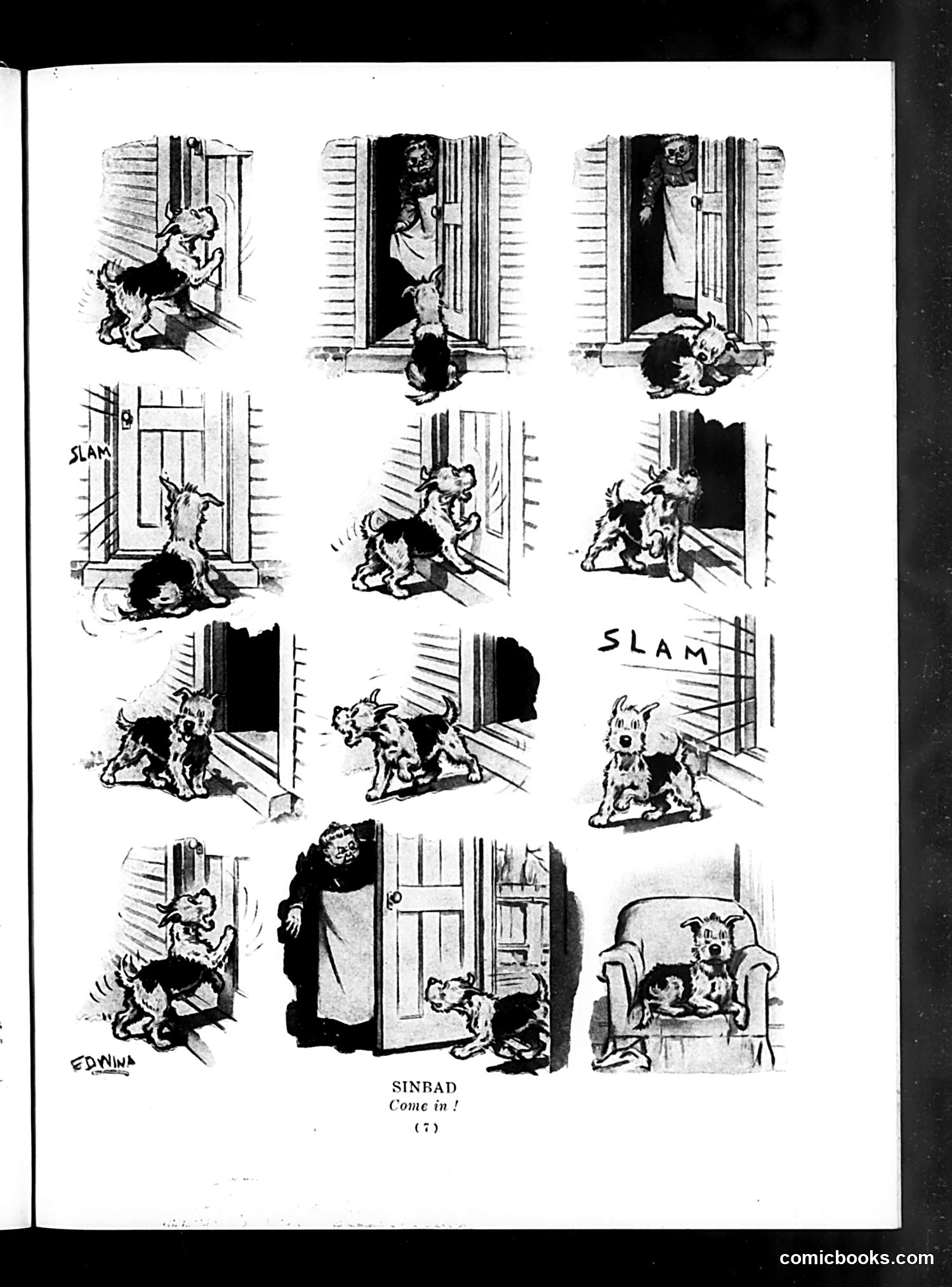
# "Sinbad: Come In!" Comic Strip Analysis This is a sequential comic strip featuring a small dog named Sinbad repeatedly trying to enter a house through a door, while a woman (apparently the homeowner) repeatedly closes it on him—often slamming it forcefully, as indicated by the "SLAM" sound effects. The humor is physical comedy: the dog persistently attempts entry despite repeated rejections, while the exasperated woman grows increasingly frustrated. The strip demonstrates a common domestic scenario of the early-to-mid 20th century—an unwanted pet or animal pestering a homeowner. The joke relies on slapstick timing and the dog's determination contrasted against human irritation. The artist's signature "EDWINA" appears in the lower left. This represents straightforward comic entertainment rather than political satire.
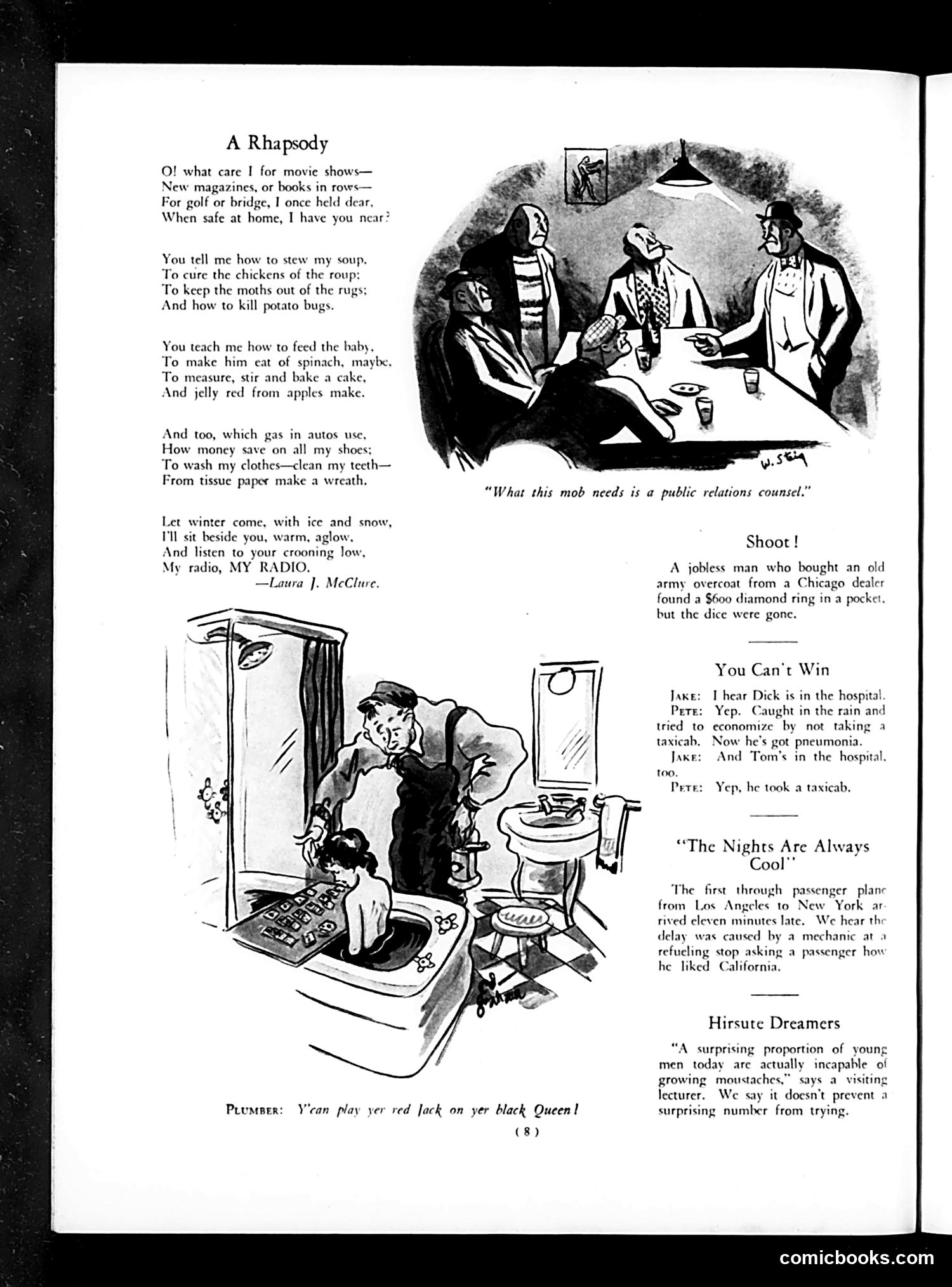
# Analysis of Life Magazine Page **"A Rhapsody"** is a poem by Laura J. McClure celebrating domestic radio as entertainment and companionship—a relatively new technology at the time. The speaker values radio over expensive entertainments like movies or golf. **The main cartoon** shows four men discussing public relations, with the caption "What this mob needs is a public relations counsel." This satirizes how businesses were increasingly hiring PR specialists to manage their public image and corporate messaging. **Lower cartoons** include brief humorous anecdotes ("You Can't Win," "Shoot!," "The Nights Are Always Cool," "Hirsute Dreamers") and a plumbing joke. These are typical Life magazine filler—quick, topical gags about everyday life and current social trends. The page reflects 1920s-30s concerns: new technology adoption, corporate image-making, and social awkwardness.
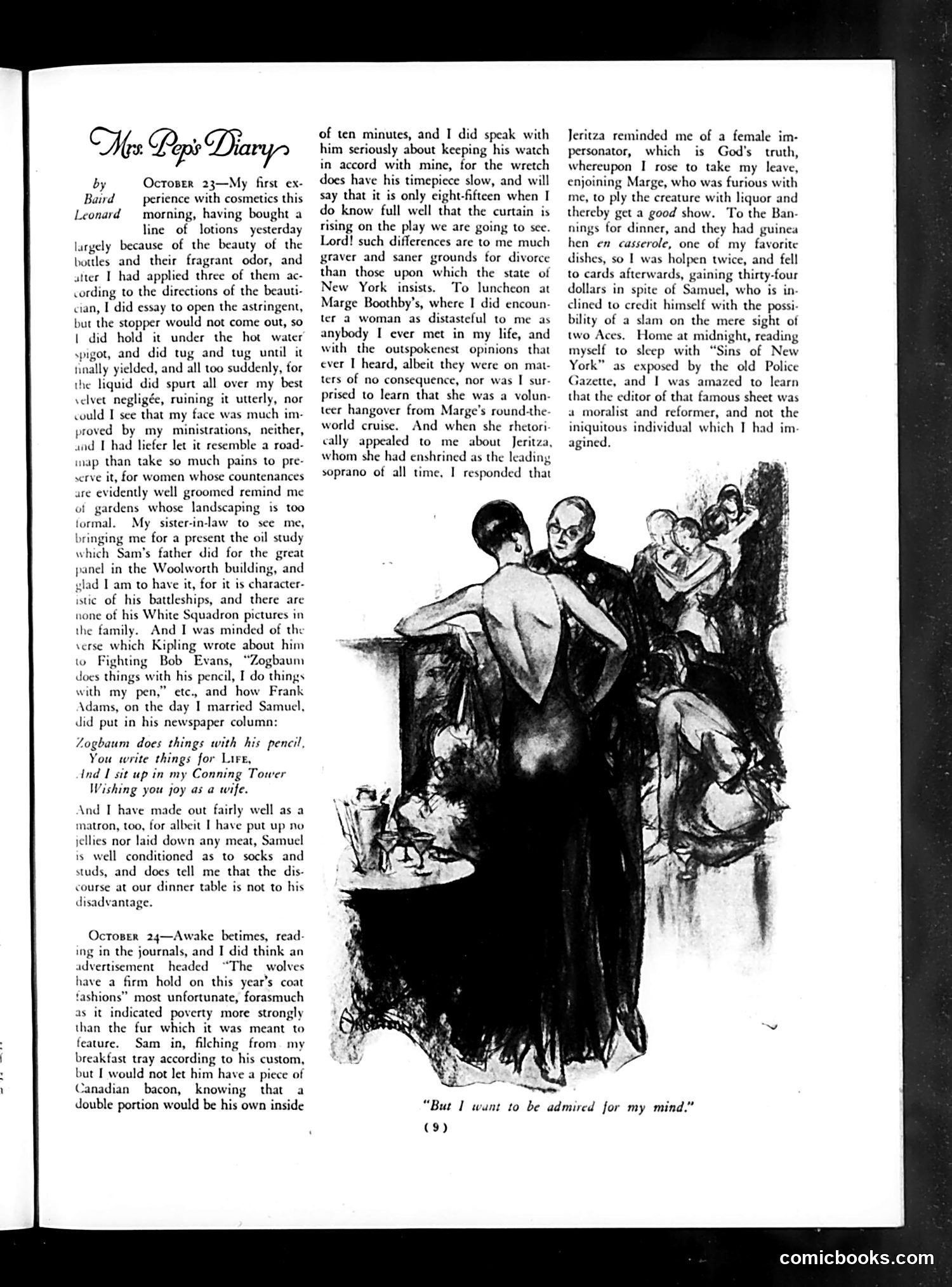
# Analysis of "Mrs. Pep's Diary" Page This is a diary entry from a satirical column titled "Mrs. Pep's Diary" by Baird Leonard, dated October 23-24. The accompanying sketch illustrates a social scene with multiple figures in what appears to be an interior setting. The diary entries mock upper-class social conventions and marital dynamics. Mrs. Pep discusses cosmetics, divorce grounds in New York, and encounters with a "distasteful" woman at Marge Boothby's lunch. She references a soprano named Jeritza and critiques a "Sins of New York" exposé in a police gazette. The illustration's caption reads "But I want to be admired for my mind," suggesting ironic commentary on women claiming intellectual merit while engaged in superficial social posturing. The satire targets affluent New York society's pretensions and women's contradictions between stated values and actual behavior.
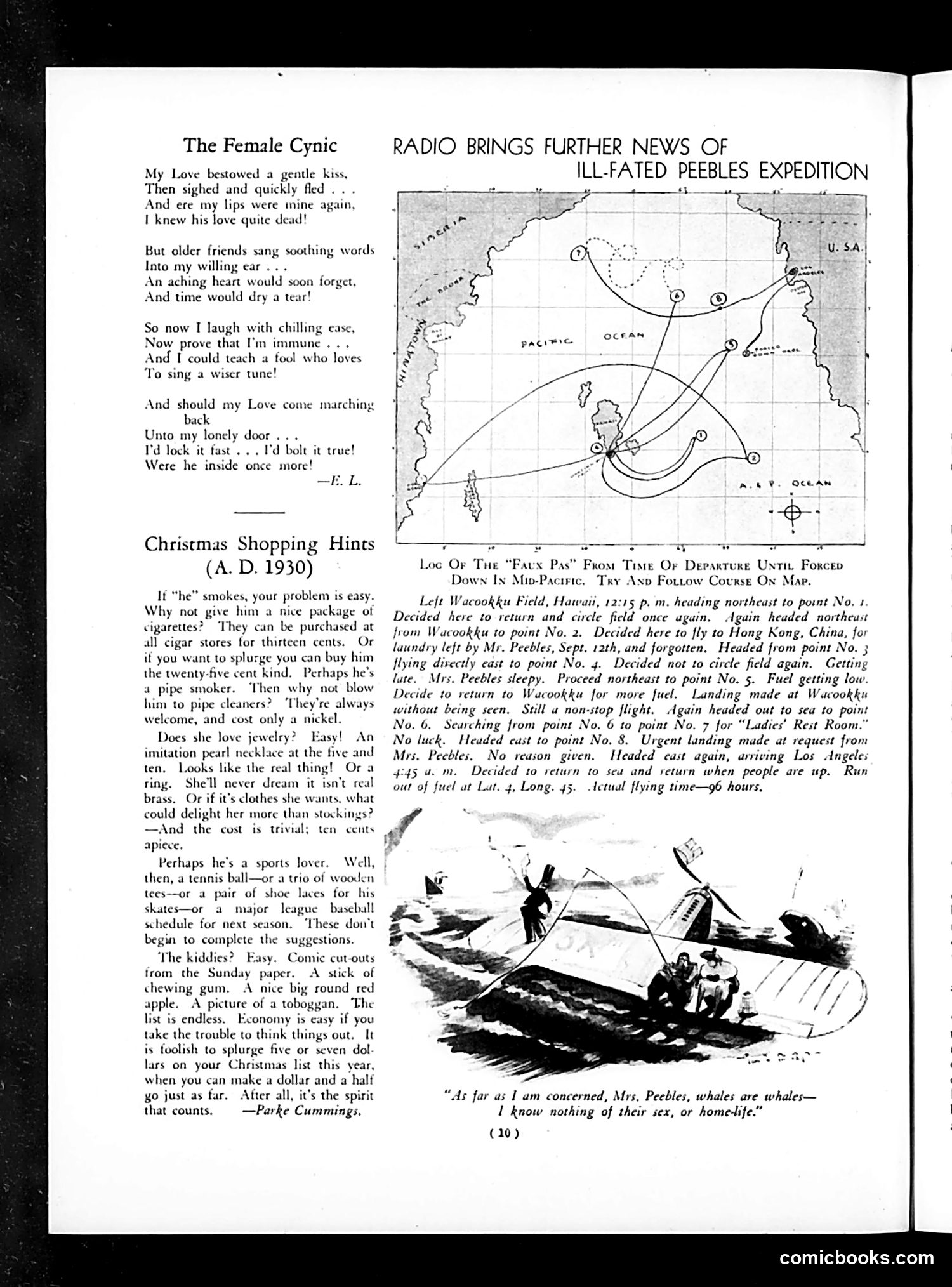
# Analysis of Life Magazine Page (circa 1930) This page contains three distinct items: 1. **"The Female Cynic"** — A poem by E.L. about romantic disillusionment, where a woman decides to harden her heart after a lover's departure, adopting cynicism as self-protection. 2. **"Christmas Shopping Hints (A.D. 1930)"** — Humorous gift suggestions attributed to Parke Cummings, offering economical Depression-era alternatives (comic cuts, chewing gum, shoelaces) with tongue-in-cheek commentary about making "a dollar and a half go just as far." 3. **"Radio Brings Further News of Ill-Fated Peebles Expedition"** — A satirical story with accompanying map and illustration. It mocks an expedition member (Mrs. Peebles) lost in the Pacific, with radio reports of repeated failed landing attempts. The cartoon caption quotes her dismissive attitude toward whales, suggesting absurdist humor about her plight. The overall tone reflects 1930s Depression-era satire: economical, cynical, and comedic about misfortune.