A complete issue · 37 pages · 1930
Life — September 12, 1930
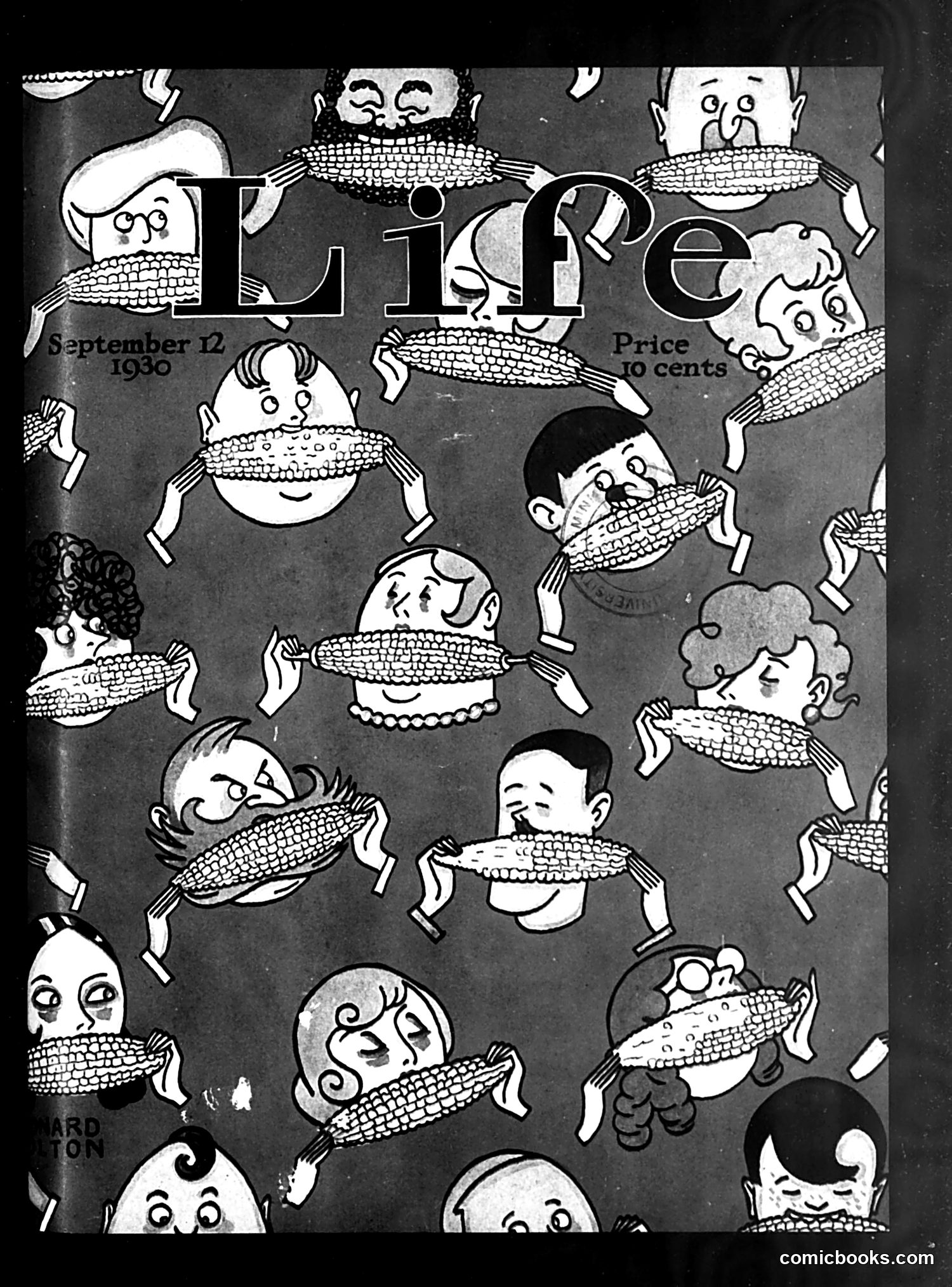
# Life Magazine Cover, September 12, 1930 This is the cover of Life magazine from September 1930, priced at 10 cents. The dominant image shows multiple cartoon faces of different ethnicities and styles—male, female, young, old—all holding oversized ears of corn to their mouths as if eating or speaking. The satirical point appears to address corn consumption or corn-related issues during the Great Depression era. The diverse crowd likely comments on how corn affected Americans across demographic lines. The exaggerated mouths and corn-cob positioning suggests commentary on either agricultural abundance, food staples during economic hardship, or possibly political rhetoric about farming. The exact satirical target remains somewhat unclear without additional context from the magazine's interior.
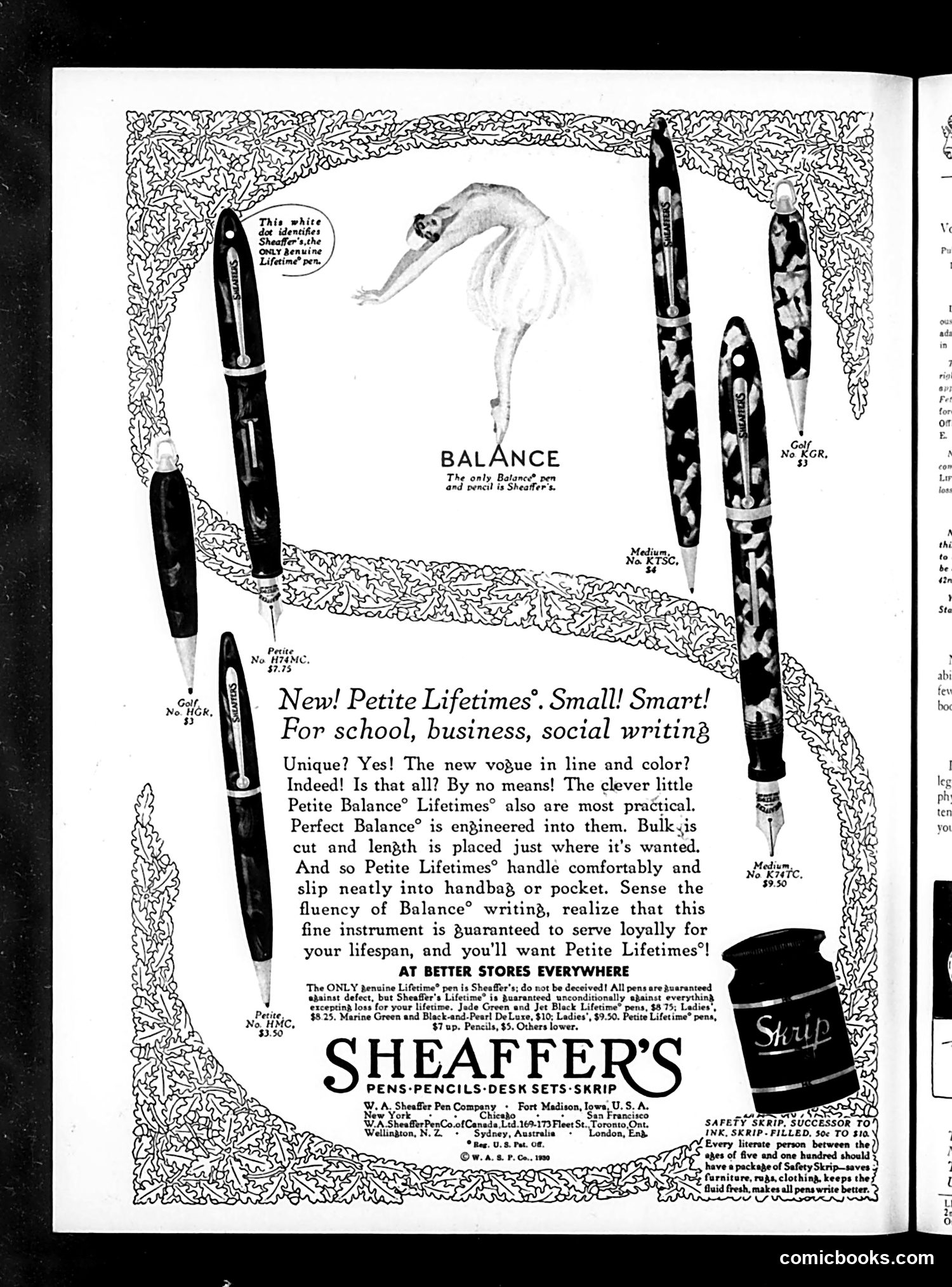
# Analysis This page is primarily a **commercial advertisement**, not editorial content or satire. It promotes Sheaffer's "Petite Lifetimes" pens—smaller writing instruments marketed for "school, business, social writing." The central image shows a ballet dancer in an arabesque position, illustrating the concept of "Balance"—the advertisement's central selling point. The text emphasizes that these pens have "Perfect Balance" engineered into them, allowing comfortable writing and neat pocket/handbag storage. Multiple pen designs are displayed around the border with decorative leaf patterns. The ad targets consumers seeking practical, fashionable writing instruments, playing on the pen's reliability ("guaranteed to serve loyally for your lifespan") and style appeal. This represents typical early-20th-century advertising strategy: pairing consumer products with artistic imagery and lifestyle aspirations.
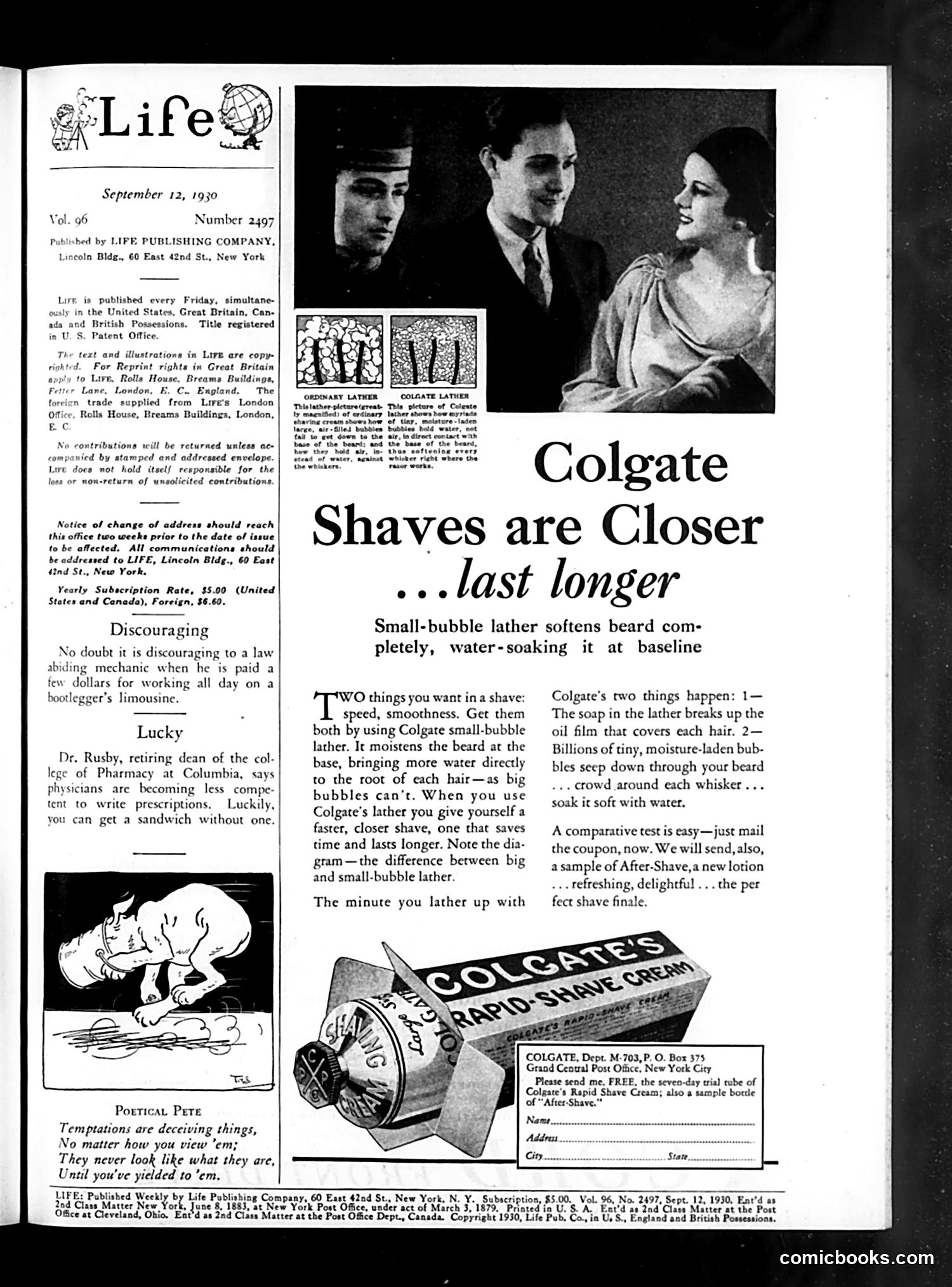
# Analysis of Life Magazine, September 12, 1930 This page is primarily an **advertisement for Colgate shaving cream**, occupying most of the right side. The ad emphasizes that Colgate's small-bubble lather provides a closer, longer-lasting shave by better softening the beard. The left side contains three unrelated editorial pieces: 1. **"Discouraging"** - A brief joke about underpaid auto mechanics working on bootleggers' limousines during Prohibition. 2. **"Lucky"** - A quip about Dr. Ruby, retiring dean of pharmacy at Columbia, noting fewer physicians prescribe medicines since people can obtain sandwiches without prescriptions. 3. **"Poetical Pete"** - A cartoon poem about temptation's deceptive nature. The accompanying illustration shows a sleeping pig—the satire's subject is unclear from the image alone. The page demonstrates Life's mix of advertising, short humor, and social commentary typical of early 1930s magazines.
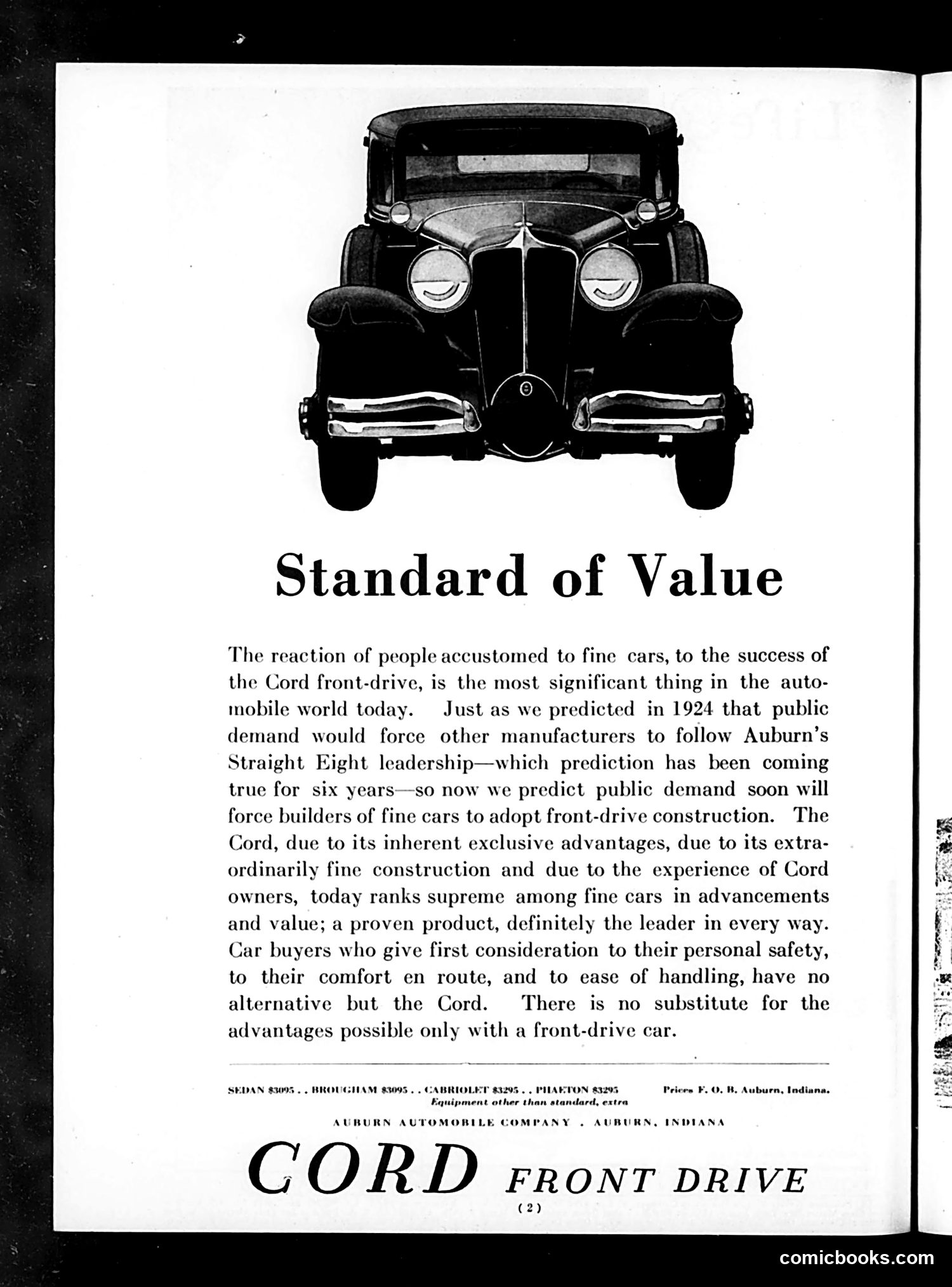
# Analysis This is **not a satirical cartoon page** but rather a **vintage automobile advertisement** for the Cord automobile, circa 1930 (based on the styling and reference to Auburn's "six years" of front-drive leadership since 1924). The page shows a front-facing illustration of a Cord vehicle and contains marketing text claiming the Cord's front-wheel-drive design represents a "Standard of Value" among luxury cars. The ad argues that other fine car manufacturers will be forced to adopt this technology due to public demand and the Cord's proven advantages in safety, comfort, and handling. This appears in *Life* magazine as a paid advertisement promoting the Auburn Automobile Company's Cord brand, not as editorial satire or comics content.
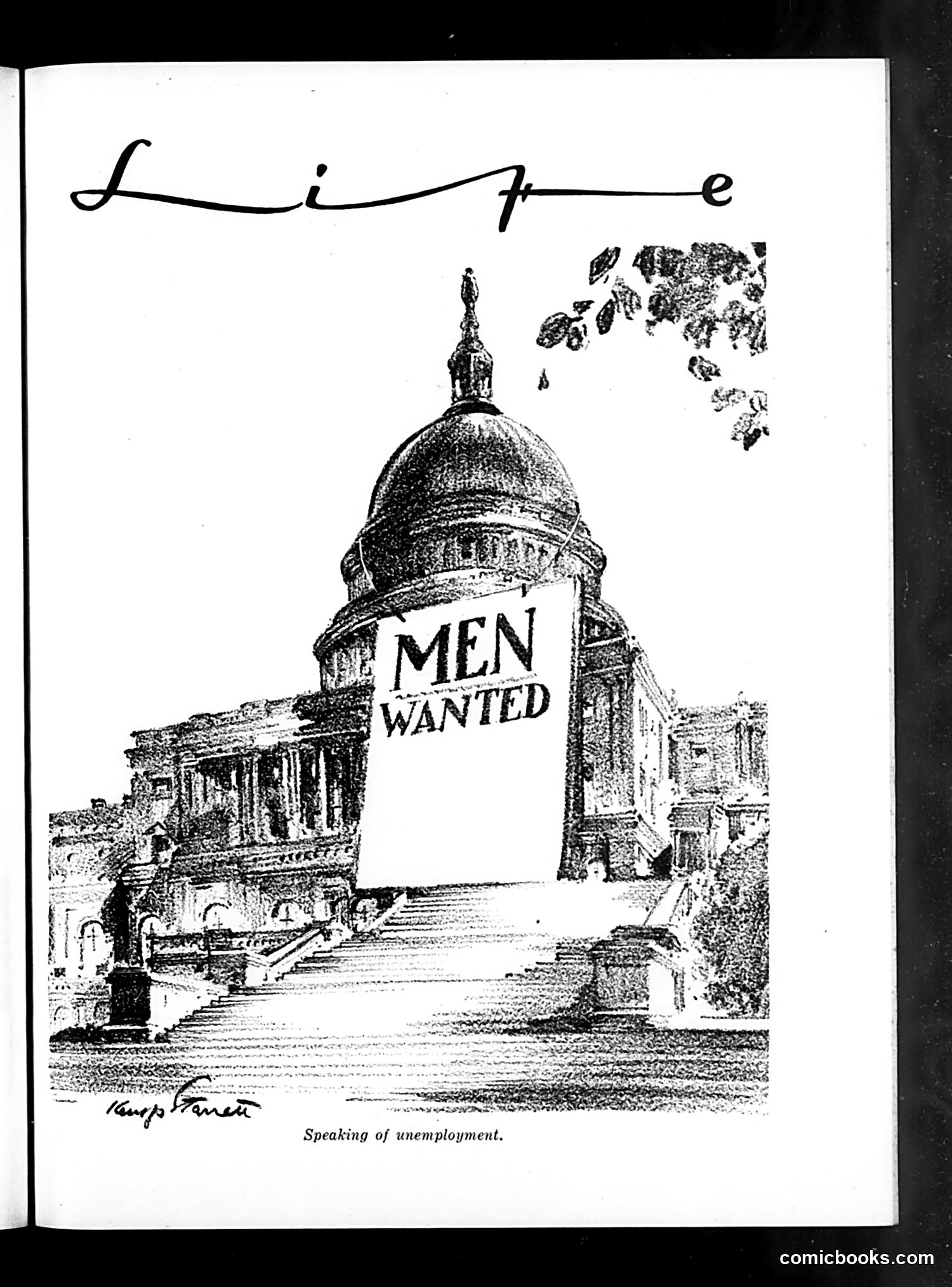
# Cartoon Analysis: "Speaking of unemployment" This political cartoon uses stark irony to critique unemployment. The U.S. Capitol building—the seat of government responsible for economic policy—displays a large "MEN WANTED" sign. The juxtaposition is pointed: the government itself is advertising for workers while presiding over widespread joblessness. The caption "Speaking of unemployment" confirms the satirical intent. By showing the Capitol as if it were any commercial establishment posting hiring notices, the cartoonist mocks the government's apparent indifference to or inability to address the unemployment crisis affecting ordinary citizens. The artist's signature appears lower left. This cartoon likely dates from an economic downturn period when joblessness was a pressing public concern, and government intervention (or lack thereof) was heavily criticized.
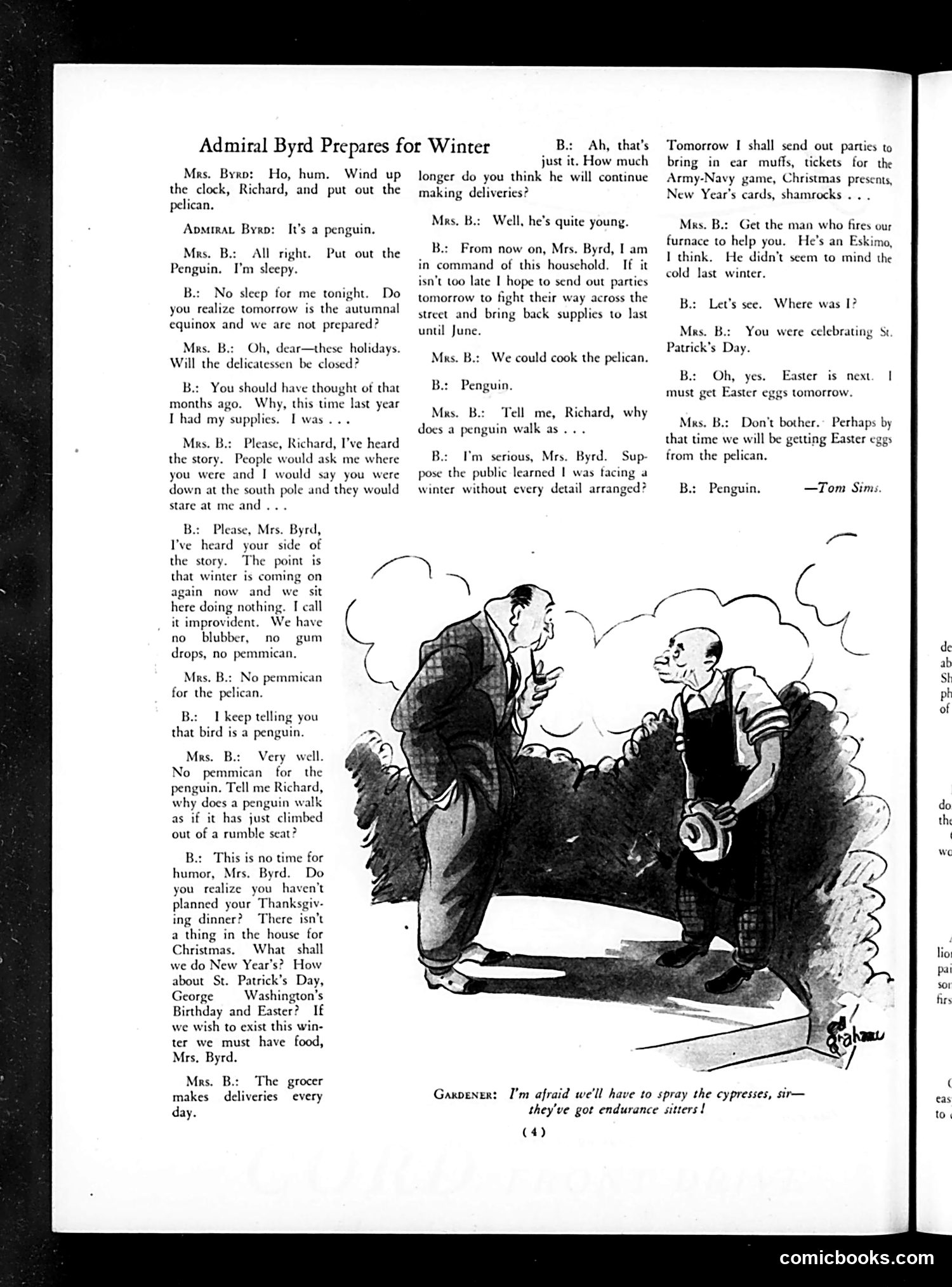
# "Admiral Byrd Prepares for Winter" This is a humorous domestic sketch between Mrs. B. and Admiral Byrd (likely Richard E. Byrd, the famous polar explorer). The joke hinges on Byrd's preparations for Antarctic winter expeditions being absurdly applied to preparing his household for winter at home. Mrs. B. repeatedly mistakes his references to penguin supplies and expedition logistics as household planning failures. The cartoon illustrates the clash between his polar explorer mindset and ordinary domestic life—he's mentally focused on Antarctic conditions while his wife desperately needs him to handle Christmas, Thanksgiving, groceries, and heating fuel. The accompanying cartoon shows a gardener warning about "endurance itters" (jitters), likely depicting stress from wartime or economic anxiety.
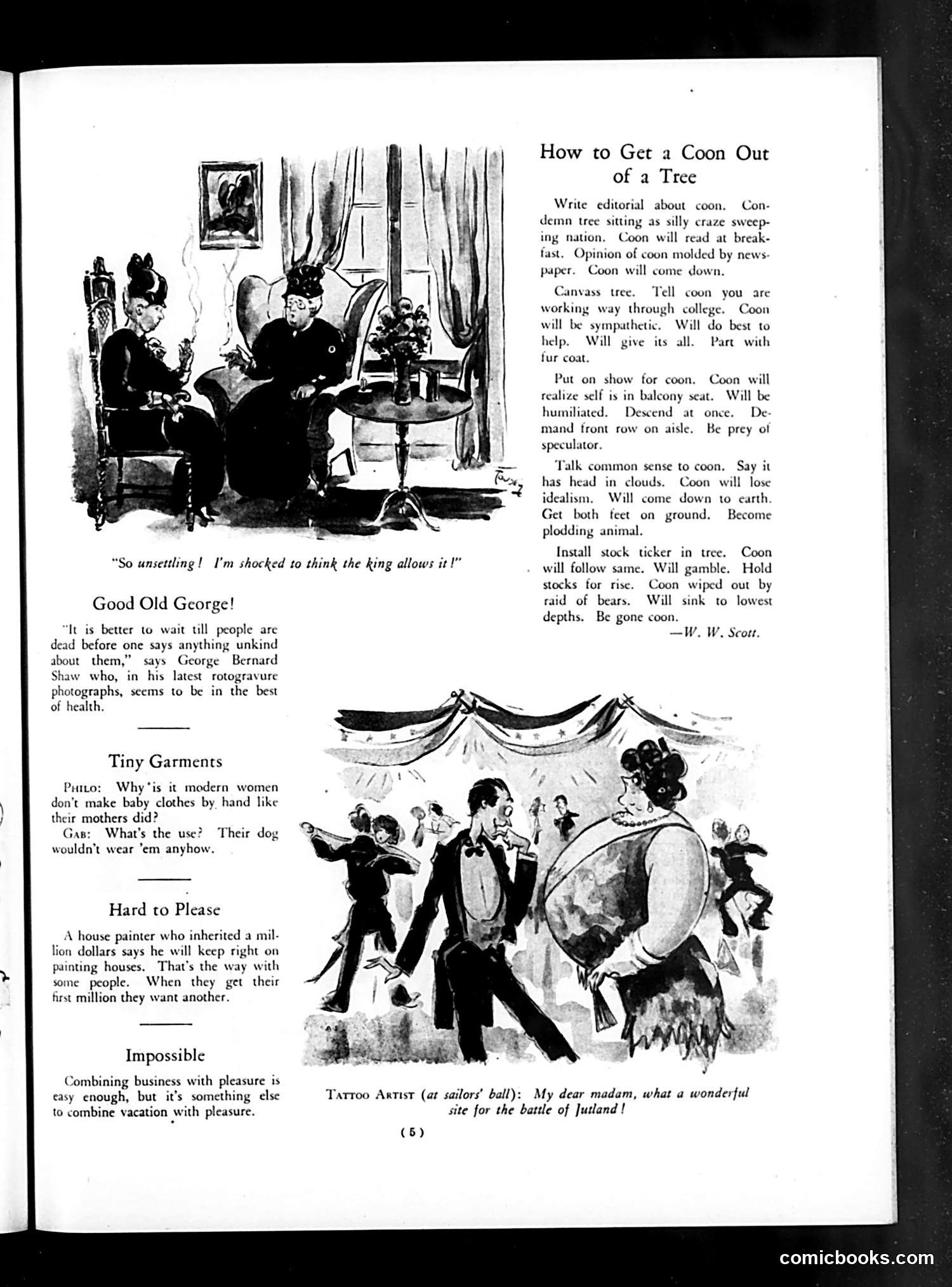
# Analysis of Life Magazine Page This page contains several brief satirical pieces and two cartoon illustrations. The main content includes: 1. **"How to Get a Coon Out of a Tree"** — A humorous editorial by W.W. Scott offering absurd suggestions to remove a raccoon from a tree (write editorials condemning it, canvas neighbors, put on a show, etc.). The satire mocks excessive public opinion and social pressure. 2. **"Good Old George!"** — A brief item about George Bernard Shaw appearing healthy in recent photographs. 3. **Lower cartoon** — Shows a "Tattoo Artist (at sailors' ball)" admiring a woman's large posterior, calling it "a wonderful site for the battle of Jutland." This appears to reference WWI's naval Battle of Jutland while making crude humor about the woman's body. The page demonstrates Life's characteristic mix of social satire and ribald humor.
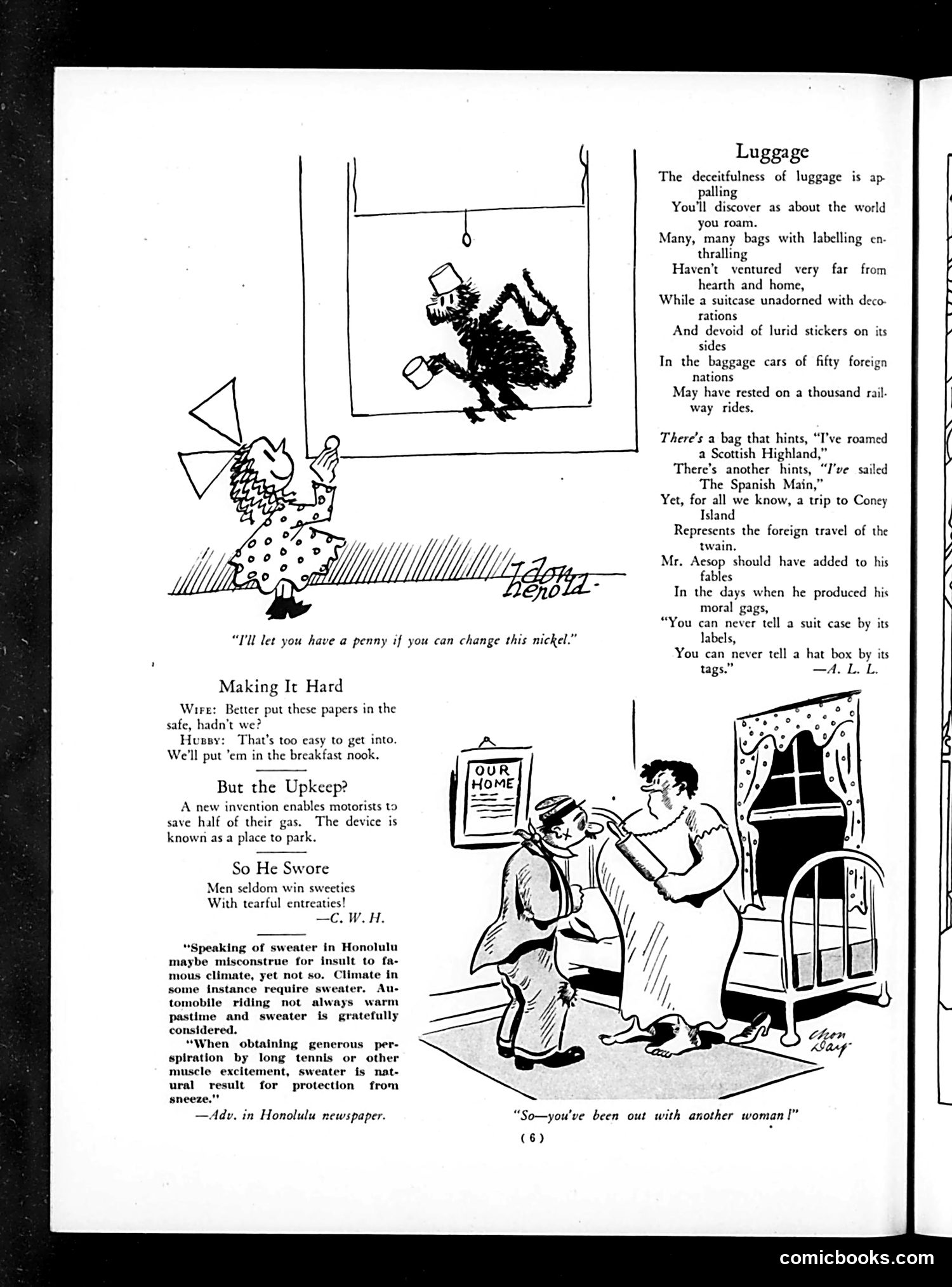
This page contains three separate satirical pieces: 1. **"Luggage"** (top right): A poem mocking travelers' pretentious luggage covered with travel stickers from exotic locations, suggesting people buy decorated suitcases to appear well-traveled rather than actually traveling. 2. **"Making It Hard"** (middle): A brief joke about motorists hiding gas rationing papers in inconvenient places (like the breakfast nook) to make theft harder during what appears to be a wartime or scarcity period. 3. **"So He Swore"** (bottom): A cartoon depicting a domestic argument where a man appears caught with another woman, with his wife confronting him. The humor derives from the juxtaposition of the quotation marks suggesting he's swearing oaths of innocence—a commentary on infidelity and marital dishonesty. All pieces reflect early-to-mid 20th-century American domestic and social anxieties.
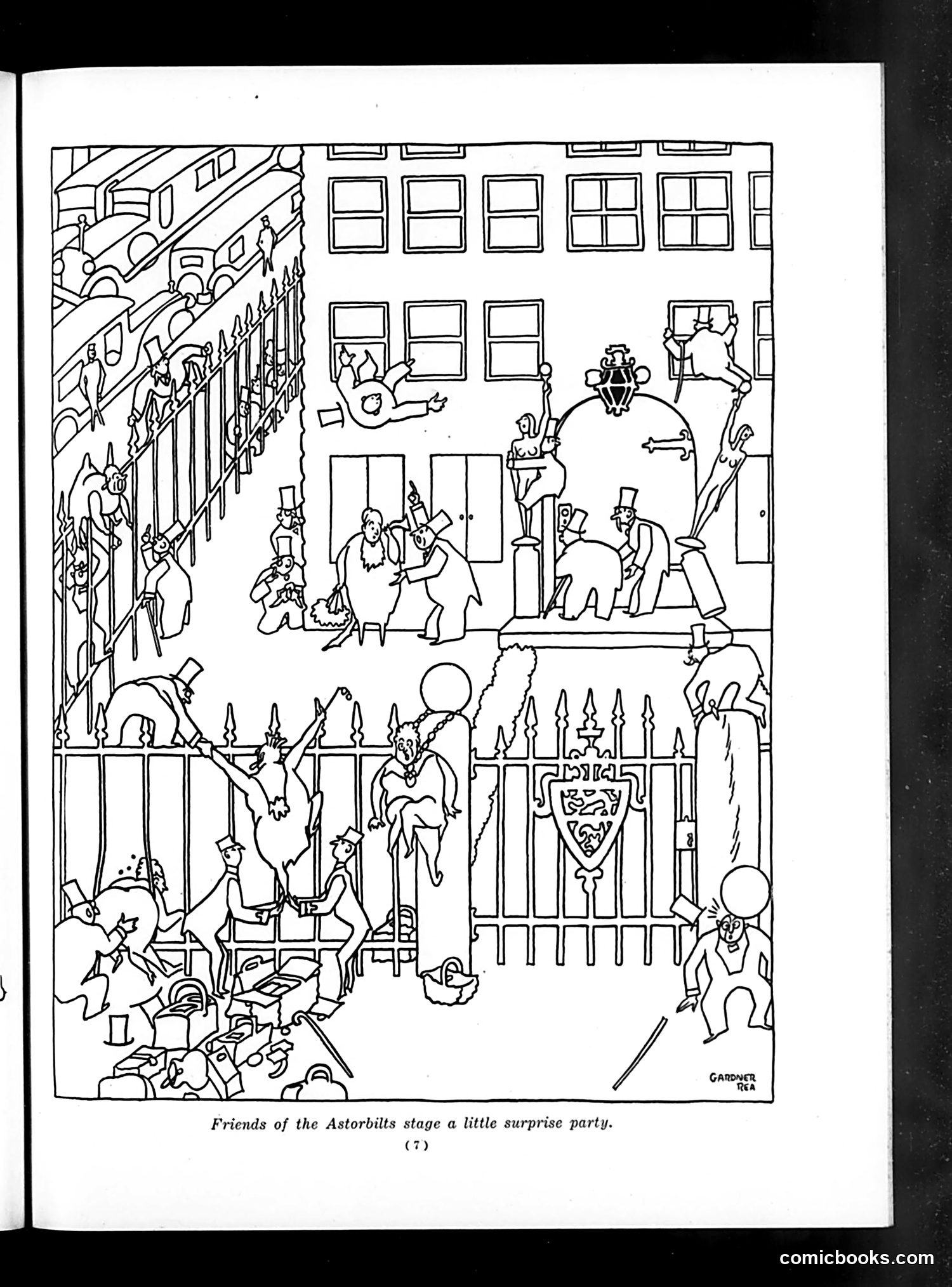
# Analysis of "Friends of the Astorbilts Stage a Little Surprise Party" This single-panel cartoon depicts an elaborate outdoor party in front of a large building, with multiple levels of activity. The title references the "Astorbilts"—an apparent satirical reference to the wealthy Astor family, prominent American socialites and industrialists. The humor appears to target extravagant upper-class entertaining: the scene shows elaborate decorations, performers, musicians on a stage, and numerous guests in formal attire engaged in conspicuous consumption and revelry. The comic critique likely mocks the ostentatious nature of Gilded Age wealth and the frivolous pastimes of the ultra-wealthy. The signature reads "GARDNER '12" (or similar), suggesting this cartoon dates to approximately 1912. The satire typical of *Life* magazine during this era often lampooned nouveau riche excess.
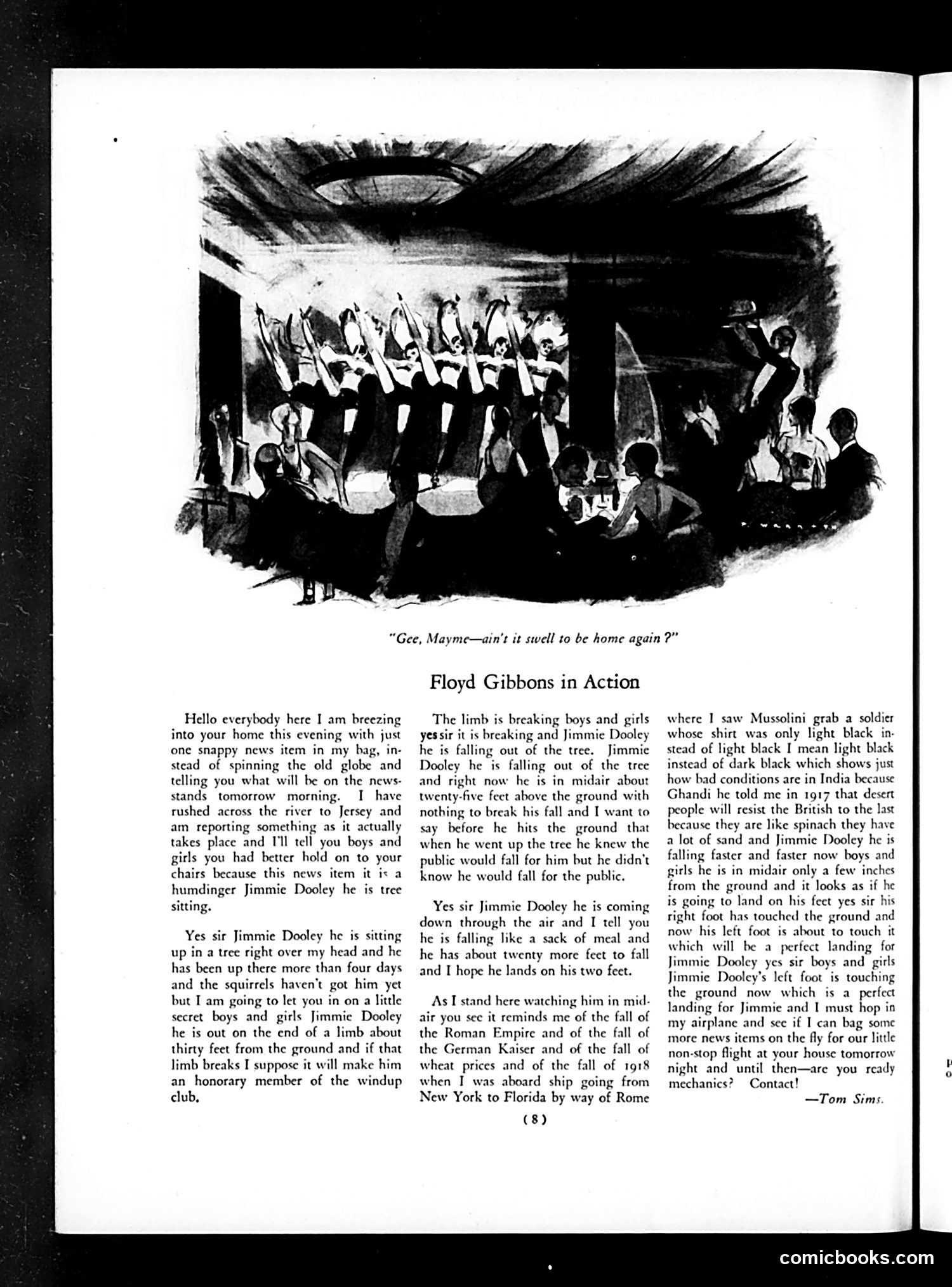
# Floyd Gibbons in Action This page satirizes **Floyd Gibbons**, a famous war correspondent known for dramatic radio broadcasts. The cartoon depicts him broadcasting from what appears to be a nightclub or social venue, describing a child (Jimmie Dooley) falling from a tree in exaggerated, breathless language—comparing it to historical catastrophes like the fall of Rome and the German Kaiser. The satire mocks Gibbons's sensationalist style: he transforms a mundane domestic incident into epic tragedy. The text's breathless tone ("Yes sir Jimmie Dooley he is coming down through the air...") parodies his characteristic rapid-fire delivery and tendency toward overblown drama. The joke is that Gibbons treats minor news with the gravity of major historical events, satirizing both his broadcasting persona and 1920s media sensationalism.
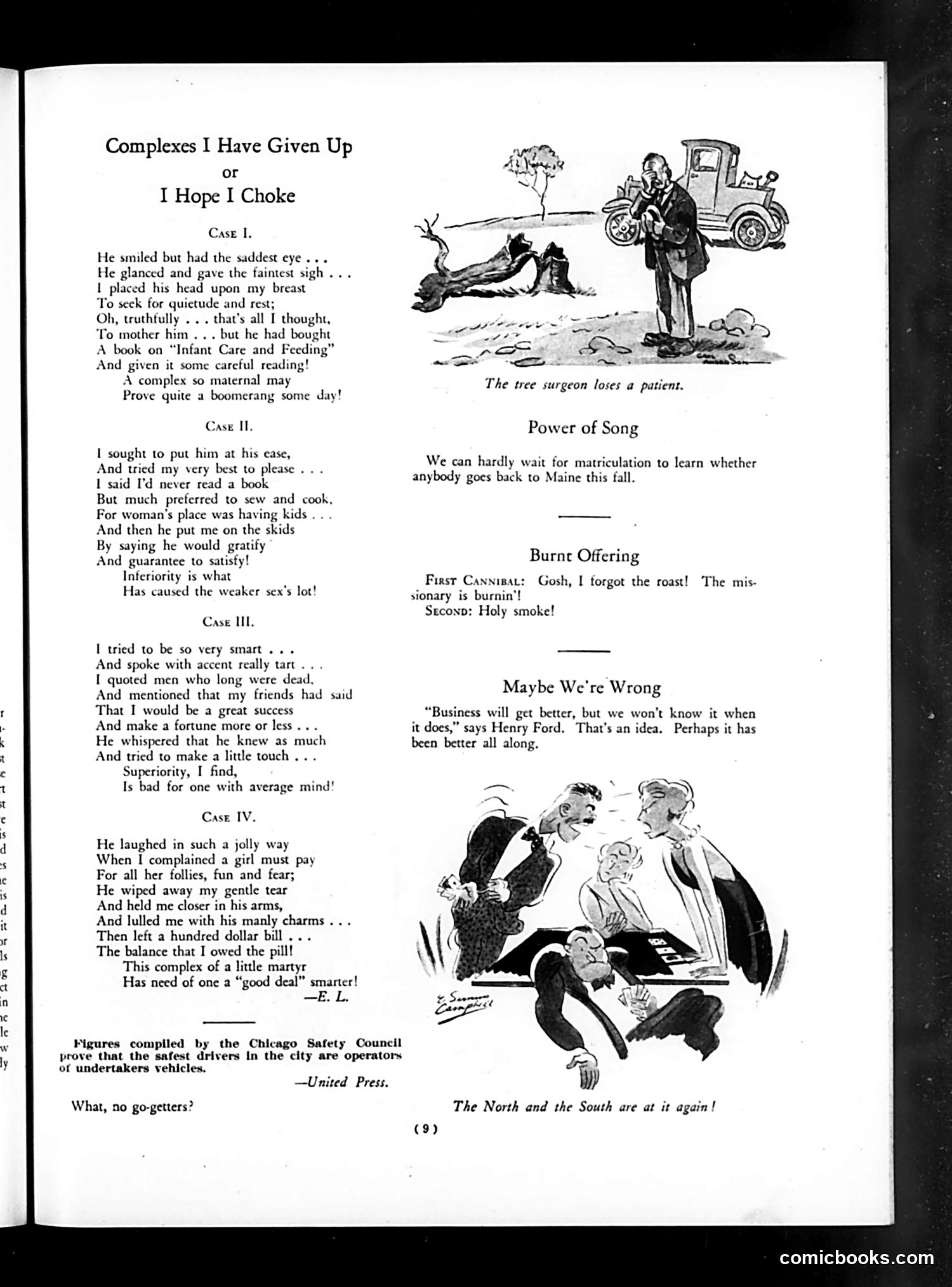
# Analysis of Life Magazine Page This page satirizes gender roles and relationship dynamics of the early 20th century through four poetic "cases" about male-female complexes. **The main cartoon** ("The tree surgeon loses a patient") shows a man lying beneath a fallen tree while another man stands nearby with a car—likely mocking a husband's incompetence or bad luck, positioned against an image of male professional success. **The four poems** humorously describe men's anxieties: Case I involves infant care books backfiring; Case II shows a man's discomfort with domestic expectations; Case III satirizes intellectual pretension; Case IV depicts emotional manipulation in relationships. The humor targets masculine insecurity and changing social expectations as women gained education and independence. The page mocks both men's resistance to women's autonomy and their emotional manipulation when threatened.
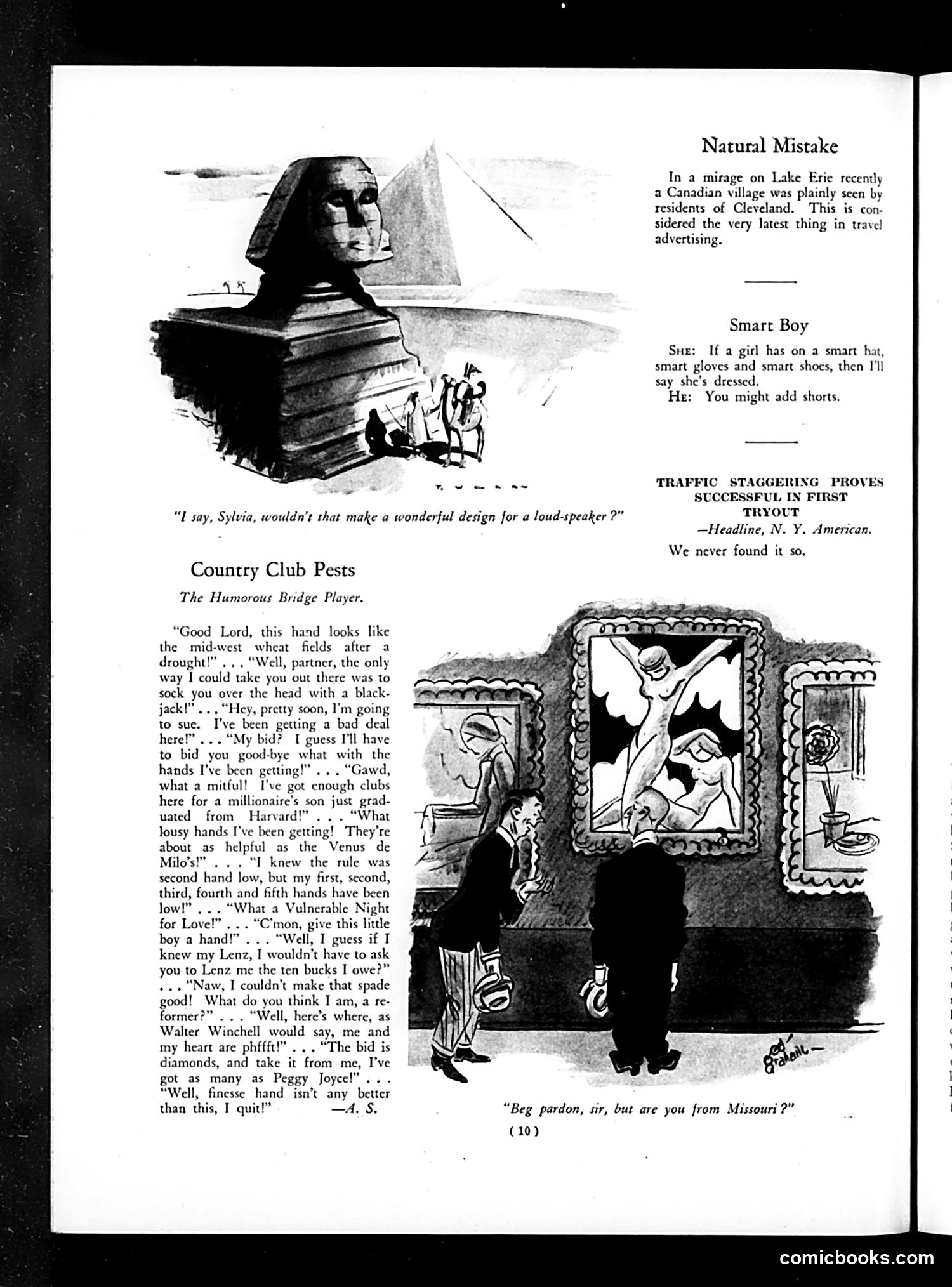
# Page 10 Analysis: Life Magazine Humor This page contains three brief humorous items typical of Life's satirical content: 1. **"Natural Mistake"**: A joke about a mirage on Lake Erie showing a Canadian village to Cleveland residents—mocking travel advertising claims. 2. **"Smart Boy"**: A brief dialogue joke where a girl lists fashionable accessories, and a boy suggests adding "shorts," implying she's underdressed. 3. **"Country Club Pests"**: The main feature, titled "The Humorous Bridge Player," presents a long monologue of a stereotypical wealthy, name-dropping bridge player. The character boasts about Harvard connections, romantic conquests, and financial status while playing cards—satirizing upper-class pretension and poor sportsmanship at country clubs. 4. **Bottom cartoon**: Shows a man asking another "Beg pardon, sir, but are you from Missouri?"—likely referencing the "Show-Me State" stereotype about skepticism or rusticity.