A complete issue · 42 pages · 1930
Life — August 22, 1930
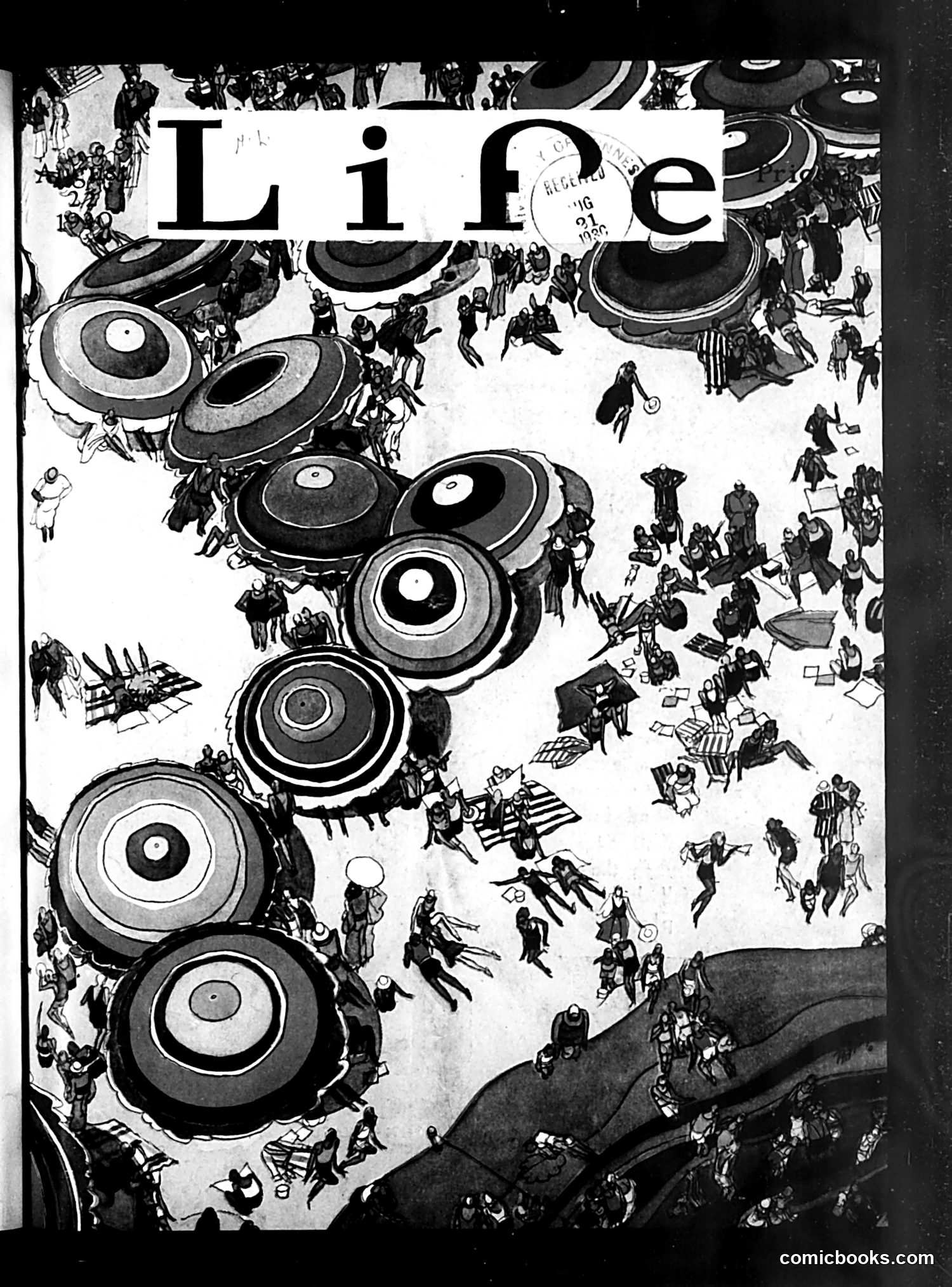
# Life Magazine Cover Analysis This appears to be a Life magazine cover featuring an aerial or bird's-eye-view illustration of a crowded public space—likely a park or plaza—with numerous small human figures scattered below large circular objects that resemble umbrellas or parasols viewed from above. The satire likely comments on **mass leisure, consumerism, or urban crowding** in early-to-mid 20th century America. The contrast between the massive, uniform circular structures dominating the composition and the tiny, scattered people below suggests commentary on how individual humans are dwarfed by commercial or institutional forces. Without visible date or clearer identifying details, the specific historical reference remains unclear, though the style suggests the 1920s-1940s era of Life magazine's peak satirical influence.
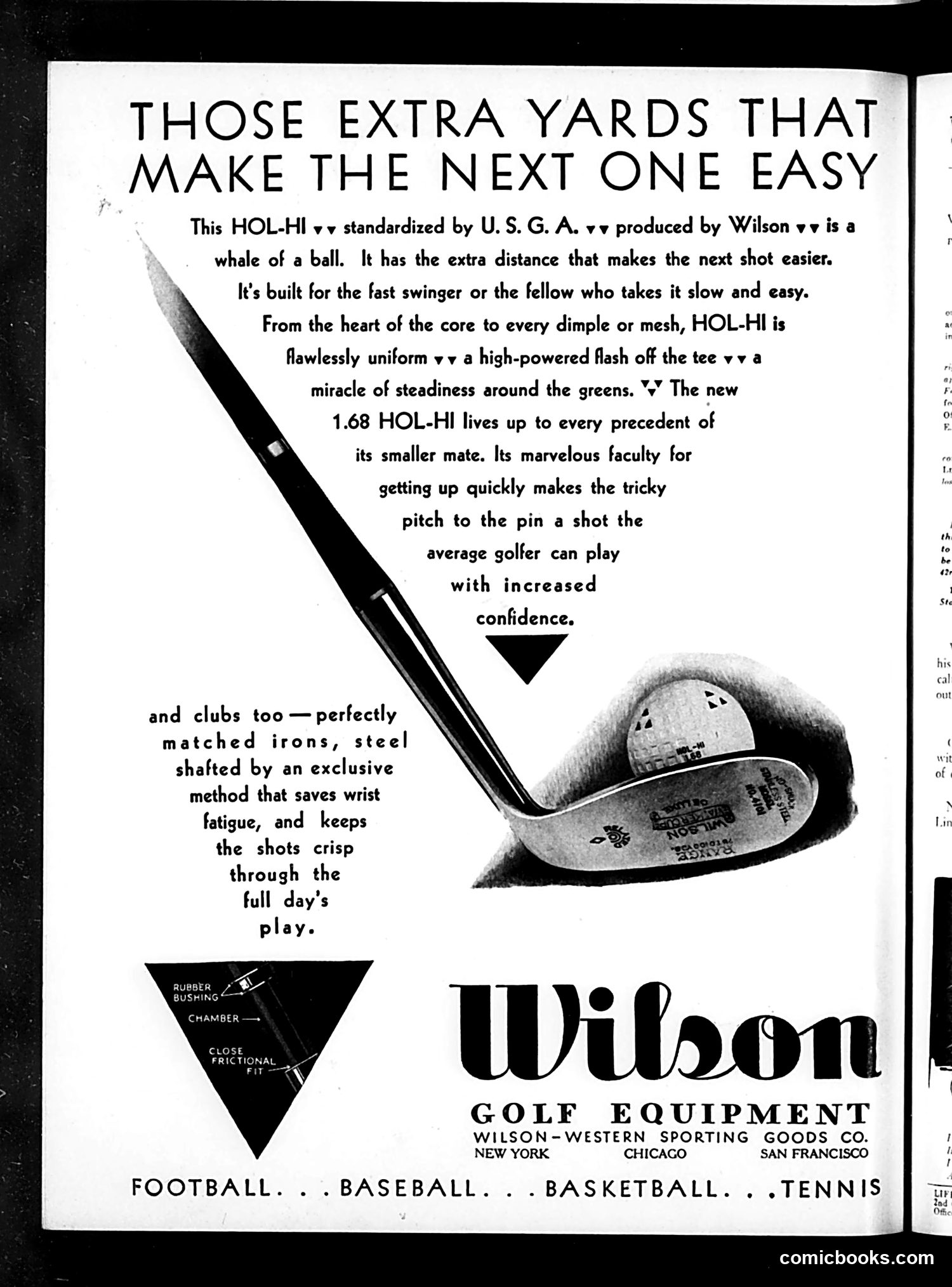
# Analysis This is a **Wilson golf equipment advertisement**, not satirical content. There are no political cartoons or caricatures present. The ad promotes Wilson's "HOL-HI" golf ball, emphasizing that its extra distance makes the next shot easier. It appeals to both aggressive ("fast swinger") and cautious ("slow and easy") golfers. The copy highlights the ball's uniform construction, dimple pattern, and the company's matched iron sets with specially designed steel shafts. The visual shows a golf club and ball in a realistic product photograph. A technical diagram explains the shaft's "close frictional fit" design to reduce wrist fatigue. The page represents standard 1930s–1940s advertising: manufacturer branding across multiple sports (football, baseball, basketball, tennis) with aspirational messaging about performance and consistency.
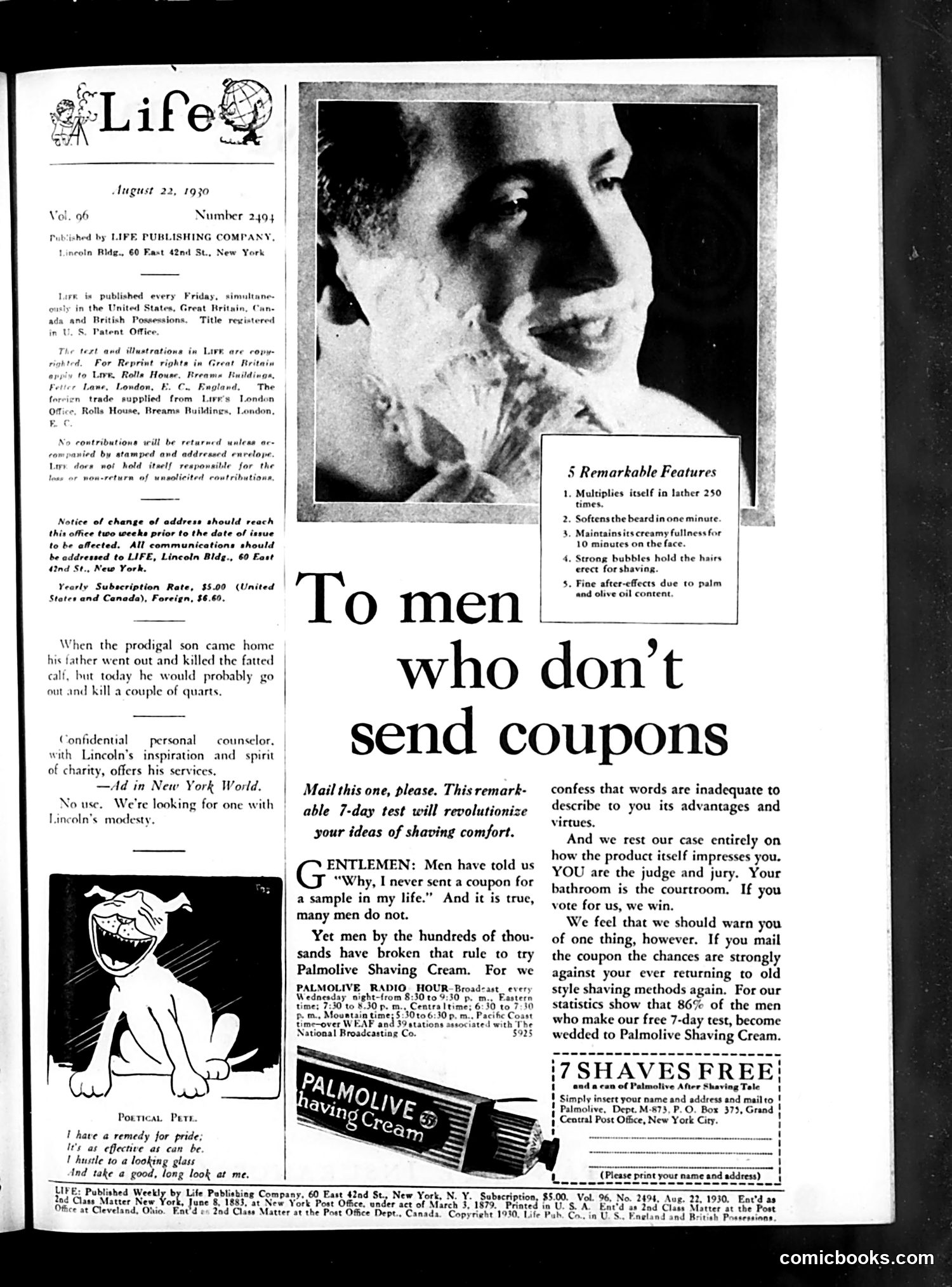
This page is primarily a **Palmolive Shaving Cream advertisement** from August 22, 1930, disguised as editorial content. The main headline—"To men who don't send coupons"—is a mock-serious appeal addressed to men resistant to mail-in promotions. The ad uses social pressure as its sales tactic, essentially shaming reluctant customers by suggesting that hundreds of thousands of men have already tried the product via coupon. The "5 Remarkable Features" box lists specific shaving benefits. The small political cartoon at bottom left appears unrelated—a brief satirical comment, though the OCR text is unclear about its specific subject. The bulk of the page is straightforward 1930s advertising copy and a coupon offer for "7 shaves free," reflecting the era's common direct-mail marketing strategies.
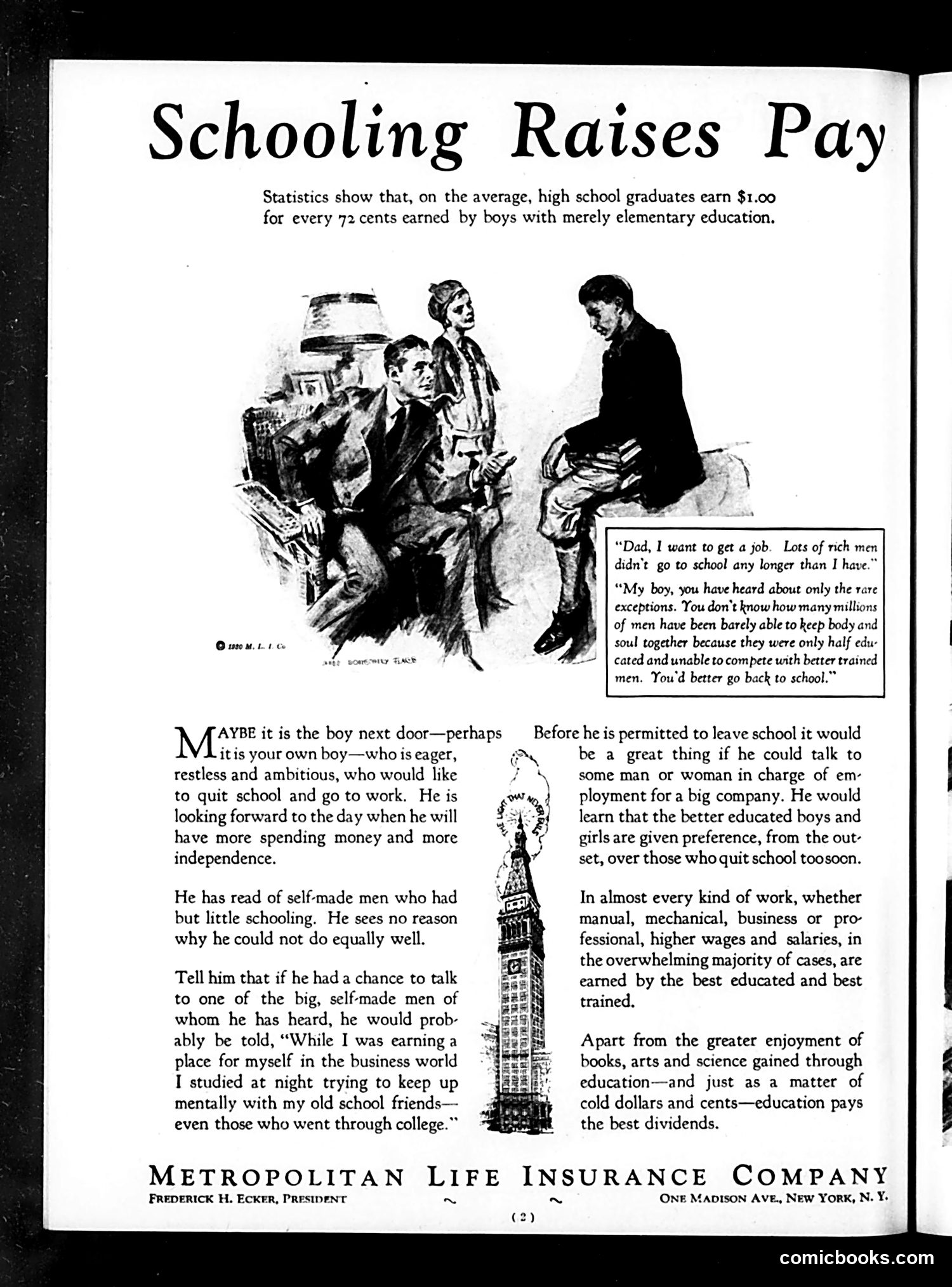
# "Schooling Raises Pay" - Metropolitan Life Insurance Advertisement This is **not satire but persuasive advertising** by Metropolitan Life Insurance Company. The page uses a domestic scene—a boy asking his father about quitting school for work—to argue that **education increases earning potential**. The ad presents statistics: high school graduates earn $1.00 for every 72 cents earned by boys with only elementary education. The father counsels his son that while self-made men exist, they are exceptions. Better-educated workers receive preference in employment and earn higher wages across manual, mechanical, and professional fields. The underlying pitch: education provides financial security, making life insurance (and Metropolitan's policies) a worthwhile investment for families' futures. The message reflects early 20th-century American faith in education as economic mobility.
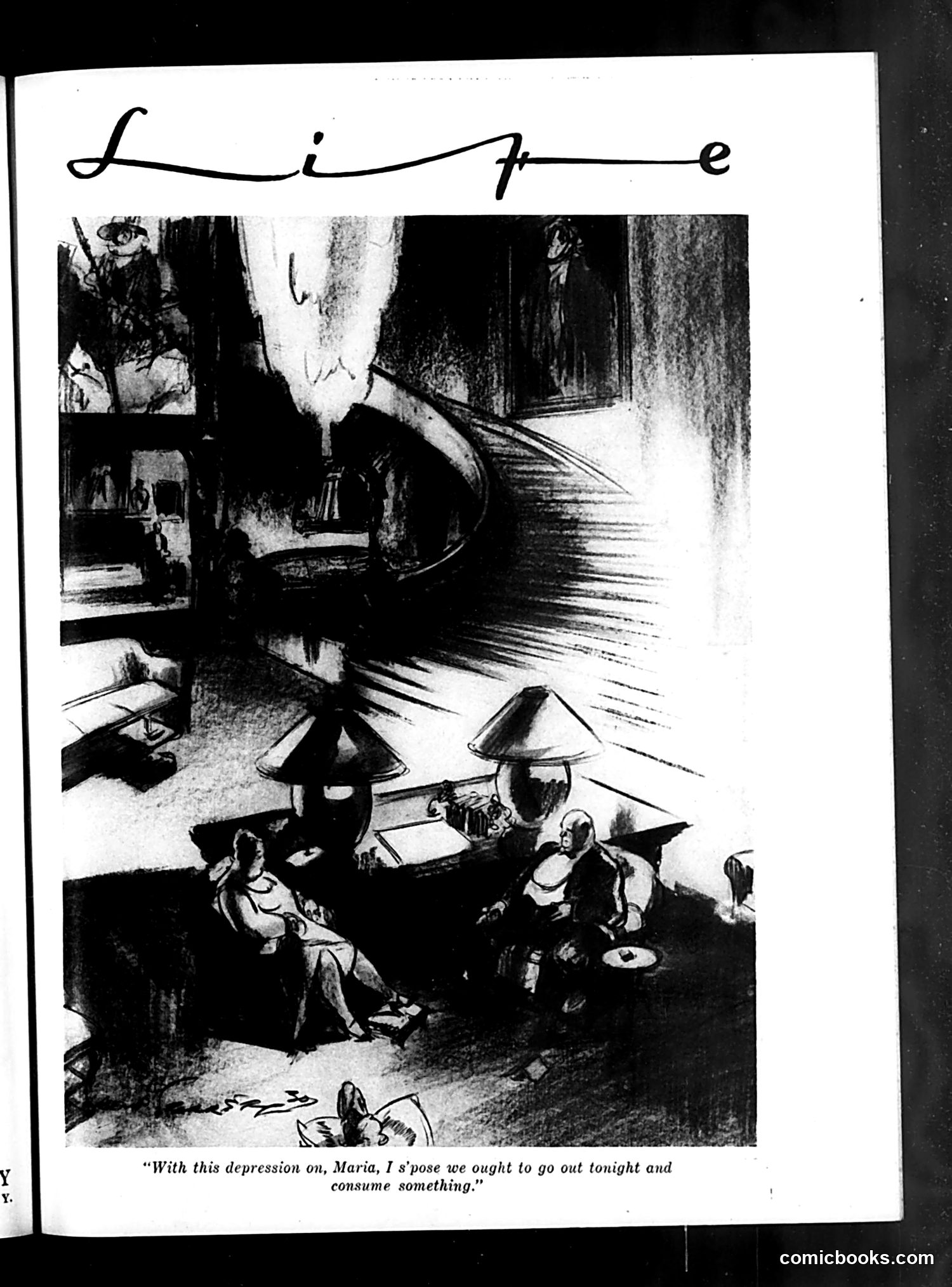
# Analysis of "Life" Magazine Page This appears to be a satirical cartoon from Life magazine's "Life" section (as indicated by the handwritten title at top). The illustration depicts what seems to be an Asian setting, with figures wearing conical hats typical of East Asian dress, seated outdoors. The caption reads: "With this depression on, Maria, I s'pose we ought to go out tonight and consume something." The satire targets Depression-era consumer culture. Despite economic hardship ("this depression"), the character suggests they should go out and spend money anyway—likely mocking both the contradiction of Depression poverty and society's continued emphasis on consumption and entertainment as solutions to economic woes. The exotic setting may suggest either travel escapism or serve as mere decorative background for the economic commentary.
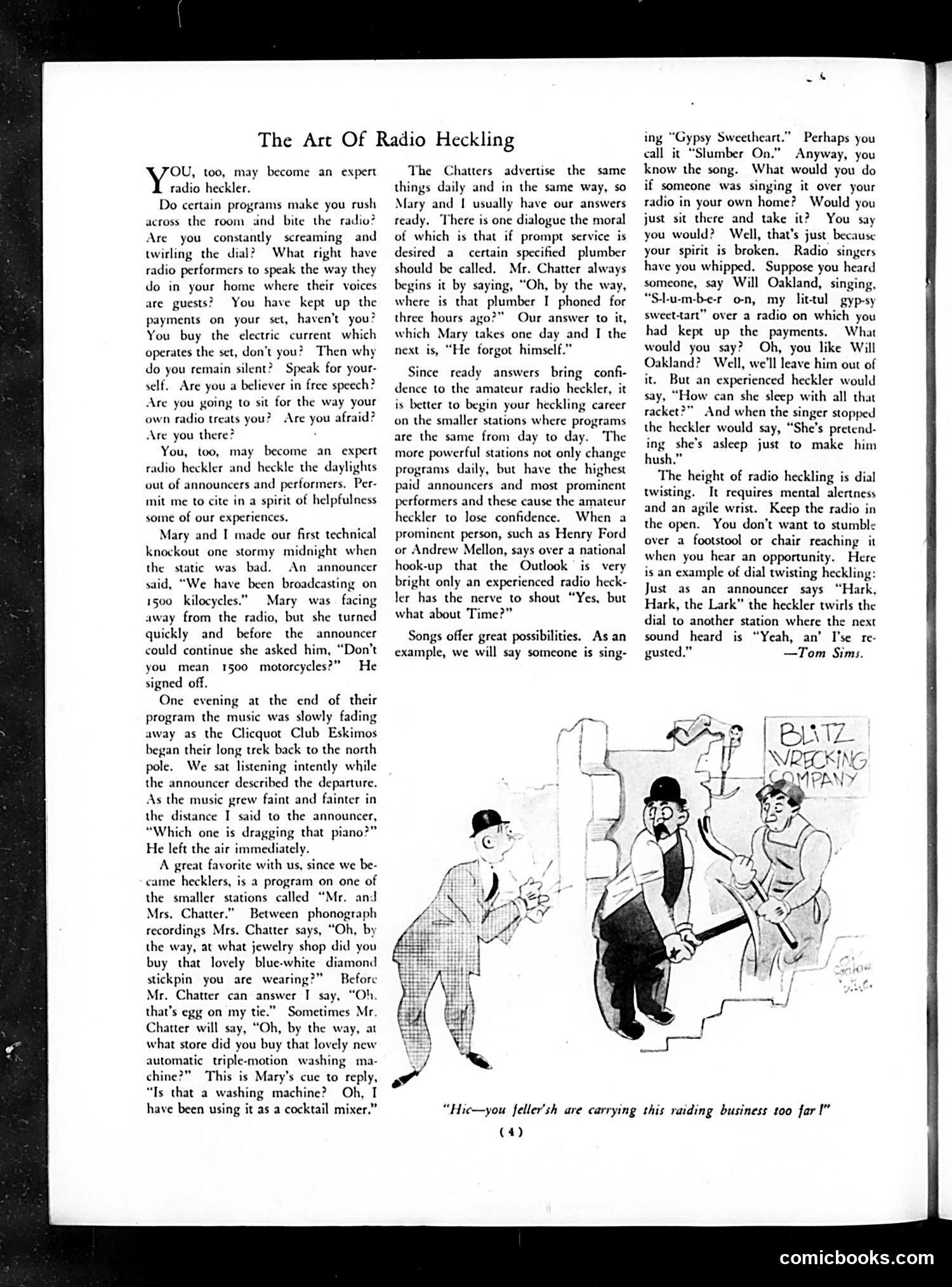
# "The Art of Radio Heckling" - Life Magazine Satire This article satirizes amateur radio enthusiasts ("hecklers") who interrupt broadcasts on early radio stations. The author describes how listeners would call in during live programming to harass announcers—asking absurd questions like "Don't you mean 1500 motorcycles?" or inquiring about jewelry purchases. The accompanying cartoon depicts radio hecklers calling into a station, with one declaring "BLITZ HECKING CAMPAIGN" while another complains the activity has "gone too far." The satire targets the novelty and chaos of early radio: with no screening, any listener could reach live broadcasters mid-show. The piece humorously documents this new form of public nuisance enabled by radio technology, treating amateur heckling as a widespread amateur sport among radio listeners.
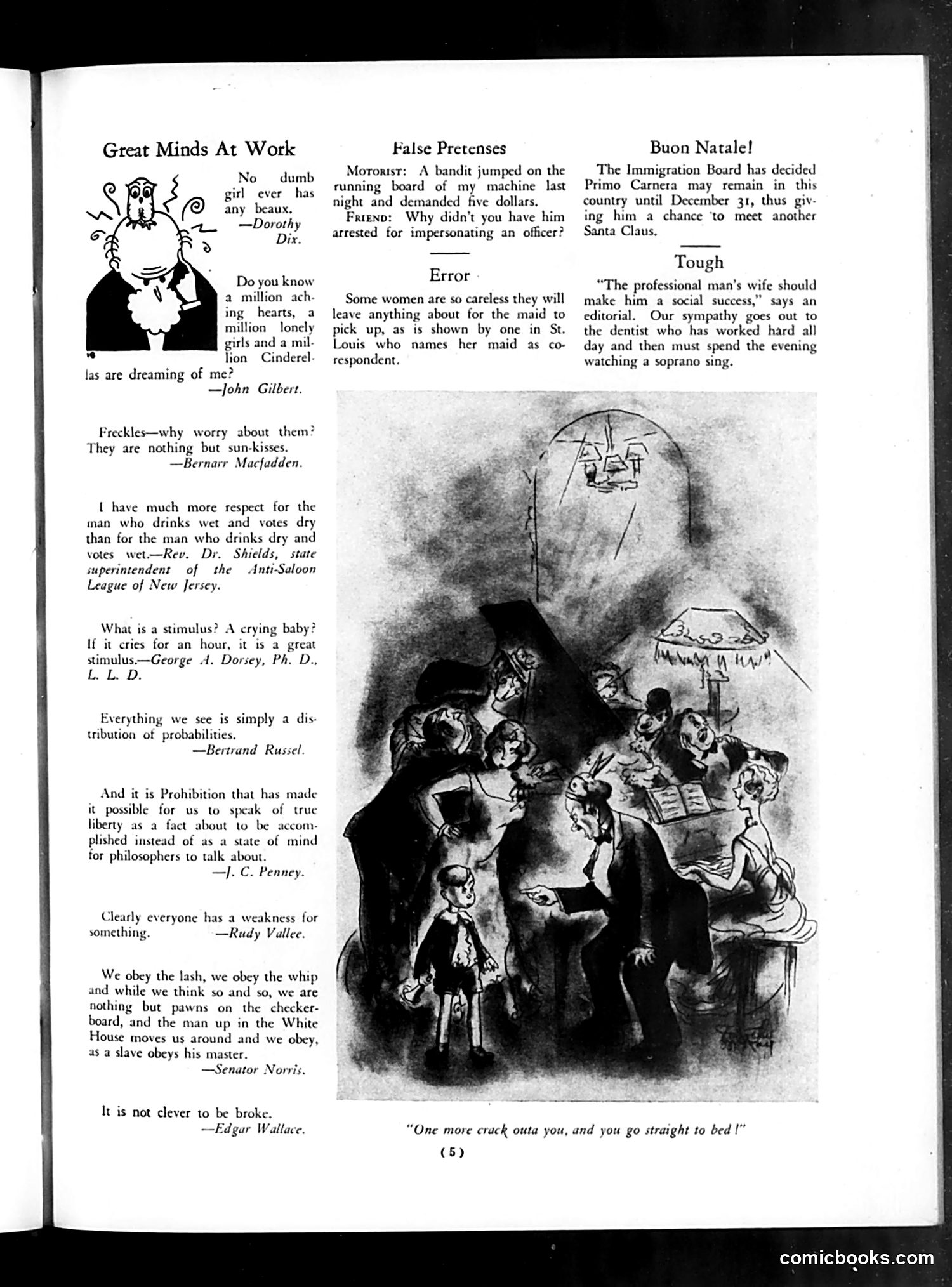
# Analysis of Life Magazine Page This page contains satirical quotes and a political cartoon addressing immigration and holiday traditions. **The Main Cartoon** ("One more crack outa you, and you go straight to bed!") depicts Santa Claus disciplining rowdy children during Christmas—likely a commentary on American behavior or social chaos. **"Buon Natale!" Section** references the Immigration Board keeping "Primo Carrera" in the country until December 31st to meet "another Santa Claus"—appearing to satirize immigration policy or the treatment of foreign nationals around Christmas. **"Great Minds at Work" Quotes** are satirical observations from various figures mocking Prohibition, women's roles, prohibition's effects on free speech, and social hypocrisy of the era. The page reflects 1920s concerns: Prohibition enforcement, immigration debates, and gender dynamics in American society.
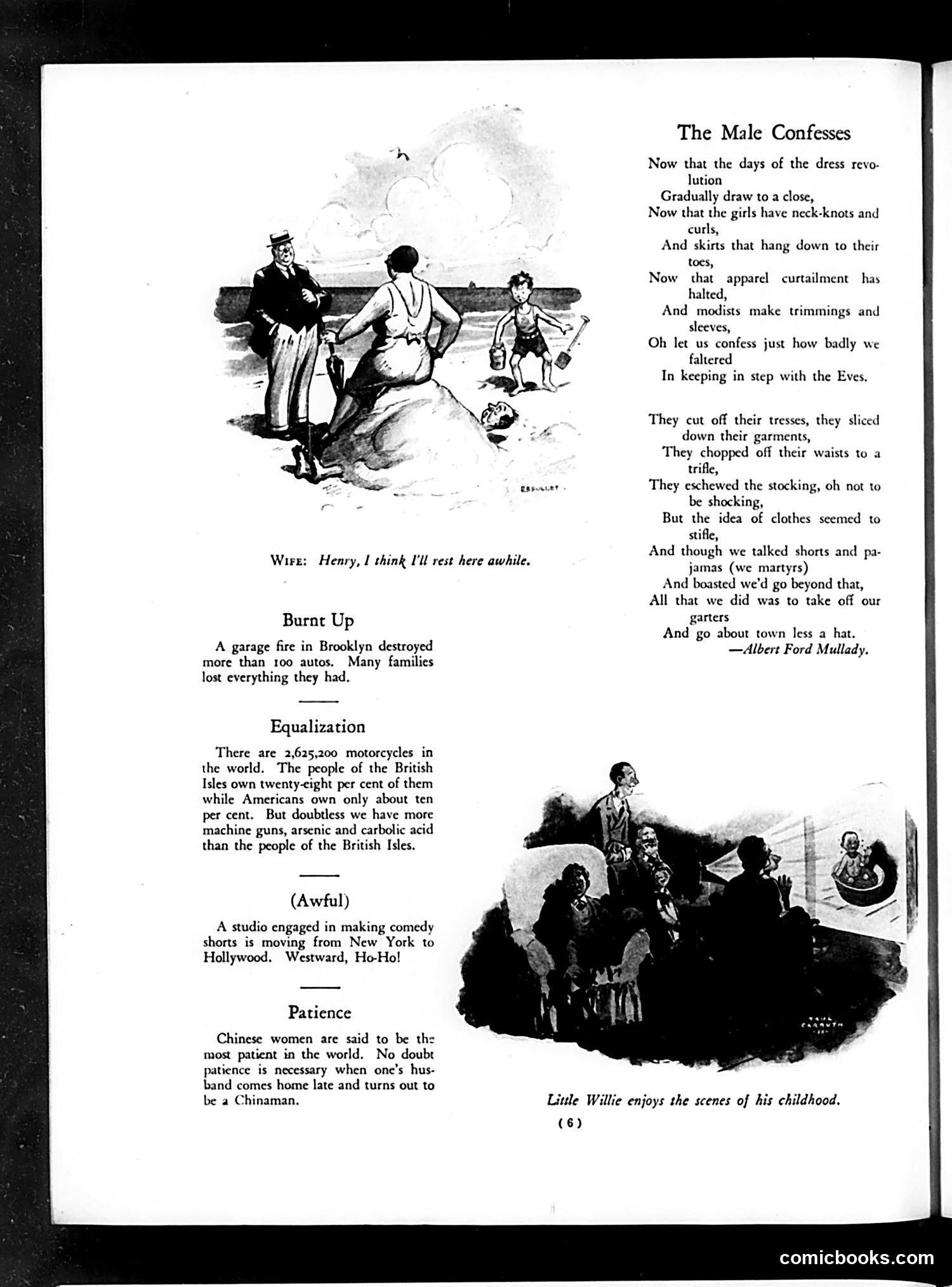
# "The Male Confesses" and Related Satirical Items **Top cartoon**: A wife confronts her husband about fashion. The poem "The Male Confesses" mocks men who complained about women's fashion changes—shorter skirts, fewer petticoats, simpler garments. The husband admits men talked big about accepting these changes ("we boasted we'd go beyond that"), but actually just removed their hats and garters rather than genuinely adapting. The satire criticizes male hypocrisy regarding women's liberation and the dress reform movement. **Lower items** are brief satirical notes on unrelated topics: a Brooklyn garage fire, motorcycle statistics comparing Britain and America, a comedy studio relocating west, and observations about Chinese women's patience. The page captures early 20th-century gender tensions over women's changing fashion and social roles.
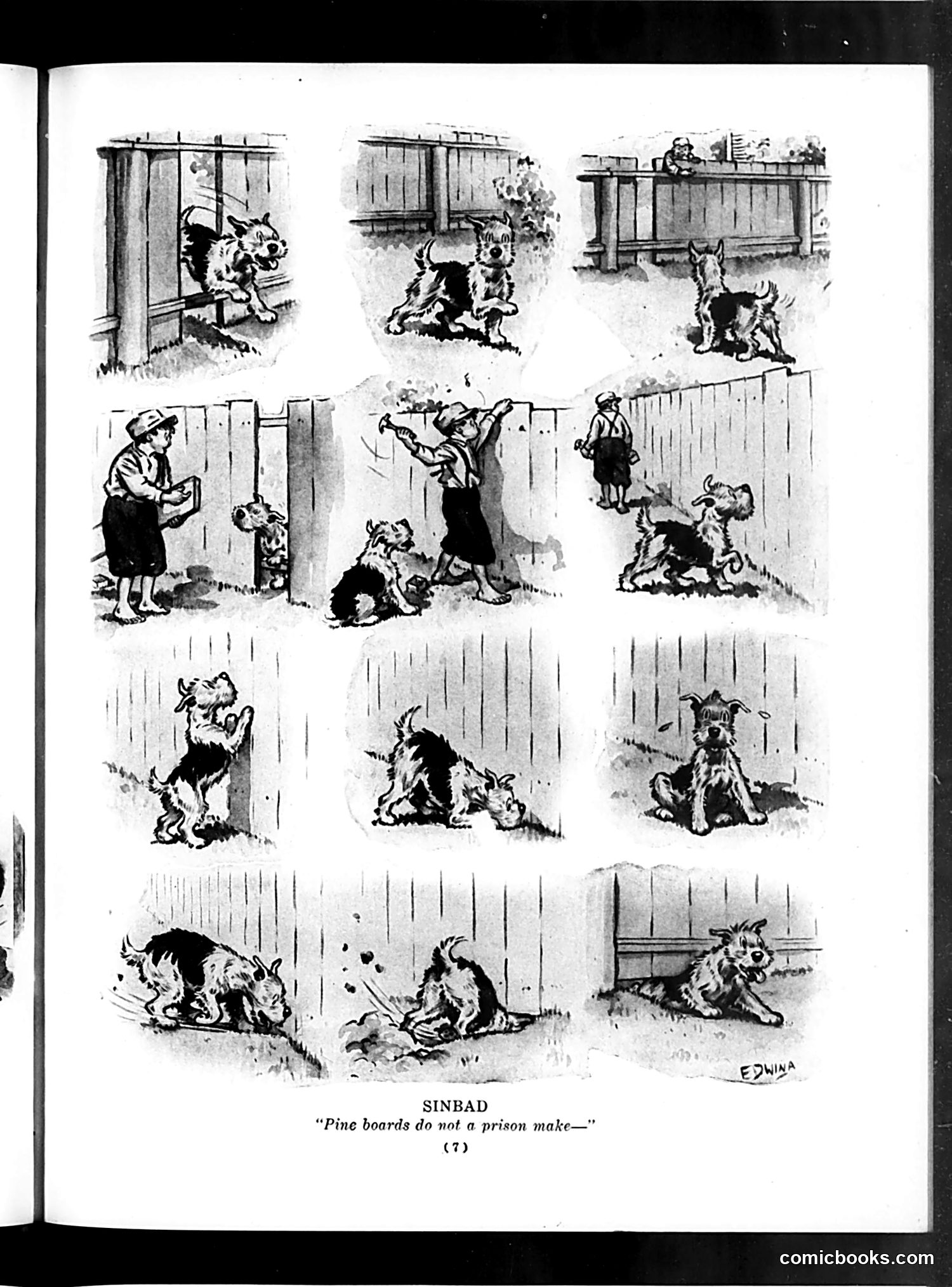
# "Sinbad: Pine boards do not a prison make" This is a comic strip sequence showing a dog (Sinbad) repeatedly escaping from or breaching wooden fence enclosures. The title quotes Alexander Pope's famous line "Stone walls do not a prison make," applying it humorously to pine boards. The joke progresses through twelve panels depicting the dog's various escape attempts and exploits—jumping over fences, digging under them, breaking through, or simply ignoring the barriers. The cartoon satirizes the futility of trying to contain an determined, resourceful animal with inadequate fencing. The strip is credited to "EDWINA" (the artist's signature). It's a lighthearted observation about pet behavior rather than political satire, appearing in *Life* magazine's humor section.
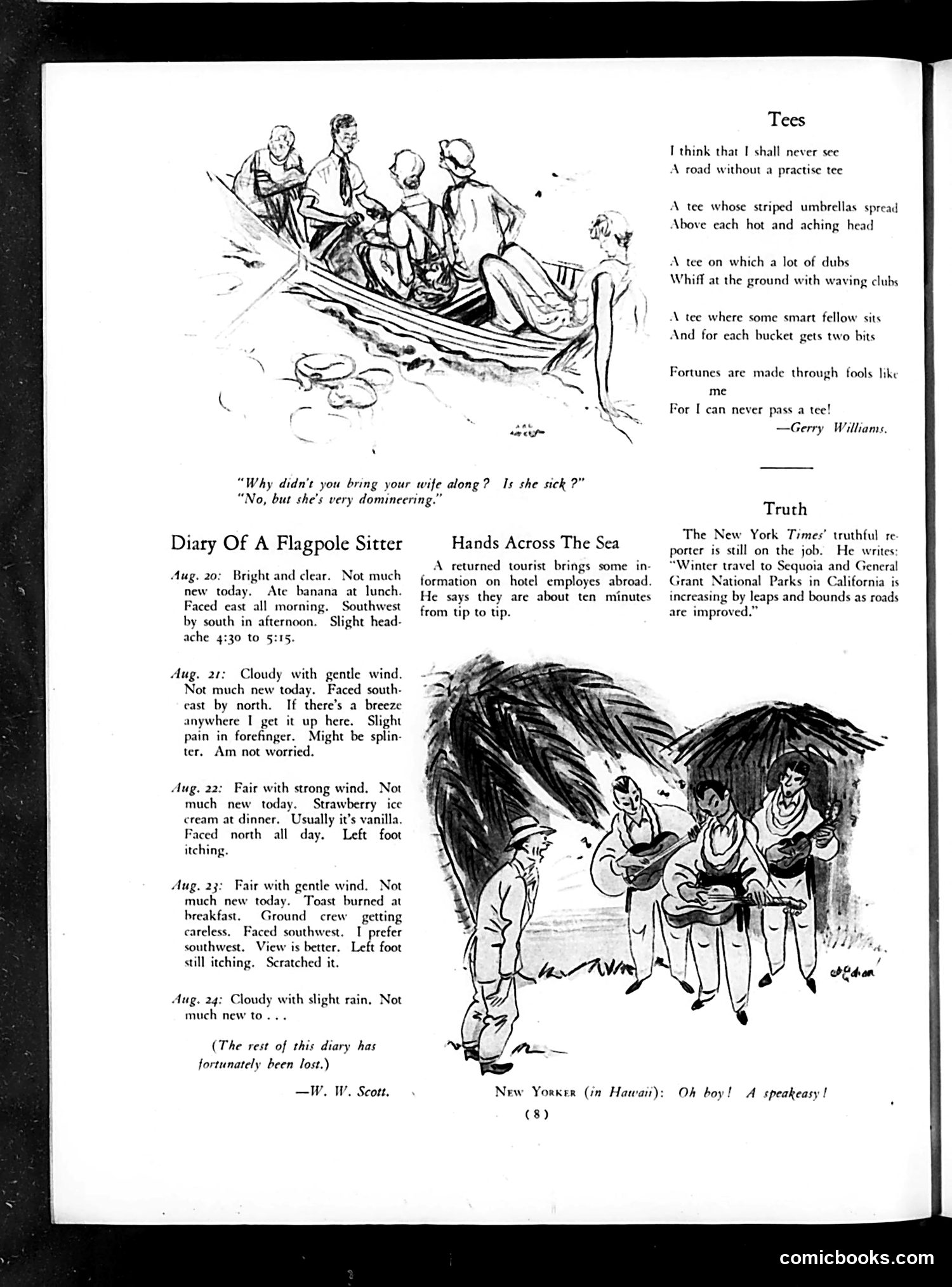
# Analysis of This Life Magazine Page This page contains three separate pieces of humor content: **"Tees"** — A poem by Gerry Williams celebrating golf practice tees, illustrated with a sketch of golfers relaxing under umbrellas on a course. The humor is gentle, praising tees as essential tools for making fortunes in golf. **"Diary of a Flagpole Sitter"** — A brief diary by W.W. Scott documenting daily weather and minor events (Aug. 20-24), with a note that the rest was lost. This appears to reference the 1920s fad of flagpole sitting—a bizarre endurance stunt where people sat atop tall poles for extended periods, drawing crowds. **"Hands Across the Sea"** — A cartoon showing tourists in Hawaii encountering what appears to be a local speakeasy (referenced as "speakeasy" in the caption). The humor relies on Prohibition-era context, where illegal alcohol consumption was common even in tourist destinations.
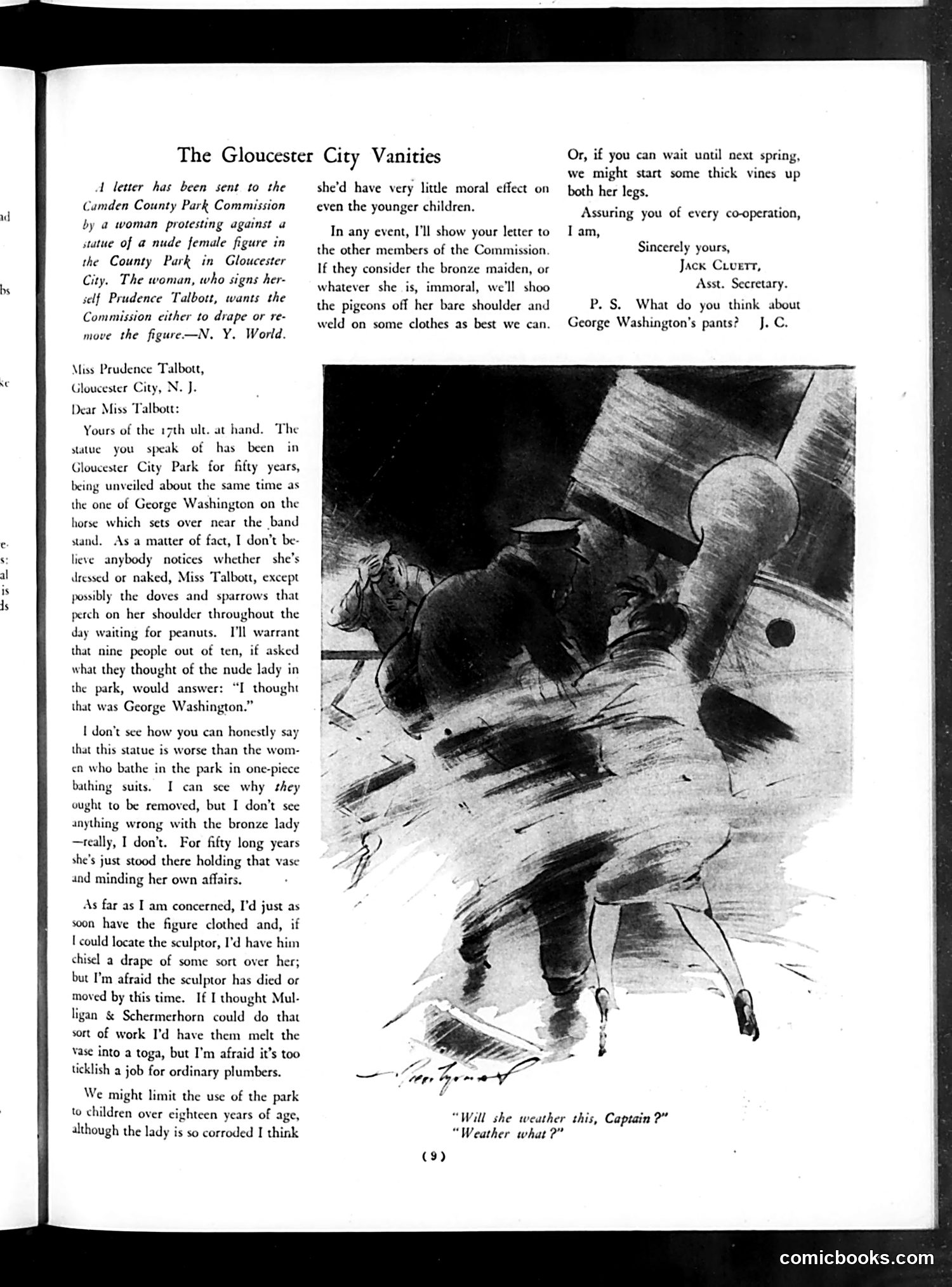
# Analysis of "The Gloucester City Vanities" Page This page contains a letter-to-editor debate about a bronze statue of a nude female figure in Gloucester City Park (New Jersey). A woman protested the statue's "immorality," and Jack Cluett, the park commission's assistant secretary, responds dismissively. Cluett argues the statue has stood unnoticed for fifty years, that it's no worse than women in bathing suits, and that removing it would be an unnecessarily difficult task. He suggests clothing the figure instead, or waiting until spring to plant vines to cover it. The accompanying cartoon shows a weathered statue being rained on, with the caption "Will the weather this, Captain?" — suggesting that time and nature will resolve the controversy without intervention, mocking the protester's concerns as petty.
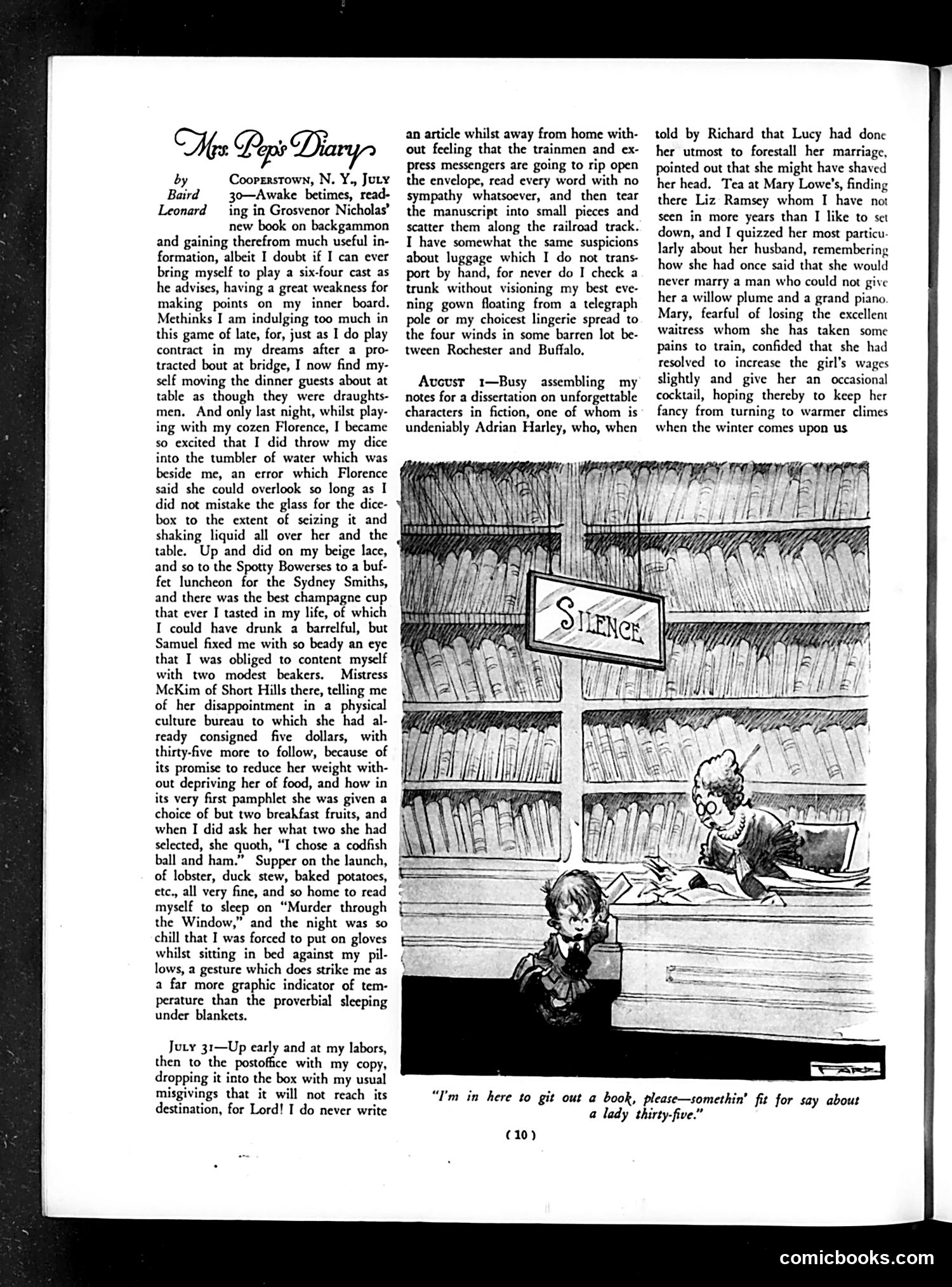
# Mrs. Pepps Diary - Library Scene Cartoon This is a diary entry by Baird Leonard dated July 30-31 from Cooperstown, NY. The accompanying cartoon illustrates a humorous library scene where a child approaches a librarian requesting a book "fit for a lady thirty-five" — apparently seeking age-appropriate reading material. The joke appears to mock both the child's innocence and the arbitrary nature of gendered reading recommendations of the era. The "SILENCE" sign visible in the library reinforces the stuffy, rule-bound atmosphere of early 20th-century libraries. The diary text itself contains various social observations about daily life, including comments on marriage, servants, and class dynamics typical of the period's satirical social commentary.