A complete issue · 44 pages · 1929
Life — November 15, 1929
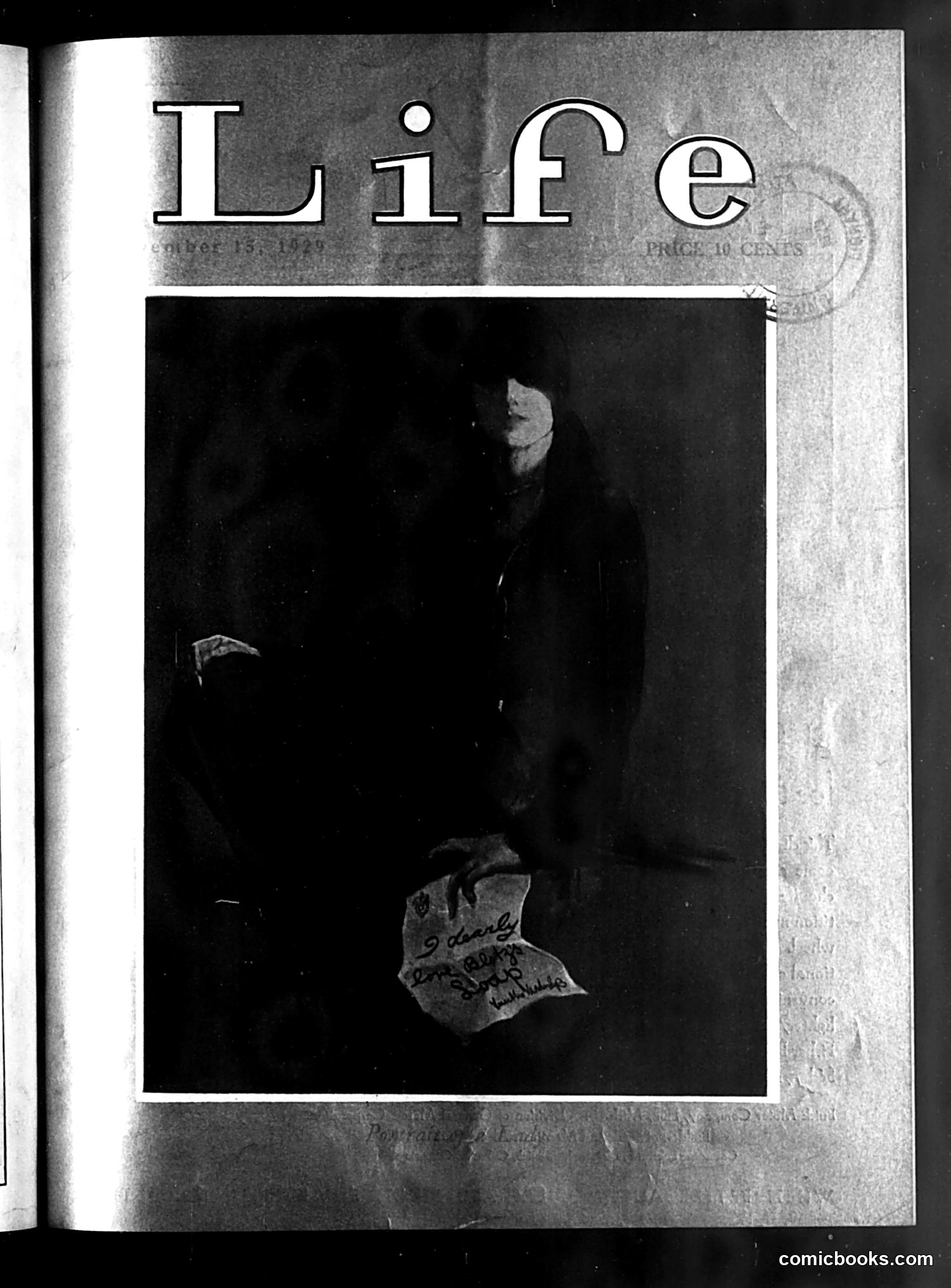
# Analysis I can see this is a *Life* magazine cover featuring the word "Life" in large letters at the top. The main image is a very dark photograph showing a figure in silhouette against a black background, with what appears to be a hand or arm gesture visible. There's handwriting or annotation on the lower portion of the photograph. However, the image quality and darkness make it difficult to identify the specific figure, date, or satirical subject with confidence. Without clearer visibility of the photograph's details or accompanying article text, I cannot reliably determine which political or social figure this caricatures, what event it references, or what the intended satire conveys. To provide accurate analysis rather than speculation, I would need either a clearer image or additional contextual text from the magazine page.
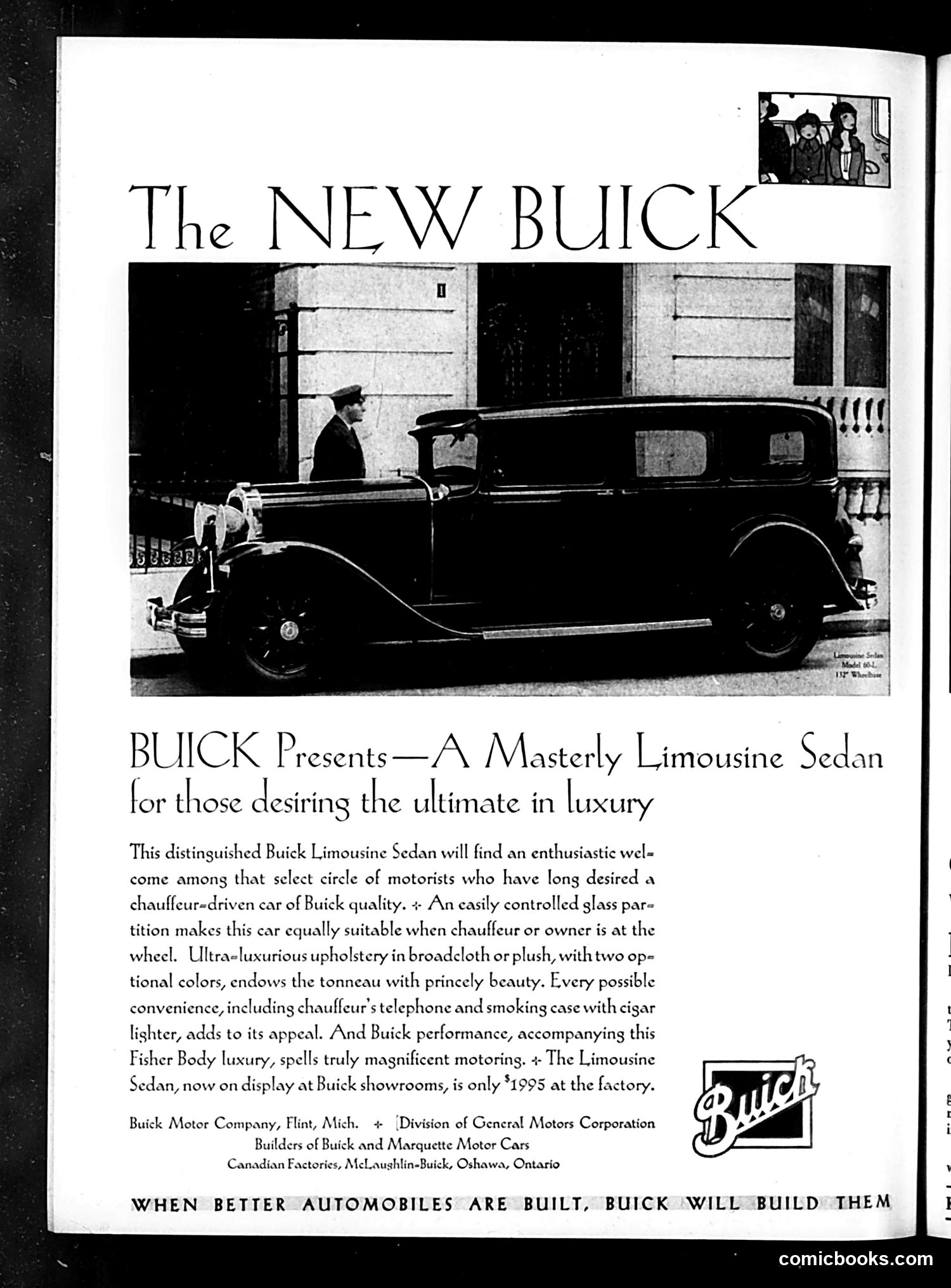
# Analysis This is **not a cartoon or satire page** — it's a straightforward luxury automobile advertisement for Buick's new Limousine Sedan model, circa 1920s-1930s based on the styling. The page features a photograph of an elegant chauffeur-driven sedan parked before an upscale building, with a uniformed driver visible. The advertisement emphasizes luxury features: glass partition between driver and passengers, ultra-luxurious upholstery, telephone, and smoking accessories. The text targets wealthy motorists seeking premium vehicles. The price of $1,495 "at the factory" was substantial for the era, positioning this as an exclusive product. The Buick logo and company information appear at bottom. This is period **commercial advertising**, not political or social satire.
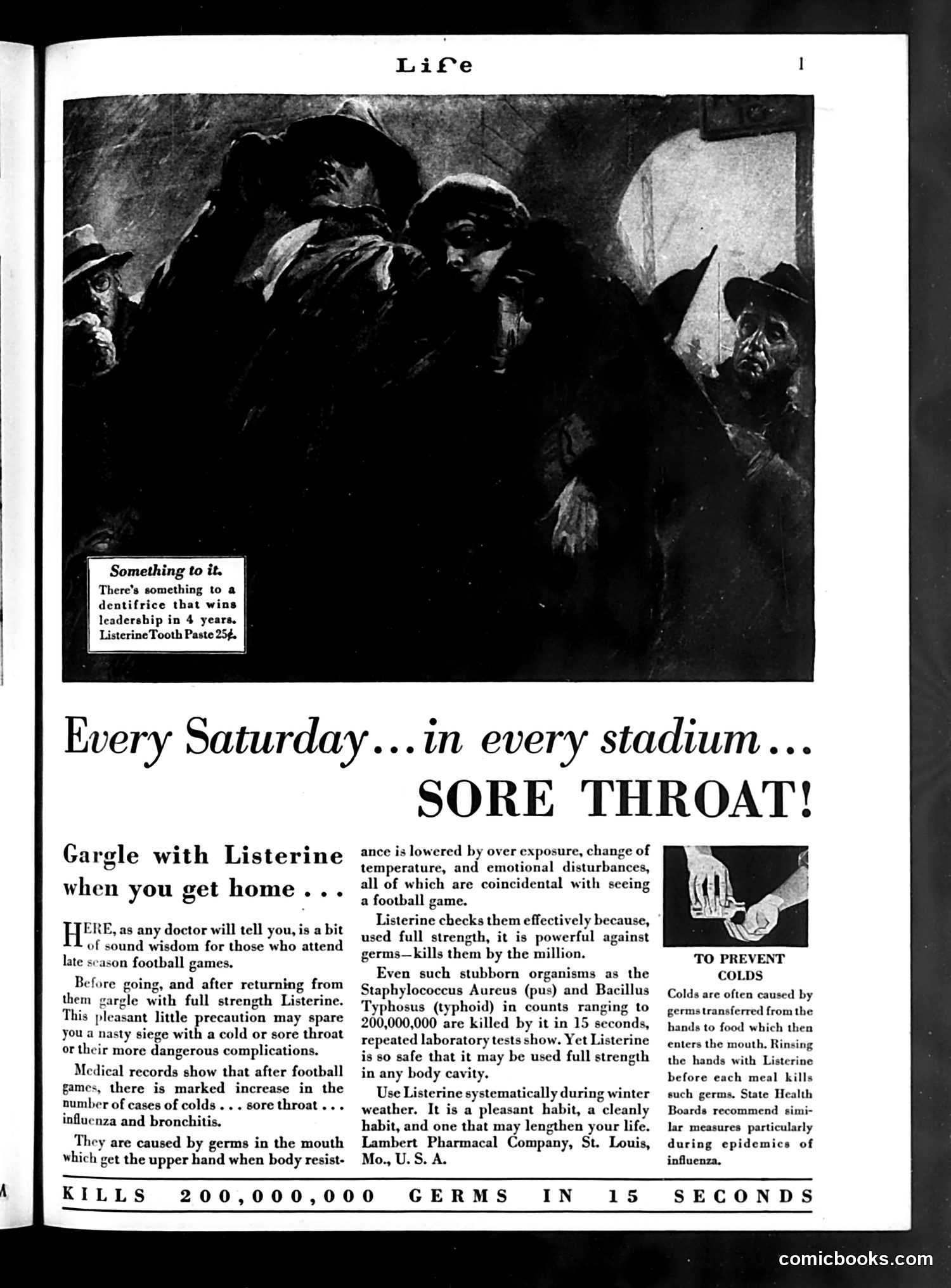
# Analysis This is primarily a **Listerine advertisement**, not a political cartoon. The dramatic dark image at top appears to show a crowd of people in distress or discomfort—illustrating the advertiser's claim about sore throats at football games. The ad uses humorous exaggeration to connect attending football games (specifically Saturday games) with catching colds and sore throats. The text claims that "body resistance is lowered by over exposure, change of temperature, and emotional disturbances, all of which are coincidental with seeing a football game." The joke is satirizing the common experience: attending outdoor fall sports events leads to illness. Listerine positions itself as preventative medicine—a gargle solution that "kills 200,000,000 germs in 15 seconds." This reflects early 20th-century advertising's tendency to manufacture anxieties while promoting medical remedies.
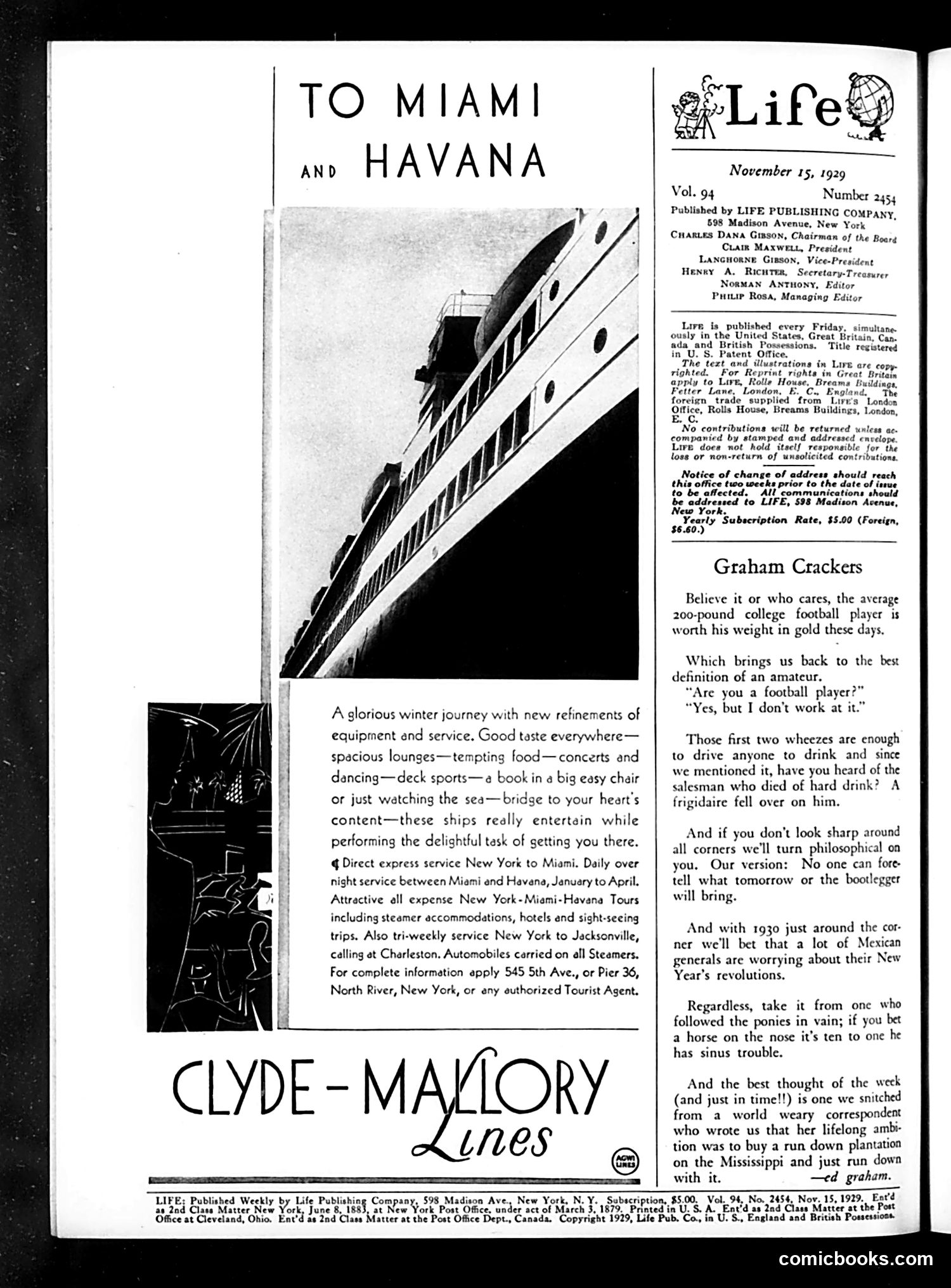
# Analysis This page is primarily **advertising for Clyde-Mallory shipping lines**, promoting their steamship service between New York and Miami/Havana. The large ship photograph illustrates the "glorious winter journey" the company offered. The right column contains **"Graham Crackers,"** a satirical humor column. Its jokes reference: - **College football players' market value** (they were "worth their weight in gold") - **Amateur athletics debate** — the tension between amateur status and hidden compensation - **1930 New Year's concerns** about Mexico's political situation (likely revolution-related) - **General social commentary** about horses, drinking, and a correspondent's plantation ambitions The humor is light, conversational satire typical of Life magazine's style — social observation rather than sharp political critique. The column mocks contemporary leisure-class concerns and hypocrisy around amateurism in sports.
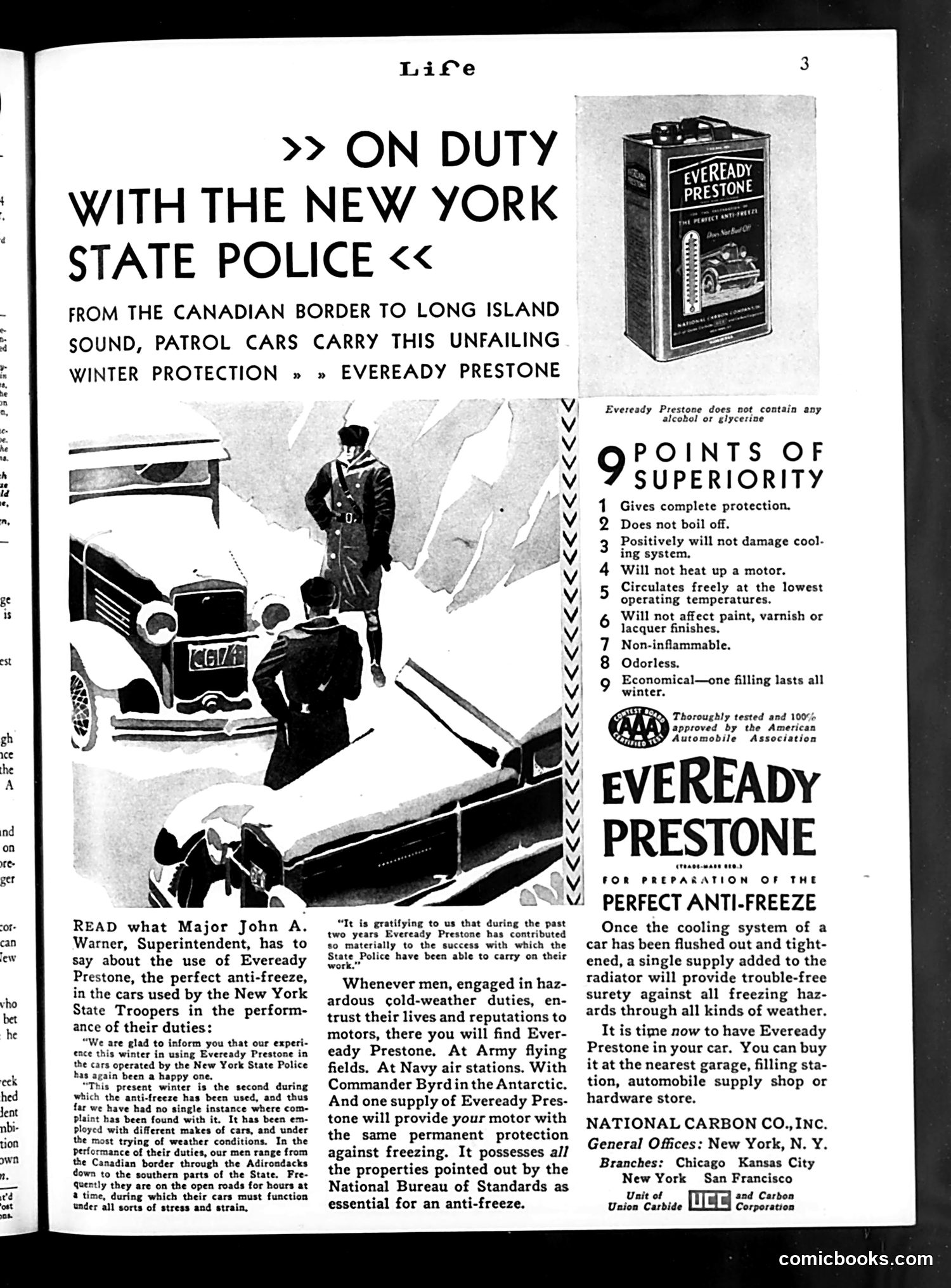
# Analysis This is primarily **advertising, not satire or political commentary**. The page promotes Eveready Prestone antifreeze by featuring a testimonial from Major John A. Warner, Superintendent of the New York State Police. The advertisement uses the authority of law enforcement to market the product, claiming state troopers rely on Eveready Prestone for winter operations along the Canadian border and Long Island Sound. The illustration shows uniformed state police officers with vintage automobiles in winter conditions, establishing credibility through association with official duty. The "9 Points of Superiority" list emphasizes practical benefits (doesn't boil off, won't damage cooling systems, economical). This represents typical mid-20th-century advertising strategy: leveraging institutional endorsement to build consumer trust in a commercial product.
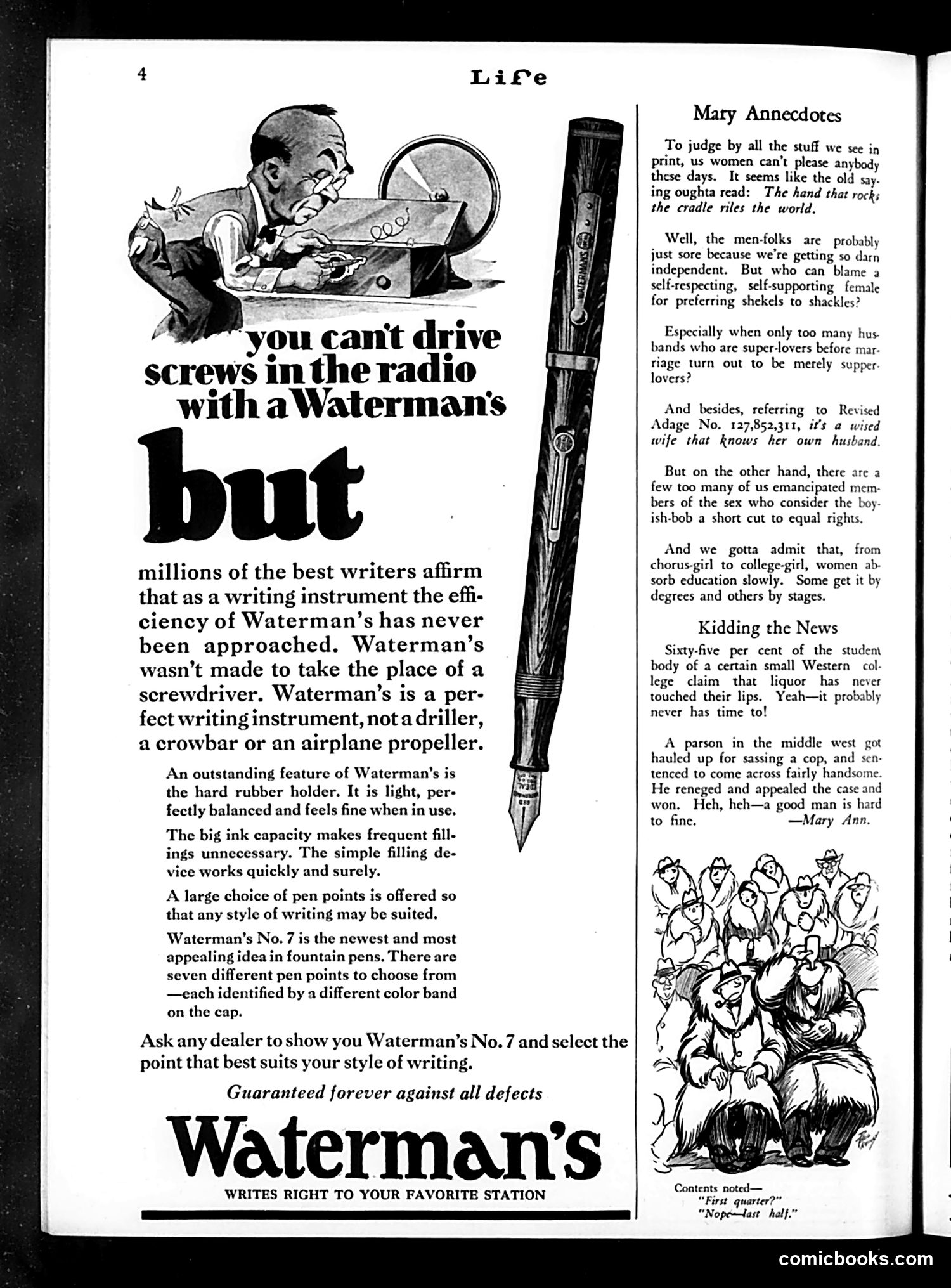
# Analysis This page is primarily a **Waterman's fountain pen advertisement** (left side) with an unrelated editorial column titled "Mary Annecdotes" (right side). The ad features a caricatured man struggling to use a radio with a screwdriver, captioned "you can't drive screws in the radio with a Waterman's but" — a humorous contrast establishing that while pens aren't tools, they excel as writing instruments. The ad emphasizes the pen's efficiency, balance, and variety of points. The right column discusses women's independence and education, referencing debates about gender roles and suffrage-era tensions. The accompanying cartoon shows a group of men in old-fashioned clothing, though its specific satirical target is unclear without additional context. The "Kidding the News" section contains brief anecdotes about contemporary life.
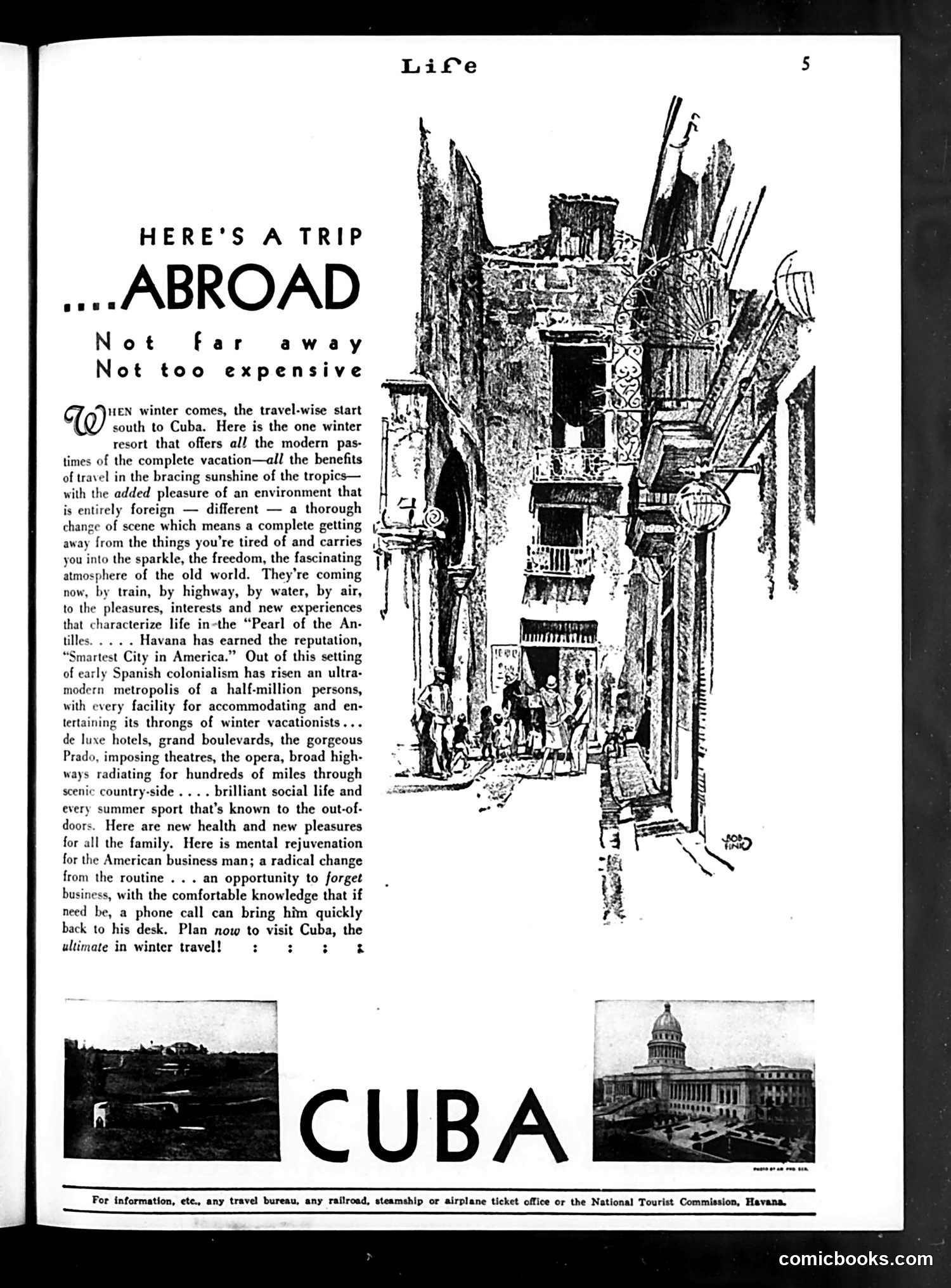
This is a travel advertisement, not a political cartoon. The page promotes Cuba as a winter vacation destination, emphasizing its accessibility and affordability for American tourists. The illustrated sketch depicts a narrow colonial street in Havana, showcasing Spanish colonial architecture with balconies and period buildings. The text describes Cuba as offering "modern" amenities (luxury hotels, theaters, opera) alongside exotic foreign atmosphere and relief from American business routines. The advertisement targets middle-class American businessmen, promising mental rejuvenation and the comfort of quick communication back home ("a phone call can bring him quickly back to his desk"). Two photographs show landscape and the U.S. Capitol building, likely comparing American and Cuban destinations. This reflects early 20th-century American tourism marketing to Cuba before the 1959 revolution.
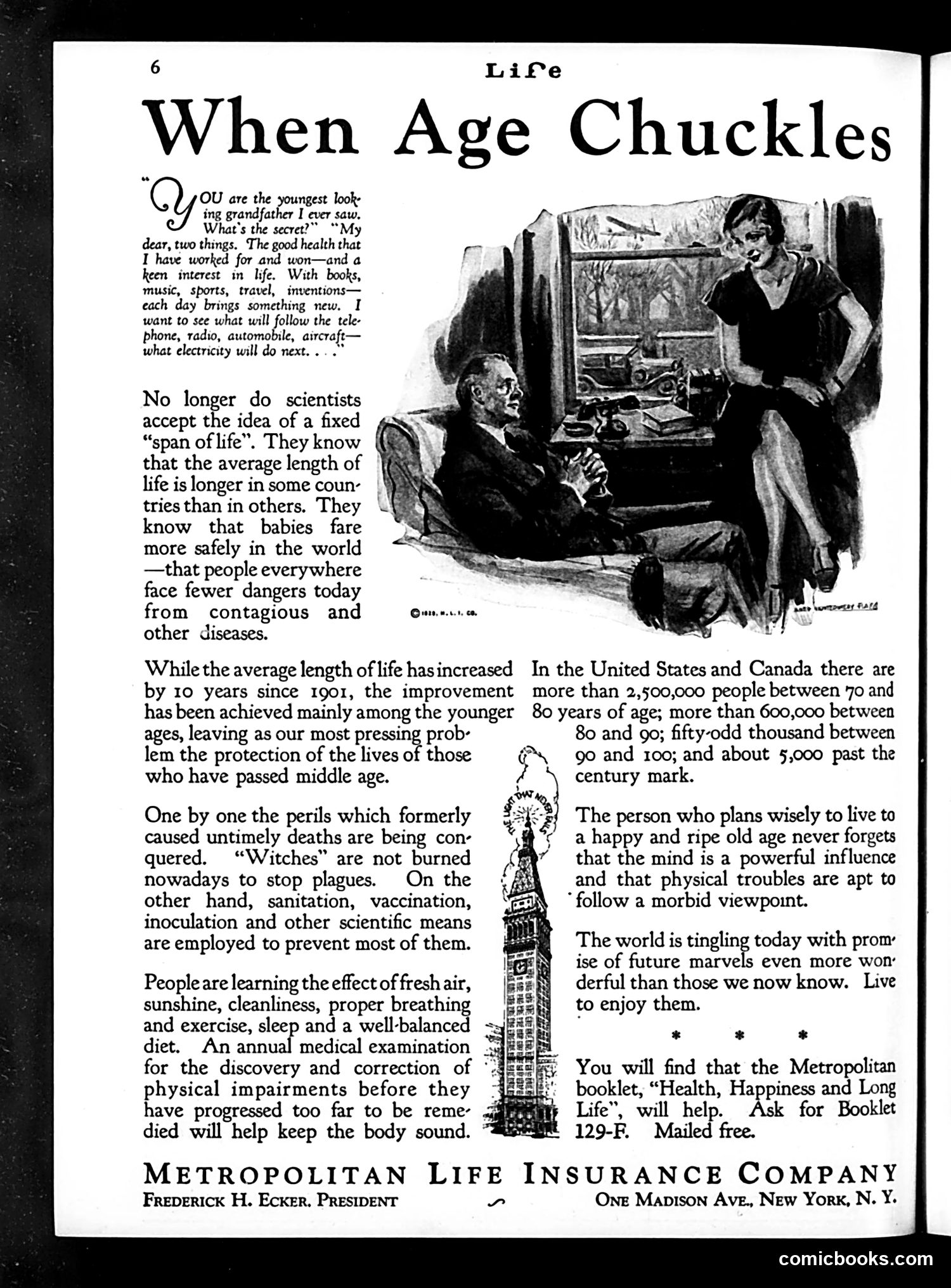
# Analysis of "When Age Chuckles" This page is primarily a **Metropolitan Life Insurance advertisement** disguised as an article about longevity. The illustration shows an elderly man seated while a younger woman (likely a family member or caregiver) stands nearby, suggesting intergenerational family dynamics. The headline plays on the idea that aging people can remain youthful-looking and mentally active. The text argues that modern science has extended life expectancy, particularly for younger generations, making old age less fearful. It emphasizes preventive health measures—fresh air, sanitation, vaccination, medical exams—rather than accepting death as inevitable. The satirical angle is subtle: the ad presents staying young as achievable through proper health habits while simultaneously promoting life insurance as protection. It's essentially selling optimism about longevity while profiting from mortality anxiety.
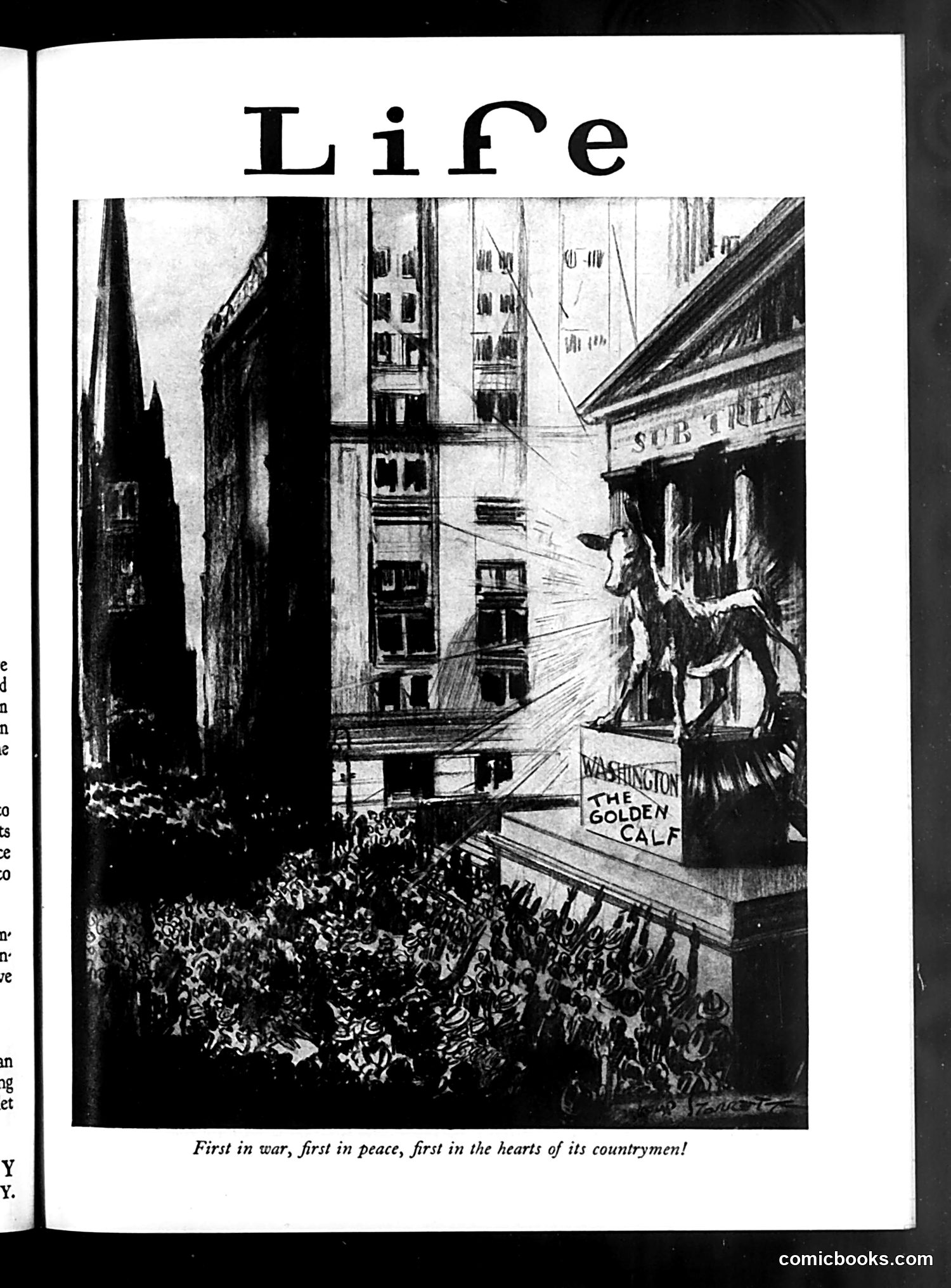
# Analysis This is a Life magazine cover featuring a patriotic illustration titled "First in war, first in peace, first in the hearts of its countrymen!" — a famous phrase about George Washington. The image depicts a large crowd gathered in an urban street canyon, with tall buildings creating dramatic perspective. A winged female figure (likely Lady Liberty or Columbia, representing America) hovers above, gesturing triumphantly. A storefront sign reads "THE GOLDEN CALF," apparently referencing materialism or false idolatry. The satire likely contrasts America's patriotic ideals with commercial greed or shallow worship of wealth. The biblical reference to the golden calf (idol worship) suggests the magazine is critiquing American society for prioritizing materialism over genuine civic virtue, even while wrapping itself in patriotic rhetoric. The date and specific historical context remain unclear without additional information.
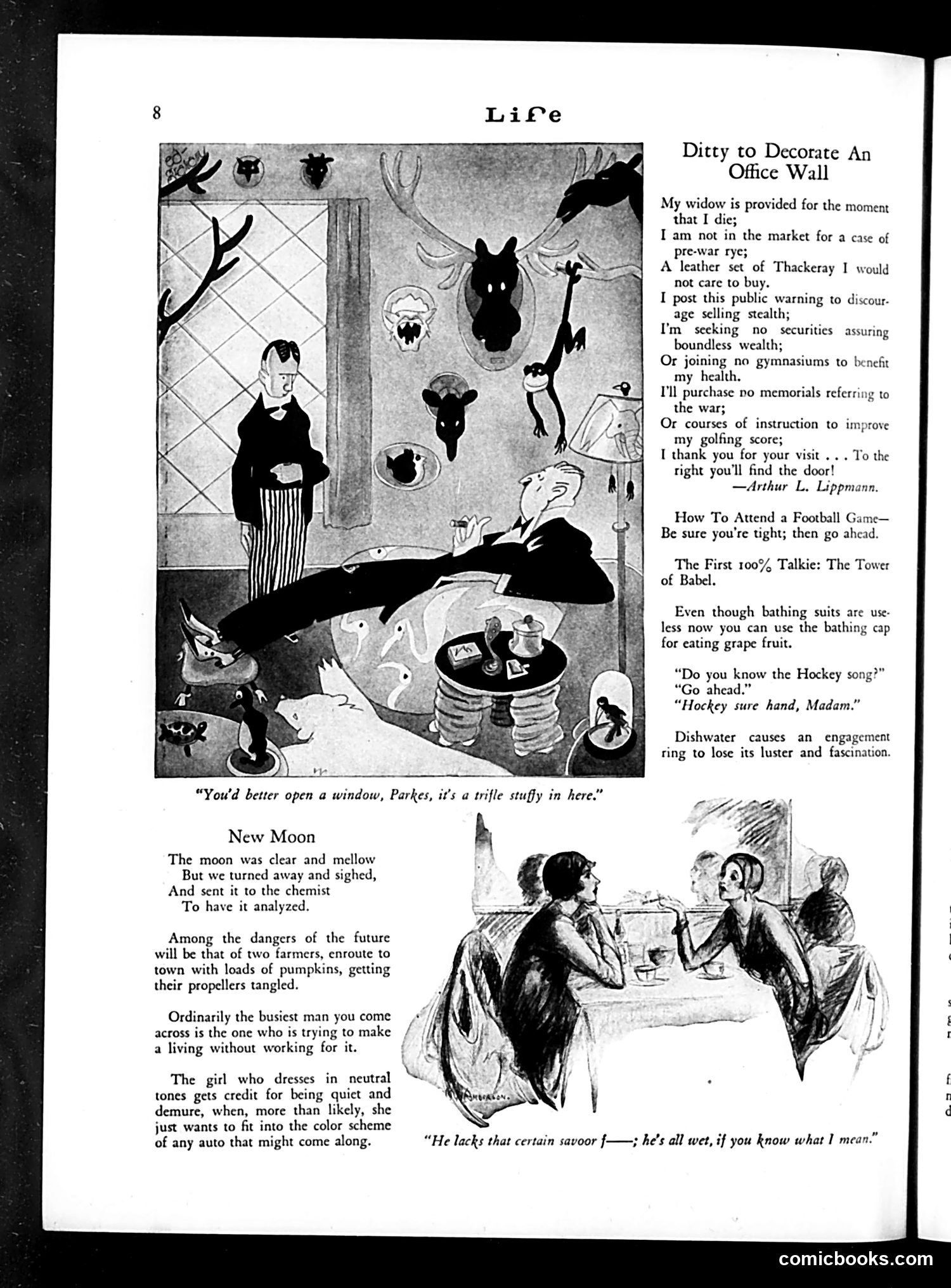
# Analysis of Life Magazine Page This page contains humorous social commentary typical of Life magazine's satirical style. The main cartoon depicts a cluttered office where a woman suggests opening a window, with supernatural/demonic decorations covering the walls. The joke mocks the pretentious practice of decorating offices with exotic artwork and "sophisticated" décor—here rendered absurdly with creepy imagery. The column "Ditty to Decorate An Office Wall" by Arthur L. Lippmann humorously lists things the author *won't* do or buy, satirizing wealthy people's ostentatious displays and health-obsessed behaviors. Below, "New Moon" offers witty social observations about contemporary life—farmers with tangled propellers, women choosing drab clothing for practicality rather than style. The lower cartoon shows people dining, with commentary on social pretense and superficiality.
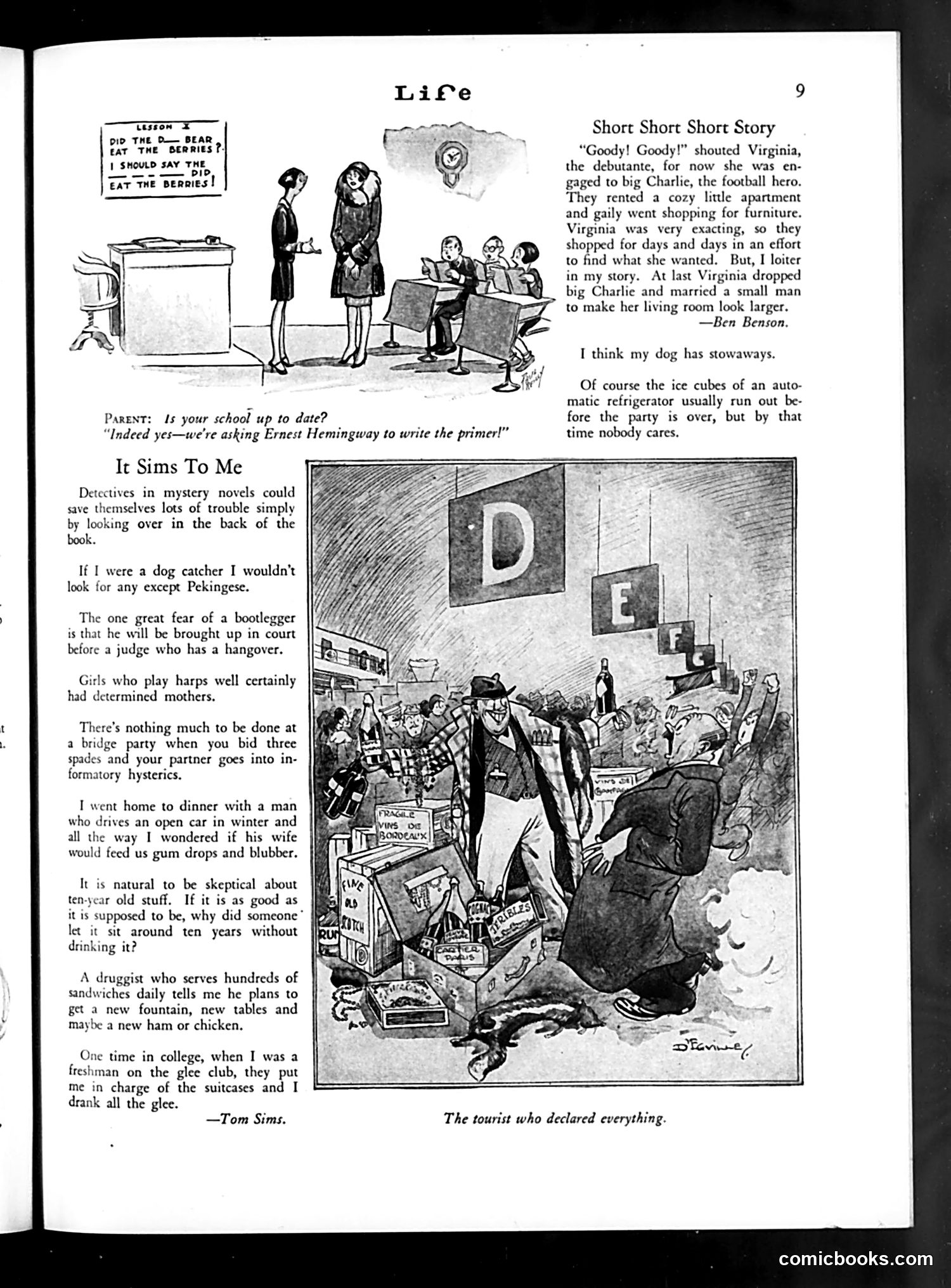
# Explanation of This Life Magazine Page This page contains two separate pieces of humor: **Top cartoon:** Shows a parent asking a teacher if the school is "up to date," requesting Ernest Hemingway write the primer. It satirizes the 1920s-30s trend of treating modernist literary figures as cultural authorities, while mocking both Hemingway's fame and educational pretension. **"It Sims To Me" column:** Tom Sims offers scattered one-liners on contemporary life—bootleggers fearing judges with hangovers, observations about bridge parties and ten-year-old liquor. These are light social commentary on Prohibition-era concerns. **Right illustration:** "The tourist who declared everything" depicts a crowded scene with large letters D, E, F visible—likely satirizing tourists who make grand pronouncements about unfamiliar places. The detailed crowd and carnival-like chaos emphasize the chaotic nature of such declarations.
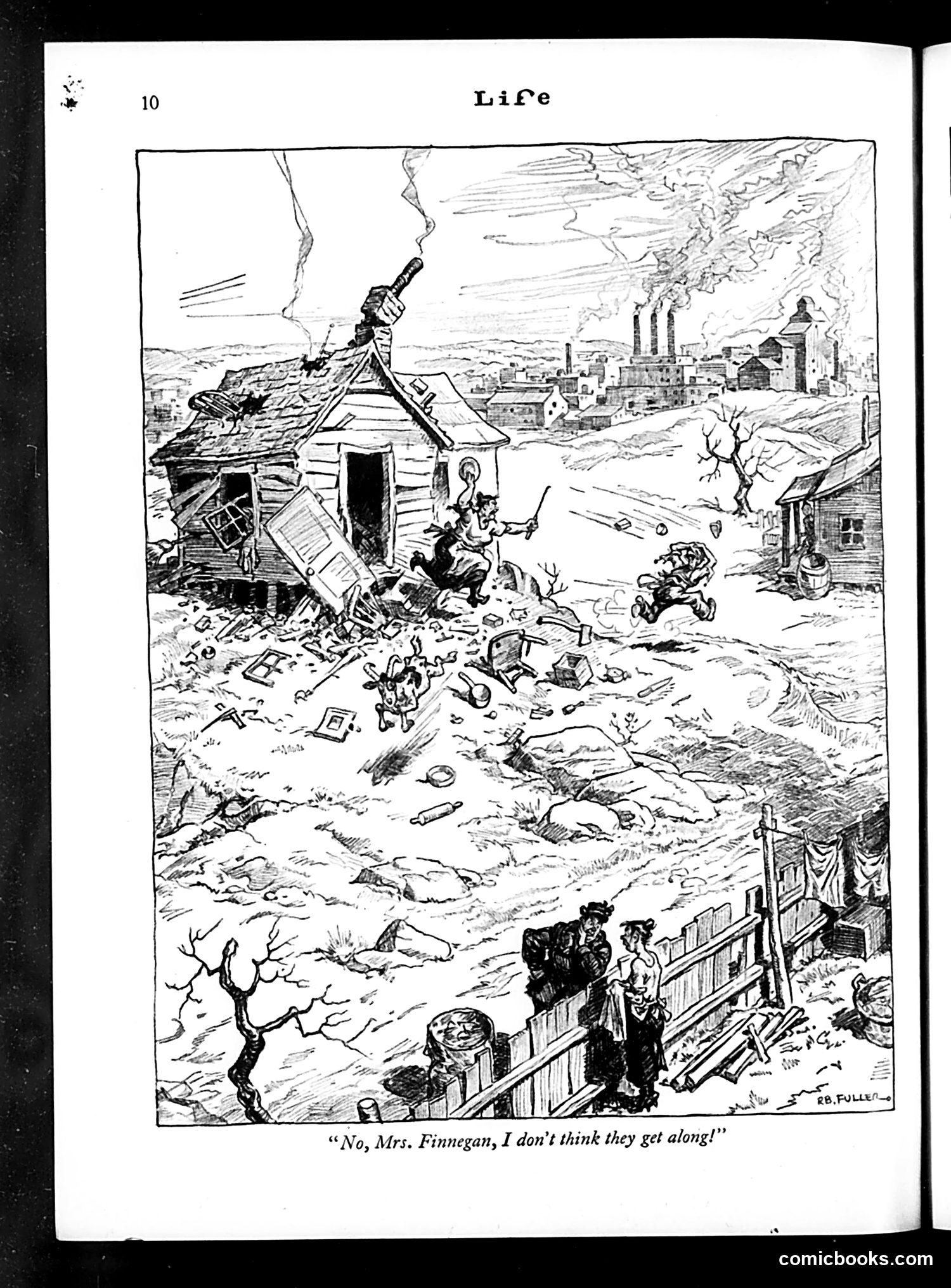
# Analysis of "Life" Magazine Cartoon This single-panel cartoon depicts a chaotic domestic scene. A man and woman (identified by the caption as Mrs. Finnegan) stand at a fence observing the turmoil. In the yard, anthropomorphized animals—appearing to be deer or similar creatures—are fighting and creating havoc around a dilapidated house, with furniture and debris scattered everywhere. An industrial cityscape looms in the background. The caption reads: "No, Mrs. Finnegan, I don't think they get along!" The joke appears to be satirizing either poor living conditions, domestic discord, or the chaos of urban/working-class life. The anthropomorphized animals likely represent people, with their fighting symbolizing social conflict or marital strife. The illustration is credited to "B.B. Fuller" (visible at bottom right).