A complete issue · 40 pages · 1929
Life — November 1, 1929
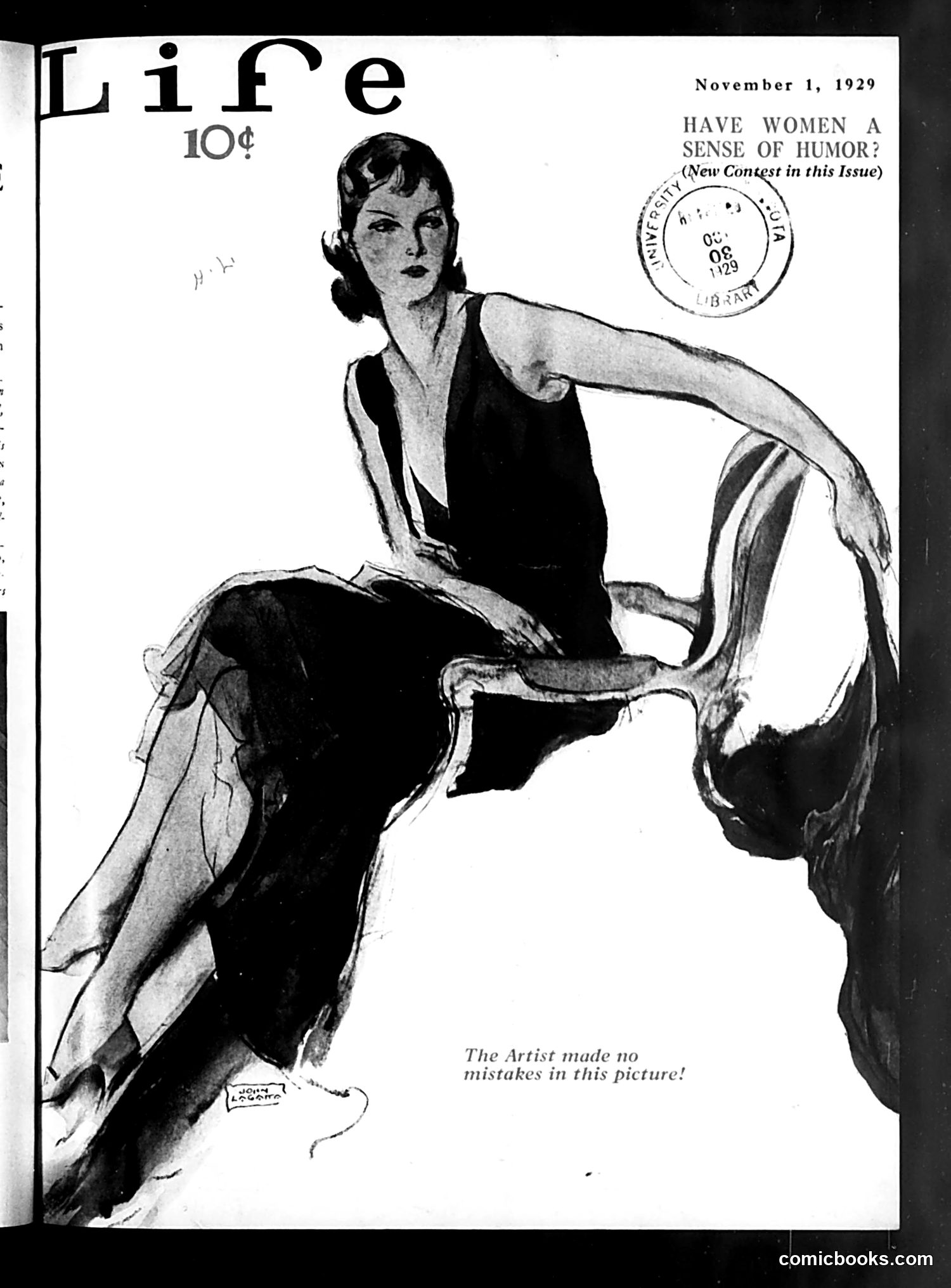
# Life Magazine Cover, November 1, 1929 This is the cover of *Life* magazine's humor issue, featuring a stylized illustration of a woman in an elegant black halter dress seated in a chair. The image promotes a contest asking "HAVE WOMEN A SENSE OF HUMOR?" The caption "The Artist made no mistakes in this picture!" suggests the artwork is intentionally flawless—likely a joke about whether women could appreciate or understand the artistic joke being presented. This references 1920s-era stereotypes about women lacking humor or sophistication. The contest itself was likely a humor feature where readers submitted answers or observations about the image or topic. The ten-cent price reflects *Life*'s positioning as an accessible, middlebrow satirical publication of the era.
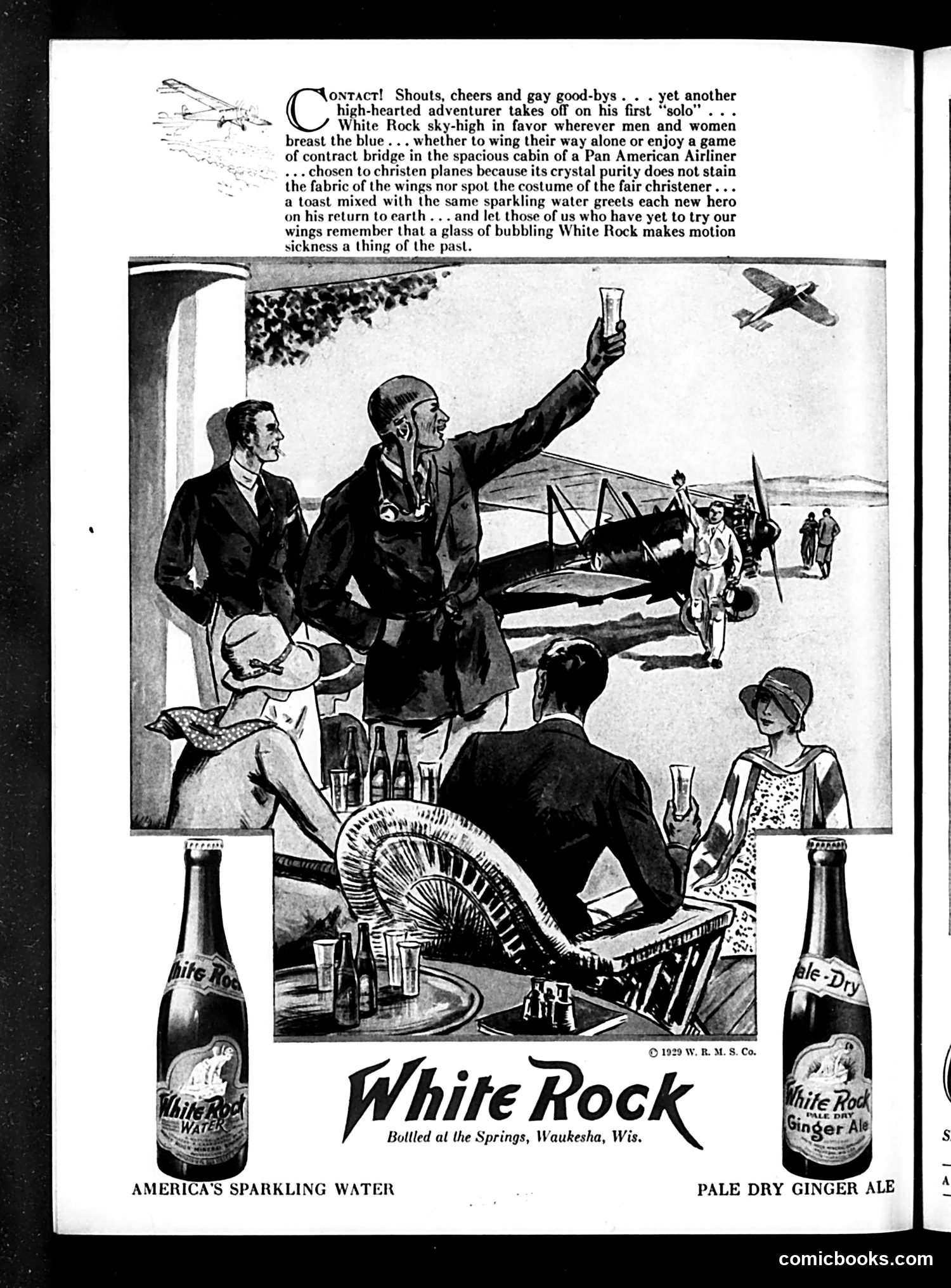
# White Rock Advertisement (1929) This is primarily a **beverage advertisement**, not satire. The page promotes White Rock brand sparkling water and ginger ale, bottled in Waukesha, Wisconsin. The illustration depicts a **celebratory aviation scene**: well-dressed people toast a departing pilot with champagne glasses filled with White Rock products. An airplane flies overhead while others wave farewell on an airfield below. The accompanying text uses **aviation imagery as aspirational marketing**, comparing drinking White Rock to the thrilling novelty of early airplane travel—positioning the beverage as modern, exciting, and associated with daring adventure. The copyright date is 1929, placing this during the **peak of 1920s enthusiasm for aviation** as an exciting new technology. The advertisement capitalizes on this cultural moment to suggest White Rock embodies similar sophistication and excitement.
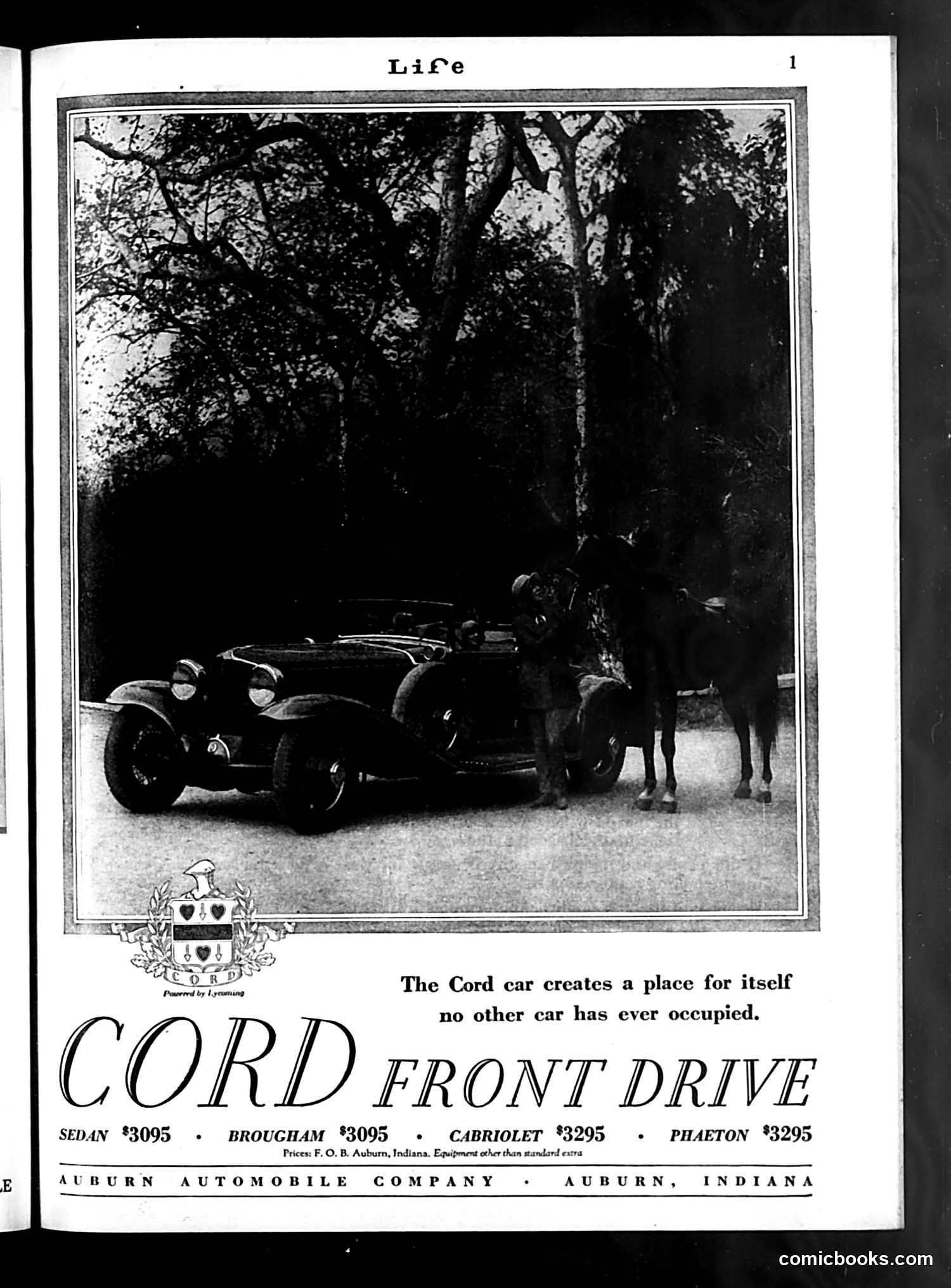
# Analysis This page is primarily **advertising, not satire or political commentary**. It's a Cord automobile advertisement from the Auburn Automobile Company of Auburn, Indiana. The image shows a Cord car parked beneath trees with two men and a horse standing beside it. The advertisement's tagline claims "The Cord car creates a place for itself no other car has ever occupied." This is standard early automotive marketing rhetoric emphasizing the vehicle's unique qualities and superior design. The specific models listed (Sedan, Brougham, Cabriolet, Phaeton) and their prices ($3,095-$3,295) are typical product information from this era. There is no political cartoon, satire, or hidden meaning—simply a vintage car advertisement promoting Cord's "front drive" technology as a distinctive selling point.
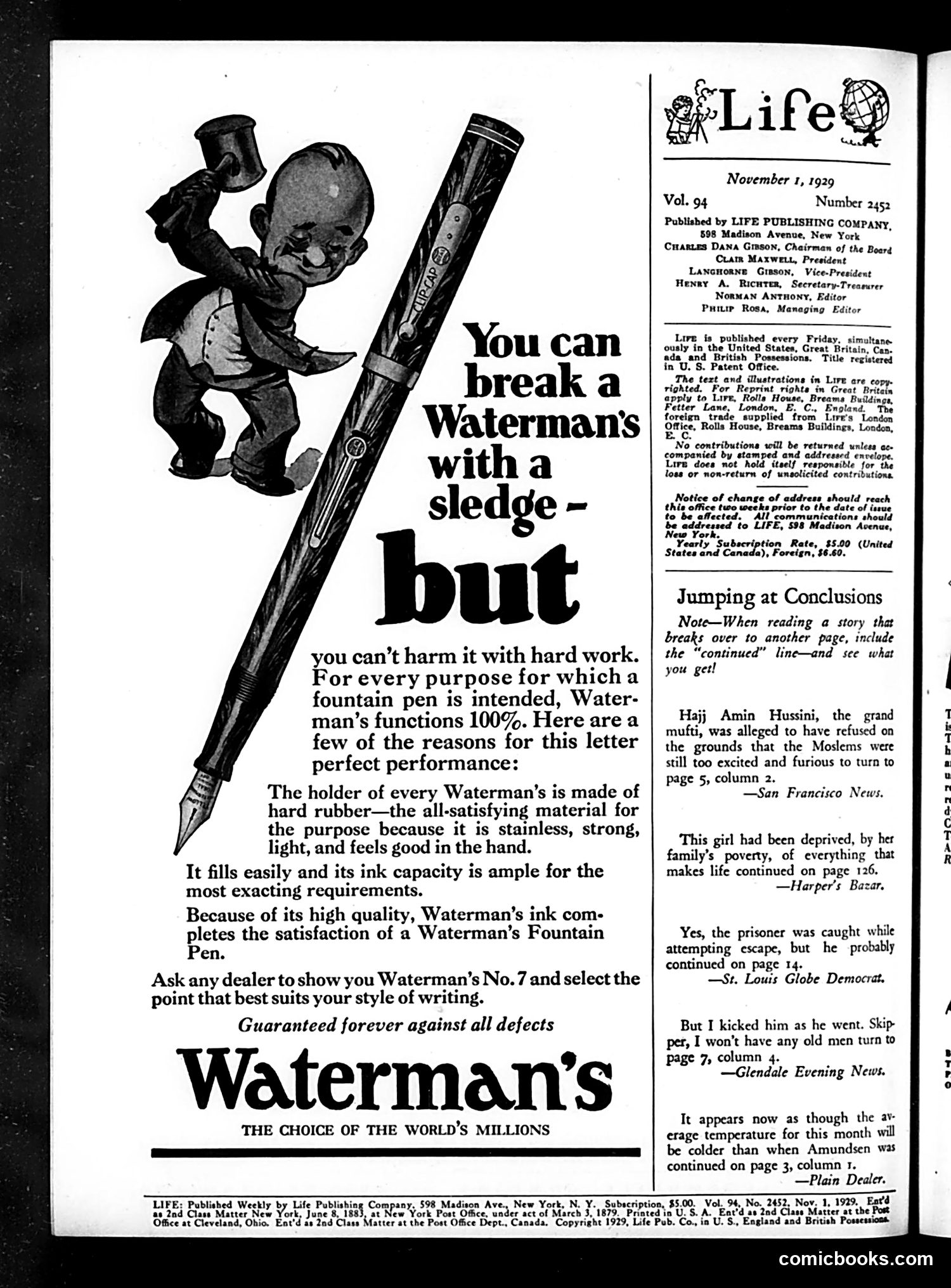
# Waterman's Fountain Pen Advertisement This page is primarily a **commercial advertisement** for Waterman's fountain pens, not political satire. The left side features a cartoon of a cherub or baby figure wielding a sledgehammer against a large pen, illustrating the advertising claim that "you can't break a Waterman's with a sledge—but you can't harm it with hard work." The right column contains Life magazine's masthead and several brief editorial notes about stories continued elsewhere in the issue, including references to Hajj Amin Hussini and a prisoner escape. The cartoon serves **product promotion rather than social commentary**, emphasizing the pen's durability through hyperbolic humor typical of 1920s advertising.
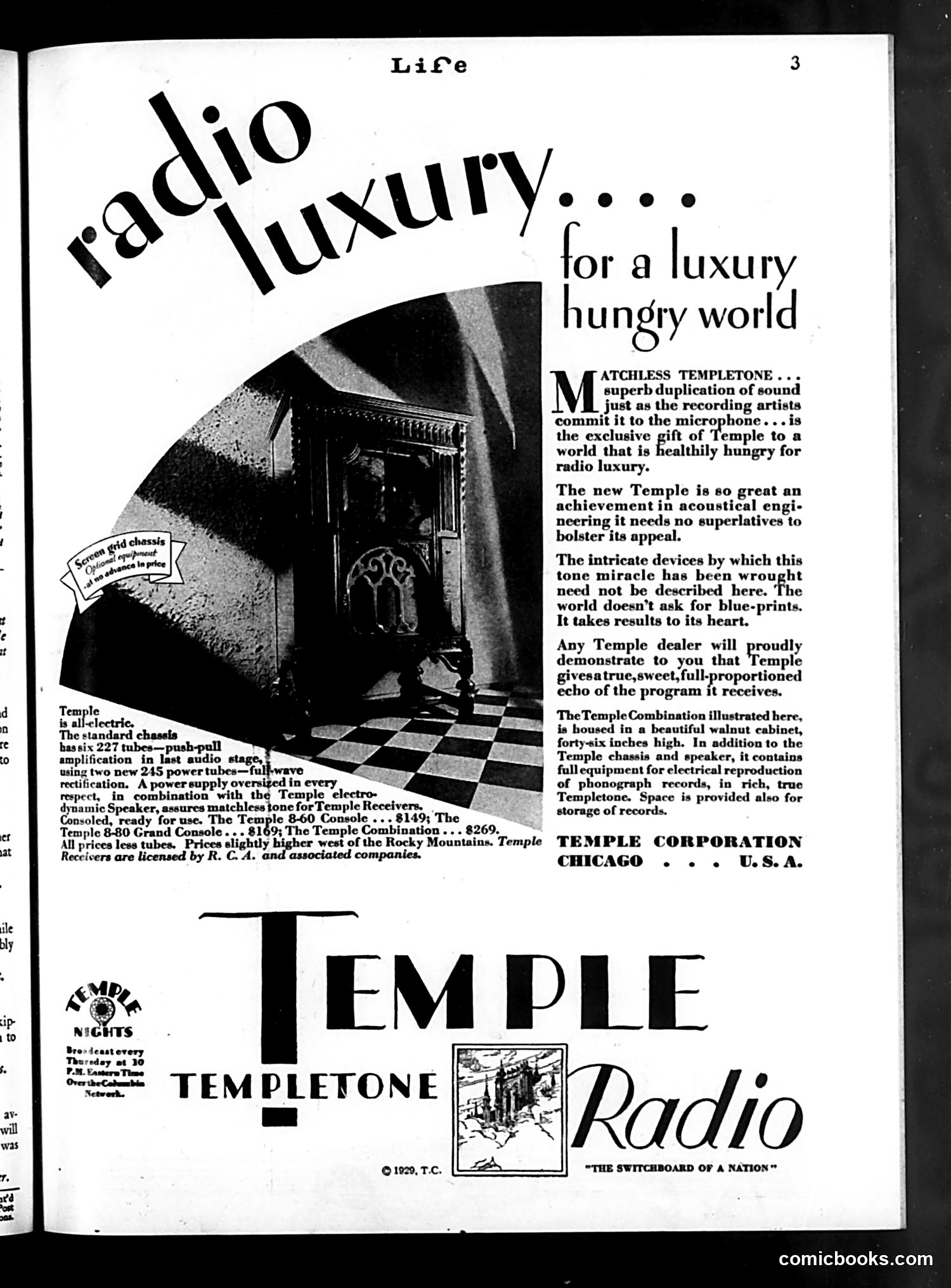
# Analysis This page is primarily a **product advertisement**, not political satire. It promotes Temple Radio brand receivers from the Temple Corporation of Chicago. The ad uses the phrase "radio luxury for a luxury hungry world" to market high-end radio equipment. The copy emphasizes the Temple brand's technical superiority—particularly the "Matchless Templetone" pickup and advanced acoustical engineering. The image shows an ornate radio console housed in a walnut cabinet. The advertisement lists several Temple models with prices ($149-$269), noting that "Temple Receivers are licensed by R.C.A. and associated companies." This reflects the 1920s radio boom when radio sets were luxury consumer goods. The "luxury hungry world" phrasing suggests marketing to affluent buyers during what appears to be the prosperous pre-Depression era. There is no political cartoon or satirical content present.
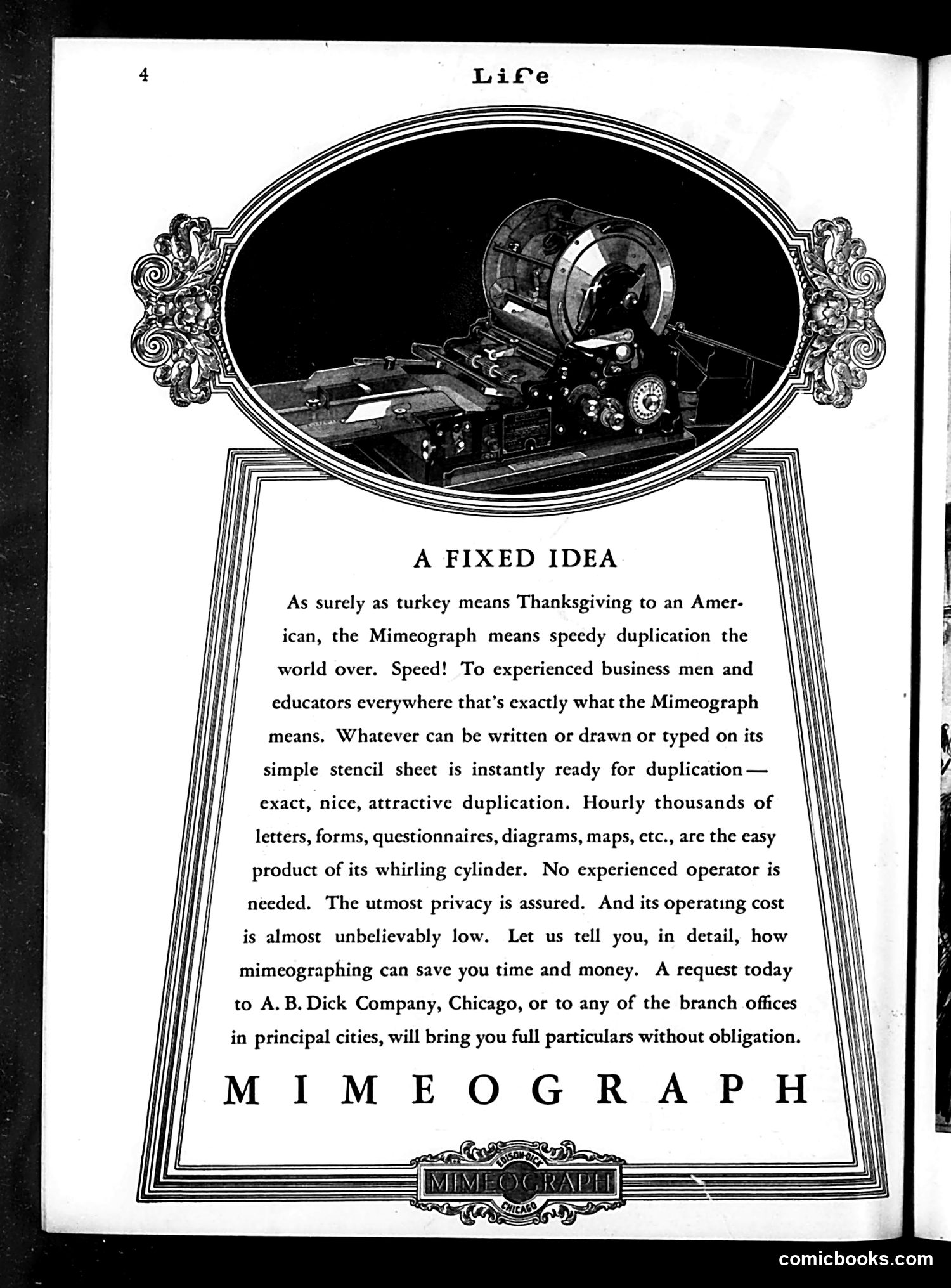
# Page Analysis This is primarily a **Mimeograph machine advertisement** rather than a political cartoon. The page shows a ornate oval frame containing an image of an early mimeograph device with its characteristic rotating cylinder mechanism. The ad uses a humorous comparison ("As surely as turkey means Thanksgiving to an American") to establish the mimeograph as the standard tool for document duplication. It appeals to "experienced business men and educators" by emphasizing speed, ease of use, privacy, and low operating costs. The advertisement is placed in *Life* magazine, which was indeed a satirical publication during this era, but this particular page functions as commercial promotion rather than social or political satire. It represents early 20th-century office technology marketing.
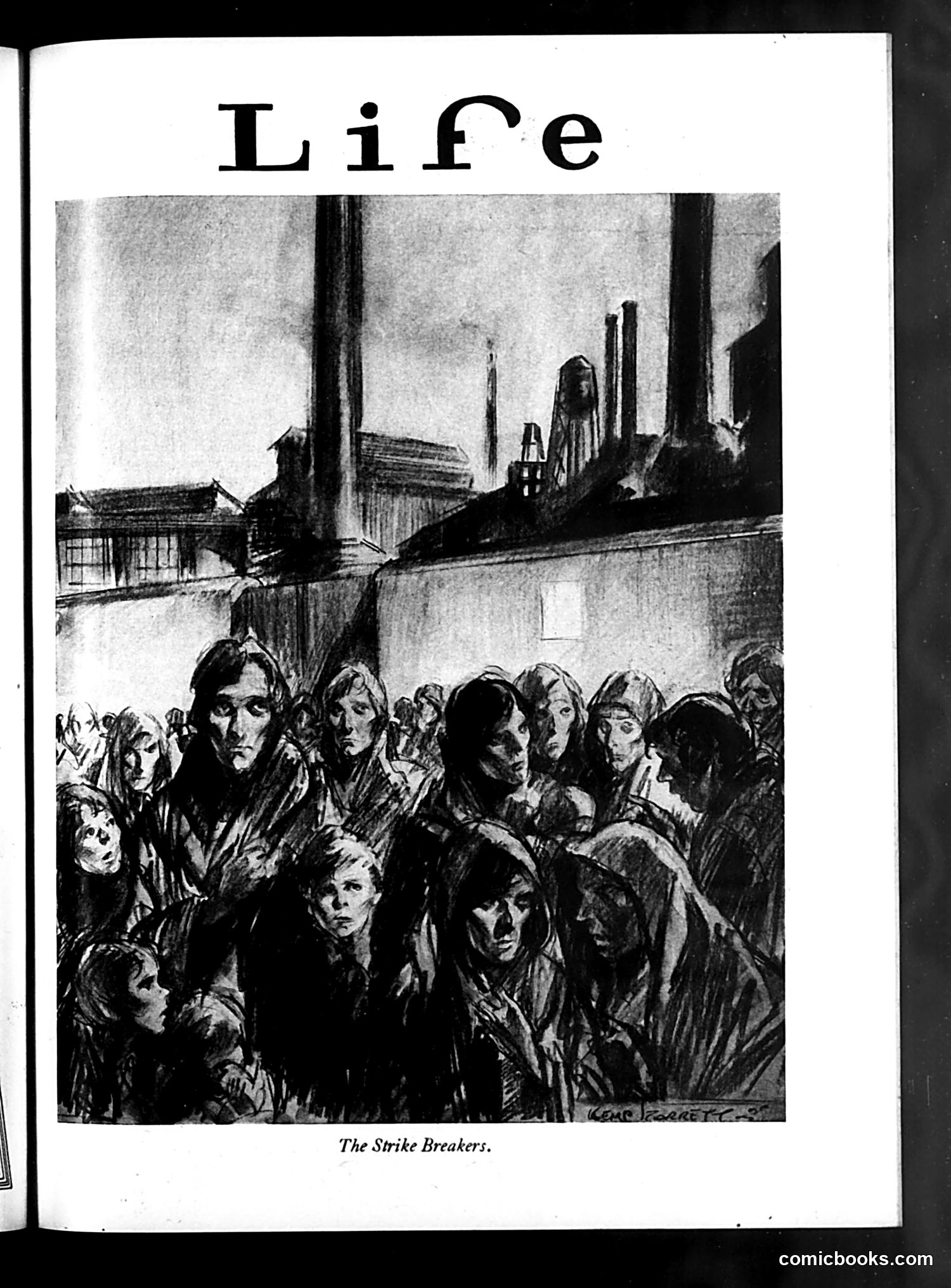
# "The Strike Breakers" - Life Magazine This illustration depicts a crowd of working-class people, appearing downtrodden and impoverished, gathered before an industrial landscape with factory smokestacks and buildings. The caption "The Strike Breakers" suggests satire directed at laborers who crossed picket lines or undermined strikes. The artwork's dark, expressionistic style emphasizes the hardship and desperation of the figures—implying these individuals were driven by economic necessity rather than choice to break strikes. The composition critiques the system that forced workers into this position: rather than mocking the strike-breakers themselves, the satire appears directed at the economic conditions and power structures that made such desperate choices necessary. The looming industrial infrastructure dominates the scene, reinforcing themes of worker vulnerability to larger economic forces.
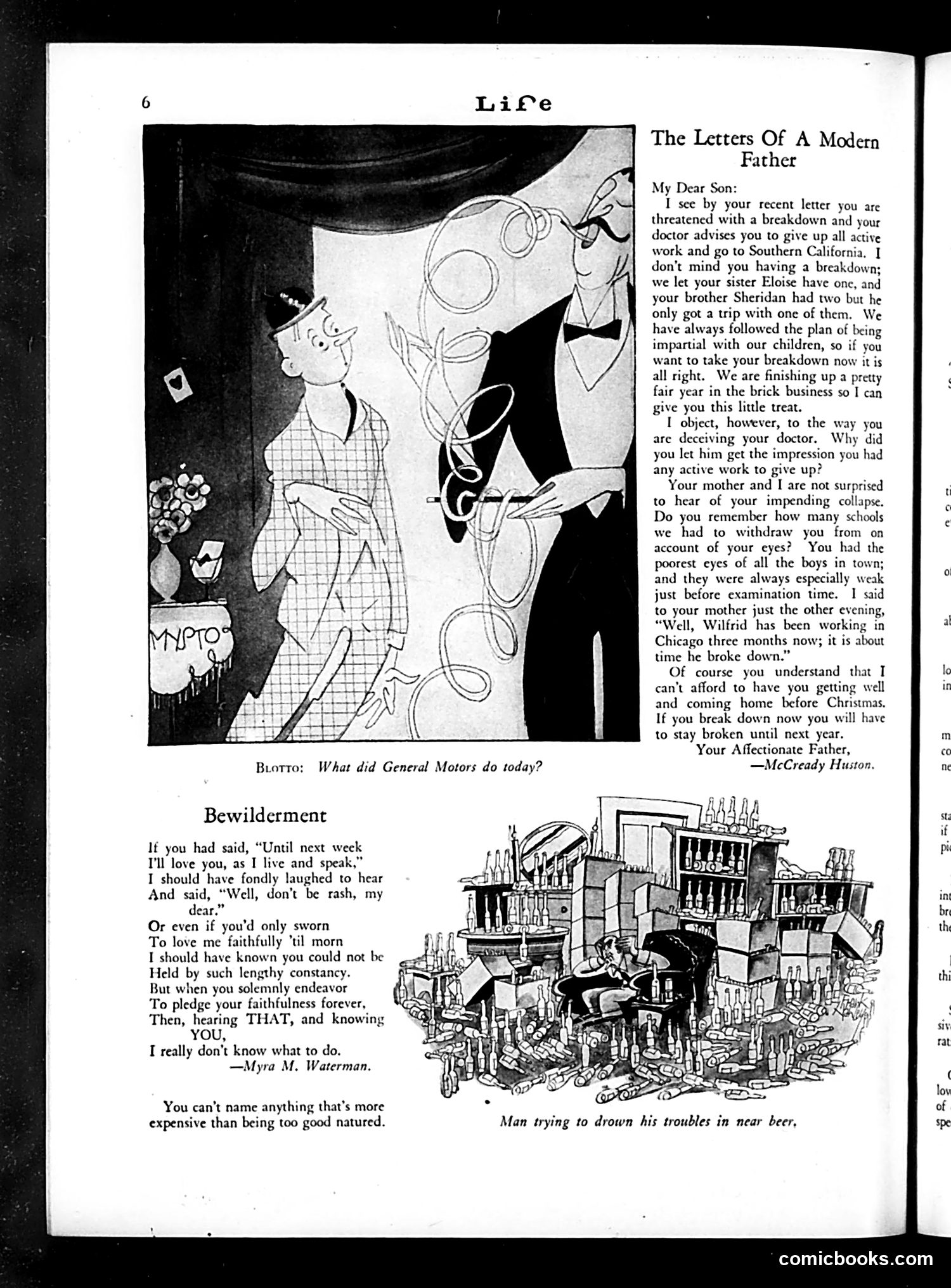
# Analysis of Life Magazine Page 6 **Top Cartoon ("Blotto")**: A well-dressed man in formal attire is being questioned by a smaller, disheveled figure about General Motors' activities. The caption reads "What did General Motors do today?" This appears to be satirizing either corporate malfeasance or the public's obsession with tracking major corporations' business dealings during this era. **"The Letters of a Modern Father"**: A paternalistic letter from a father denying his son's request for rest due to nervous breakdown, citing that other children have had similar issues. The tone mocks overly stern, unsympathetic parenting attitudes. **"Bewilderment" Poem & Bottom Cartoon**: A poem about confusion regarding moral commitment, paired with an illustration of a man drowning himself in beer bottles—satirizing escapism and alcohol abuse as responses to life's troubles.
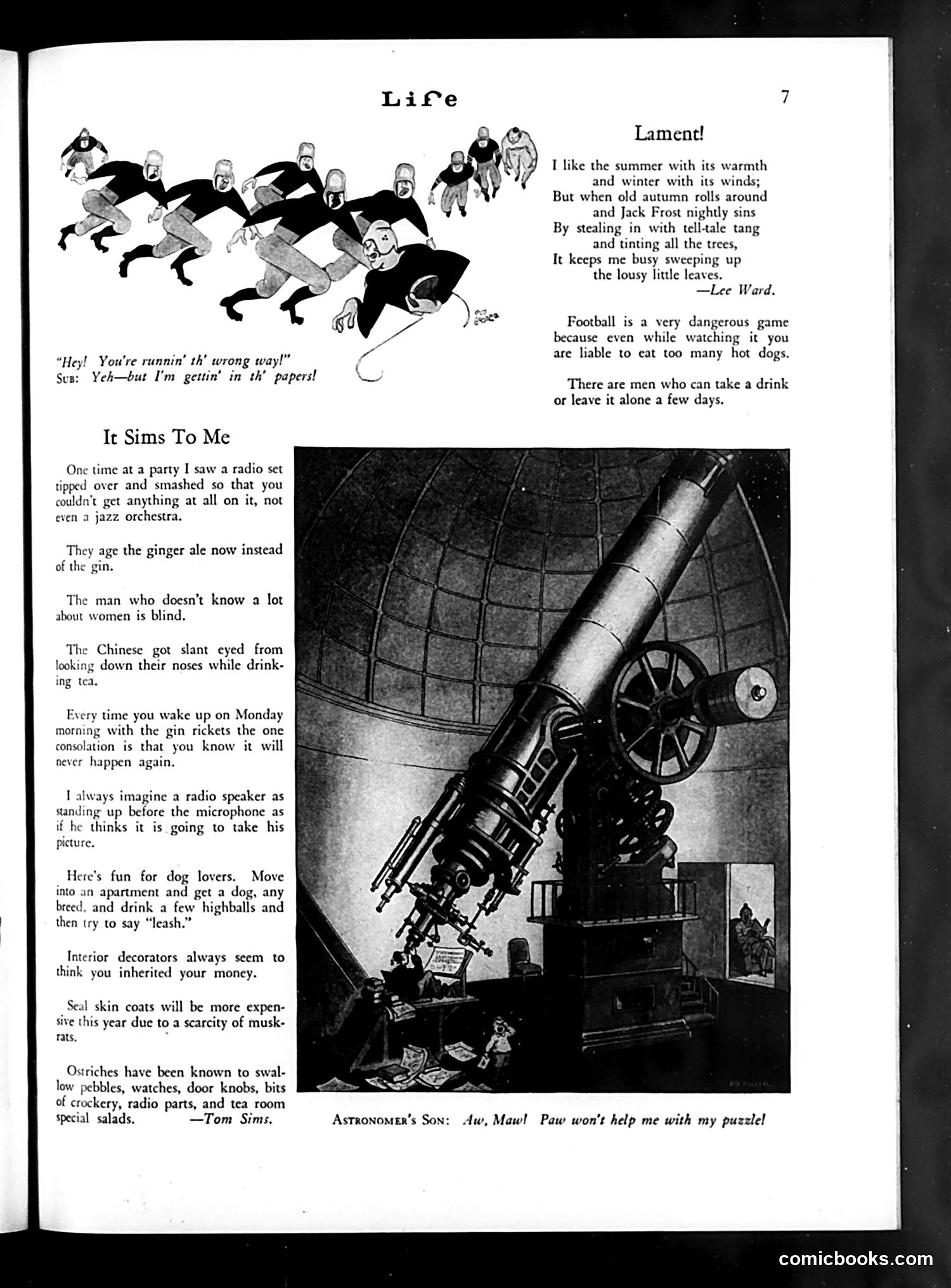
# Analysis of Life Magazine Page 7 **Top Cartoon:** Shows football players running chaotically, with someone shouting "Hey! You're runnin' th' wrong way!" and another responding "Yeh—but I'm gettin' in th' papers!" This satirizes football players' apparent priority on getting newspaper publicity over actually playing the game correctly—mocking the era's sports celebrity culture. **"It Sims to Me" Column:** A humorous collection of observations by Tom Sims about everyday life, including jokes about radio sets being destroyed at parties, drinking habits, and interior decorating. **Bottom Image:** A cartoon titled "Astronomer's Son" showing a boy at a telescope with the caption "Aw, Maw! Paw won't help me with my puzzle!" The joke appears to play on the father being absorbed in stargazing rather than attending to domestic duties.
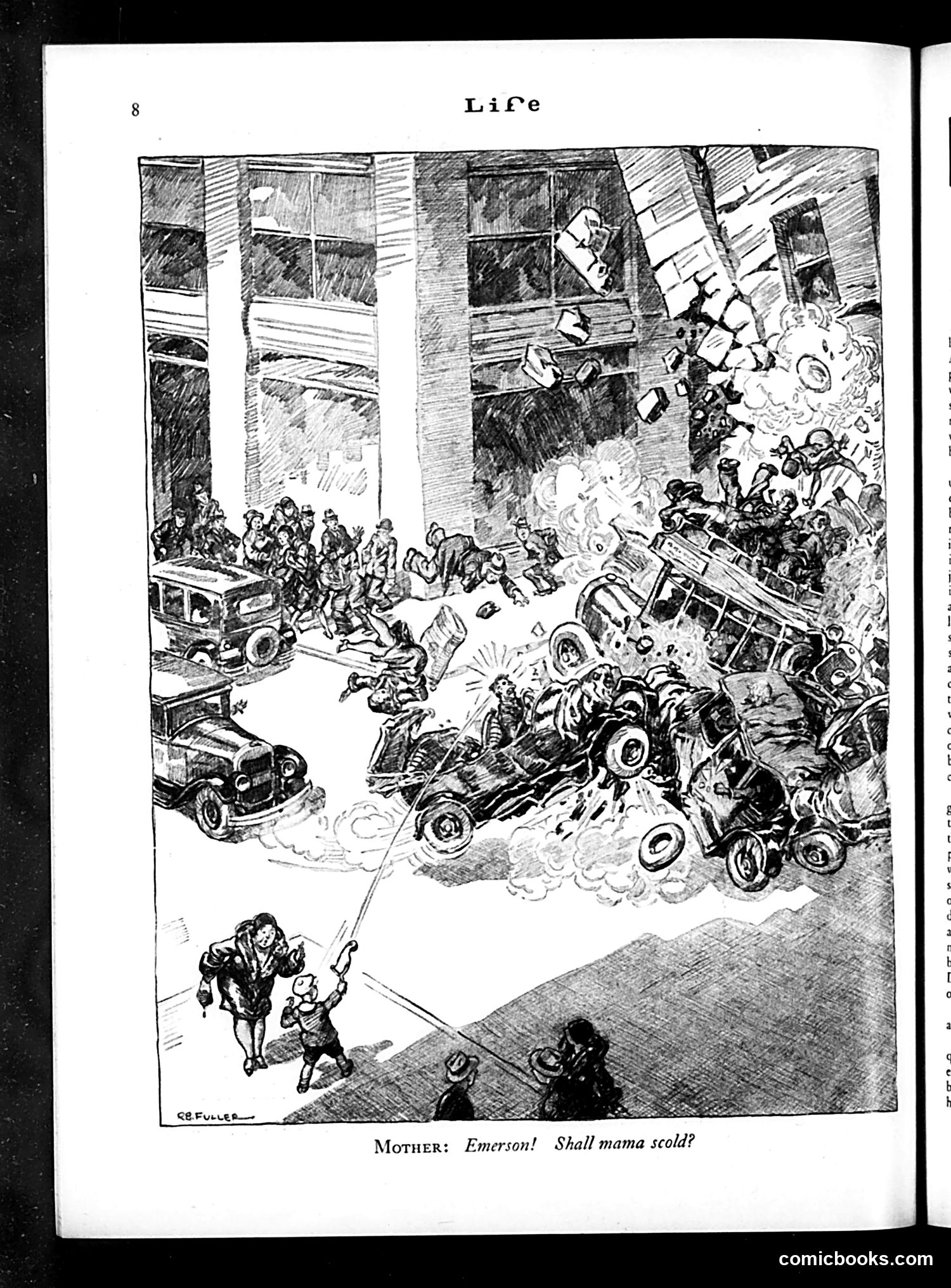
# Analysis of Life Magazine Cartoon This cartoon depicts a chaotic street scene showing a major traffic accident involving multiple automobiles colliding and overturning beneath tall urban buildings. The explosion of vehicles and debris creates a disaster scene with numerous figures scattered around. The caption reads: "MOTHER: *Emerson!* Shall mama scold?" The satire appears to target early automotive culture and the dangers of reckless driving. The mother's mild, almost sarcastic question—asking whether she should merely "scold" for what is clearly a catastrophic multi-car pile-up—provides dark humor by treating a massive disaster as a minor infraction deserving light parental discipline. This undercuts the severity of the accident, satirizing both parental permissiveness and the dangerousness of unregulated early automobile traffic in crowded urban areas.
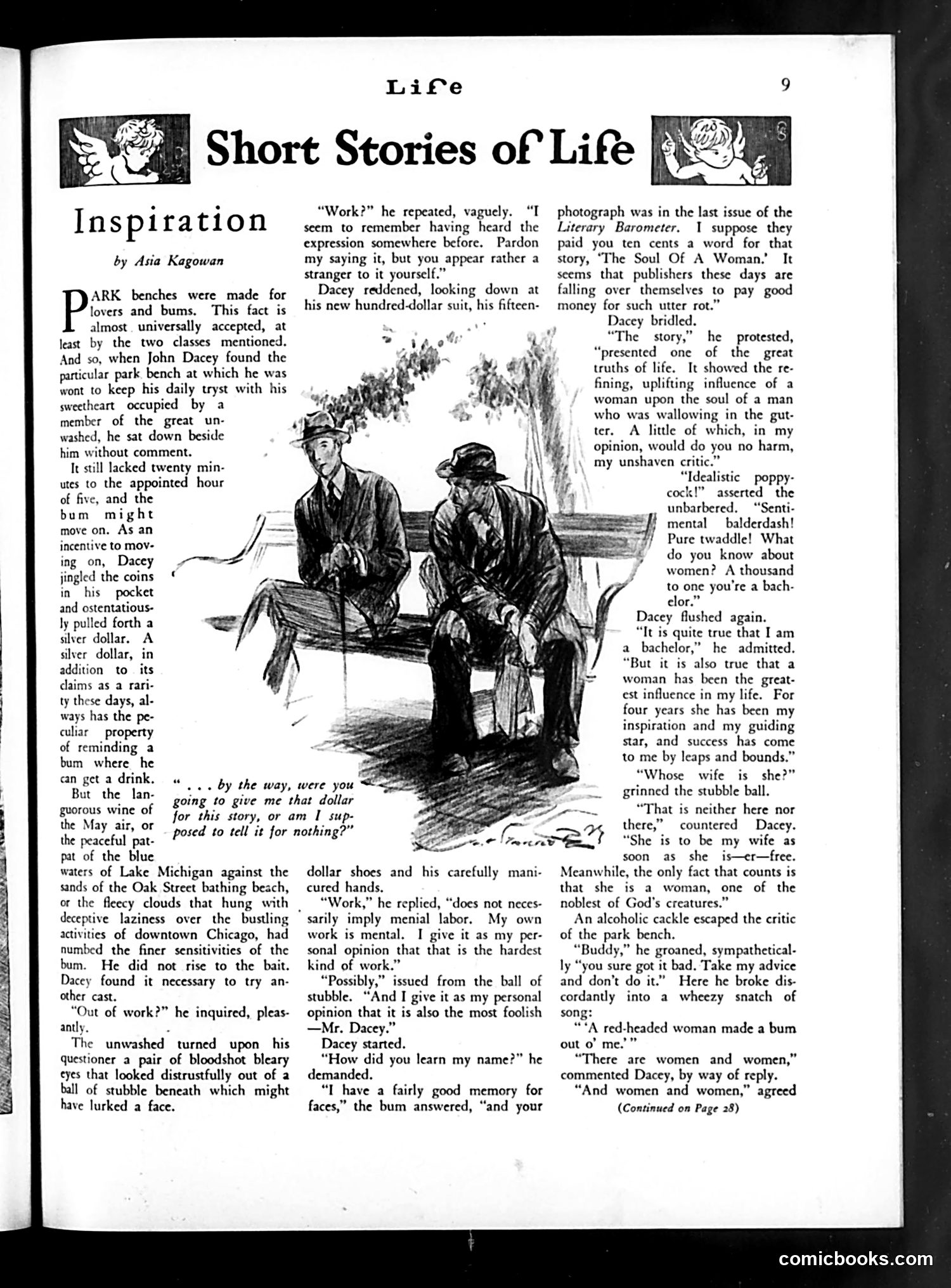
# "Inspiration" by Ana Kagowan This short story depicts two men on a park bench—one well-dressed, one a vagrant. The narrative explores class and artistic inspiration through their dialogue. The well-dressed man (Dacey) is a writer seeking material. The vagrant (the "bum") initially offers to sell him a dollar for a story, but Dacey rejects this. Their conversation shifts to deeper themes: Dacey reveals that a woman has been his greatest inspiration for four years, and he credits her with his success. The satire critiques both artistic pretension and romantic idealization. The vagrant's crude observations about "women and women" deflate Dacey's sentimental language, suggesting that even humble people understand life's truths—undercutting the notion that inspiration requires refined sensibilities or romantic mythology.
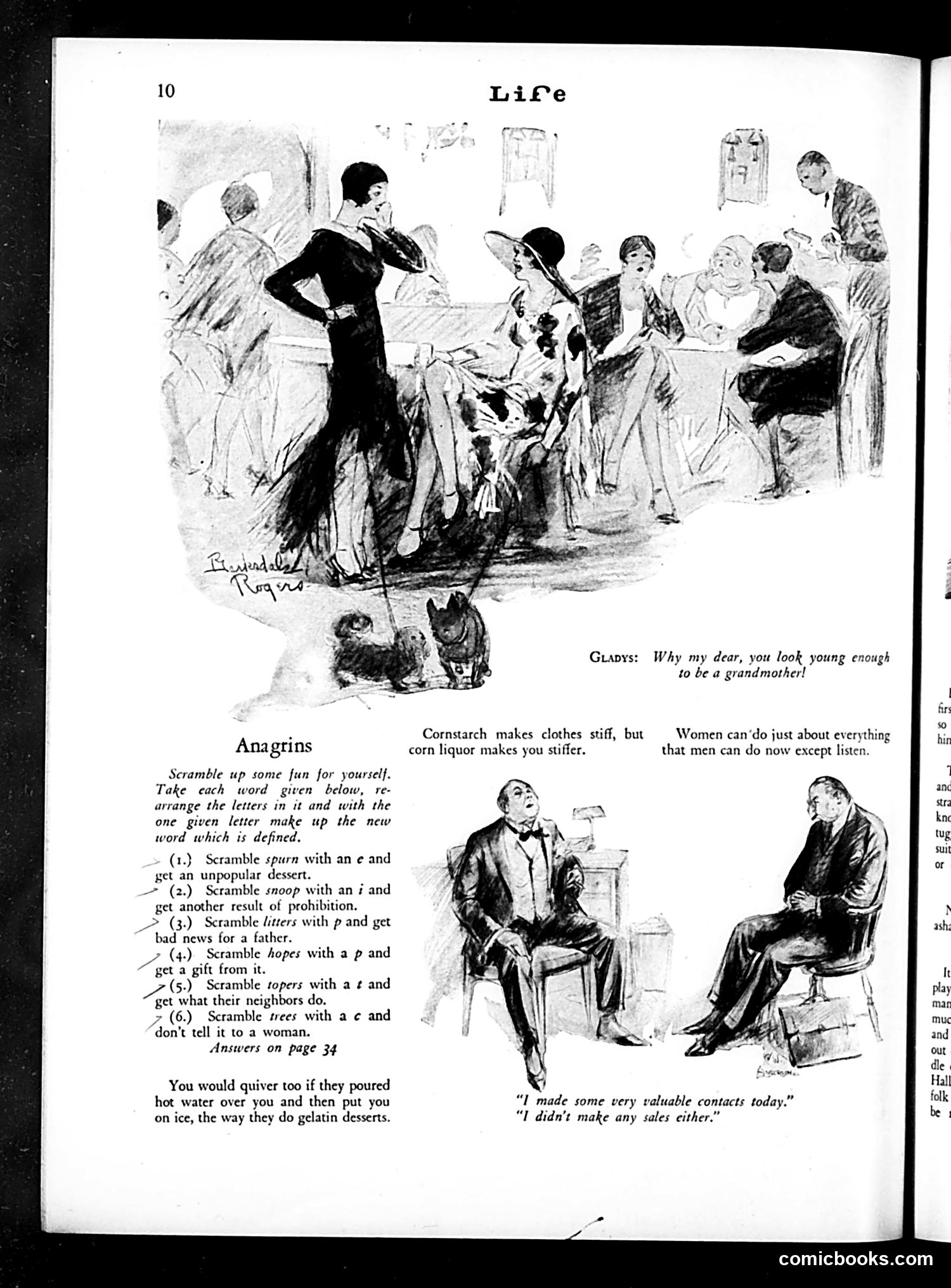
# Analysis of Life Magazine Page 10 This page contains two distinct satirical cartoons from early 20th-century Life magazine. **Top cartoon**: Depicts a social gathering where a woman in fashionable dress is presented to others. The caption "Why my dear, you look young enough to be a grandmother!" is sarcastic commentary on women's appearance and vanity—likely mocking either cosmetic practices or unrealistic beauty standards of the era. **Bottom cartoon**: Shows two men in conversation. One claims "I made some very valuable contacts today" while admitting "I didn't make any sales either." This satirizes business culture and networking—poking fun at people who measure success by social connections rather than actual commercial results. The "Anagrins" word puzzle appears to be filler entertainment content typical of Life's format.