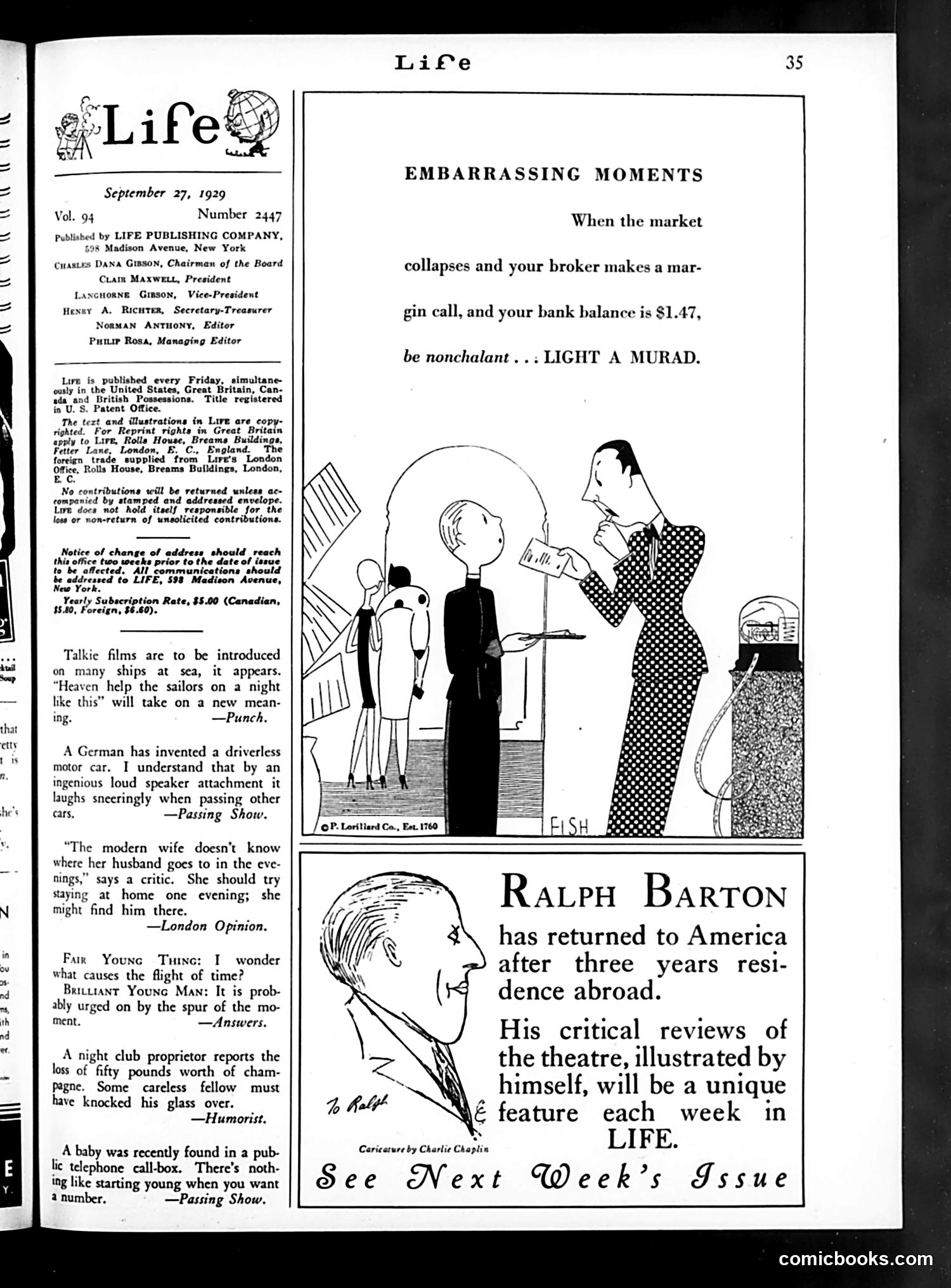
A complete issue · 37 pages · 1929
Life — September 27, 1929
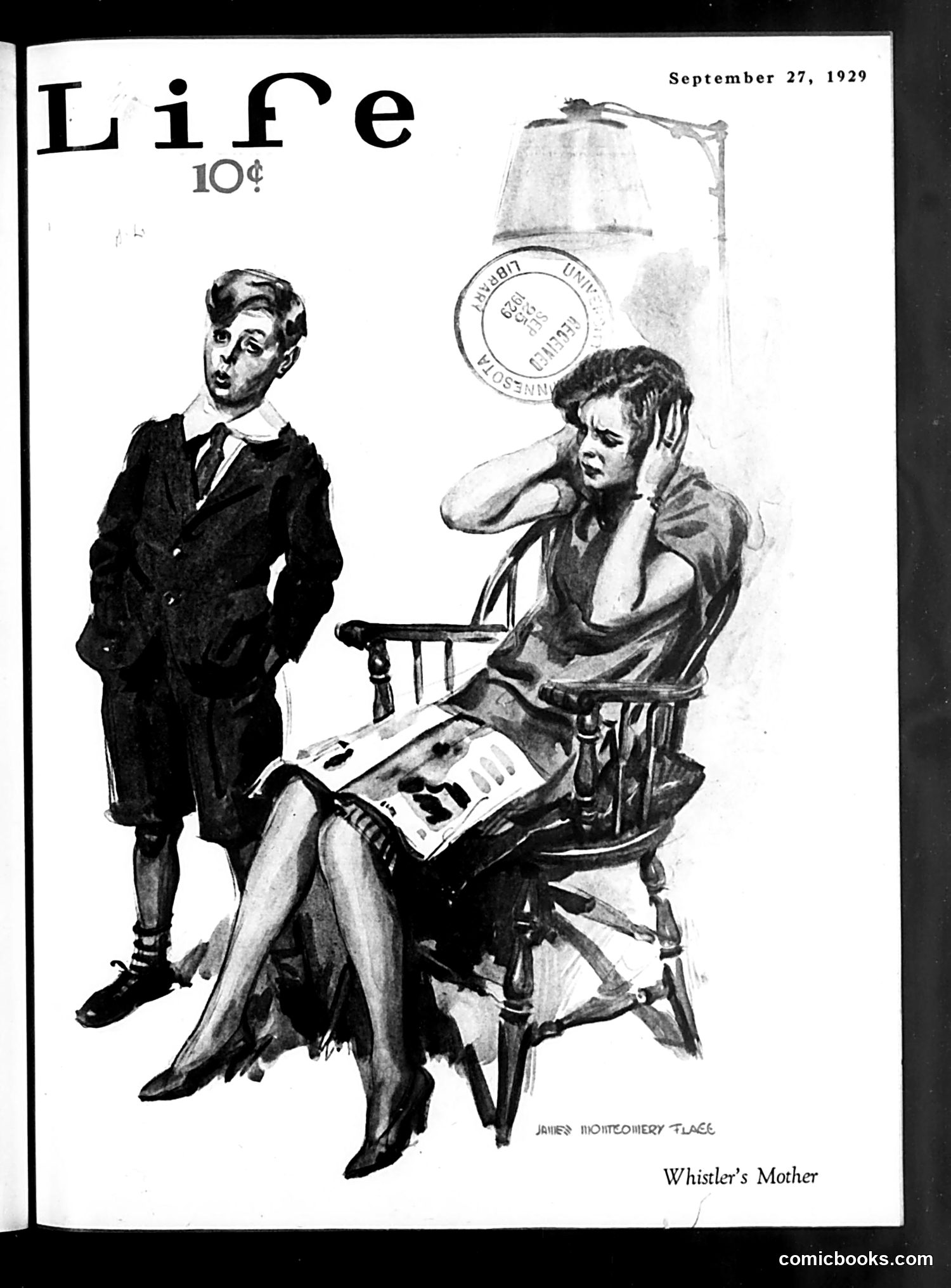
# "Whistler's Mother" - Life Magazine, September 27, 1929 This cartoon by James Montgomery Flagg satirizes a domestic quarrel. A man in formal attire stands confronting a woman seated in a chair, who covers her ears in distress. The title references James McNeill Whistler's famous 1871 painting "Arrangement in Grey and Black No. 1" (commonly called "Whistler's Mother"), which depicts an elderly woman sitting calmly in profile. The joke inverts that iconic image: instead of a dignified, patient mother, we see a modern woman actively refusing to listen to complaints—a commentary on contemporary marital disputes and changing gender dynamics in 1920s America. The composition parodies the original painting while mocking domestic conflict and women's increasing assertiveness.
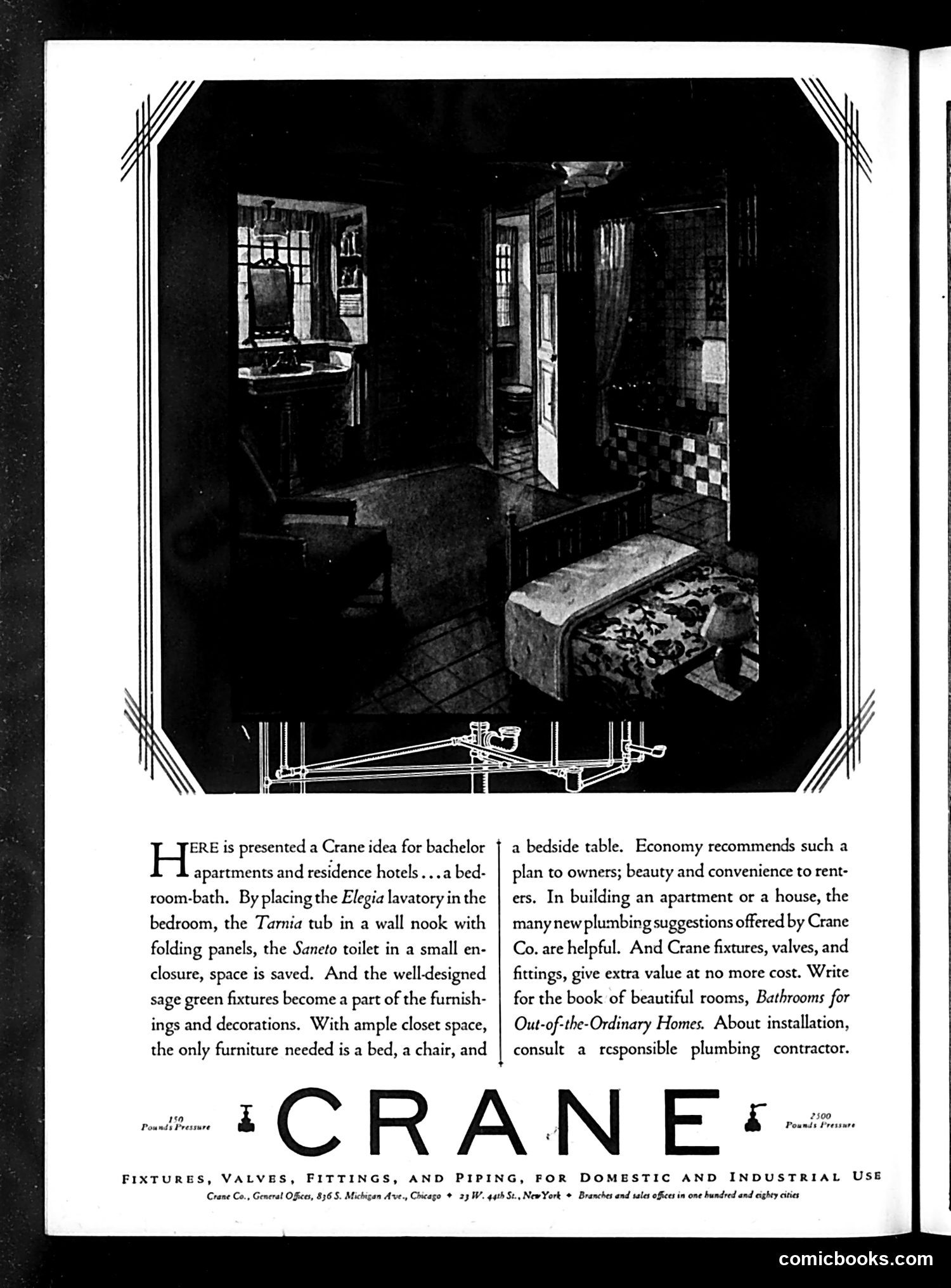
# Analysis This page is **primarily an advertisement**, not satirical content. It's a Crane Co. advertisement for bathroom fixtures and plumbing supplies, specifically promoting their products for "bachelor apartments and residence hotels." The image shows a compact, efficiently designed bathroom layout featuring Crane's products: an Elegia lavatory, Tamia tub, and Sancto toilet. The advertiser emphasizes space-saving design and aesthetic appeal—fixtures "become a part of the furnishings and decorations." The pitch targets budget-conscious renters and builders by highlighting economy and convenience. There is **no political satire or social commentary** here; this is straightforward product marketing typical of 1920s-era Life magazine advertising, promoting modern plumbing innovations to American consumers.
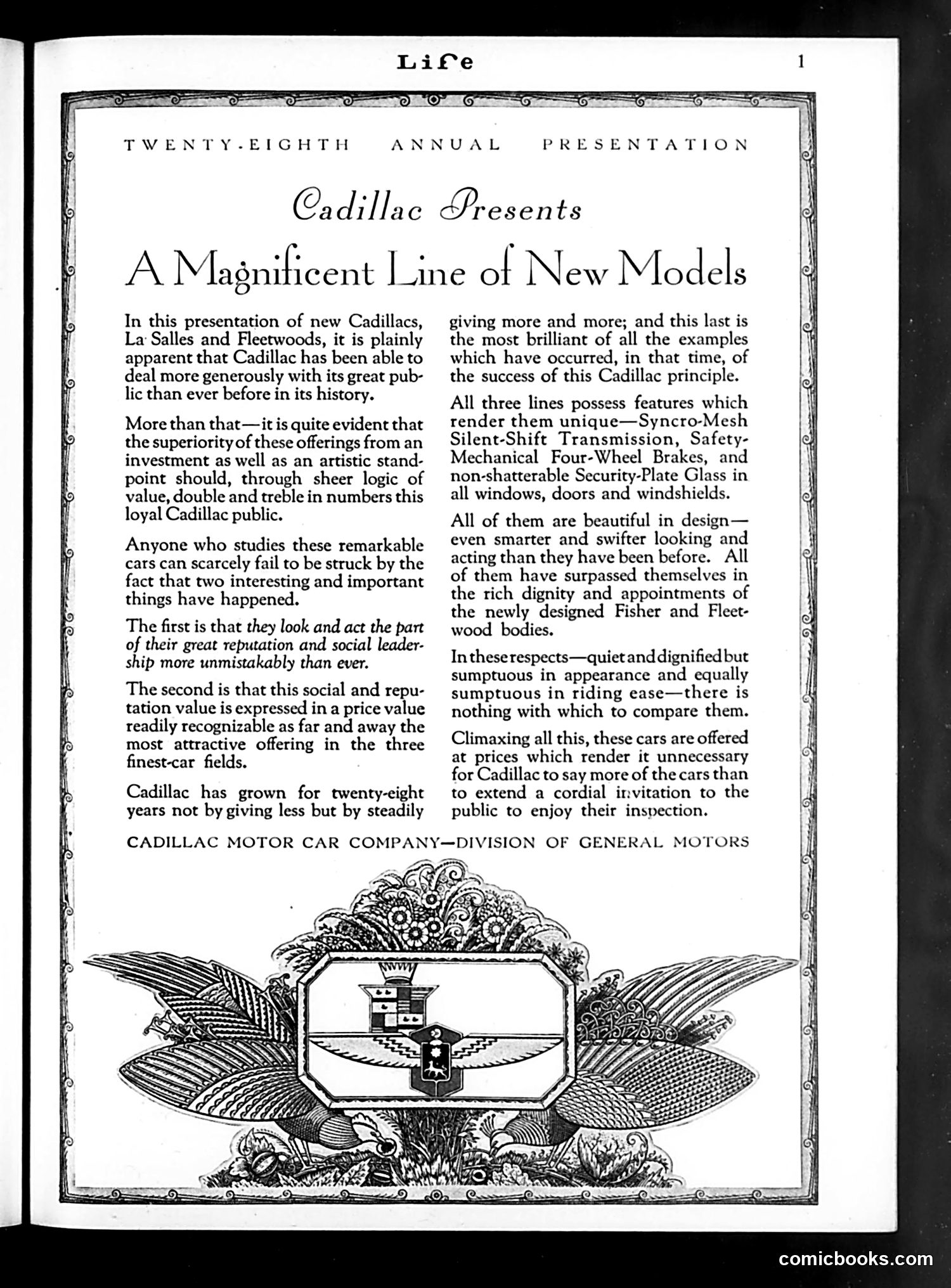
# Analysis This page is **not satire or political cartoon**—it's a straightforward **advertisement** for Cadillac automobiles. The ornate header declares this the "Twenty-Eighth Annual Presentation" of new Cadillac models (La Salles and Fleetwoods). The text promotes three product lines, emphasizing their superior engineering features: Syncro-Mesh transmission, Safety-Mechanical brakes, and Security-Plate Glass windows. The elaborate decorative emblem at bottom featuring wings and a crowned shield is Cadillac's corporate logo and brand identity. The pitch emphasizes Cadillac's 28-year growth strategy: expanding their offerings while maintaining premium reputation and pricing. The tone is aspirational, positioning these cars as markers of "great reputation and social leadership." This represents typical high-end automotive advertising from the early twentieth century, targeting wealthy consumers.
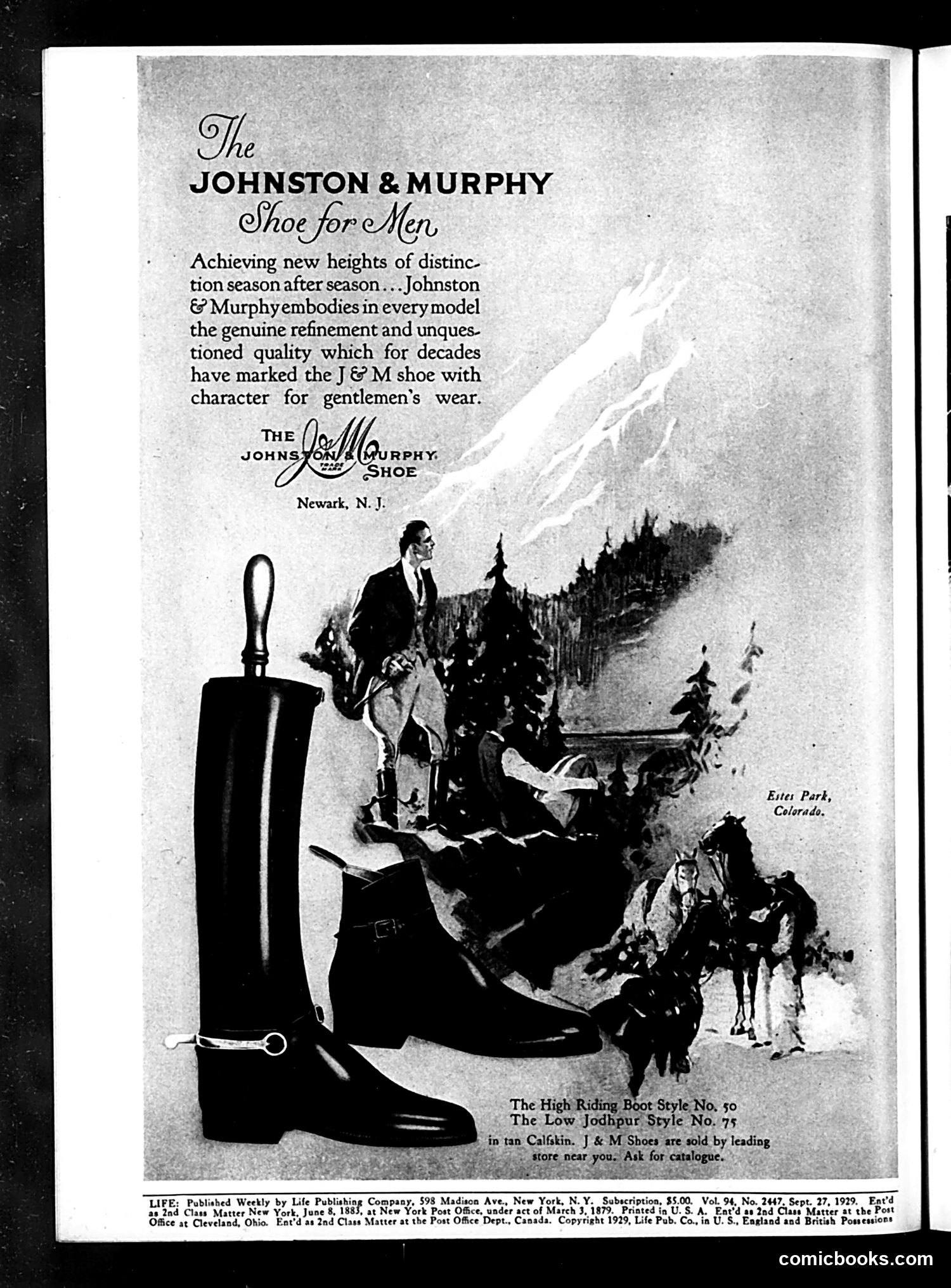
# Analysis This is **not a political cartoon or satire**—it's a straightforward advertisement for Johnston & Murphy shoes, a men's footwear brand based in Newark, New Jersey. The ad uses an aspirational wilderness scene showing a well-dressed man in business attire overlooking a scenic Colorado landscape (labeled "Estes Park, Colorado"). The imagery suggests that Johnston & Murphy shoes are appropriate for both refined gentlemen's wear and outdoor/sporting activities. The text emphasizes the brand's decades-long reputation for "genuine refinement and unquestioned quality" in men's footwear. Two specific styles are advertised: a High Riding Boot (Style No. 50) and a Low Jodhpur Style (No. 75). The ad is from Life magazine's September 27, 1929 issue. This is purely commercial marketing, not political commentary.
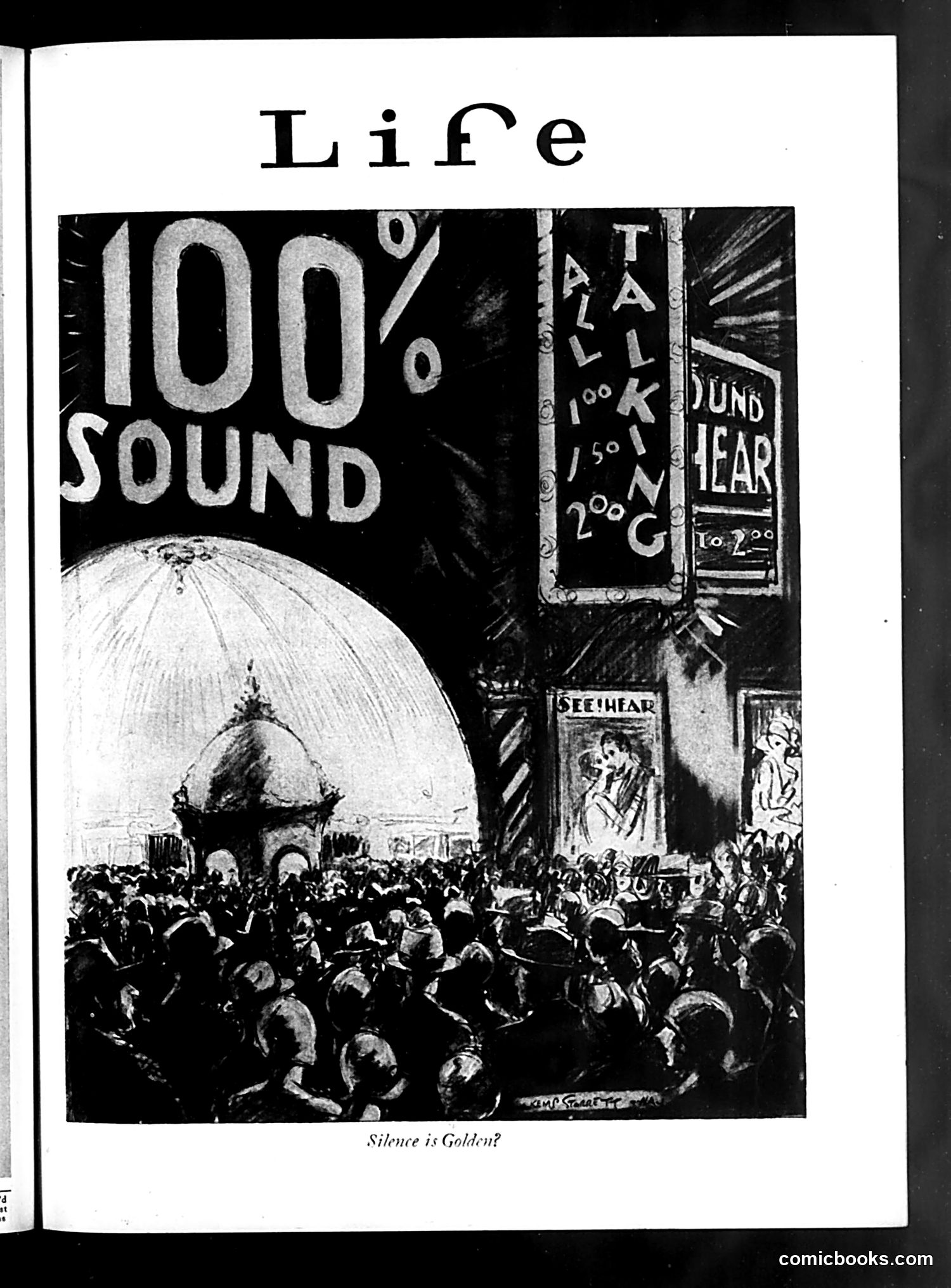
# Analysis of "Life" Magazine Page This page satirizes the transition to "talking pictures" (sound films), a revolutionary technology of the late 1920s. The illustration shows a massive crowd gathered around a giant dome-shaped speaker or sound apparatus, with signs advertising "100% SOUND," "TALK," and "DUMB HEAR." The caption "Silence is Golden!" ironically contrasts the era's enthusiasm for audible cinema against the previous silent film era. The cartoon critiques how crowds eagerly embrace this new technology, suggesting perhaps concerns about quality or artistic merit being sacrificed for novelty and commercial appeal. The dystopian imagery—the overwhelming crowds, mechanical scale—implies social commentary on mass culture and technological determinism rather than celebrating progress.
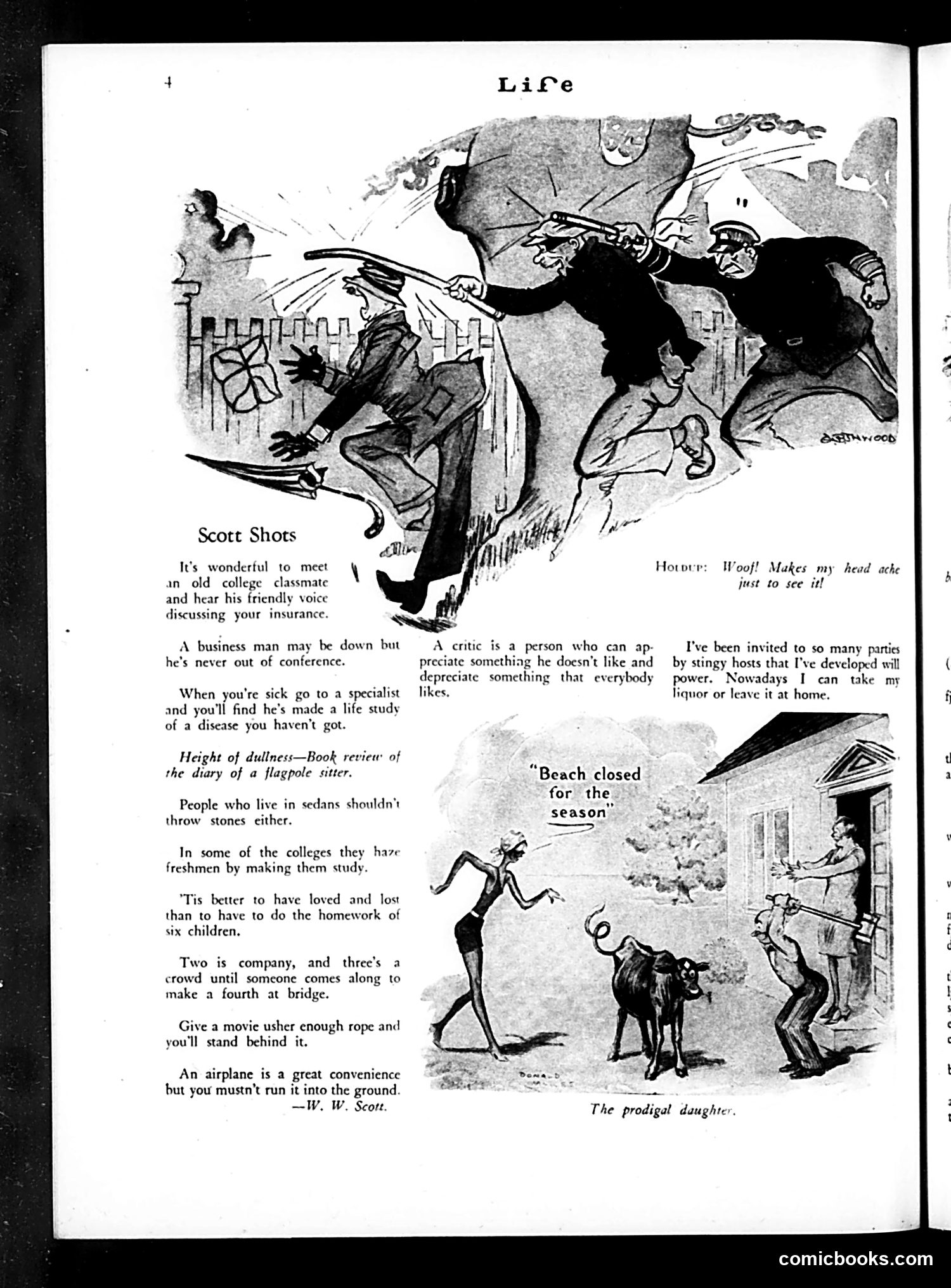
# "Life" Magazine Page Analysis This page from *Life* magazine contains two distinct sections: **"Scott Shots"** (top): A satirical cartoon depicting business and social commentary through humorous observations. The chaotic illustration shows figures in various predicaments, accompanying quips about insurance, specialists, critics, and colleges. The humor relies on gentle social satire about everyday situations. **"The Prodigal Daughter"** (bottom): A cartoon showing a scantily-clad young woman attempting to enter a beach house while being turned away by what appears to be a parent or authority figure. The caption "Beach closed for the season" is a double entendre—the joke appears to reference either parental disapproval of the daughter's appearance or behavior, reflecting era-appropriate commentary on youth culture and social propriety. Both exemplify *Life*'s signature blend of visual humor and social observation.
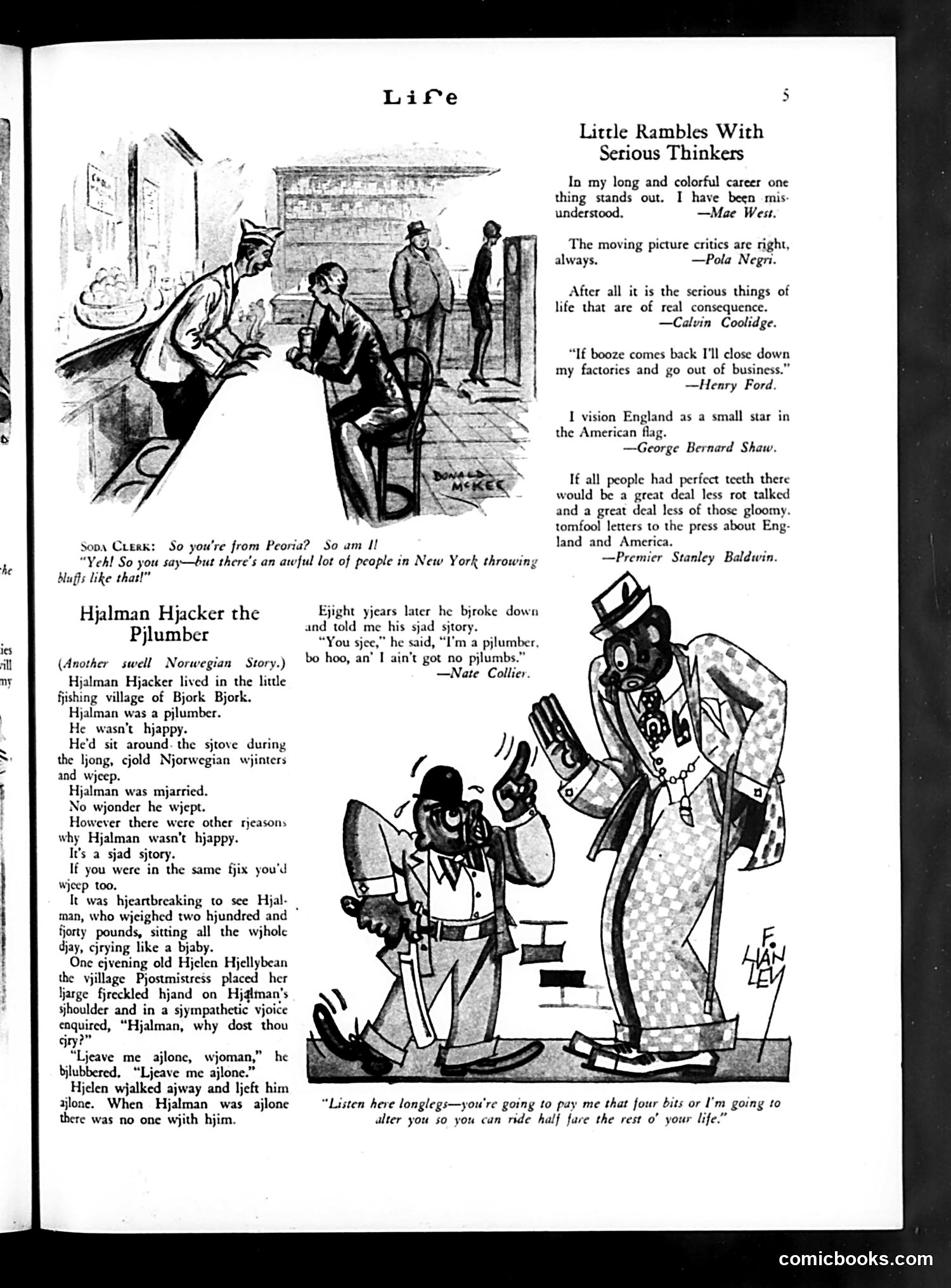
# Analysis of Life Magazine Page 5 This page contains two satirical sections: **Top cartoon:** A soda clerk addresses a customer from Peoria, Illinois, mocking New Yorkers as rowdy and unruly—likely reflecting early 20th-century regional stereotypes about urban versus small-town American behavior. **Main story: "Hjalman Hjacker the Plumber"** presents a Norwegian folk-tale style narrative about an unhappy plumber in a fishing village. The story emphasizes his misery despite material comfort, illustrating a common theme: that contentment depends on emotional/relational fulfillment rather than mere employment or survival. The bottom cartoon shows what appears to be a domestic dispute, with a threatening figure demanding payment or threatening consequences. The page mixes short humor pieces with social commentary typical of Life's satirical approach to American life and character.
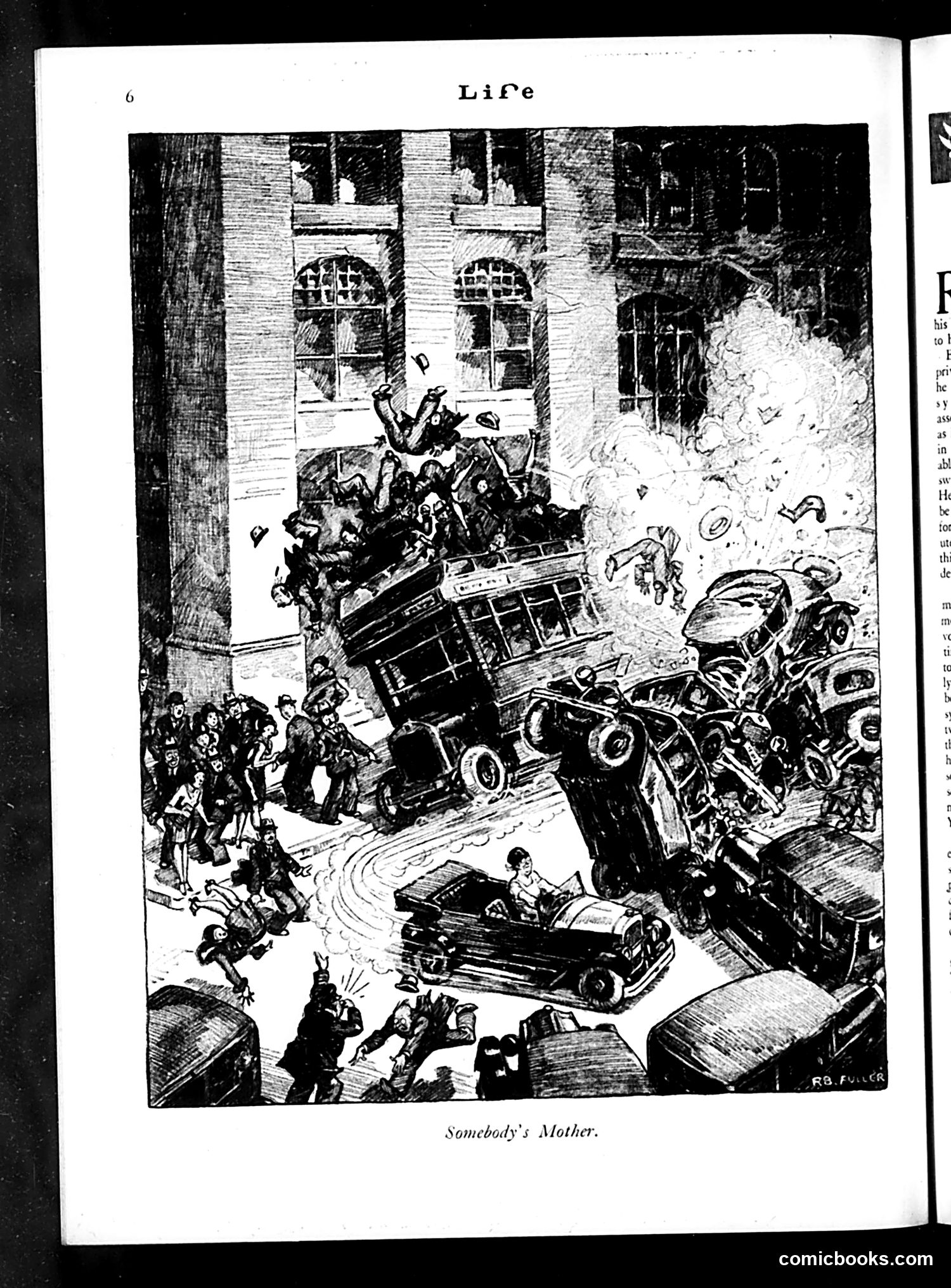
# Analysis of "Somebody's Mother" This cartoon depicts a tragic urban street scene showing a truck accident with casualties. The composition shows: - A large overturned truck in the center, spilling its load - Multiple automobiles scattered around the street - Pedestrians and onlookers surrounding the accident - A brick building in the background - Bodies or injured persons visible in the wreckage The title "Somebody's Mother" suggests the satire focuses on the human cost of traffic accidents—specifically highlighting how victims are someone's family member, emphasizing the tragedy behind statistics. This appears to be social commentary on urban traffic dangers during the automobile era, when such accidents were becoming increasingly common and deadly. The piece likely criticizes either unsafe driving practices, inadequate street safety measures, or society's indifference to these mounting casualties.
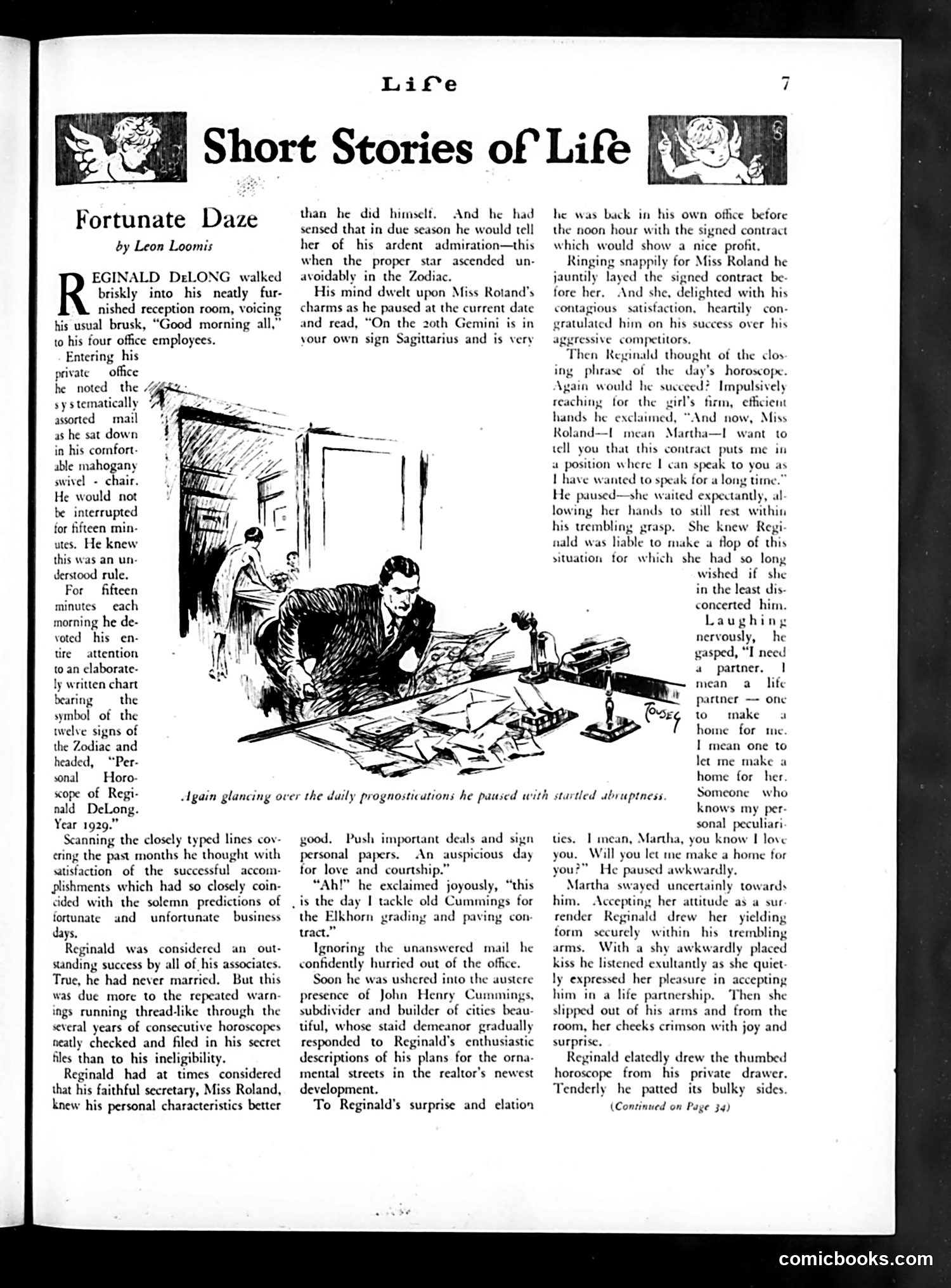
# "Fortunate Daze" by Leon Loomis This is a short story, not a political cartoon. The narrative follows Reginald DeLong, a businessman who consults daily horoscopes based on zodiac signs. The story satirizes the absurdity of making important business decisions—like signing contracts and pursuing romance—based on astrological predictions rather than rational judgment. The accompanying illustration shows Reginald sprawled dramatically over his desk, surrounded by astrological charts and papers, having apparently acted on his horoscope's advice. The humor targets early 20th-century fascination with pseudoscientific fortune-telling and superstition among even educated, professional men, mocking their willingness to surrender decision-making to mystical nonsense.
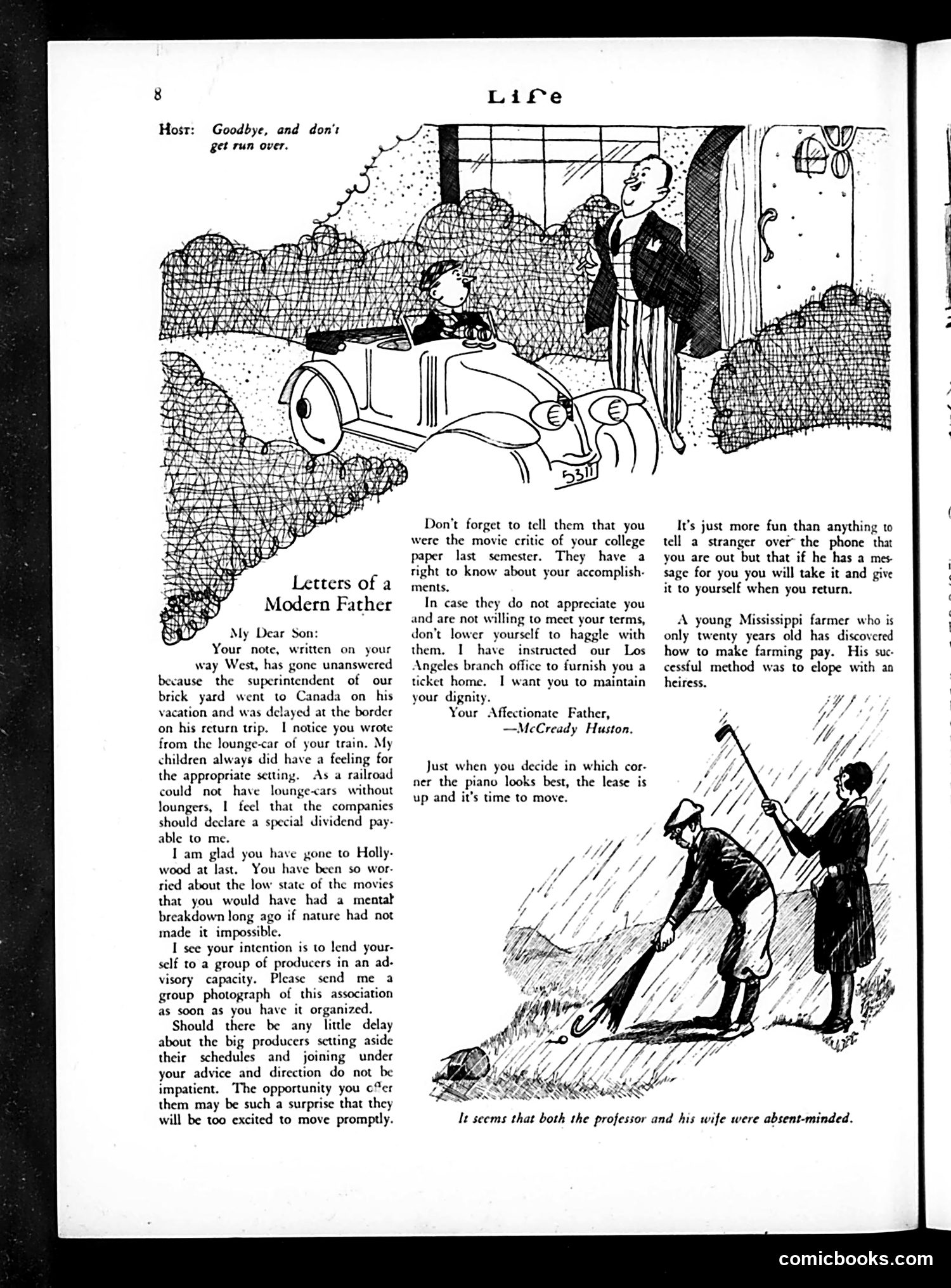
# Analysis of Life Magazine Page 8 This page contains two distinct pieces: **Top cartoon**: Shows a man in a car saying goodbye to another man, with the caption "Goodbye, and don't get run over." The humor satirizes casual, dismissive farewells—suggesting indifference to someone's safety. **"Letters of a Modern Father"**: A humorous advice column from "McCready Huston" to his son in Hollywood. The father scolds his son for lounging in train cars, warns against impressing movie producers, and advises maintaining dignity. The satire mocks both aspiring young men seeking Hollywood success and overbearing paternal concern about social status and proper behavior. **Bottom cartoon**: Shows two figures in heavy rain, with caption "It seems that both the professor and his wife were absent-minded," depicting domestic absent-mindedness as comedy. All three pieces use gentle satire about American social attitudes toward career ambition, family propriety, and everyday behavior.
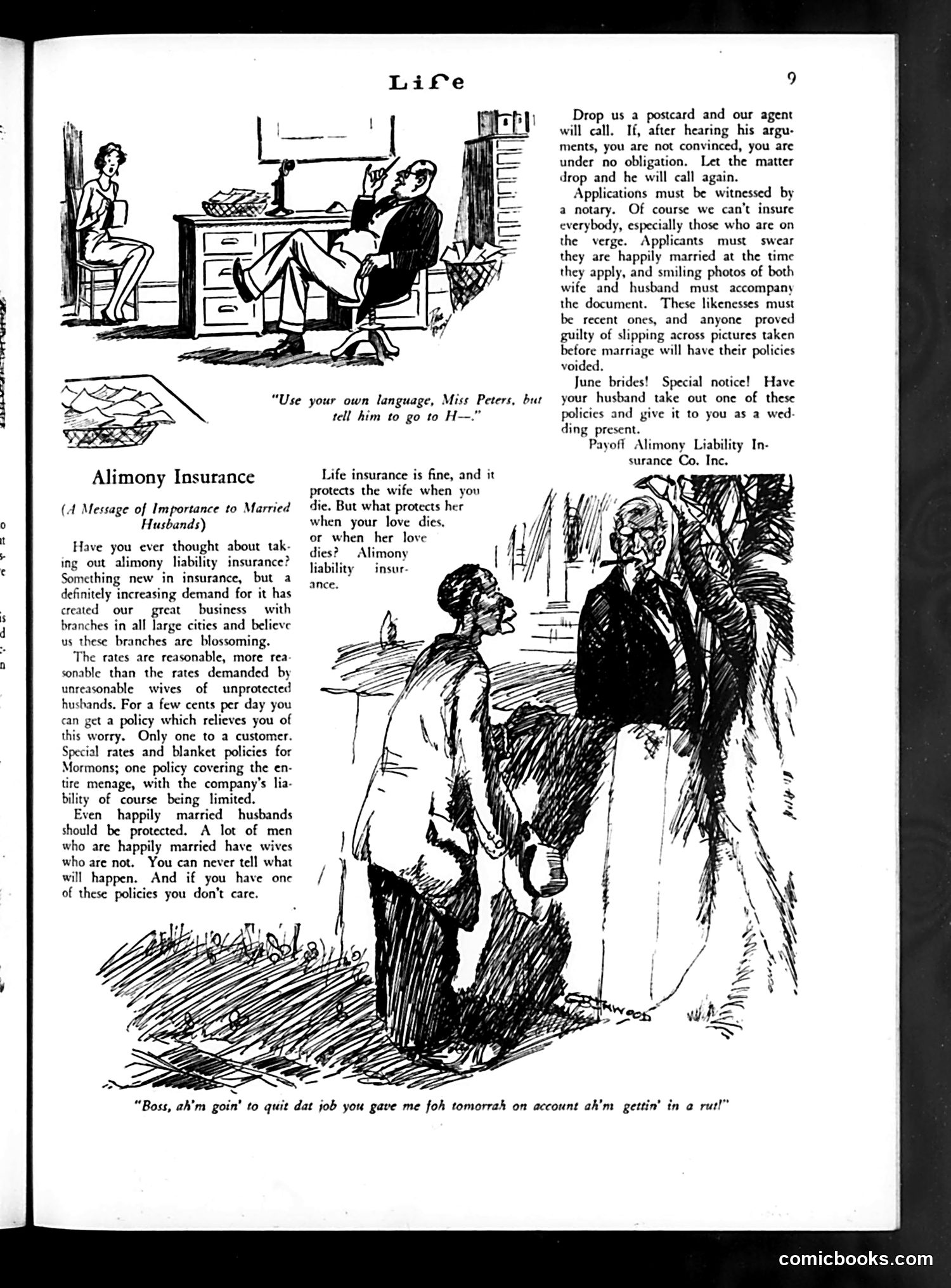
# Analysis of Life Magazine Page 9 This page contains two distinct sections: **Top Cartoon:** Depicts an office scene where a man at a desk tells a woman (Miss Peters) to use more forceful language when instructing someone to go to "H—" (Hell). It's a mild workplace joke about professional propriety. **Main Feature: "Alimony Insurance"** A satirical advertisement-style article promoting insurance against alimony payments. The accompanying cartoon shows a man confronting his boss, threatening to quit due to a new rut/entanglement, implying marital trouble. The satire targets the emerging phenomenon of alimony liability insurance—policies protecting husbands from financial obligations if marriages fail. The piece mocks both the insurance industry's opportunism and the anxiety among married men about potential divorce costs. The crude dialect in the caption suggests working-class vulnerability to such schemes.
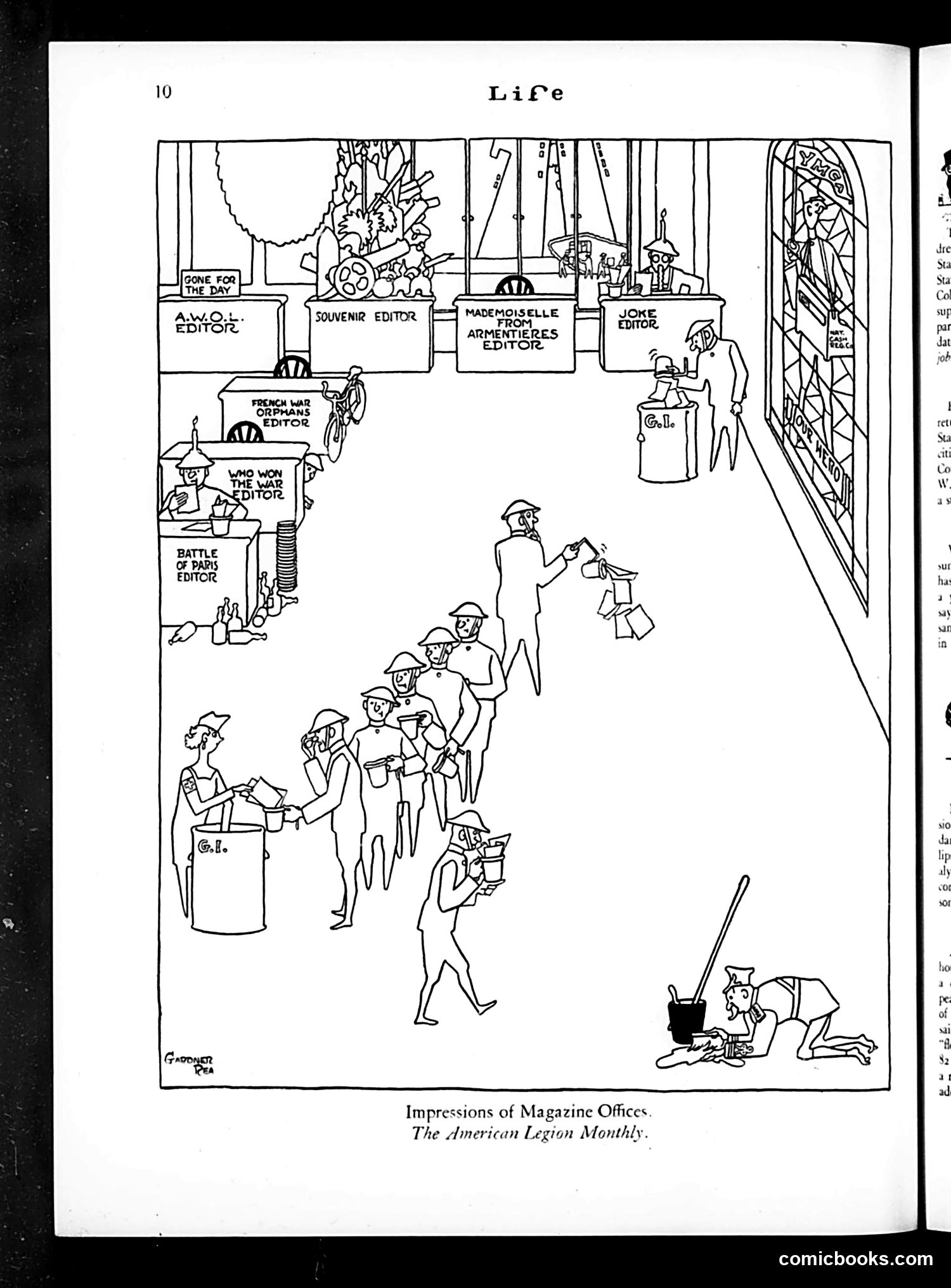
# Impressions of Magazine Offices This satirical cartoon depicts the editorial hierarchy and workflows of magazine publishing offices during the World War I era. The upper tier shows specialized editors at their desks: an "Awol Editor," "Souvenir Editor," "Mademoiselle and Armetieres Editor," and "Joke Editor." Below them are lower-ranking editors handling war-related content ("French War Orphans Editor," "Who Won the War Editor," "Battle of Paris Editor"). The bottom half shows soldiers as raw material being processed through this system—they're being funneled, sorted, and distributed like commodities to feed the magazine's war-focused content. The satire mocks how American magazines exploited soldiers' experiences and war narratives for commercial purposes, treating human suffering as editorial inventory rather than genuine news.