A complete issue · 36 pages · 1936
Judge — August 1936
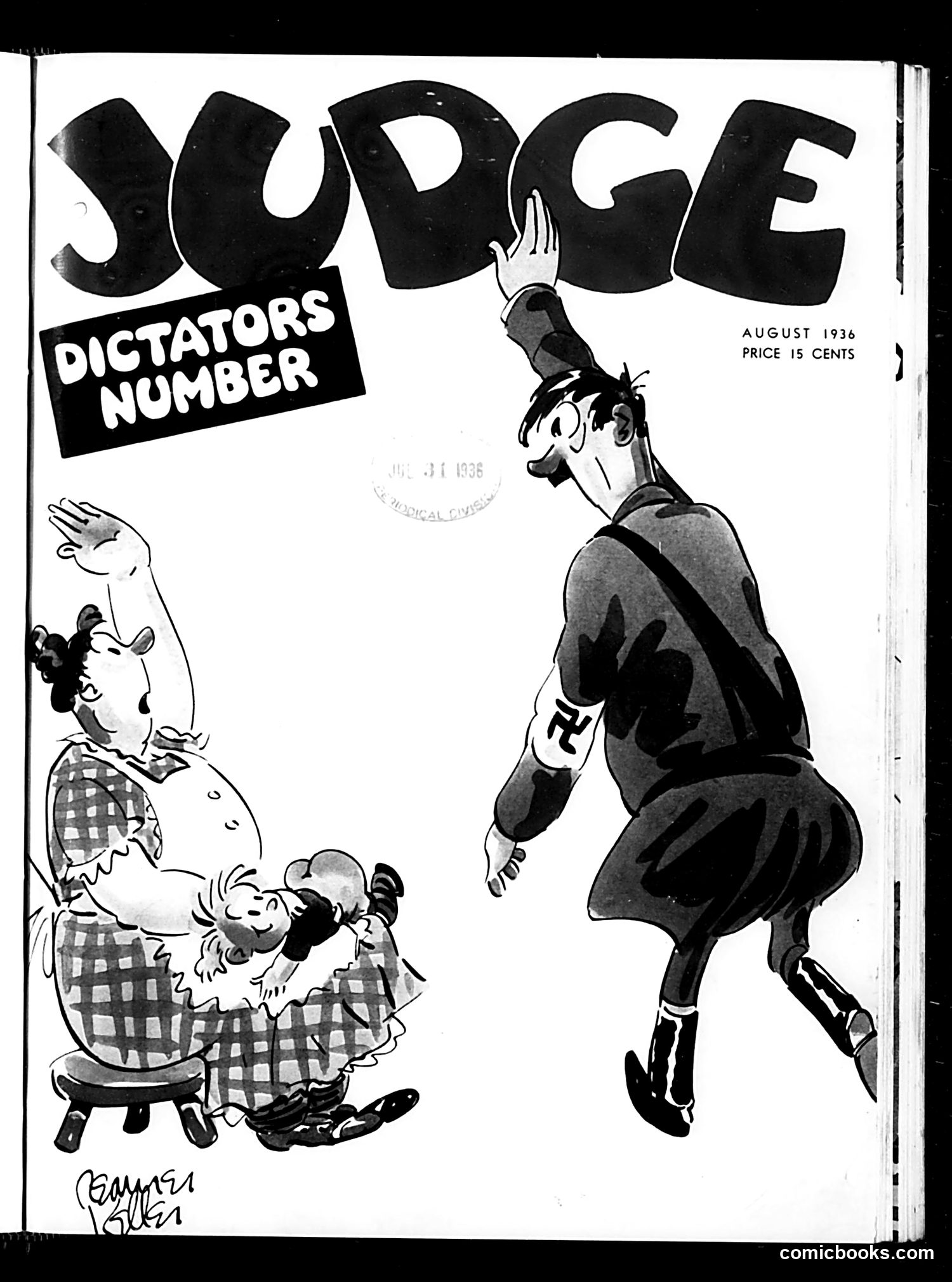
# Judge Magazine - August 1936: "Dictators Number" This is the cover of Judge's special "Dictators Number" from August 1936, priced at 15 cents. The artwork satirizes contemporary authoritarian leaders through exaggerated caricature. On the right, a figure in military uniform with a swastika armband appears to be a caricature of Adolf Hitler, depicted in a menacing pose. On the left, a rotund, crude caricature holds what appears to be children, likely representing a dictator's exploitation or control of populations. The large "JUDGE" letters dominating the cover underscore the magazine's satirical mission. This was published during the rise of fascism in Europe, when American satirical publications actively mocked Hitler and other authoritarian leaders. The exaggerated, dehumanizing style was typical of 1930s political cartooning.
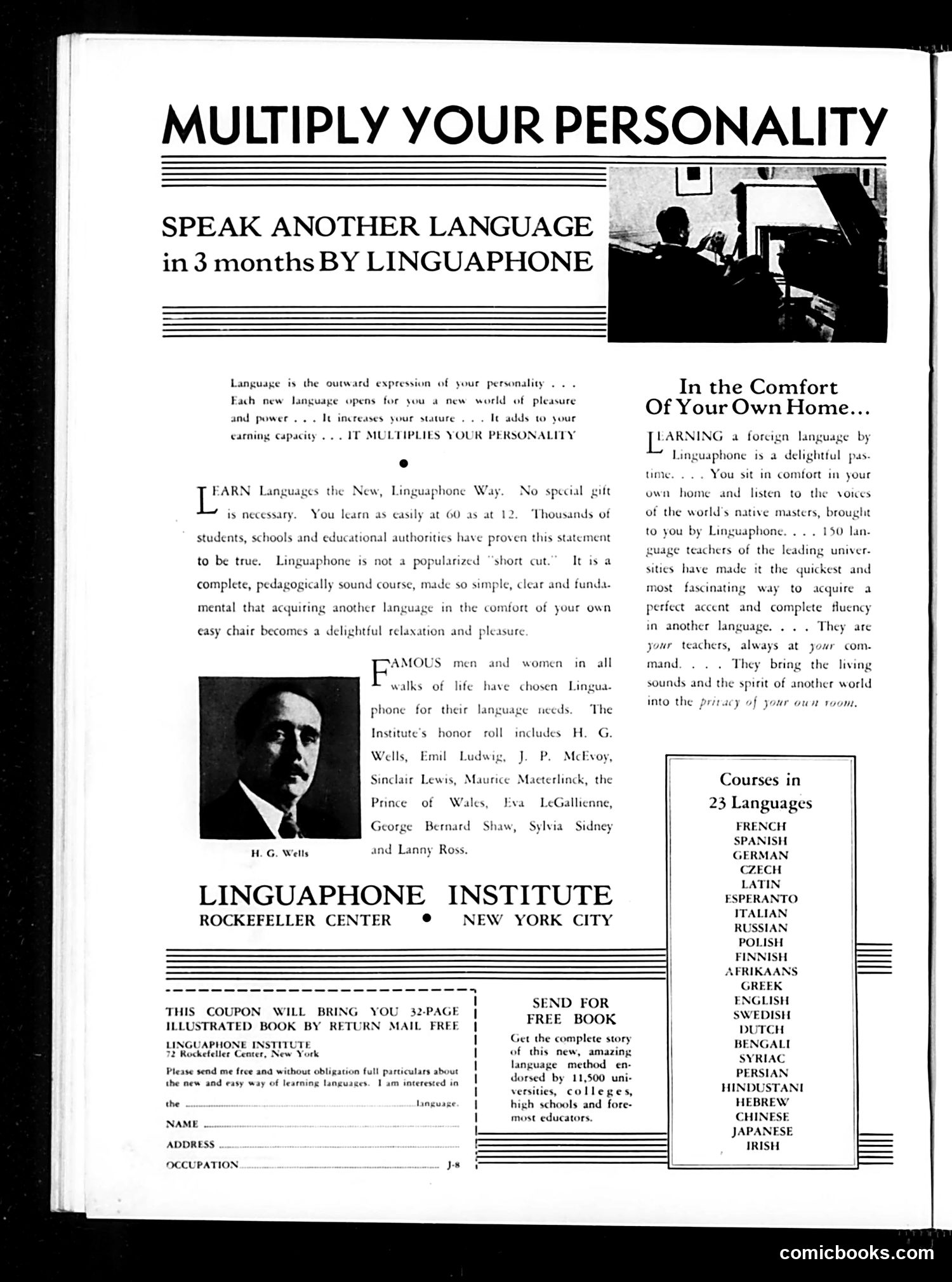
# Analysis This page is primarily **advertising, not satire or political commentary**. It's a Linguaphone Institute advertisement promoting language instruction through their mail-based method. The only identified figure is **H.G. Wells**, the famous British author, whose photograph appears alongside testimonial copy. His inclusion lends credibility to the language course by suggesting a prominent intellectual endorses it. The ad's appeal centers on **self-improvement and social status**: "Multiply Your Personality" promises that learning languages increases one's standing and earning capacity. The claim of learning "in 3 months" and studying "in comfort of your own home" targeted busy professionals. The 23-language course list and celebrity endorsement were standard advertising tactics of this era (appears to be 1920s-30s). No political satire is evident here.
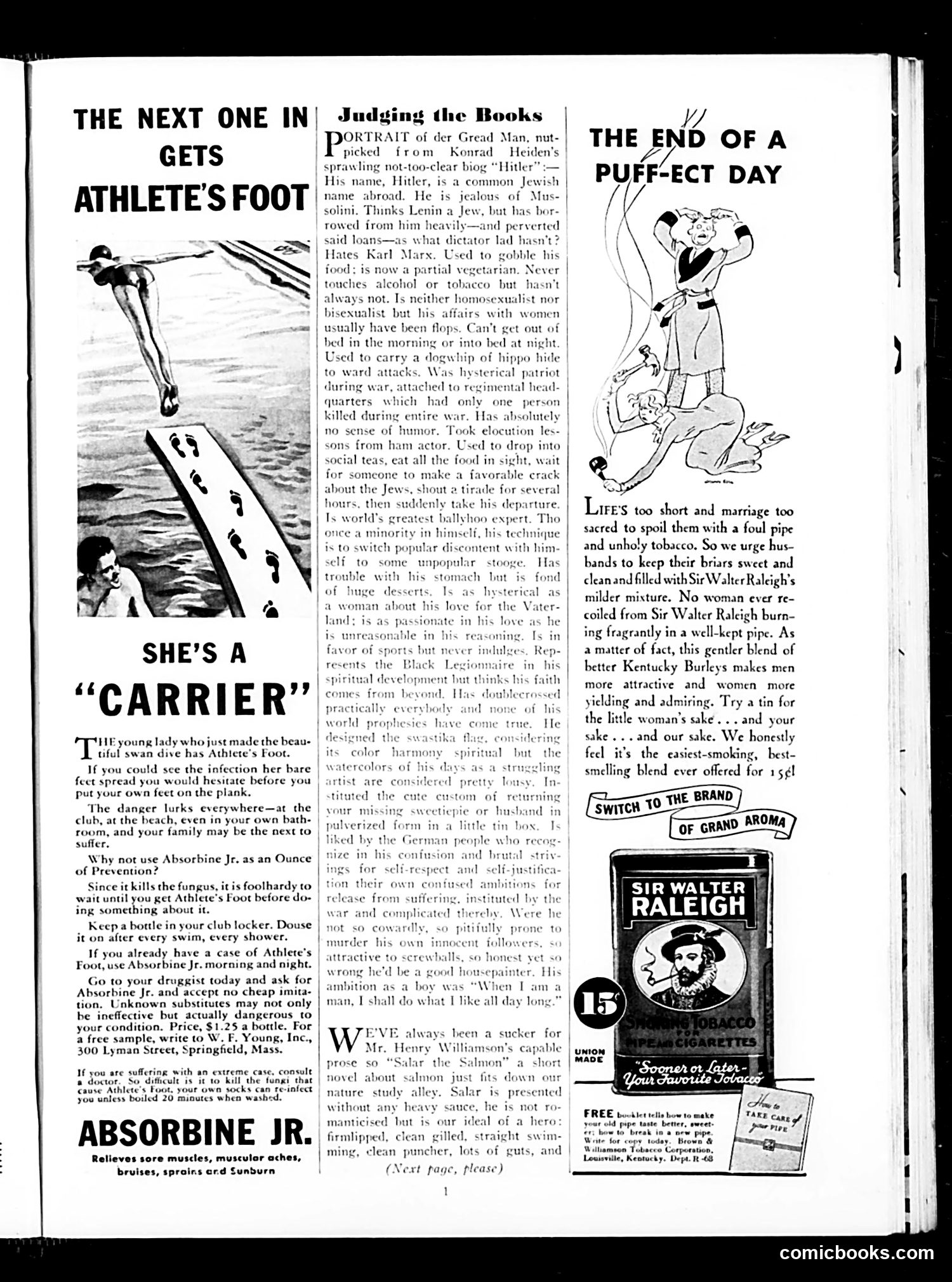
# Analysis of Judge Magazine Page This page mixes advertisements with satirical content. The left column attacks **Adolf Hitler** through a "Portrait of the Great Man" section, cataloging his alleged character flaws—jealousy of Mussolini, vegetarianism, sexual affairs, lack of humor, and hysteria. The satire portrays him as emotionally unstable and morally contemptible. The right side features "The End of a Puff-ect Day," a lighthearted cartoon about pipe smoking, recommending **Sir Walter Raleigh tobacco** as superior to cigarettes. This advertisement uses humor to market the product as the gentlemanly choice. The page reflects **WWII-era American sentiment**—virulent anti-Nazi propaganda alongside consumer advertising. The contrast shows how wartime satire coexisted with ordinary commercial messaging in American magazines.
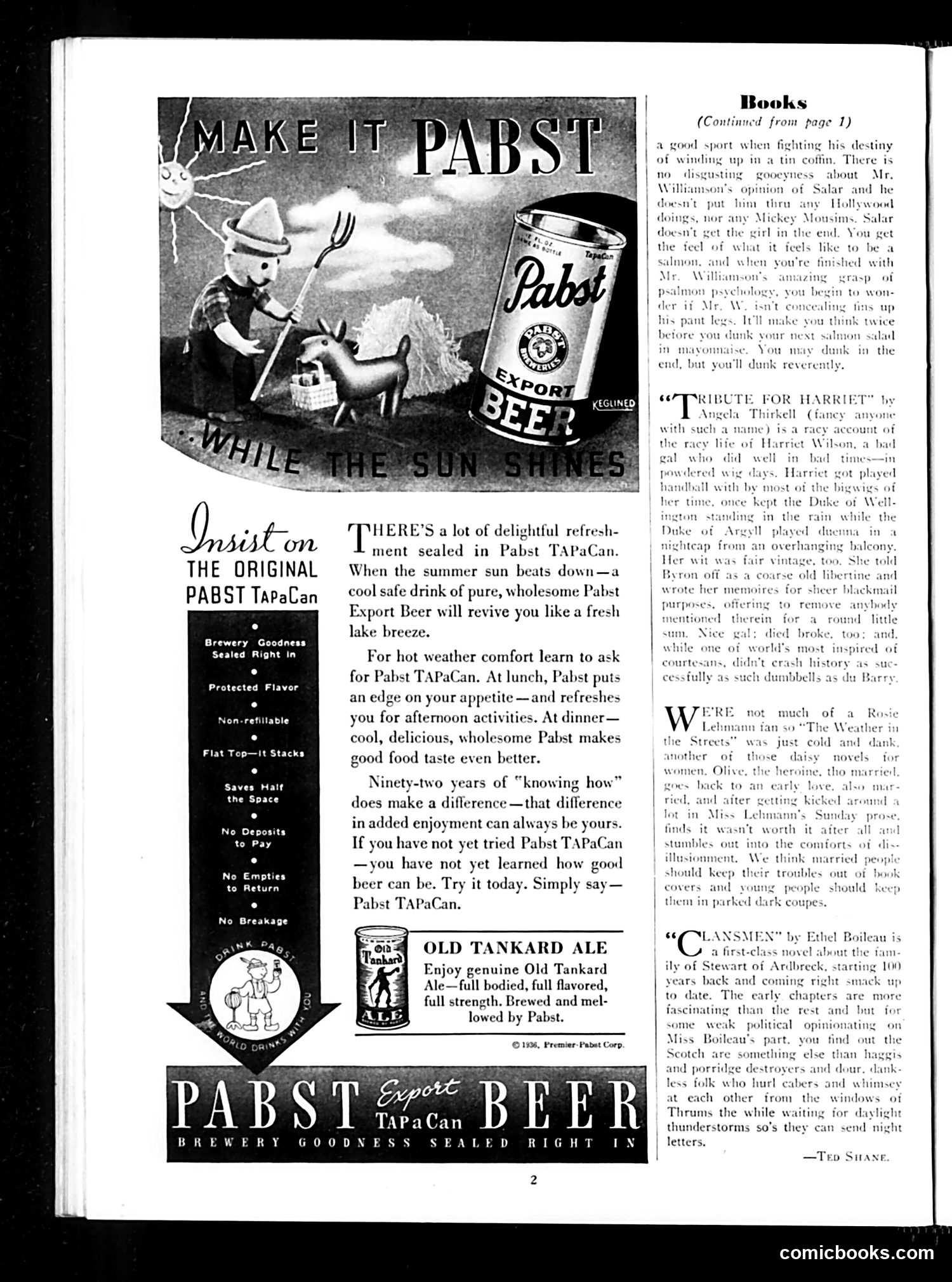
# Page Analysis This page is **primarily advertising** for Pabst beer products, not political satire. The main image shows a cheerful figure fishing while enjoying Pabst Export Beer, with the slogan "Make it Pabst While the Sun Shines." The right column contains **book reviews** (continued from page 1), discussing literary works including "Tribute for Harriet" by Angela Thirkell and other novels. There is **no political cartoon or satirical content** on this page. The only visual elements are beer advertisements featuring Pabst's TaPaCan product and Old Tankard Ale, along with their marketing copy emphasizing the drink's qualities and 92 years of brewing experience. This appears to be a typical Judge magazine page mixing entertainment content with full-page commercial advertising.
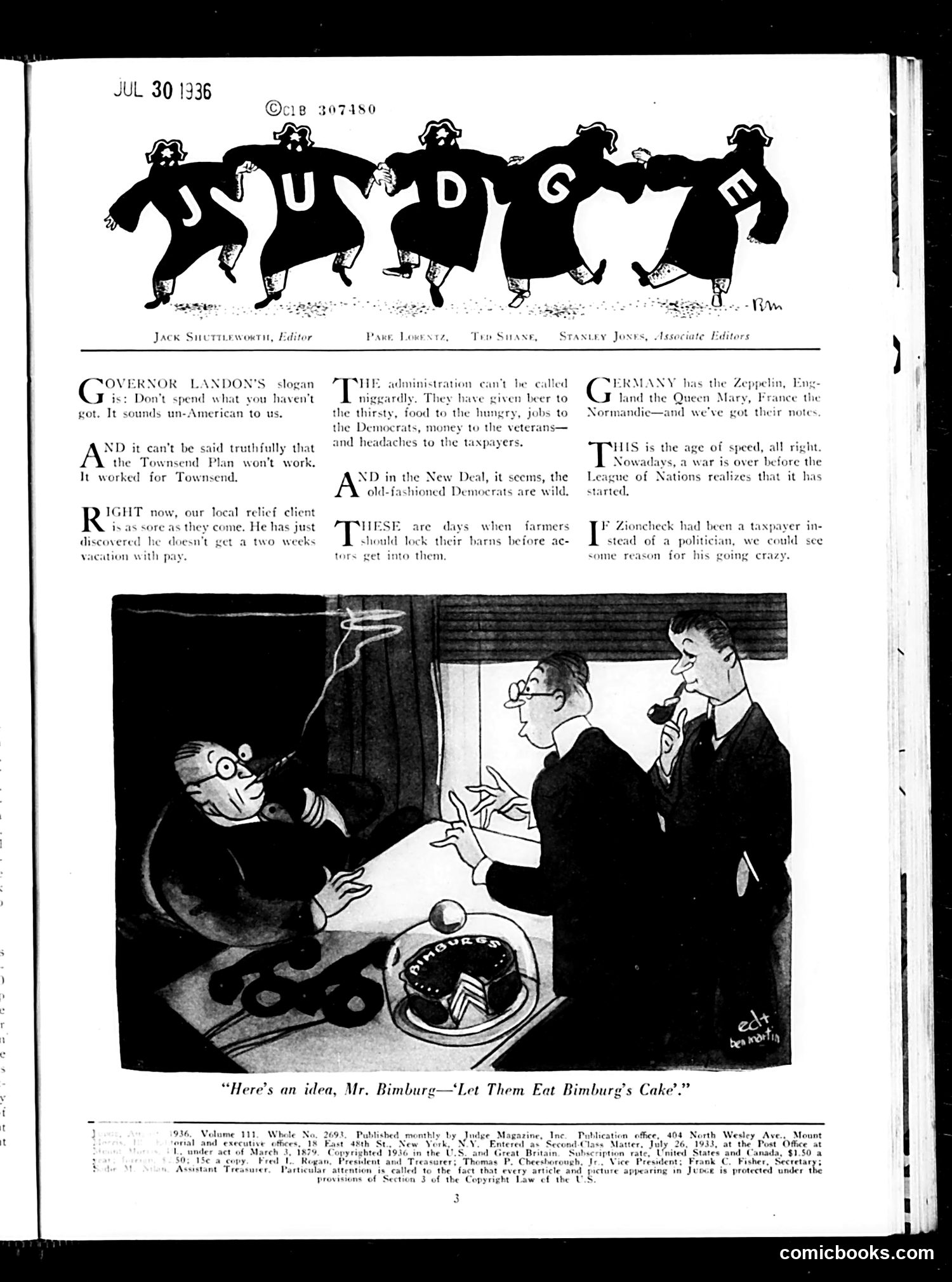
# Political Commentary from Judge Magazine, July 30, 1936 This page satirizes the Roosevelt administration's New Deal policies. The editorial quips criticize: **Governor Landon's slogan** ("Don't spend what you haven't got") as hypocritical—the New Deal itself practiced deficit spending. **The administration's spending**: Critics claim it gave beer to libraries, food to the hungry, jobs to Democrats, money to veterans, and "headaches to the taxpayers." **The main cartoon** depicts someone (likely a corporate figure) offering a cake labeled "Bimburg's" to two businessmen, with the caption "Let Them Eat Bimburg's Cake"—a cynical reference to Marie Antoinette's famous phrase, suggesting the wealthy were being appeased while common people suffered. The page reflects conservative opposition to FDR's 1936 re-election campaign, particularly wealthy interests' concerns about New Deal redistribution policies.
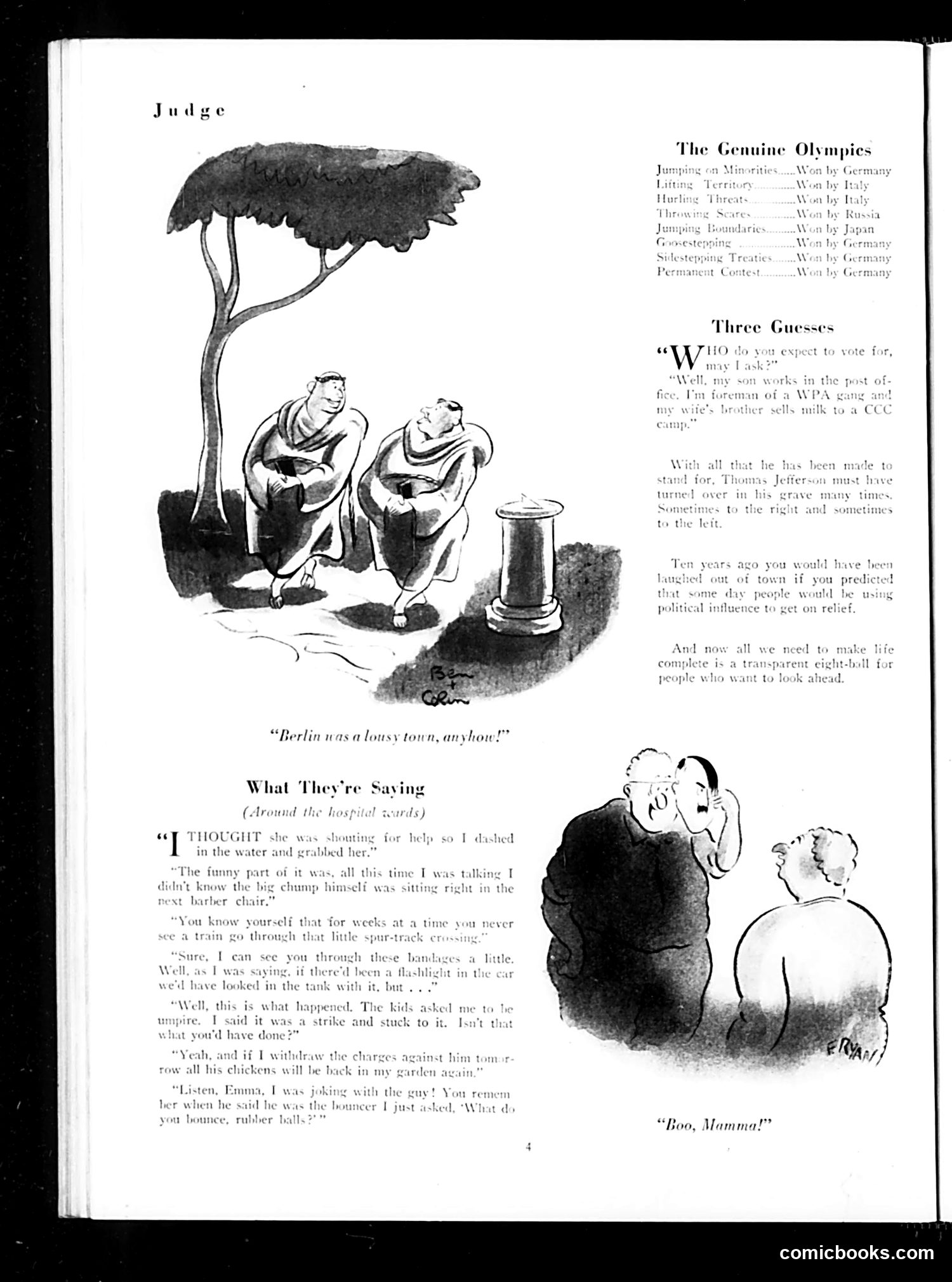
# Analysis of Judge Magazine Page This page satirizes political indecision, particularly regarding Thomas Jefferson (referenced in "Three Guesses"). The top cartoon, captioned "Berlin was a lousy town, anyhow!" depicts two figures under a tree discussing relief efforts, likely commenting on post-WWI reconstruction debates and conflicting political priorities. "The Genuine Olympics" lists satirical "competitions" won by various nations (Germany, Italy, Russia, Japan), mocking international tensions and nationalist rivalries of the interwar period. "What They're Saying" presents hospital gossip anecdotes—typical Judge humor mixing domestic comedy with political commentary. The right cartoon "Boo, Mamma!" appears unrelated domestic humor. Overall, the page reflects 1920s-30s American anxieties about political corruption, international relations, and relief policy amid economic uncertainty.
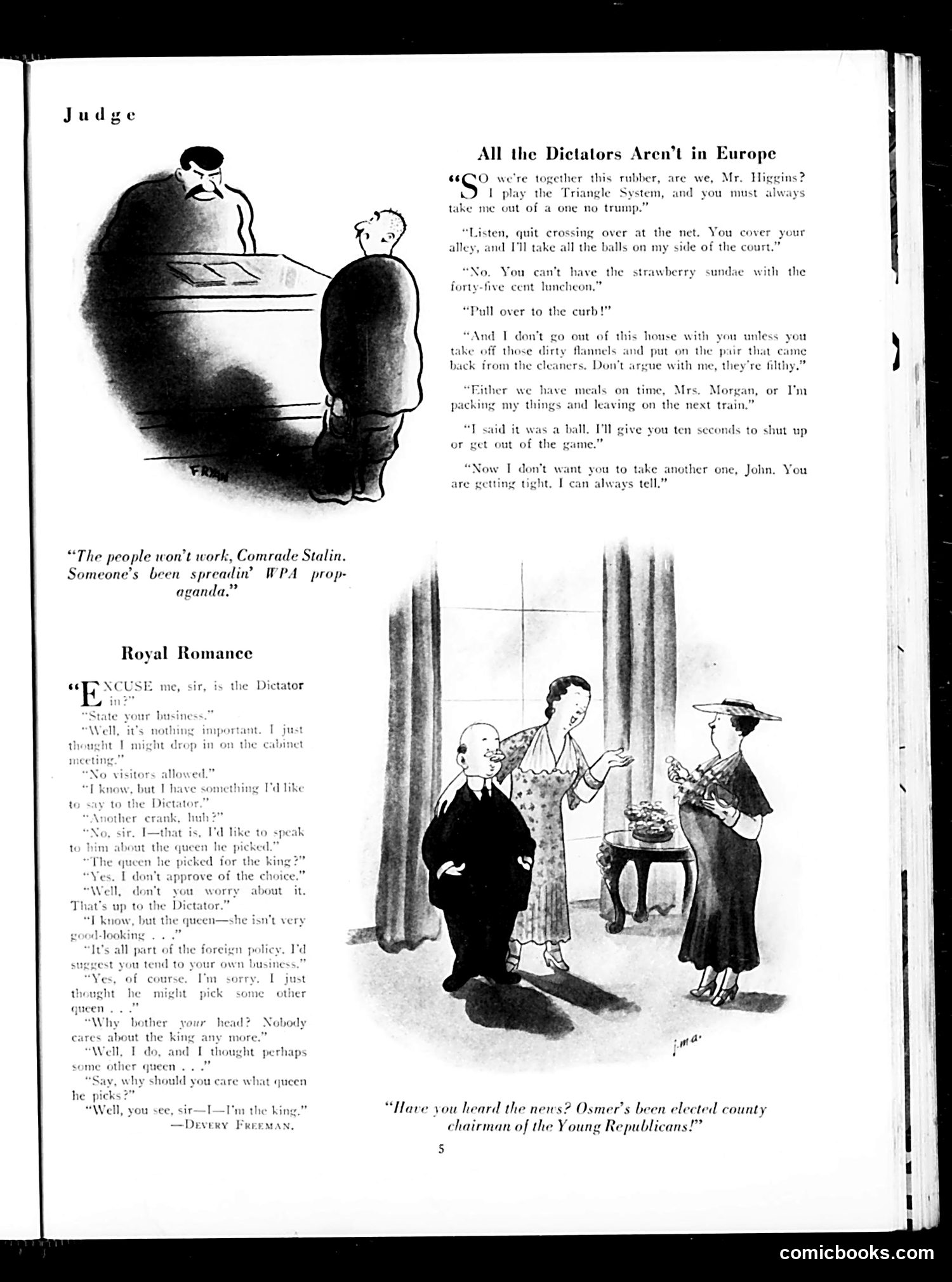
# Political Satire from Judge Magazine This page contains two separate cartoons satirizing political figures and domestic life during the interwar period. **"All the Dictators Aren't in Europe"** depicts a nagging wife dominating her husband at home, comparing domestic marital control to European authoritarian regimes. The satire suggests that American wives exercise "dictatorial" power over their husbands through various domestic demands and restrictions. **"Royal Romance"** mocks a Dictator character who objects to his queen's choice of a king, absurdly reversing expected power dynamics. The final caption references "Osmer" being elected county chairman of the Young Republicans—likely a local political figure whose name escapes modern recognition. Both cartoons use exaggeration to critique power imbalances and political pretension in 1920s-30s American life.
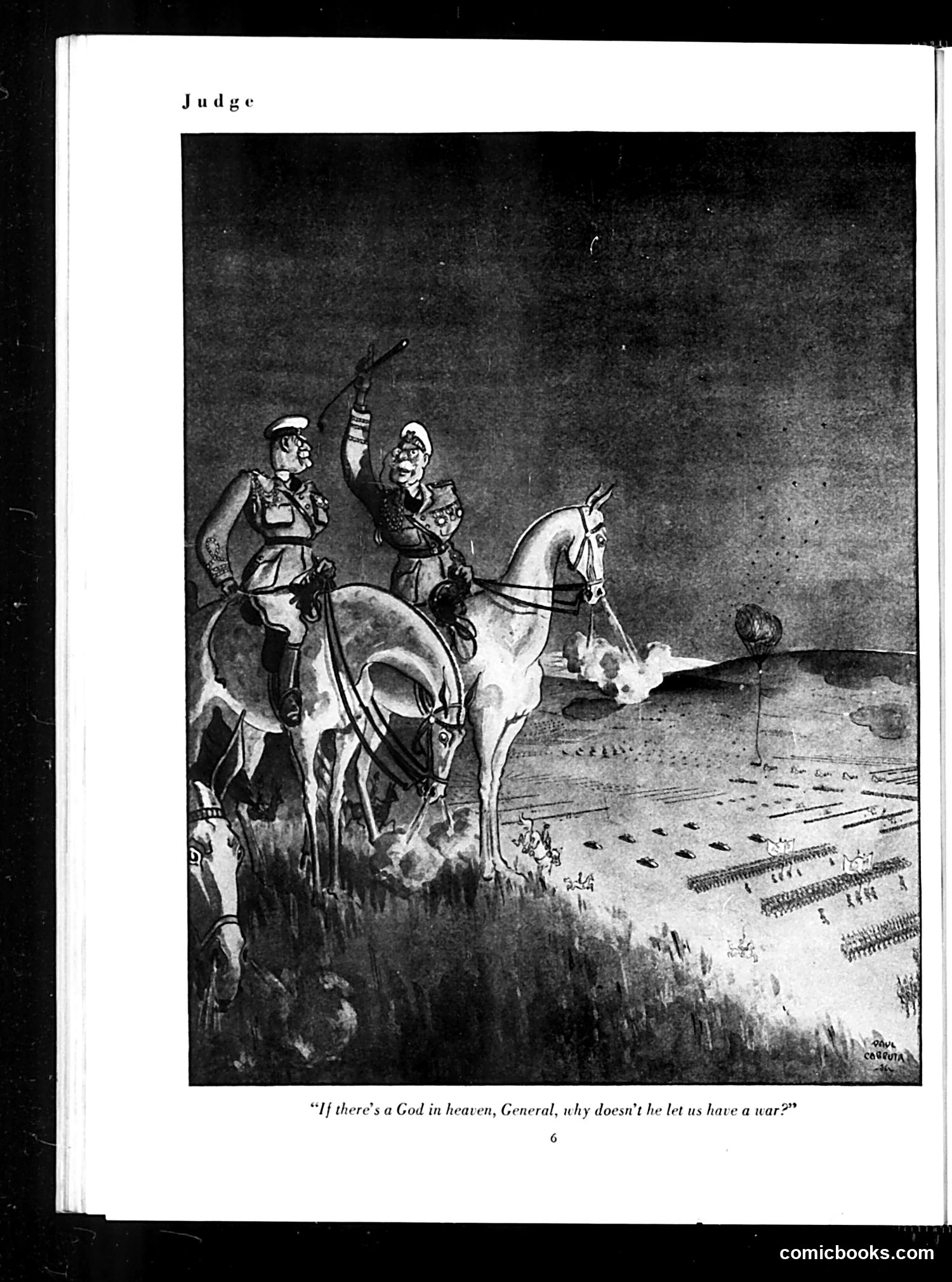
# Analysis of "Judge" Cartoon: "Judge" This political cartoon depicts two military officers on horseback overlooking a battlefield with troops arranged below. One officer asks the other: "If there's a God in heaven, General, why doesn't he let us have a war?" The satire critiques militaristic attitudes and the absurdity of military leadership during peacetime (or a period without active conflict). The joke suggests that military commanders are so eager for warfare that they're questioning divine will itself—treating war as a desirable outcome rather than a tragedy. This reflects broader anti-militarism sentiment common in American satirical publications of the early 20th century, mocking the assumption that generals and military hierarchy inherently desire conflict regardless of human cost.
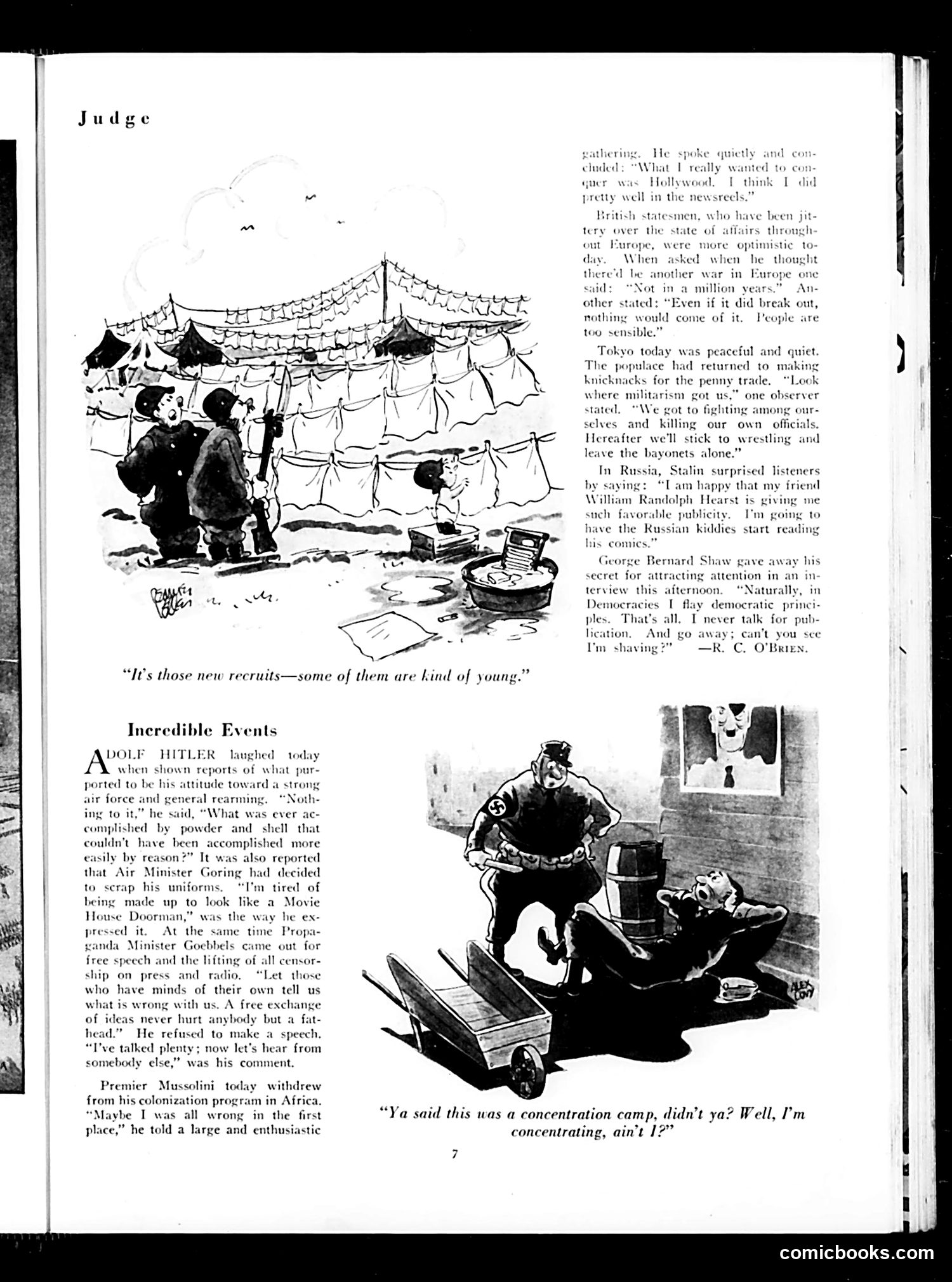
# Analysis of Judge Magazine Page This page from Judge satirizes World War II-era political figures and events. The top cartoon mocks military recruit training with the caption "It's those new recruits—some of them are kind of young." The "Incredible Events" section attacks Adolf Hitler, Hermann Göring, and Benito Mussolini through hostile commentary. It reports Hitler laughed at reports of German military weakness, mocks Göring's uniform changes, and ridicules Mussolini withdrawing from African colonization efforts. The lower cartoon depicts what appears to be a Nazi official (likely representing a concentration camp commandant) telling a prisoner "Ya said this was a concentration camp, didn't ya? Well, I'm concentrating, ain't I?"—darkly satirizing Nazi brutality by presenting the official's torture as literal "concentration." The content reflects American wartime anti-Axis propaganda and commentary.
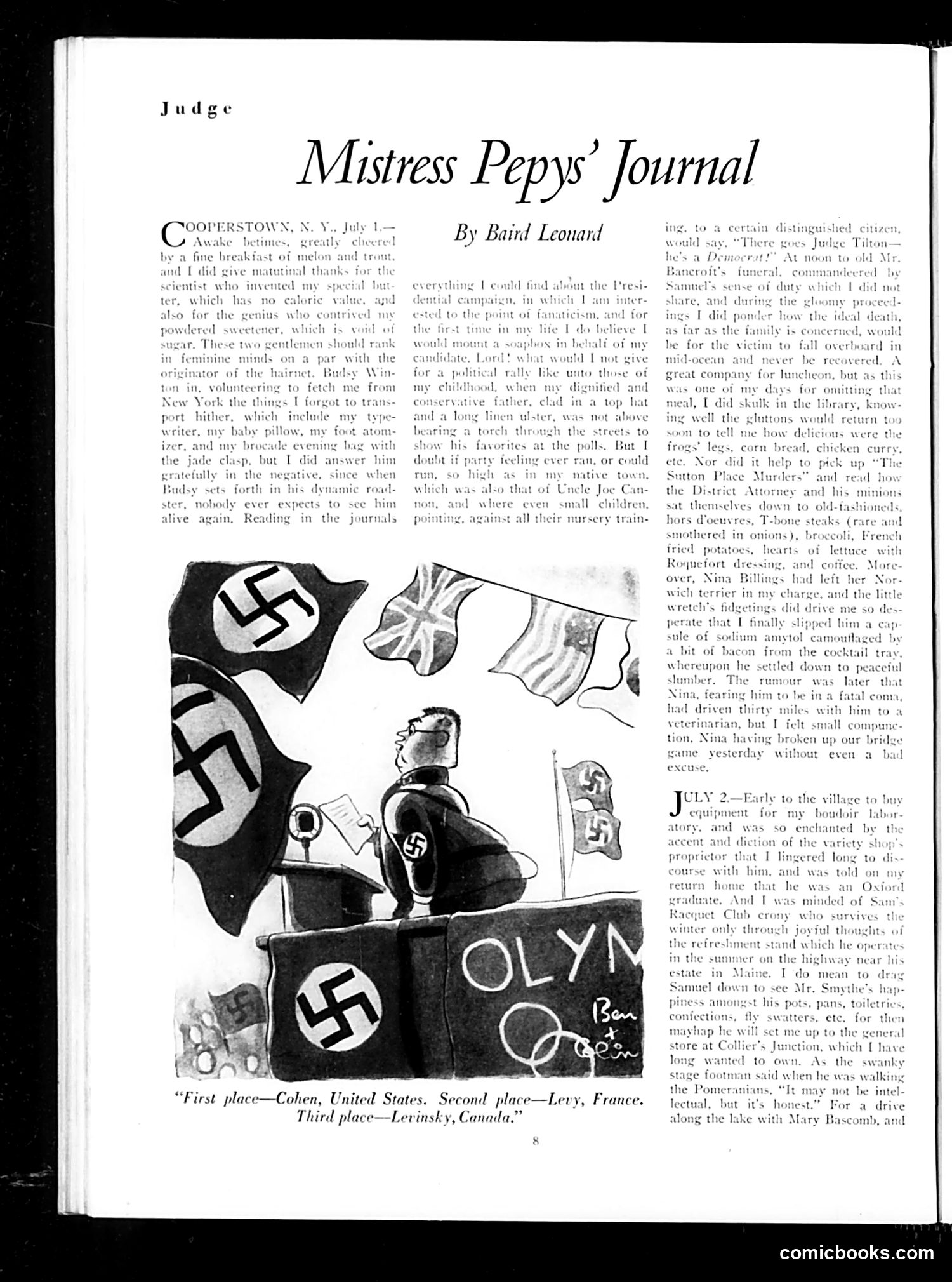
# Analysis of "Mistress Pepys' Journal" Cartoon This page contains a political cartoon satirizing the 1936 Olympic Games medal results. The illustration depicts an Olympic podium where the three medal winners are labeled "Cohen" (United States, first place), "Levy" (France, second place), and "Levinsky" (Canada, third place)—all Jewish surnames. The cartoon is flanked by Nazi and fascist flags, making the satire explicit: it mocks the antisemitic ideology of Nazi Germany by showing that despite Hitler's theories of racial superiority, Jewish athletes dominated Olympic competition. The three flags (Nazi, British, and what appears to be Italian fascist imagery) emphasize the irony of fascist regimes' presence at the Olympics while their racist doctrines were demonstrably false. The accompanying "Mistress Pepys' Journal" text appears to be unrelated society commentary, suggesting this was a mixed-content satirical magazine page typical of the mid-1930s.
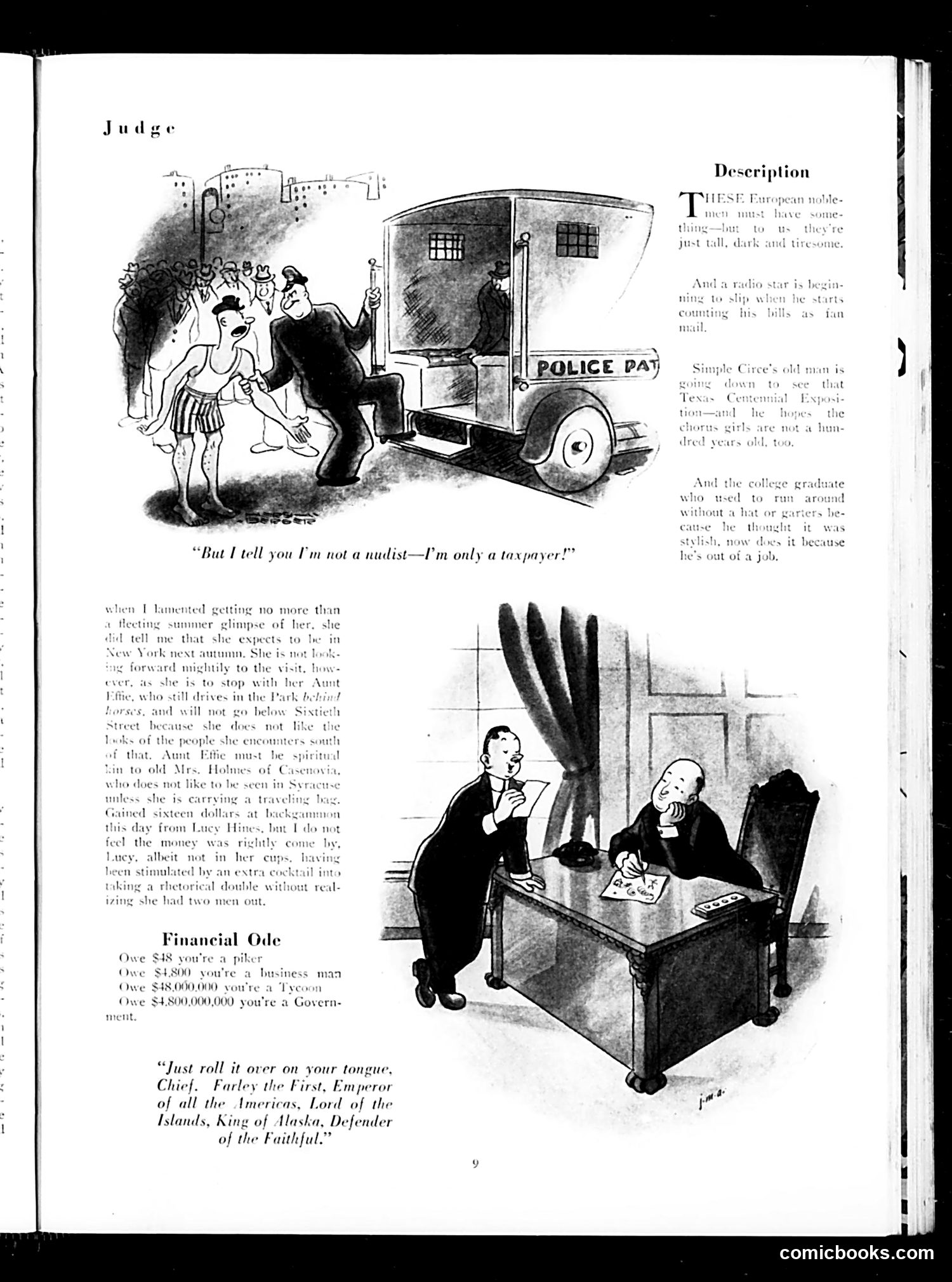
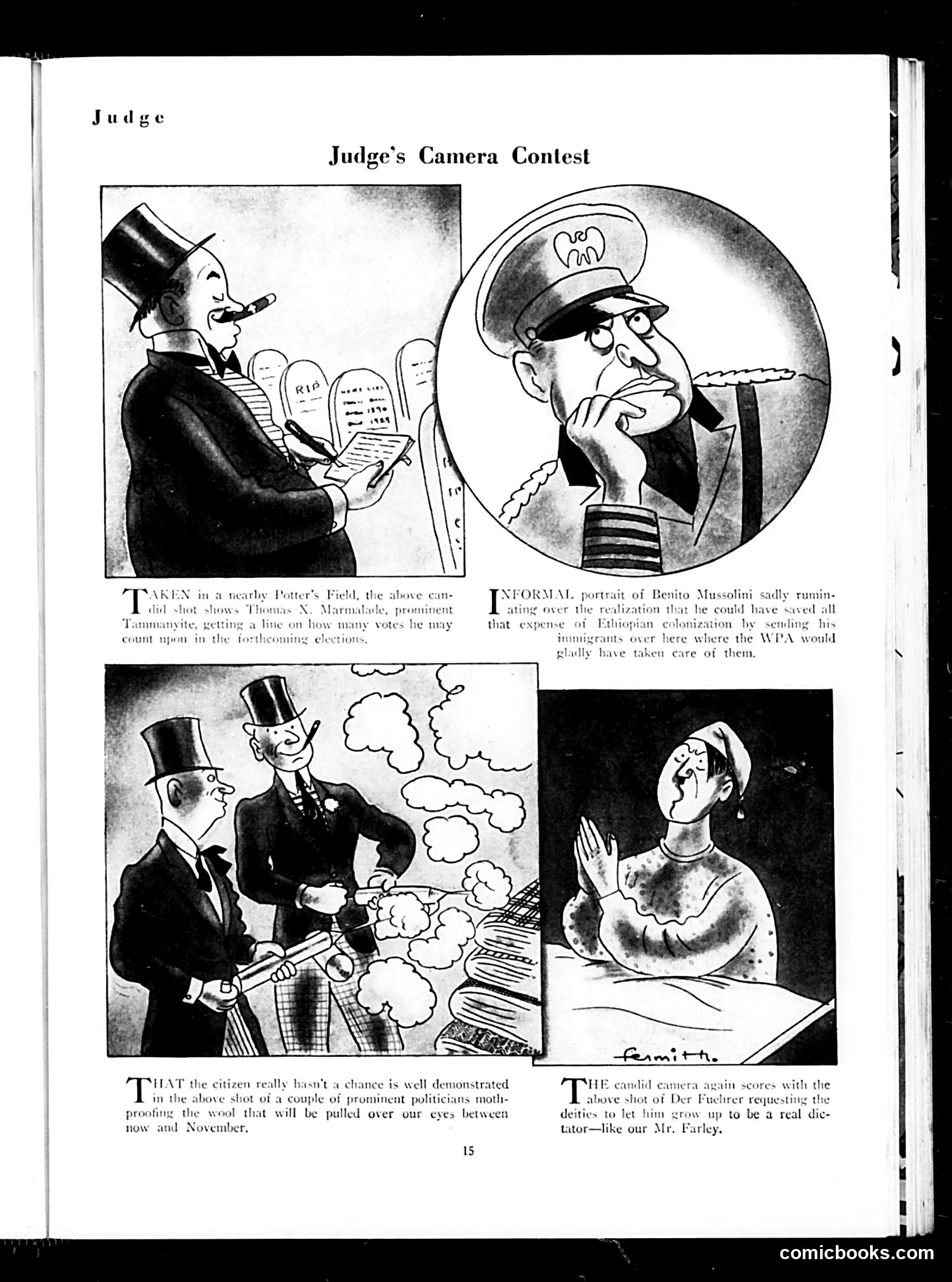
# Judge Magazine Cartoon Analysis The top cartoon mocks Prohibition-era arrests, showing a police paddy wagon apprehending nude or scantily-clad partygoers. The defendant's protest—"I'm not a nudist, I'm only a taxpayer!"—satirizes the absurdity of raids on private gatherings during Prohibition, suggesting law enforcement priorities are misplaced. The bottom cartoon appears to reference James Farley, Franklin D. Roosevelt's Postmaster General and political operative. The caption mockingly addresses him as "Farley the First, Emperor," with grandiose titles, satirizing his political power and influence. The scene shows him at a desk, likely commenting on his outsized role in New Deal politics. The "Financial Ode" section above uses escalating wealth figures as satire about economic inequality.
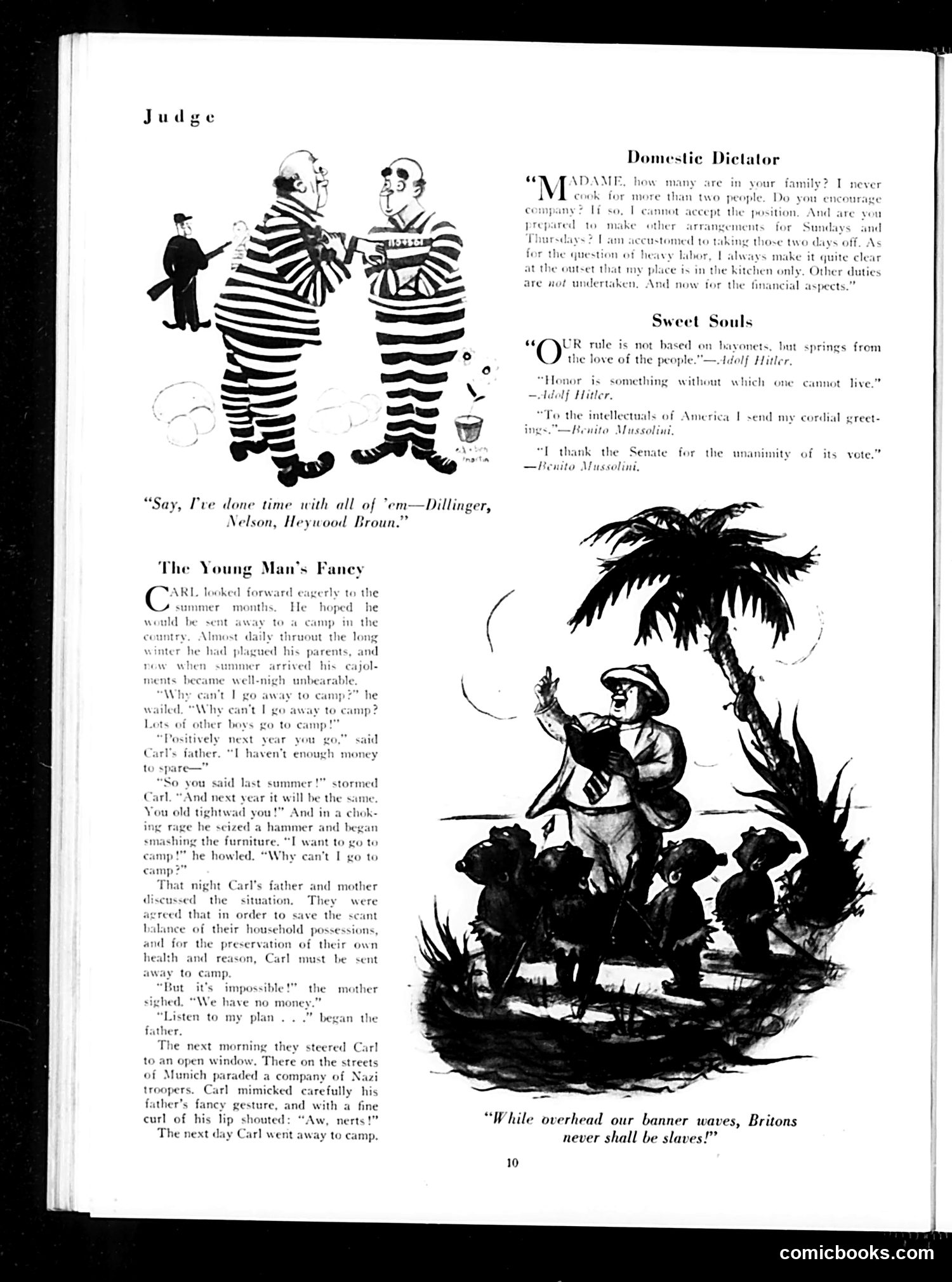
# Judge Magazine Page Analysis This page satirizes both domestic authoritarianism and fascist regimes through three pieces: **"Domestic Dictator"** depicts a housewife laying down strict rules to a prospective cook—controlling family size, work hours, and duties. The satire equates her household tyranny to authoritarian rule. **"Sweet Souls"** quotes Hitler and Mussolini claiming their power derives from "love of the people" and "honor," not force—obvious irony given their brutal regimes. The juxtaposition with a criminal ("Dillinger, Nelson") suggests their moral equivalence. **"The Young Man's Fancy"** tells of Carl, whose parents cannot afford summer camp. When Carl sees Nazi stormtroopers parading in Munich and mimics their salute dismissively ("Aw, nerts!"), his parents immediately send him to camp. The implication: even poor families will sacrifice to remove children from fascist influence. The page uses humor to warn American readers about authoritarianism—both petty domestic tyranny and dangerous totalitarianism abroad—likely dating from the late 1930s when Nazi Germany was increasingly prominent in American consciousness.