
Judge, 1936-08 · page 12 of 36
Judge — August 1936 — page 12: what you’re looking at
What you’re looking at
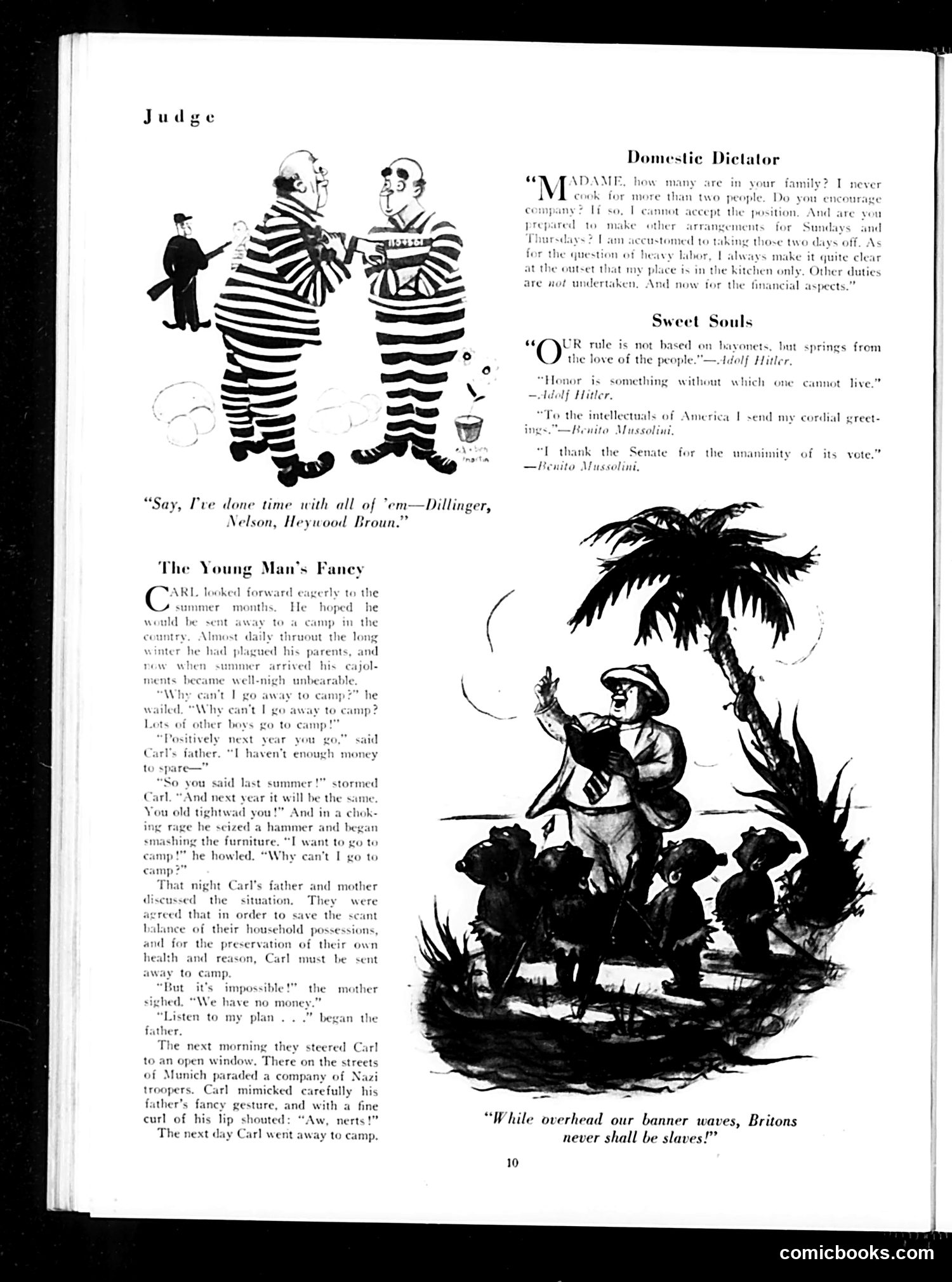
# Judge Magazine Page Analysis This page satirizes both domestic authoritarianism and fascist regimes through three pieces: **"Domestic Dictator"** depicts a housewife laying down strict rules to a prospective cook—controlling family size, work hours, and duties. The satire equates her household tyranny to authoritarian rule. **"Sweet Souls"** quotes Hitler and Mussolini claiming their power derives from "love of the people" and "honor," not force—obvious irony given their brutal regimes. The juxtaposition with a criminal ("Dillinger, Nelson") suggests their moral equivalence. **"The Young Man's Fancy"** tells of Carl, whose parents cannot afford summer camp. When Carl sees Nazi stormtroopers parading in Munich and mimics their salute dismissively ("Aw, nerts!"), his parents immediately send him to camp. The implication: even poor families will sacrifice to remove children from fascist influence. The page uses humor to warn American readers about authoritarianism—both petty domestic tyranny and dangerous totalitarianism abroad—likely dating from the late 1930s when Nazi Germany was increasingly prominent in American consciousness.
📄 Transcribed text from this page (OCR, searchable)
Machine-transcribed from the original scan — historical spelling and the odd misread are preserved.
Domestic Dictator “N ADAME, how many are in your famil | ‘i cook for more than two people. Do you en company? Ti so, 1 ean ition, And are you vecept the to make irrang =? Tam accustomed to tuking those two days off. As for the question of heavy labor, [always make it quite clear at the outset ¢ kitchen only, Oth le financial aspects.” my place is in en, And now te duties are not undert Sweet Souls SOYER rule is not based on bayonets, but springs from the love of the people.” —.4delf Hitler. "Honor is something without which one cannot live If Hitler. “To the intellectuals of America | send my cordial greet- —Kenito Mussolini. thank Senate for the unanimity of its vote.” I o Mussolini, the “Say, I've done time with all of ’°em—Dillinger, Nelson, Heywood Broun.” The Young Man’s Faney C= looked forward eagerly Y sumt months. He «camp most daily thruout ive cajol- ively next year ye th r. “I haven't en money “So you said last summer!” stormed Carl. “And next vear it will be the u old tightwad you!” And in a el he seized a hammer and be the furniture. “I wan he howled. “Why can’t I go to oto camp That night Carl's father ed the situatio y 1 that in order to save the scant and for the preservation of their own health and reason, Carl must be sent away to ¢ Sut it’s sighed. “We have no money Listen to my plan...” +4. $i ible mother n the next morning they steered Carl to an open window, There on the streets of Munich paraded a company of Nazi troopers. Carl mimicked carefully his father’s fancy gesture, and with a fine ; . curl of his lip shouted: “Aw, nerts!” “While overhead our banner waves, Britons The next day Carl went away to camp, never shall be slaves!” 10 comicbooks.com