
Judge, 1939-01 · page 28 of 39
Judge — January 1939 — page 28: what you’re looking at
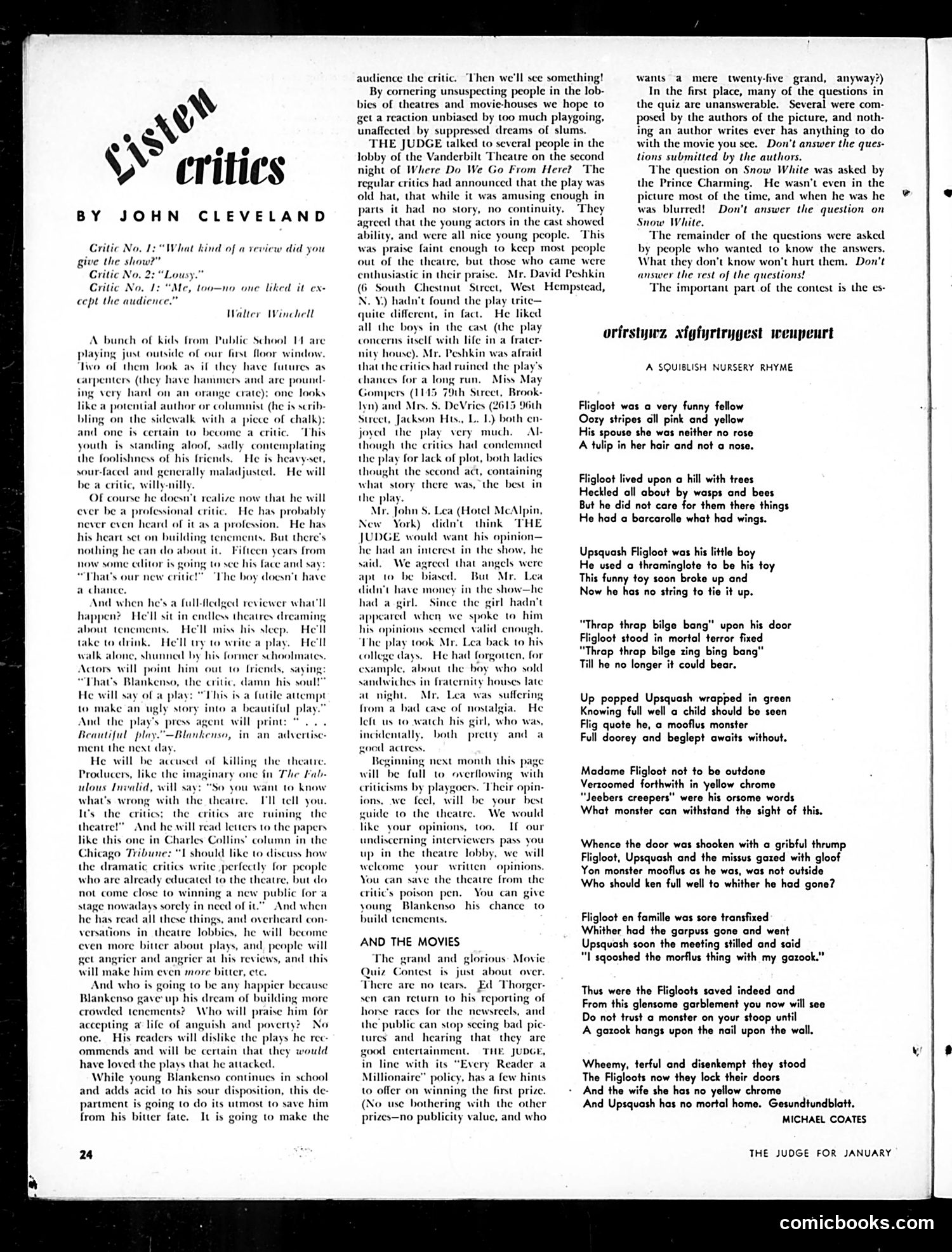
A restored page from Judge, 1939-01. Page through the whole issue in the reader above.
📄 Transcribed text from this page (OCR, searchable)
Machine-transcribed from the original scan — historical spelling and the odd misread are preserved.
aw 0 % S one critics Critic No, 1: “What kind of a review did you give the show: Critic No. 2, Critic No. 1: “Me, too—no one liked it exe cept the audience. Walter Winchell A bunch of kids from Public School 14 are playing just outside of our first floor window. Hive of them look as if they have futures as arpenters (they have hammers and are pound: ng very hard on an orange crate); one looks potential author or columnist (he iy scrib- on the sidewalk with a picce of chalk): and one is certain to become a critic. This youth iy standing aloof, sadly contemplating the foolishness of his friends, He is heavysct, sour-faced and generally maladjusted. He will be a critic, willy-nilly. OF course he doesn't realize now that he will ever be a profesional critic, He has probably never even hea i profession. He has his heart sct on building tencments, But there's nothing he can do about it, Fifteen years from now some cditor is go “That's our new criti a chance. And when he’s a full-fledged reviewer what'll happen? He'll sit in endless theatres dreaming about tenements. He'll miss his sleep. He take to drink, He'll uy to write a play, He'll walk ne, shunned by his former schoolmates, Actors will point him out to friends, saying “That's Blankenso, the critie, damn hiy soul!” He will say of a play: “This iy a futile attempt to make an ugly story into a beautiful play.” And the play’s press agent will prit Beautiful play.’—Blankenso, in an ment the next day. He will | accused of killing the theatre. Producers, like the imaginary one in The Fab- ulous Invalid, will say: "So you want to know what's wrong with the theatre. I'll tell you. It’s the criti: the aiticy are ruining the theatre!” And he will read letters to the papers like this one in Charles Collins’ column in the Chicago Tribune: “1 should like to discuss how the dramatic critics write perfectly for people who are already educated to the theatre, but do not come close to winning a new public for a stage nowadays sorely in need of it.” And when he has re ese thi nd overheard con- versations ca he will become even more bitter about plays, and, people will get angrier and angrier at his reviews, and this will make him even more bitte! And who is going to be any happier because Blankenso gave up his dream of building more crowded tenements? Who will praise him for accepting @ life of anguish and poverty one. His readers will dislike the plays he ree- ommends and will be certain that they would have loved the plays that he attacked. While young Blankenso continues in school and adds acid to his sour disposition, this de- partment is going to do its utmost to save him from his bitter fate. It is going to make the 24 audience the critic. “Then we'll sce something! wants a mere twenty-five grand, anyway?) By cornering unsuspecting people in the lob- In the first place, many of the questions in bies of theatres and movie-houses we hope to the quiz are unanswerable. Several were com- get a reaction unbiased by too much playgoing, posed by the authors of the picture, and noth- unaffected by suppressed dreams of slums. ing an author writes ever has anything to do THE JUDGE talked to several people in the with the movie you sce. Don't answer the ques- lobby of the derbilt Theatre on the second tions submitted by the authors. night of Where Do We Go From Here?’ The The question on Snow White was asked by regular critics had announced that the play was the Prince Charmi He wasn’t even in the old hat, that while it was amusing cnough in picture most of the time, and when he was he parts it had no story, no continuity. They was blurred! Don't answer the question on agreed that the young actors in the cast showed Snow White. ability, and were all nice young people. This The remainder of the questions were asked was praise faint cnough to kecp most people by people who wanted to know the answers. out of the theatre, but those who came were What they don’t know won't hurt them, Don't enthusiastic in their praise. Mr. David Peshkin answer the rest of the questions! (G@ South Chestnut Street, West Hempstead, The important part of the contest is the es- N. ¥) hadn't found the play trite— quite different, in fact. He liked all the boys in the cast (the play concerns itself with life in a frater- nity houye). Mr. Peshkin way afraid that the critics had ruined the play's A SQUIBLISH NURSERY RHYME chances for a long run. Misy Gompers (1115 79th Street, Brook- Iyn) and Mrs. $. DeVries (2615 96th Fligloot was a very funny fellow Suet, Jackson Hts., L. 1.) both en- Oory stripes all pink and yellow joyed the play very much. Ale His spouse she was neither no rose though the critics had condemned A tulip in her hair and not a nose. the play for lack of plot, both ladies nt the second act, containing what story there was, the best in the play. orirstywz xigtyrirygest wenpeurt Fligloot lived upon a hill with trees Heckled all about by wasps and bees , But he did not care for them there things Mr, John S, Lea (Hotel McAlpin, i New York) didn’t think THE He hed a bercorolle what hod wings. JUDGE would want his opinion— he had an interest in the show, he Upsquash Fligloot was his little boy sid. We agreed that angels were He used a thraminglote to be his toy apt to be biased. But Mr. Lea This funny toy soon broke up and didn't have money in the show—he Now he has no string to tie it up. had a girl. Since the girl hadn't appeared when we spoke to him of i soernce: vali cough. “Throp thrap bilge bang" upon his door The play took Mr, Lea back to hiy Fligloot stood in mortal torror fixed college days. He had forgotten, for Throp thrap bilge zing bing bang example, about the boy who sold Till he no longer it could bear. sandwiches in fraternity houses late at night. Mr. Lea way suffering Up popped Upsquoth wrapped in green fiom a bad case of nostalgia. He Knowing full well a child should be seen left us to watch his girl, who was, Fligiquote’ he: a moeflus monster incidentally, both pretty and a Full doorey and beglept awaits without. x Uress. next month this page will be full to overflowing with Madame Fligloot not to be outdone criticisms by playgoers. Their opin- Verzoomed forthwith in yellow chrome ions, we feel, will be your best "Jeebers creepers" were his orsome words idle to the theatre. We would What monster can withstand the sight of this. like your opinions, too, If our undiscerning interviewers pass you up in the theatre lobby, we will welcome your written” opinions. Whenco the door was shooken with a gribful thrump Fligloot, Upsquath and the missus gazed with gloof Yon monster mooflus as he was, was not outside You can save the theatre from the Who should ken full well to whither he had gone? critic's poison pen. You can give young Blankenso his chance’ to build tenements. Fligloot on famille was sore transfixed Whither had the garpuss gone and went AND THE MOVIES Upsquash soon the meeting stilled and said The grand and glorious: Movie “I sqooshed the morflus thing with my gazook." Quiz Contest is just about over. There are no te Ed Thorger- sen can return to hiy reporting of horye races for the newsreels, and the public can stop secing bad pic- tures and hearing that they are good entertainment. THE JUDGE, in line with its “Every Reader a Wheemy, terful and disenkempt they stood Millionaire” policy, has a few hints The Fligloots now they lock their doors to offer on winning the first prize.» And the wife she has no yellow chrome (No use bothering with the other ‘And Upsquash has no mortal home. Gesundtundblatt. prizes—no publicity value, and who MICHAEL COATES Thus were the Fligloots saved indeed and From this glensome garblement you now will see Do not trust a monster on your stoop until A gazook hangs upon the nail upon the wall. THE JUDGE FOR JANUARY comicbooks.com