
Judge, 1938-09 · page 7 of 53
Judge — September 1938 — page 7: what you’re looking at
What you’re looking at
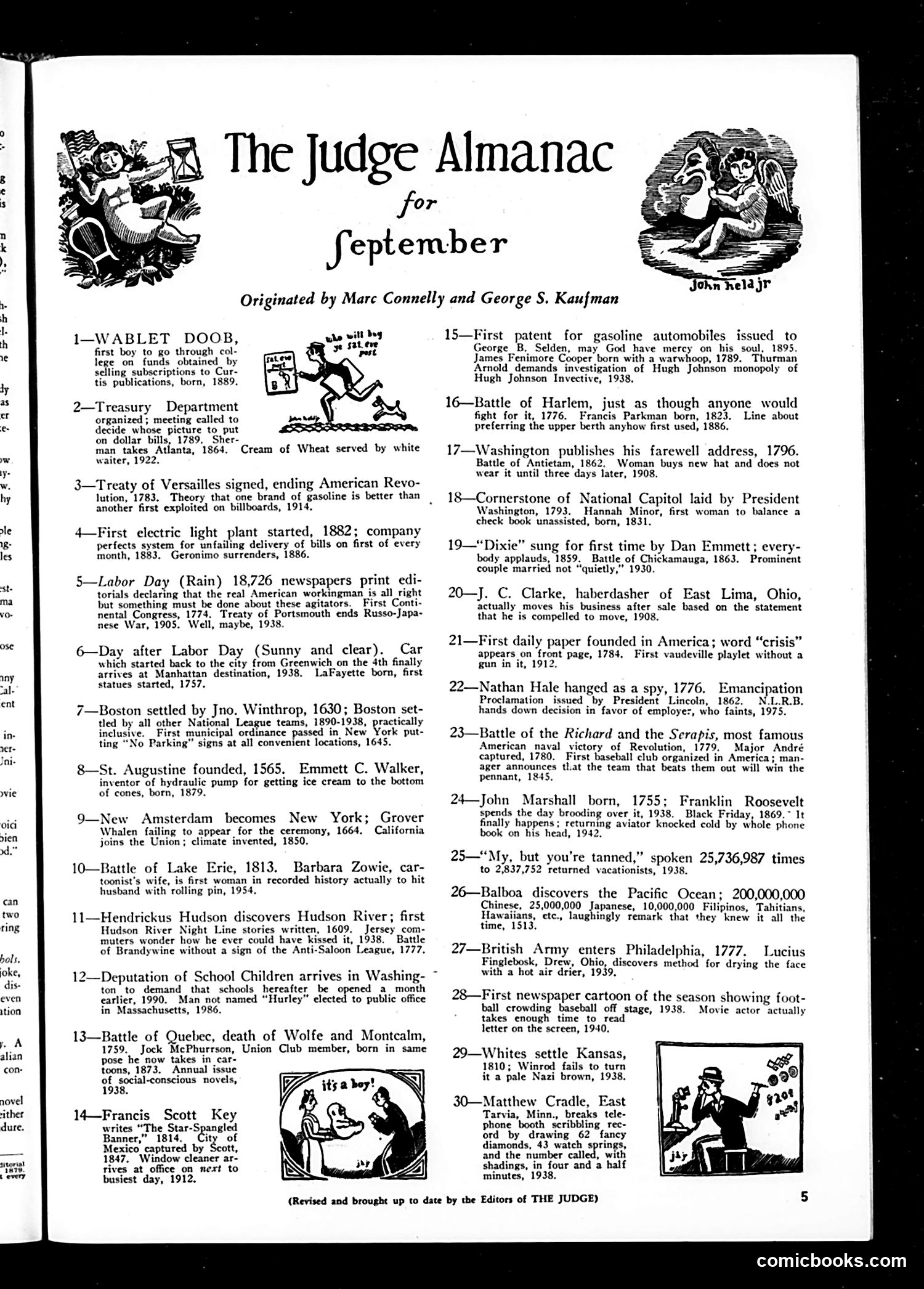
# The Judge Almanac for September This page is primarily an **almanac of historical facts and dates**, not political satire. It lists 30 significant American historical events tied to September dates—ranging from the founding of Boston (1630) to recent 1938 items like a movie actor reading a letter on screen. The three small **cartoon illustrations** are generic vignettes accompanying unrelated items: one shows someone running (item 5, Labor Day), another depicts a domestic scene (item 14), and a third shows a man with money (item 30). These are decorative elements typical of Judge magazine's layout rather than satirical commentary. The page functions as educational/entertaining reference material, reflecting American historical pride through compiled dates and achievements.
📄 Transcribed text from this page (OCR, searchable)
Machine-transcribed from the original scan — historical spelling and the odd misread are preserved.
The Judge Almanac for september Originated by Marc Connelly and George S. Kaufman 1—WABLET DOOB will bey first boy to go through ¢ lege on funds obtained by selling subscriptions to Cur- tis publications, born, 1889. 2—Treasury Department organized; meeting called to decide whose picture to put on dollar bills, 1789. Sher- man takes Atlanta, 1864. Cream of Wheat served by white waiter, 1922, 3—Treaty of Versailles signed, ending American Revo- lution, 1783. Theory that one brand of gasoline is better than another first exploited on billboards, 1914, 4First electric light plant started, 1882; company perfects system for unfailing delivery of bills on first of every month, 1883. Geronimo surrenders, 1 5—Labor Day (Rain) 18,726 newspapers print edi- torials declaring that the real American workingman is all right but something must be done about these agitators. First Conti- nental Congress, 1774. Treaty of Portsmouth ends Russo-Japa- nese War, 1905. Well, maybe, 1938. 6—Day after Labor Day (Sunny and clear). Car which started back to the city from Greenwich on the 4th finally arrives at Manhattan destination, 1938. LaFayette born, first statues started, 1757. 7—Boston settled by Jno. Winthrop, 1630; Boston set- tled by all other National League teams, 1890-1938, practically inclusive. First municipal ordinance passed in New York put- ting “No Parking” signs at all convenient locations, 1645. 8—St. Augustine founded, 1565. Emmett C. Walker, inventor of hydraulic pump for getting ice cream to the bottom of cones, born, 1879. 9—New Amsterdam becomes New York; Grover Whalen failing to appear for the ceremony, 1664, California joins the Union; climate invented, 1850. 10—Battle of Lake Erie, 1813. Barbara Zowie, car- toonist’s wife, is first woman in recorded history actually to hit husband with’rolling pin, 1954, 11—Hendrickus Hudson discovers Hudson River; first Hudson River Night Line stories written, 1609. Jersey com- muters wonder how he ever could have kissed it, 1938. Battle of Brandywine without a sign of the Anti-Saloon League, 1777. 12—Deputation of School Children arrives in Washing- ton to demand that schools hereafter be opened a month earlier, 1990. Man not named “Hurley” elected to public office in Massachusetts, 1986. 13—Battle of Quebec, death of Wolfe and Montcalm, 1759. Jock McPhurrson, Union Club member, born in same pose he now takes in car- toons, 1873. Annual issue of social-conscious no’ 14—Francis Scott Key writes “The Star-Spangled Banner,” 1814. City of Mexico captured by ; 1847. Window cleaner a rives at office on next to busiest day, 1912, 15—First patent for gasoline automobiles issued to George _B. Selden, may God have mercy on his soul, 1895. James Fenimore Cooper born with a warwhoop, 1789. Thurman Arnold demands investigation of Hugh Johnson monopoly of Hugh Johnson Invective, 1938. 16—Battle of Harlem, just as though anyone would fight for it, 1776. Francis Parkman born, 1823. Line about preferring the upper berth anyhow first used, 1886. 17—Washington publishes his farewell address, 1796. Battle of Antietam, 1862, Woman buys new hat and does not wear it until three days later, 1908. 18—Cornerstone of National Capitol laid by President Washington, 1793. Hannah Minor, first woman to balance a check book unassisted, born, 1831. 19—“Dixie” sung for first time by Dan Emmett; every- body applauds, 1859, Battle of Chickamauga, 1863. Prominent couple married not “quietly,” 1930. 20—J. C. Clarke, haberdasher of East Lima, Ohio, actually moves his business after sale based on the statement that he is compelled to move, 1908, 21—First daily paper founded in America; word “crisis” appears on front page, 1784, First vaudeville playlet without a gun in it, 1912. 22—Nathan Hale hanged as a spy, 1776. Emancipation Proclamation issued by President ‘Lincoln, 1862. N.L.R.B. hands down decision in favor of employez, who faints, 1975. 23—Battle of the Richard and the Serapis, most famous American naval victory of Revolution, 1779. Major André captured, 1780. First baseball club organized in America; man- ager announces that the team that beats them out will win the pennant, 1845. 24—John Marshall born, 1755; Franklin Roosevelt spends the day brooding over it, 1938. Black Friday, 1869.” It finally happens ; returning aviator knocked cold by whole pho book ‘on his head, 1942, 2 EES PONE 25—“My, but you're tanned,” spoken 25,736,987 times to 2\837,752 returned vacationists, 1938. 26—Balboa discovers the Pacific Ocean; 200,000,000 Chinese, 25,000,000 japanese, 10,000,000 Filipinos, Tahitians, Hawaiians, etc., laughingly remark that they knew it all the time, 1513. 27— British, Army enters Philadelphia, 1777, Lucius Finglebosk, Drew, Ohio, dis vi Finglebosk, Drew, Ohio, discovers method for drying the face 28—First newspaper cartoon of the season showing foot- ball crowding baseball off stage, 1938. takes enough time to read letter on the screen, 1940. Movie actor actually it a pale Nazi brown, 1938, 30—Matthew Cradle, East Tarvia, Minn., breaks tele- phone booth scribbling rec- ord by drawing 62 fancy diamonds, 43 watch springs, and the number called, with shadings, in four and a half minutes, 1938, (Revised and brought up to date by the Editors of THE JUDGE) comicbooks.com