
Judge, 1938-09 · page 19 of 53
Judge — September 1938 — page 19: what you’re looking at
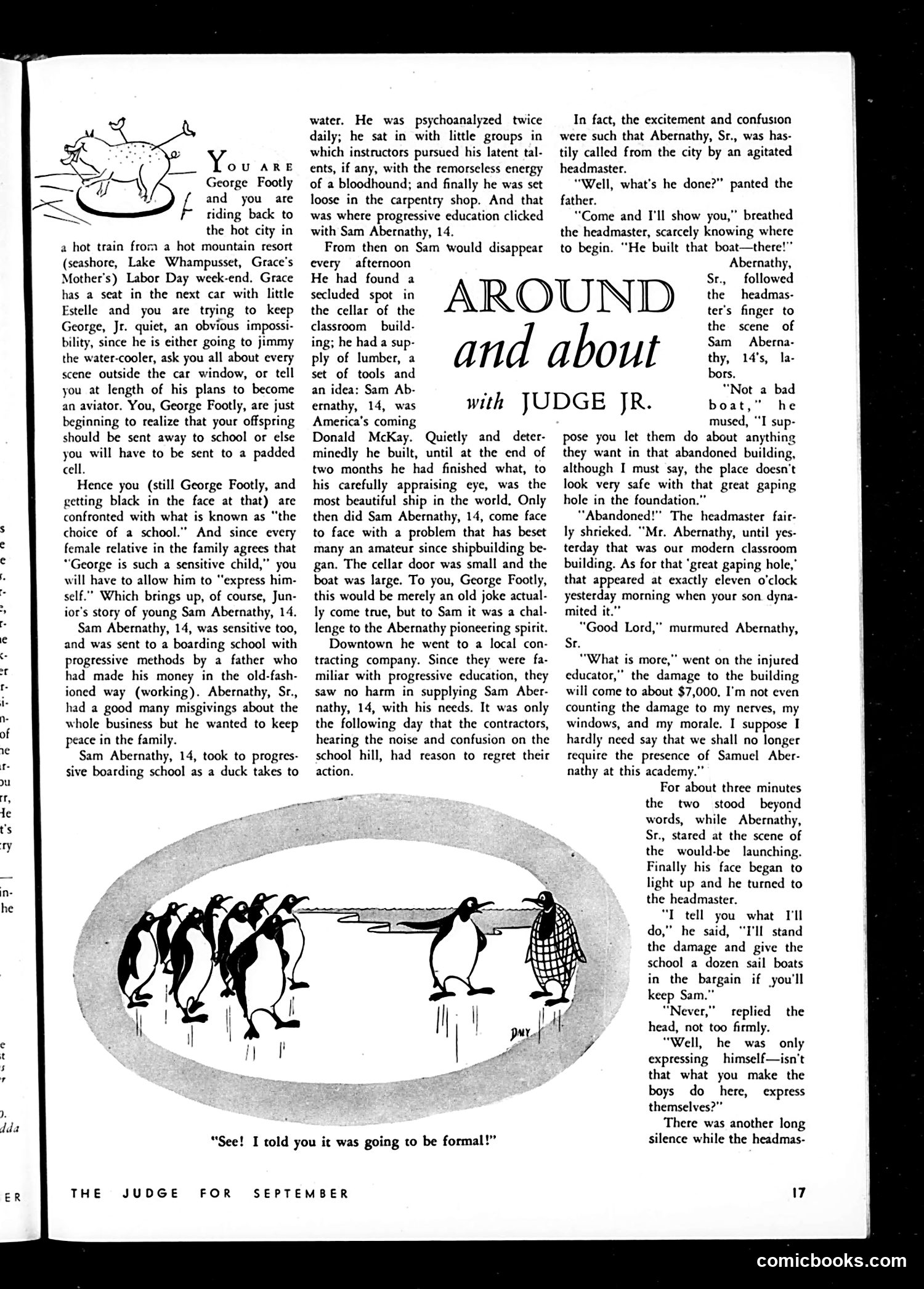
A restored page from Judge, 1938-09. Page through the whole issue in the reader above.
📄 Transcribed text from this page (OCR, searchable)
Machine-transcribed from the original scan — historical spelling and the odd misread are preserved.
George Footly and you are riding back to the hot city in a hot train from a hot mountain resort (seashore, Lake Whampusset, Grace's Mother's) Labor Day week-end. Grace has a seat in the next car with little Estelle and you are trying to keep George, Jr. quiet, an obvious impossi- bility, since he is either going to jimmy the water-cooler, ask you all about every scene outside the car window, or tell you at length of his plans to become an aviator. You, George Footly, are just beginning to realize that your offspring should be sent away to school or else you will have to be sent to a padded cell. Hence you (still George Footly, and getting black in the face at that) are confronted with what is known as “the choice of a school.” And since every female relative in the family agrees that “George is such a sensitive child,” you will have to allow him to “express him- self.” Which brings up, of course, Jun- ior's story of young Sam Abernathy, 14. Sam Abernathy, 14, was sensitive too, and was sent to a boarding school with progressive methods by a father who had made his money in the old-fash- ioned way (working). Abernathy, Sr., had a good many misgivings about the whole business but he wanted to keep peace in the family. Sam Abernathy, 14, took to progres- sive boarding school as a duck takes to water. He was psychoanalyzed twice daily; he sat in with little groups in which instructors pursued his latent tal- ents, if any, with the remorseless energy of a bloodhound; and finally he was set loose in the carpentry shop. And that was where progressive education clicked with Sam Abernathy, 14. From then on Sam would disappear every afternoon He had found a secluded spot in the cellar of the classroom _ build- ing; he had a sup- ply of lumber, a set of tools and an idea: Sam Ab- ernathy, 14, was America’s coming Donald McKay. Quietly and deter- minedly he built, until at the end of two months he had finished what, to his carefully appraising eye, was the most beautiful ship in the world, Only then did Sam Abernathy, 14, come face to face with a problem that has beset many an amateur since shipbuilding be- gan. The cellar door was small and the boat was large. To you, George Footly, this would be merely an old joke actual- ly come true, but to Sam it was a chal- lenge to the Abernathy pioneering spirit. Downtown he went to a local con- tracting company. Since they were fa- miliar with progressive education, they saw no harm in supplying Sam Aber- nathy, 14, with his needs. It was only the following day that the contractors, hearing the noise and confusion on the school hill, had reason to regret their action. “See! I told you it was going to be formal!” THE FOR SEPTEMBER AROUND and about with JUDGE JR. In fact, the excitement and confusion were such that Abernathy, Sr., was has- tily called from the city by an agitated headmaster. “Well, what's he done?” panted the father. “Come and I'll show you,” breathed the headmaster, scarcely knowing where to begin. “He built that boat—there!” Abernathy, Sr., followed the headmas- ter's finger to the scene of Sam Aberna- thy, 14's, la- bors. “Not a bad boat,” he mused, “I sup- pose you let them do about anything they want in that abandoned building, although I must say, the place doesn’t look very safe with that great gaping hole in the foundation.” “Abandoned!” The headmaster fair- ly shrieked. “Mr. Abernathy, until yes- terday that was our modern classroom building. As for that ‘great gaping hole,’ that appeared at exactly eleven o'clock yesterday morning when your son dyna- mited it.” “Good Lord,” murmured Abernathy, Sr. “What is more,” went on the injured educator,” the damage to the building will come to about $7,000, I'm not even counting the damage to my nerves, my windows, and my morale. I suppose I hardly need say that we shall no longer require the presence of Samuel Aber- nathy at this academy.” For about three minutes the two stood beyond words, while Abernathy, Sr., stared at the scene of the would-be launching. Finally his face began to light up and he turned to the headmaster. “I tell) you what I'll do,” he said, “I'll stand the damage and give the school a dozen sail boats in the bargain if you'll keep Sam.” “Never,” replied head, not too firmly. “Well, he was only expressing himself—isn’t that what you make the boys do here, express themselves?” There was another long silence while the headmas- the comicbooks.com