
Judge, 1938-08 · page 20 of 36
Judge — August 1938 — page 20: what you’re looking at
A restored page from Judge, 1938-08. Page through the whole issue in the reader above.
📄 Transcribed text from this page (OCR, searchable)
Machine-transcribed from the original scan — historical spelling and the odd misread are preserved.
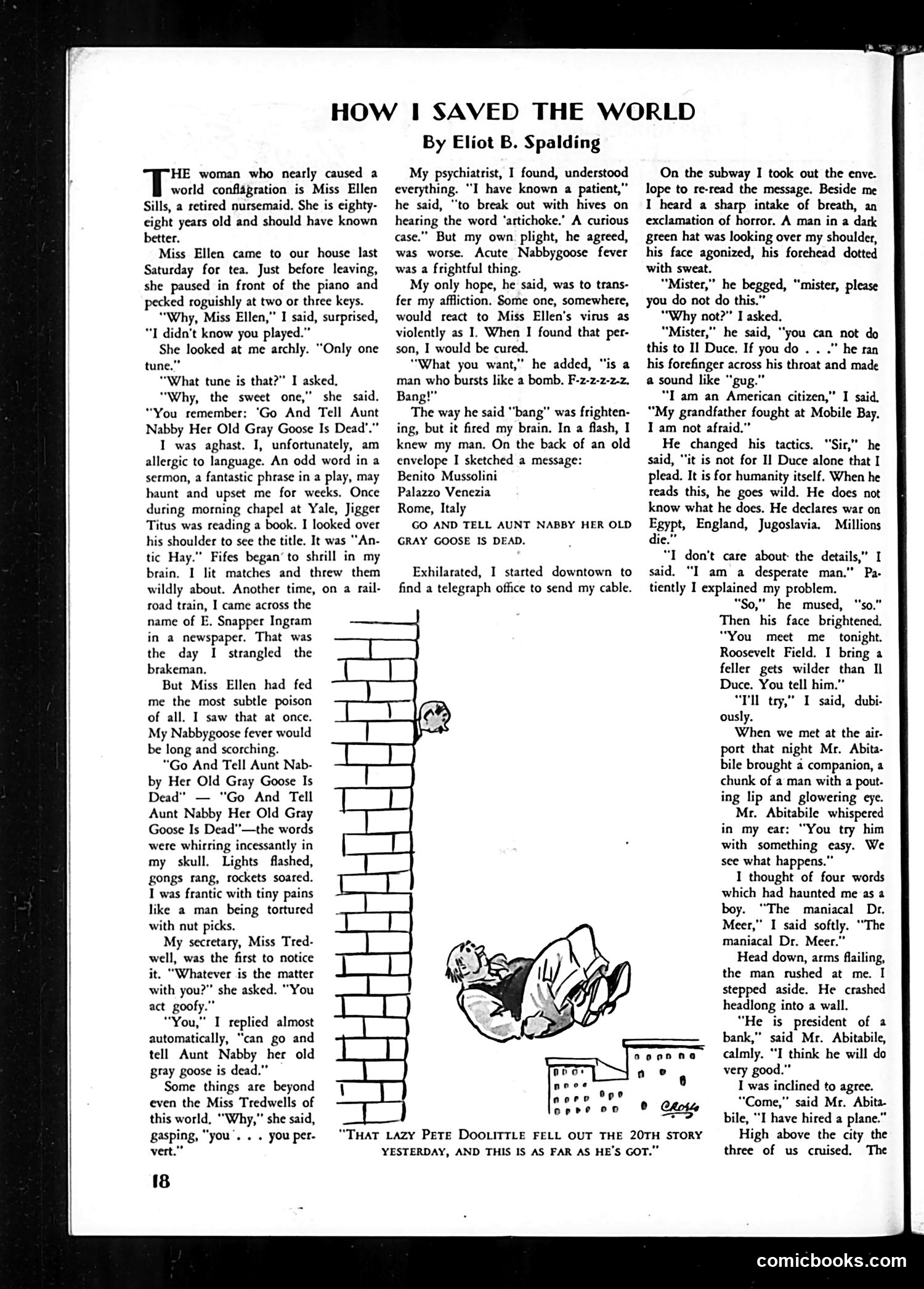
HOW I SAVED THE WORLD HE woman who nearly caused a world conflagration is Miss Ellen Sills, a retired nursemaid. She is eighty- eight years old and should have known better. Miss Ellen came to our house last Saturday for tea. Just before leaving, she paused in front of the piano and pecked roguishly at two or three keys. “Why, Miss Ellen,” I said, surprised, “I didn’t know you played.” She looked at me archly. “Only one tune.” “What tune is that?” I asked, “Why, the sweet one,” she said. “You remember: ‘Go And Tell Aunt Nabby Her Old Gray Goose Is Dead’.” I was aghast. I, unfortunately, am allergic to language. An odd word in a sermon, a fantastic phrase in a play, may haunt and upset me for weeks. Once during morning chapel at Yale, Jigger Titus was reading a book. I looked over his shoulder to see the title. It was “An- tic Hay.” Fifes began’ to shrill in my brain. I lit matches and threw them wildly about. Another time, on a rail- road train, I came across the name of E. Snapper Ingram in a newspaper. That was the day I strangled the brakeman. But Miss Ellen had fed me the most subtle poison of all. I saw that at once. My Nabbygoose fever would be long and scorching. “Go And Tell Aunt Nab- by Her Old Gray Goose Is Dead" — “Go And Tell Aunt Nabby Her Old Gray Goose Is Dead"—the words were whirring incessantly in my skull. Lights flashed, gongs rang, rockets soared. I was frantic with tiny pains like a man being tortured with nut picks. My secretary, Miss Tred- well, was the first to notice it. “Whatever is the matter with you?” she asked. “You act goofy.” “You,” I replied almost automatically, “can go and tell Aunt Nabby her old gray goose is dead.” Some things are beyond even the Miss Tredwells of this world, “Why,” she said, gasping, “you’. . . you per- vert.” 18 By Eliot B. Spalding My psychiatrist, I found, understood everything. “I have known a patient,” he said, “to break out with hives on hearing the word ‘artichoke.’ A curious case.” But my own. plight, he agreed, was worse. Acute Nabbygoose fever was a frightful thing. My only hope, he said, was to trans- fer my affliction. Some one, somewhere, would react to Miss Ellen's virus as violently as I. When I found that per- son, I would be cured. “What you want,” he added, “is a man who bursts like a bomb. F-z-2-z-z-z, Bang!” The way he said “bang” was frighten- ing, but it fired my brain, In a flash, I knew my man. On the back of an old envelope I sketched a message: Benito Mussolini Palazzo Venezia Rome, Italy GO AND TELL AUNT NABBY HER OLD GRAY GOOSE IS DEAD. Exhilarated, I started downtown to find a telegraph office to send my cable. Troe nooe noro 9p? opre oo “THAT Lazy Pete DoOLiTTLE FELL OUT THE 20TH STORY YESTERDAY, AND THIS IS AS FAR AS HE'S GOT.” On the subway I took out the enve. lope to re-read the message. Beside me I heard a sharp intake of breath, an exclamation of horror. A man in a dark green hat was looking over my shoulder, his face agonized, his forehead dotted with sweat. “Mister,” he begged, “mister, please you do not do this.” “Why not?” I asked. “Mister,” he said, “you can not do this to Il Duce. If you do . . .” he ran his forefinger across his throat and made a sound like “gug.” “Iam an American citizen,” I said, “My grandfather fought at Mobile Bay. I am not afraid.” He changed his tactics. “Sir,” he said, “it is not for Il Duce alone that I plead. It is for humanity itself. When he reads this, he goes wild. He does not know what he does. He declares war on Esypt England, Jugoslavia. Millions ie.” “I don’t care about the details,” I said. “I am a desperate man.” Pa. tiently I explained my problem. “So,” he mused, “so.” Then his face brightened. “You meet me tonight. Roosevelt Field. I bring a feller gets wilder than Il Duce. You tell him.” “TM try,” 1 said, dubi- ously, When we met at the air- port that night Mr. Abita- bile brought a companion, a chunk of a man with a pout- ing lip and glowering eye. Mr. Abitabile whispered in my ear: “You try him with something easy. We see what happens.” I thought of four words which had haunted me as a boy. “The maniacal Dr. Meer,” I said softly. “The maniacal Dr. Meer.” Head down, arms flailing, the man rushed at me. I stepped aside. He crashed headlong into a wall. “He is president of a bank,” said Mr. Abitabile, calmly. “I think he will do very good.” I was inclined to agree. “Come,” said Mr. Abita- bile, “I have hired a plane.” High above the city the three of us cruised. The comicbooks.com