
Judge, 1938-08 · page 13 of 36
Judge — August 1938 — page 13: what you’re looking at
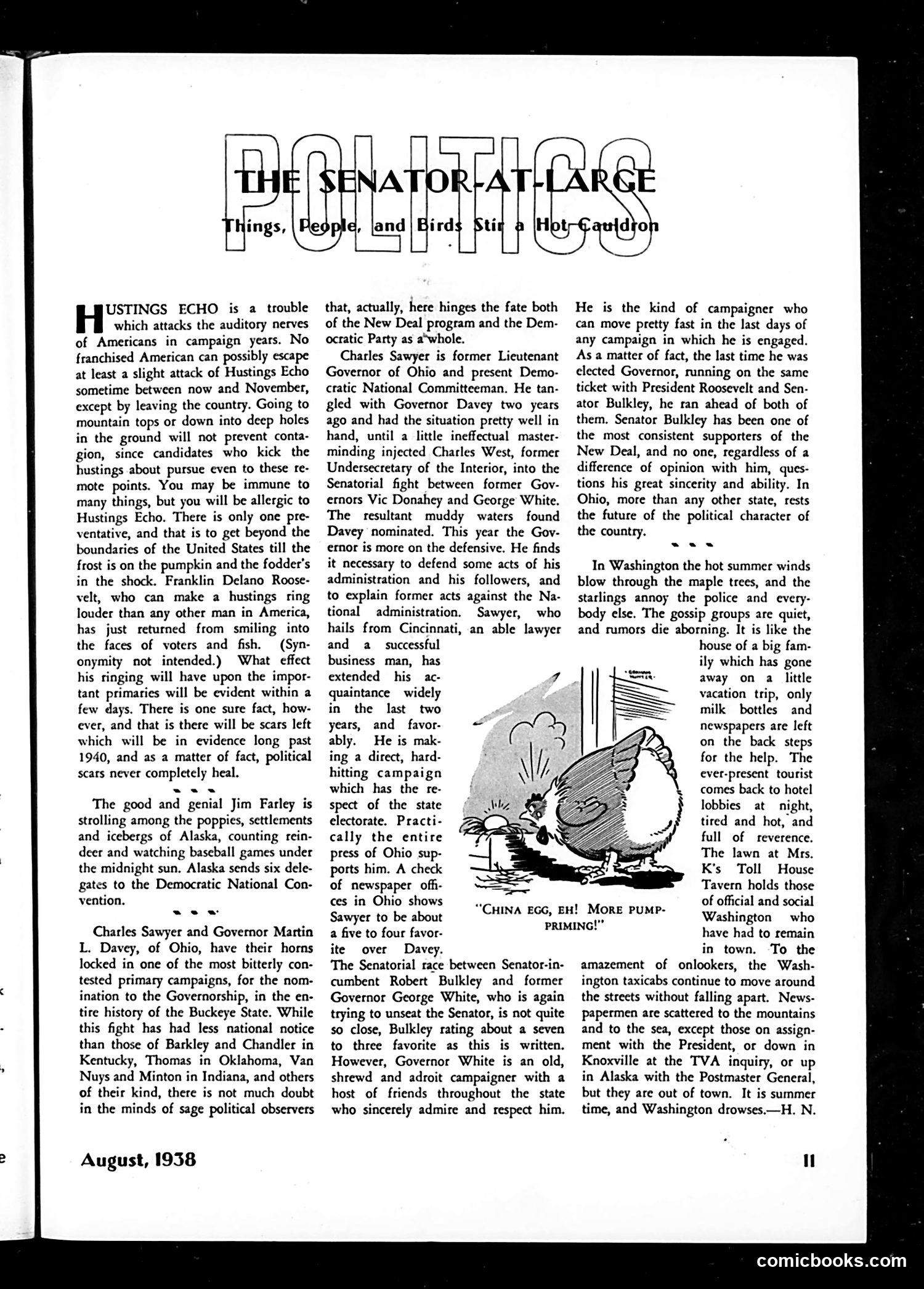
A restored page from Judge, 1938-08. Page through the whole issue in the reader above.
📄 Transcribed text from this page (OCR, searchable)
Machine-transcribed from the original scan — historical spelling and the odd misread are preserved.
| By USTINGS ECHO is a trouble which attacks the auditory nerves of Americans in campaign years. No franchised American can possibly escape at least a slight attack of Hustings Echo sometime between now and November, except by leaving the country. Going to mountain tops or down into deep holes in the ground will not prevent conta- gion, since candidates who kick the hustings about pursue even to these re- mote points. You may be immune to many things, but you will be allergic to Hustings Echo. There is only one pre- ventative, and that is to get beyond the boundaries of the United States till the frost is on the pumpkin and the fodder's in the shock. Franklin Delano Roose- velt, who can make a hustings ring louder than any other man in America, has just returned from smiling into the faces of voters and fish. (Syn- onymity not intended.) What effect his ringing will have upon the impor- tant primaries will be evident within a few days. There is one sure fact, how- ever, and that is there will be scars left which will be in evidence long past 1940, and as a matter of fact, political scars never completely heal. The good and genial Jim Farley is strolling among the poppies, settlements and icebergs of Alaska, counting rein- deer and watching baseball games under the midnight sun. Alaska sends six dele- gates to the Democratic National Con- vention. Charles Sawyer and Governor Martin L. Davey, of Ohio, have their horns locked in one of the most bitterly con- tested primary campaigns, for the nom- ination to the Governorship, in the en- tire history of the Buckeye State. While this fight has had less national notice than those of Barkley and Chandler in Kentucky, Thomas in Oklahoma, Van Nuys and Minton in Indiana, and others of their kind, there is not much doubt in the minds of sage political observers August, 1938 that, actually, here hinges the fate both of the New Deal program and the Dem- ocratic Party as a*whole. Charles Sawyer is former Lieutenant Governor of Ohio and present Demo- cratic National Committeeman. He tan- gled with Governor Davey two years ago and had the situation pretty well in hand, until a little ineffectual master- minding injected Charles West, former Undersecretary of the Interior, into the Senatorial fight between former Gov- ernors Vic Donahey and George White. The resultant muddy waters found Davey nominated. This year the Gov- ernor is more on the defensive. He finds it necessary to defend some acts of his administration and his followers, and to explain former acts against the Na- tional administration. Sawyer, who hails from Cincinnati, an able lawyer and a successful business man, has extended his ac- quaintance widely in the last two years, and favor- ably. He is mak- ing a direct, hard- hitting campaign which has the re- spect of the state electorate. Practi- cally the entire press of Ohio sup- ports him. A check of newspaper offi- ces in Ohio shows Sawyer to be about a five to four favor- ite over Davey. The Senatorial race between Senator-in- cumbent Robert Bulkley and former Governor George White, who is again trying to unseat the Senator, is not quite so close, Bulkley rating about a seven to three favorite as this is written. However, Governor White is an old, shrewd and adroit campaigner with a host of friends throughout the state who sincerely admire and respect him. “CHINA EGG, EH! MORE PUMP- PRIMING!” He is the kind of campaigner who can move pretty fast in the last days of any campaign in which he is engaged. As a matter of fact, the last time he was elected Governor, running on the same ticket with President Roosevelt and Sen- ator Bulkley, he ran ahead of both of them. Senator Bulkley has been one of the most consistent supporters of the New Deal, and no one, regardless of a difference of opinion with him, ques- tions his great sincerity and ability. In Ohio, more than any other state, rests the future of the political character of the country. In Washington the hot summer winds blow through the maple trees, and the starlings annoy the police and every- body else. The gossip groups are quiet, and rumors die aborning. It is like the house of a big fam- ily which has gone away on a little vacation trip, only milk bottles and newspapers are left on the back steps for the help. The ever-present tourist comes back to hotel lobbies at night, tired and hot, and full of reverence. The lawn at Mrs. K's Toll House Tavern holds those of official and social Washington who have had to remain in town. To the amazement of onlookers, the Wash- ington taxicabs continue to move around the streets without falling apart. News- papermen are scattered to the mountains and to the sea, except those on assign- ment with the President, or down in Knoxville at the TVA inquiry, or up in Alaska with the Postmaster General, but they are out of town. It is summer time, and Washington drowses.—H. N. comicbooks.com