
Judge, 1938-06 · page 6 of 53
Judge — June 1938 — page 6: what you’re looking at
What you’re looking at
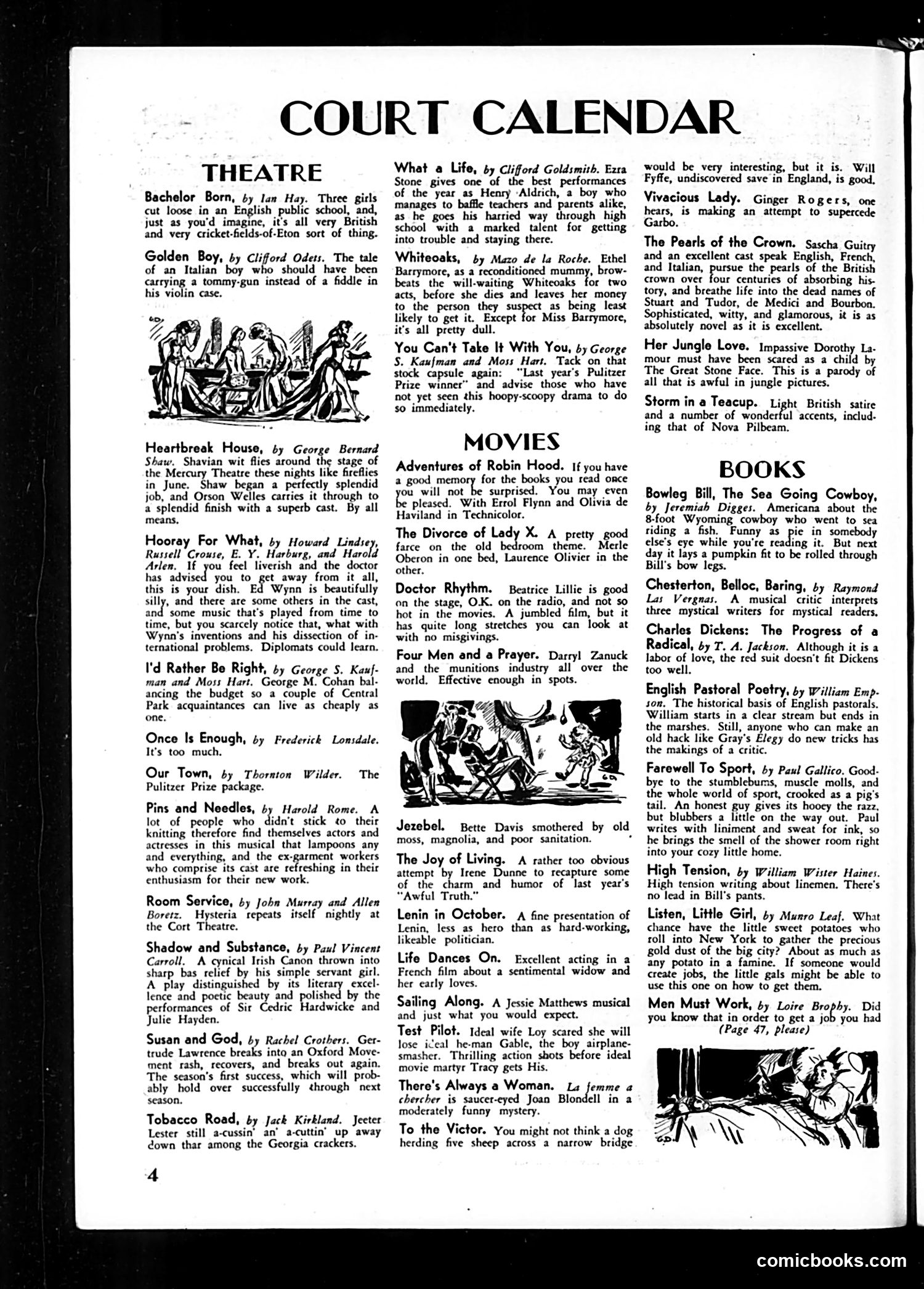
# Court Calendar Page Analysis This page is primarily a **entertainment guide**, not political satire. It lists theatrical productions, movies, and books with brief reviews and descriptions. The two small **cartoons** appear to be generic humorous illustrations accompanying entertainment reviews rather than political commentary. They depict: 1. A theatrical scene showing figures in period costume (top left) 2. A domestic or social scene with figures interacting (bottom center) These illustrations are decorative accompaniments to the entertainment listings rather than satirical commentary on current events or politics. The page itself represents Judge magazine's function as a **lifestyle publication**—providing readers with cultural recommendations for theater, cinema, and literature of the era, alongside its better-known satirical cartoons found elsewhere in the magazine.
📄 Transcribed text from this page (OCR, searchable)
Machine-transcribed from the original scan — historical spelling and the odd misread are preserved.
COURT CALENDAR THEATRE Bachelor Born, by Ian Hay. Three girls cut loose in an English public school, and, just as you'd imagine, it’s all very British and very cricket-fields-of-Eton sort of thing. Golden Boy, by Clifford Odets. The tale of an Italian boy who should have been canying a tommy gun instead of a Bddle in his violin case. Heartbreak House, by George Bernard Shaw. Shavian wit flies around the stage of the Mercury Theatre these nights like fireflies in June. Shaw began a perfectly splendid job, and Orson Welles carries it through to a splendid finish with a superb cast. By all means, Hooray For What, by Howard Lindsey, Russell Crouse, E. Y. Harburg, and Harold Arlen, If you feel liverish and the doctor has advised you to get away from it all, this is your dish. Ed Wynn is beautifully silly, and there are some others in the cast, tad some music that's played from time to time, but you scarcely notice that, what with Wynn's inventions and his dissection of in- ternational problems. Diplomats could learn. I'd Rather Be Right, by George S. Kauf- man and Moss Hart. George M. Cohan bal- ancing the budget so a couple of Central Park acquaintances can live as cheaply as one. Once Is Enough, by Frederick Lonsdale. It's too much. Our Town, by Thornton Wilder. Pulitzer Prize package. Pins and Needles, lot. of people who The by Harold Rome. A didn't stick ¢o their knitting therefore find themselves actors and actresses in this musical that lampoons any and everything, and the ex-garment workers who comprise its cast are refreshing in their enthusiasm for their new work. Room Service, by John Murray and Allen Boretz. Hysteria repeats itself nightly at the Cort Theatre. Shadow and Substance, by Pau! Vincent Carroll. A cynical Irish Canon thrown into sharp bas relief by his simple servant girl. A play distinguished by its Hiterary excel- lence and poetic beauty and polished by the performances of Sir Cedric Hardwicke and Julie Hayden. Susan and God, by Rachel Crothers. Ger- trude Lawrence breaks into an Oxford Move- ment rash, recovers, and breaks out again. The season's first success, which will prob- ably hold over successfully through next season. Tobacco Road, by Jack Kirkland. Jecter Lester still a-cussin’ an’ a-cuttin’ up away down thar among the Georgia crackers. 4 What a Life, by Clifford Goldsmith. Ezra Stone gives one of the best performances of the year as Henry Aldrich, a boy who manages to baffle teachers and parents alike, as he goes his harried way through high school with a marked talent for getting into trouble and staying there. Whiteoaks, 4y Mazo de la Roche. Ethel Barrymore, as a reconditioned mummy, brow- beats the will-waiting Whiteoaks for two acts, before she dies and leaves her money to the person they sus) as being least likely to get it. Except for Miss Barrymore, it's all pretty dull. You Can't Take It With You, by George S. Kaufman and Moss Hart. Tack on that stock capsule again: “Last year's Pulitzer Prize winner” and advise those who have not yet seen this hoopy-scoopy drama to do so immediately. MOVIES Adventures of Robin Hood. If you have a good memory for the books you read once ‘ou will not. be surprised. You may even pleased. With Errol Flynn and Olivia de Haviland in Technicolor. The Divorce of Lady X. A pretty good farce on the old room theme. Merle Oberon in one bed, Laurence Olivier in the other. Doctor Rhythm. Beatrice Lillie is good on the stage, O.K. on the radio, and not so hot in the movies. A jumbled film, but it has quite long stretches you can look at with no misgivings. Four Men and a Prayer. Darryl Zanuck and the munitions industry all over the world, Effective enough in spots. Jezebel. Bette Davis smothered by old moss, magnolia, and poor sanitation. The Joy of Living. A rather too obvious attempt by Irene Dunne to recapture some of the charm and humor of last year's “Awful Truth.” Lenin in October. A fine presentation of Lenin, less as hero than as hard-working, likeable politician. Life Dances On. Excellent acting in a French film about a sentimental widow and her early loves. Sailing Along. A Jessie Matthews musical and just what you would expect. Test Pilot. Ideal wife Loy scared she will lose ideal he-man Gable, the boy airplane- smasher. Thrilling action shots before ideal movie martyr Tracy gets His. There's Always a Woman. La femme a chercher is saucer-eyed Joan Blondell in a moderately funny mystery. To the Victor. You might not think a dog herding five sheep across a narrow bridge would be very interesting, but it is. Will Fyffe, undiscovered save in England, is good, Vivacious Lady. Ginger Rogers, one beats, is making an attempt to supercede aro. The Pearls of the Crown. Sascha Guitry and an excellent cast speak English, French, and Italian, pursue the pearls of the British crown over four centuries of absorbing his- tory, and breathe life into the dead names of Stuart and Tudor, de Medici and Bourbon. Sophisticated, witty, and glamorous, it is as absolutely novel as it is excellent. Her Jungle Love. Impassive Dorothy La- mour must have been seared a3 a child by The Great Stone Face. This is a parody of all that is awful in jungle pictures, Storm in a Teacup. Light British satire and a number of wonderful accents, includ. ing that of Nova Pilbeam. BOOKS Bowleg Bill, The Sea Going Cowboy, by Jeremiah Digges. Americana about the 8-foot Wyoming cowboy who went to sea riding a fish, Funny as pe in somebody else's eye while you're reading it. But next day it lays a pumpkin fit to be rolled through Bill's bow legs. Chesterton, Belloc, Baring, by Raymond Las Vergnas. A musical critic interprets three mystical writers for mystical readers, Charles Dickens: The Progress of a Radical, by T. A. Jackson. Although it is a labor of love, the red suit doesn’t fit Dickens too well. English Pastoral Poetry, by William Emp- son, The historical basis of English pastorals. William starts in a clear stream but ends in the marshes. Still, anyone who can make an old hack like Gray's Elegy do new tricks has the makings of a critic. Farewell To Sport, by Paul Gallico. Good- bye to the stumblebums, muscle molls, and the whole world of sport, crooked as a pig's tail. An honest guy gives its hoocy the razz, but blubbers a little on the way out. Paul writes with liniment and sweat for ink, so he brings the smell of the shower room right into your cozy little home. High Tension, by William Wister Haines. High tension writing about linemen. There's no lead in Bill's pants. Listen, Little Girl, by Munro Leaf. What chance have the little sweet potatoes who roll into New York to gather the precious gold dust of the big city? About as much as any potato in a famine. If someone would create jobs, the little gals might be able to use this one on how to get them. Men Must Work, by Loire Brophy. you know that in order to get a jol (Page 47, please) Did you had comicbooks.com