
Judge, 1938-06 · page 28 of 53
Judge — June 1938 — page 28: what you’re looking at
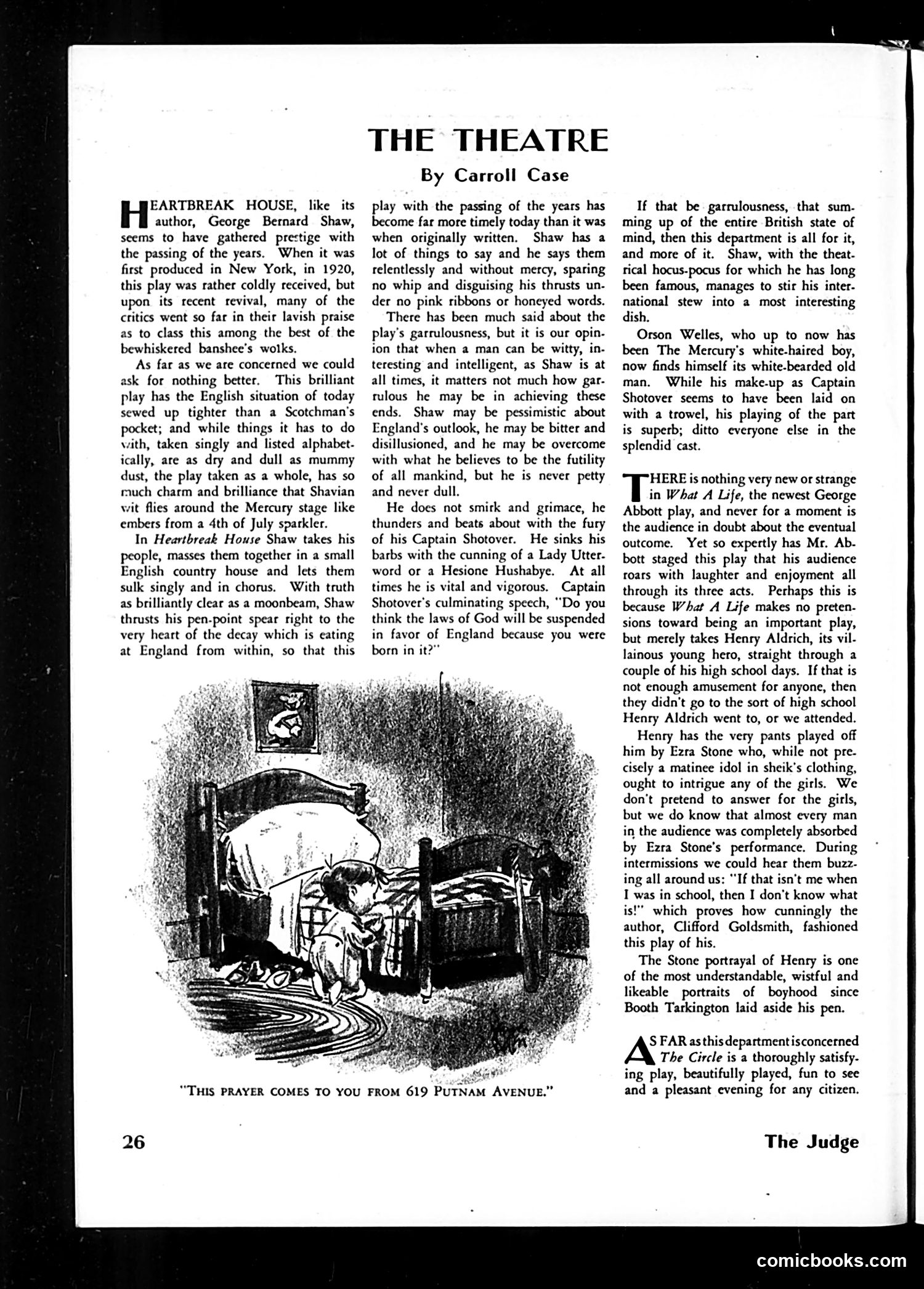
A restored page from Judge, 1938-06. Page through the whole issue in the reader above.
📄 Transcribed text from this page (OCR, searchable)
Machine-transcribed from the original scan — historical spelling and the odd misread are preserved.
EARTBREAK HOUSE, like its author, George Bernard Shaw, seems to have gathered prestige with the passing of the years. When it was first produced in New York, in 1920, this play was rather coldly received, but upon its recent revival, many of the critics went so far in their lavish praise as to class this among the best of the bewhiskered banshee’s wolks. As far as we are concerned we could ask for nothing better. This brilliant play has the English situation of today sewed up tighter than a Scotchman’s pocket; and while things it has to do with, taken singly and listed alphabet. ically, are as dry and dull as mummy dust, the play taken as a whole, has so rauch charm and brilliance that Shavian wit flies around the Mercury stage like embers from a 4th of July sparkler. In Heartbreak House Shaw takes his people, masses them together in a small English country house and lets them sulk singly and in chorus. With truth as brilliantly clear as a moonbeam, Shaw thrusts his pen-point spear right to the very heart of the decay which is eating at England from within, so that this THE THEATRE By Carroll Case play with the passing of the years has become far more timely today than it was when originally written. Shaw has a lot of things to say and he says them relentlessly and without mercy, sparing no whip and disguising his thrusts un- der no pink ribbons or honeyed words. There has been much said about the play’s garrulousness, but it is our opin- ion that when a man can be witty, in- teresting and intelligent, as Shaw is at all times, it matters not much how gar- rulous he may be in achieving these ends. Shaw may be pessimistic about England's outlook, he may be bitter and disillusioned, and he may be overcome with what he believes to be the futility of all mankind, but he is never petty and never dull. He does not smirk and grimace, he thunders and beats about with the fury of his Captain Shotover. He sinks his barbs with the cunning of a Lady Utter- word or a Hesione Hushabye. At all times he is vital and vigorous. Captain Shotover's culminating speech, “Do you think the laws of God will be suspended in favor of England because you were born in it?” “THIS PRAYER COMES TO YOU FROM 619 PUTNAM AVENUE.” If that be. garrulousness, that sum- ming up of the entire British state of mind, then this department is all for it, and more of it. Shaw, with the theat- tical hocus-pocus for which he has long been famous, manages to stir his inter- national stew into a most interesting dish. Orson Welles, who up to now has been The Mercury's white-haired boy, now finds himself its white-bearded old man. While his make-up as Captain Shotover seems to have been laid on with a trowel, his playing of the part is superb; ditto everyone else in the splendid cast. HERE is nothing very new or strange in What A Life, the newest George Abbott play, and never for a moment is the audience in doubt about the eventual outcome. Yet so expertly has Mr. Ab- bott staged this play that his audience roars with laughter and enjoyment all through its three acts. Perhaps this is because What A Life makes no preten- sions toward being an important play, but merely takes Henry Aldrich, its vil- lainous young hero, straight through a couple of his high school days. If that is not enough amusement for anyone, then they didn’t go to the sort of high school Henry Aldrich went to, or we attended. Henry has the very pants played off him by Ezra Stone who, while not pre- cisely a matinee idol in sheik’s clothing, ought to intrigue any of the girls. We don’t pretend to answer for the girls, but we do know that almost every man in the audience was completely absorbed by Ezra Stone's performance. During intermissions we could hear them buzz- ing all around us: “If that isn’t me when I was in school, then I don’t know what is!” which proves how cunningly the author, Clifford Goldsmith, fashioned this play of his. The Stone portrayal of Henry is one of the most understandable, wistful and likeable portraits of boyhood since Booth Tarkington laid aside his pen. S FAR asthisdepartmentisconcerned The Circle is a thoroughly satisfy- ing play, beautifully played, fun to see and a pleasant evening for any citizen. The Judge comicbooks.com