
Judge, 1938-01 · page 6 of 88
Judge — January 1938 — page 6: what you’re looking at
What you’re looking at
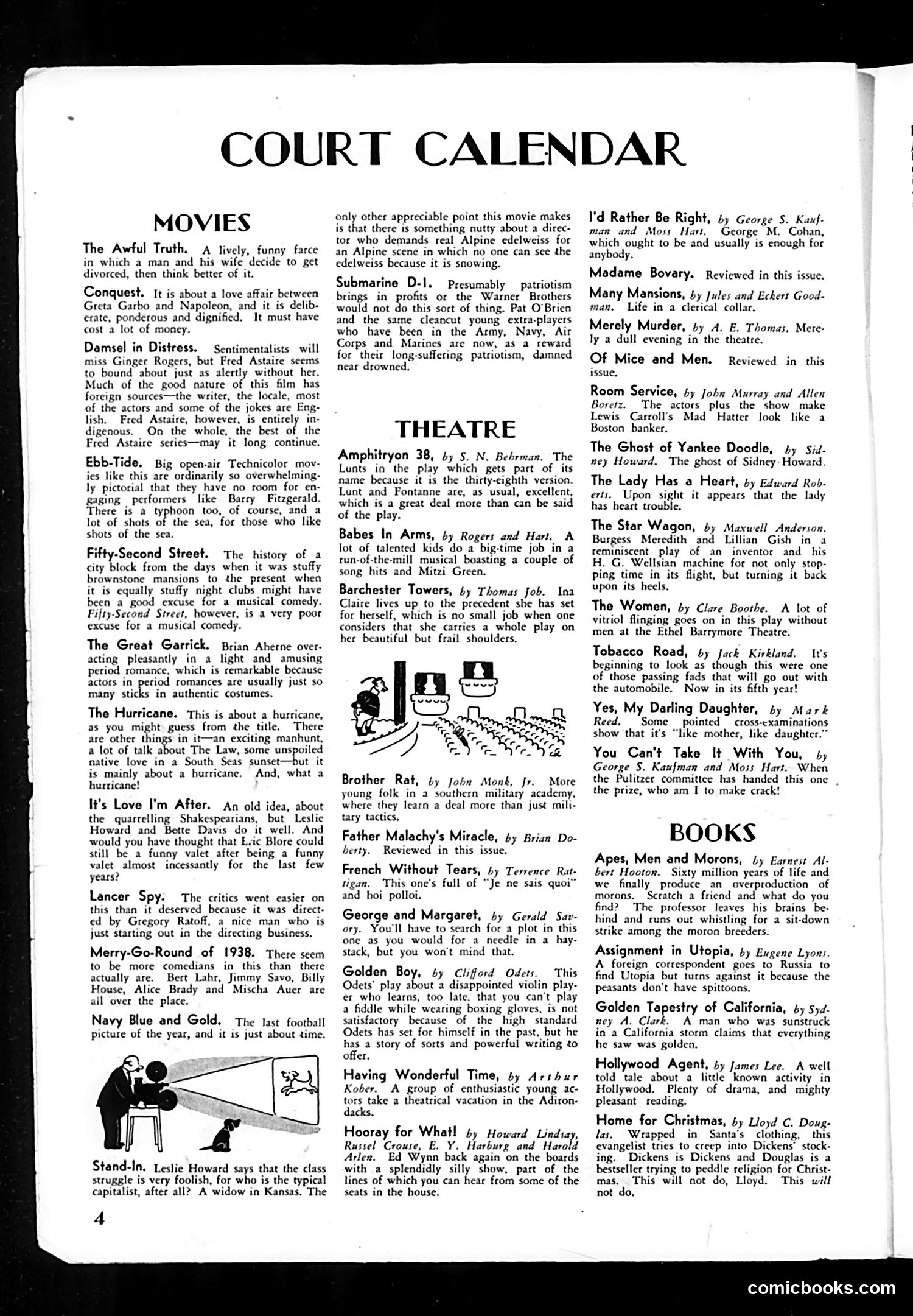
# Court Calendar Page Analysis This is primarily a **reviews and listings page** rather than a satirical cartoon section. It contains capsule reviews of current movies and theatrical productions, with brief plot summaries and critical commentary. The small illustrations appear to be generic theatrical/entertainment imagery rather than political satire—including what looks like a **top-hatted figure** (standard vaudeville iconography) and comedic theater scenes. The reviews themselves offer mild social commentary through their subject matter (military academies, Southern romance, patriotic themes), but this reflects **entertainment preferences of the era** rather than pointed political satire. This page demonstrates Judge's broader function as a **general-interest magazine** covering culture and entertainment, not exclusively political humor.
📄 Transcribed text from this page (OCR, searchable)
Machine-transcribed from the original scan — historical spelling and the odd misread are preserved.
MOVIES The Awful Truth. A lively, funny farce in which a man and his wife decide to get divorced, then think better of it. Conquest. It is about a love affair between Greta Garbo and Napoleon, and it is delib- erate, ponderous and dignified. It must have cost a lot of money. Damsel in Distress. Sentimentalists will miss Ginger Rogers, but Fred Astaire seems to bound about just as alertly without her. Much of the good nature of this film has foreign sources—the writer, the locale, most of the actors and some of the jokes are Eng- lish. Fred Astaire, however, is entirely in- digenous. On the whole, the best of the Fred Astaire series—may it long continue. Ebb-Tide. Big open-air Technicolor mov- ies like this are ordinarily so overwhelming- ly pictorial that they have no room for en- gaging performers like Barty Fitzgerald. There is a typhoon too, of course, and a lot of shots of the sea, for those who like shots of the sea. Fifty-Second Street. The history of a city block from the days when it was stuffy brownstone mansions to the present when it is equally stuffy night clubs might have been a good excuse for a musical comedy. Fifty-Second Street, however, is a very poor excuse for a musical comedy. The Great Garrick. Brian Aherne over- acting pleasantly in a light and amusing period romance, which is remarkable because actors in pstiod romances are usually just so many sticks in authentic costumes. The Hurricane. This is about a hurricane, as you might: guess from the title. There are other things in it—an exciting manhunt, a lot of talk about The Law, some unspoiled native love in a South Seas sunset—but it is mainly about a hurricane. And, what a hurricane! It's Love I'm After. An old idea, about the quarrelling Shakespearians, but Leslie Howard and Bette Davis do it well. And would you have thought that Lic Blore could still be a funny valet after being a funny valet almost incessantly for the last few years? Lancer Spy. The critics went easier on this than it deserved because it was direct- ed by Gregory Ratoff, a nice man who is just starting out in the directing business. Merry-Go-Round of 1938. There seem to be more comedians in this than there actually are. Bert Lahr, Jimmy Savo, Billy House, Alice Brady and Mischa Auer are ail over the place. Navy Blue and Gold. The Jast football picture of the year, and it is just about time. Stand-In. Leslie Howard says that the class struggle is very foolish, for who is the typical capitalist, after all? A widow in Kansas. The 4 COURT CALENDAR only other appreciable point this movie makes is that there is something nutty about a direc- tor who demands real Alpine edelweiss for an Alpine scene in which no one can see the edelweiss because it is snowing. Submarine D-!. Presumably _ patriotism brings in profits or the Warner Brothers would not do this sort of thing. Pat O'Brien and the same cleancut young extra-players who have been in the Army, Navy, Air Corps and Marines are now, as a reward for their long-suffering patriotism, damned near drowned. THEATRE Amphitryon 38, ty 5. N. Bebrman. The Lunts in the play which gets part of its name because it is the thirty-eighth version. Lunt and Fontanne are, as usual, excellent, which is a great deal more than can be said of the play. Babes In Arms, by Rogers and Hart. A lot of talented kids do a big-time job in a run-of-the-mill musical boasting a couple of song hits and Mitzi Green, Barchester Towers, by Thomas Job. Ina Claire lives up to the precedent she has set for herself, which is no small job when one considers that she carries a whole play on her beautiful but frail shoulders. Brother Rat, by John Monk, Jr. More young folk in a southern military academy, where they learn a deal more than just mili- tary tactics. Father Malachy's Miracle, by Brian Do- herty. Reviewed in this issue. French Without Tears, by Terrence Rat- tigan. This one’s full of “Je ne sais quoi” and hoi polloi. George and Margaret, by Gerald Sav- ory. You'll have to search for a plot in this one as you would for a needle in a hay- stack, but you won't mind that. Golden Boy, by Clifford Odets. This Odets’ play about a disappointed violin play- er who learns, too late, that you can’t play a fiddle while wearing boxing gloves, is not satisfactory because of the high standard Odets has set for himself in the past, but he has a story of sorts and powerful writing to offer. Having Wonderful Time, by Arthur Kober. A group of enthusiastic young ac- tors take a theatrical vacation in the Adiron- dacks. Hooray for Whatl ty Howard Lindsay, Russel Crouse, E. Y. Harburg and Harold Arlen, Ed Wynn back again on the boards with a splendidly silly show, part of the lines of which you can hear from some of the seats in the house. I'd Rather Be Right, by George S. Kauf- man and Moss Hart. George M. Cohan, which ought to be and usually is enough for anybody, Madame Bovary. Reviewed in this issue. Many Mansions, by jules and Eckert Good- man. Life in a clerical collar. Merely Murder, by A. £. Thomas. Mere- ly a dull evening in the theatre. Of Mice and Men. issue, Room Service, by John Murray and Allen Boretz. The actors plus the show make Lewis Carroll's Mad Hatter look like a Boston banker. The Ghost of Yankee Doodle, 4) sid- ney Howard, The ghost of Sidney Howard. The Lady Has a Heart, by Edward Rob- erts. Upon sight it appears that the lady has heart trouble. Reviewed in this The Star Wagon, by Maxwell Anderson. Burgess Meredith and Li Gish in a reminiscent play of an inventor and his H. G. Wellsian machine for not only stop- ping time in its flight, but turning it back upon its heels, The Women, by Clare Boothe. A lot of vitriol flinging goes on in this play without men at the Ethel Barrymore Theatre. Tobacco Road, by Jack Kirkland. It's beginning to look as though this were one of those passing fads that will go out with the automobile. Now in its fifth year! Yes, My Darling Daughter, sy Maré Reed. Some pointed cross-examinations show that it's “like mother, like daughter.” You Can't Take It With You, 4, George S. Kaufman and Moss Hart. When the Pulitzer committee has handed this one . the prize, who am I to make crack! BOOKS Apes, Men and Morons, by Earnest Al- bert Hooton. Sixty million years of life and we finally produce an overproduction of morons. Scratch a friend and what do you find? The professor leaves his brains be- hind and runs out whistling for a sit-down strike among the moron breeders. Assignment in Utopia, by Eugene Lyons. A foreign correspondent goes to Russia to find Utopia but turns against it because the peasants don’t have spittoons, Golden Tapestry of California, 4, Syd- ney A. Clark. A man who was sunstruck in a California storm claims that everything he saw was golden. Hollywood Agent, by james Lee. A well told tale about a little known activity in Hollywood. Plenty of drama, and mighty pleasant reading. Home for Christmas, 4y Lloyd C. Doug: las. Wrapped in Santa’s clothing, this evangelist tries to creep into Dickens’ stock- ing. Dickens is Dickens and Douglas is a bestseller trying to peddle religion for Ch mas. This will not do, Lloyd. This will not do. comicbooks.com