
Judge, 1938-01 · page 23 of 88
Judge — January 1938 — page 23: what you’re looking at
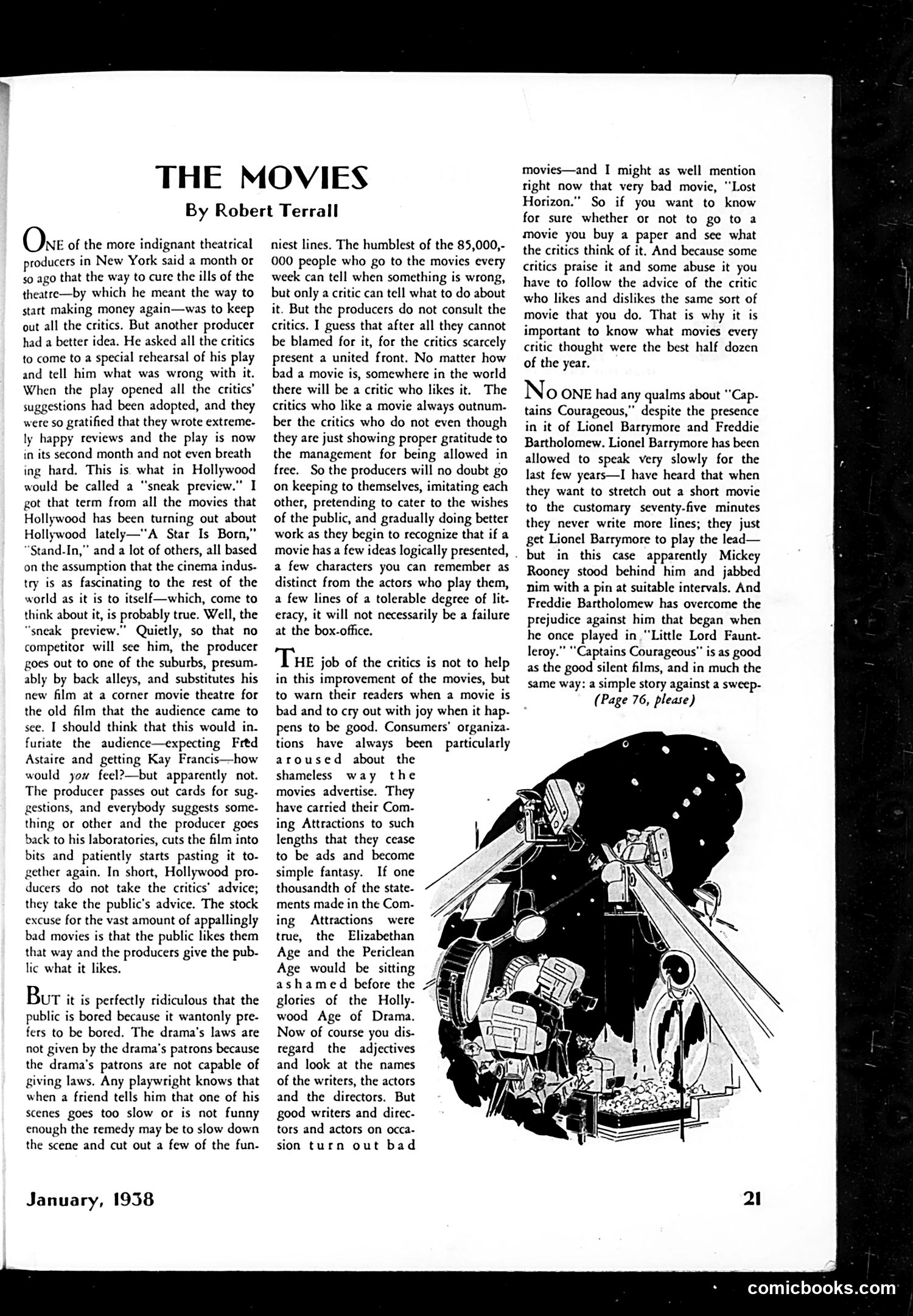
A restored page from Judge, 1938-01. Page through the whole issue in the reader above.
📄 Transcribed text from this page (OCR, searchable)
Machine-transcribed from the original scan — historical spelling and the odd misread are preserved.
THE MOVIES By Robert Terrall One of the more indignant theatrical producers in New York said a month or so ago that the way to cure the ills of the theatre—by which he meant the way to start making money again—was to keep out all the critics. But another producer had a better idea. He asked all the critics to come to a special rehearsal of his play and tell him what was wrong with it. When the play opened all the critics’ suggestions had been adopted, and they were so gratified that they wrote extreme- ly happy reviews and the play is now in its second month and not even breath ing hard. This is. what in Hollywood would be called a “sneak preview.” I got that term from all the movies that Hollywood has been turning out about Hollywood lately—"A Star Is Born,” “Stand-In,” and a lot of others, all based on the assumption that the cinema indus- try is as fascinating to the rest of the world as it is to itself—which, come to think about it, is probably true. Well, the “sneak preview.” Quietly, so that no competitor will see him, the producer goes out to one of the suburbs, presum- ably by back alleys, and substitutes his new film at a corner movie theatre for the old film that the audience came to see. I should think that this would in. furiate the audience—expecting Fred Astaire and getting Kay Francis—how would you feel?—but apparently not. The producer passes out cards for sug- gestions, and everybody suggests some- thing or other and the producer goes back to his laboratories, cuts the film into bits and patiently starts pasting it to- gether again. In short, Hollywood pro- ducers do not take the critics’ advice; they take the public’s advice. The stock excuse for the vast amount of appallingly bad movies is that the public likes them that way and the producers give the pub- lic what it likes. Bur it is perfectly ridiculous that the public is bored because it wantonly pre- fers to be bored. The drama’s laws are not given by the drama’s patrons because the drama’s patrons are not capable of giving laws. Any playwright knows that when a friend tells him that one of his scenes goes too slow or is not funny enough the remedy may be to slow down the scene and cut out a few of the fun. January, 1958 niest lines. The humblest of the 85,000,- 000 people who go to the movies every week can tell when something is wrong, but only a critic can tell what to do about it. But the producers do not consult the critics. I guess that after all they cannot be blamed for it, for the critics scarcely present a united front. No matter how bad a movie is, somewhere in the world there will be a critic who likes it. The critics who like a movie always outnum. ber the critics who do not even though they are just showing proper gratitude to the management for being allowed in free. So the producers will no doubt go on keeping to themselves, imitating each other, pretending to cater to the wishes of the public, and gradually doing better work as they begin to recognize that if a movie has a few ideas logically presented, a few characters you can remember as distinct from the actors who play them, a few lines of a tolerable degree of lit- eracy, it will not necessarily be a failure at the box-office. Tue job of the critics is not to help in this improvement of the movies, but to warn their readers when a movie is bad and to cry out with joy when it hap. pens to be good. Consumers’ organiza- tions have always been particularly aroused about the shameless way the movies advertise. They have carried their Com- ing Attractions to such lengths that they cease to be ads and become simple fantasy. If one thousandth of the state- ments made in the Com- ing Attractions were true, the Elizabethan Age and the Periclean Age would be sitting ashamed before the glories of the Holly. wood Age of Drama. Now of course you dis- regard the adjectives and look at the names of the writers, the actors and the directors. But good writers and direc- tors and actors on occa- sion turn out bad movies—and I might as well mention right now that very bad movie, “Lost Horizon.” So if you want to know for sure whether or not to go to a movie you buy a paper and see what the critics think of it. And because some critics praise it and some abuse it you have to follow the advice of the critic who likes and dislikes the same sort of movie that you do. That is why it is important to know what movies every critic thought were the best half dozen of the year. No ONE had any qualms about ‘Cap. tains Courageous,” despite the presence in it of Lionel Barrymore and Freddie Bartholomew. Lionel Barrymore has been allowed to speak very slowly for the last few years—I have heard that when they want to stretch out a short movie to the customary seventy-five minutes they never write more lines; they just get Lionel Barrymore to play the lead— but in this case apparently Mickey Rooney stood behind him and jabbed nim with a pin at suitable intervals. And Freddie Bartholomew has overcome the prejudice against him that began when he once played in “Little Lord Faunt- leroy.” “Captains Courageous” is as good as the good silent films, and in much the same way: a simple story against a sweep- (Page 76, please) 21 * comicbooks.com