
Judge, 1938-01 · page 21 of 88
Judge — January 1938 — page 21: what you’re looking at
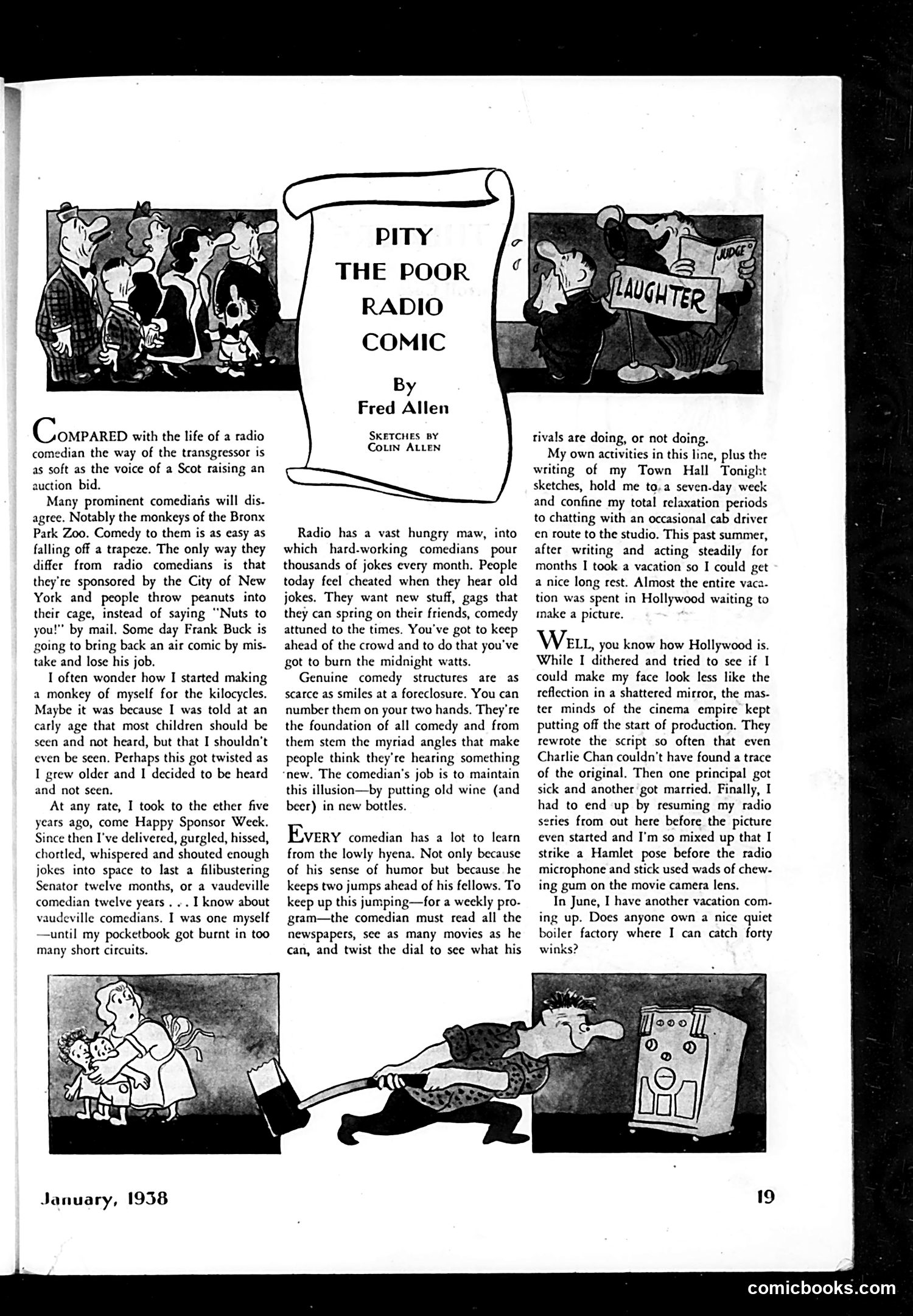
A restored page from Judge, 1938-01. Page through the whole issue in the reader above.
📄 Transcribed text from this page (OCR, searchable)
Machine-transcribed from the original scan — historical spelling and the odd misread are preserved.
Conparep with the life of a radio comedian the way of the transgressor is as soft as the voice of a Scot raising an auction bid. Many prominent comediaris will dis. agree. Notably the monkeys of the Bronx Park Zoo. Comedy to them is as easy as falling off a trapeze. The only way they differ from radio comedians is that they're sponsored by the City of New York and people throw peanuts into their cage, instead of saying “Nuts to you!” by mail. Some day Frank Buck is going to bring back an air comic by mis- take and lose his job. I often wonder how I started making a monkey of myself for the kilocycles. Maybe it was because I was told at an carly age that most children should be seen and not heard, but that I shouldn't even be seen. Perhaps this got twisted as I grew older and I decided to be heard and not seen. At any rate, I took to the ether five years ago, come Happy Sponsor Weck. Since then I've delivered, gurgled, hissed, chortled, whispered and shouted enough jokes into space to last a filibustering Senator twelve months, or a vaudeville comedian twelve years . .. I know about vaudeville comedians. I was one myself —until my pocketbook got burnt in too many short circuits. THE POOR RADIO COMIC By Fred Allen SKETCHES BY Coun ALLEN Radio has a vast hungry maw, into which hard-working comedians pour thousands of jokes every month. People today feel cheated when they hear old jokes. They want new stuff, gags that they can spring on their friends, comedy attuned to the times. You've got to keep ahead of the crowd and to do that you've got to burn the midnight watts. Genuine comedy structures are as scarce as smiles at a foreclosure. You can number them on your two hands. They're the foundation of all comedy and from them stem the myriad angles that make people think they're hearing something new. The comedian’s job is to maintain this illusion—by putting old wine (and beer) in new bottles. Every comedian has a lot to learn from the lowly hyena. Not only because of his sense of humor but because he keeps two jumps ahead of his fellows. To keep up this jumping—for a weekly pro- gram—the comedian must read all the newspapers, see as many movies as he can, and twist the dial to see what his tivals are doing, or not doing. My own activities in this line, plus the writing of my Town Hall Tonight sketches, hold me to.a seven-day week and confine my total relaxation periods to chatting with an occasional cab driver en route to the studio. This past summer, after writing and acting steadily for months I took a vacation so I could get a nice long rest. Almost the entire vaca- tion was spent in Hollywood waiting to make a picture. : Wi, you know how Hollywood is. While I dithered and tried to see if I could make my face look less like the reflection in a shattered mirror, the mas- ter minds of the cinema empire kept putting off the start of production. They rewrote the script so often that even Charlie Chan couldn't have found a trace of the original. Then one principal got sick and another got married. Finally, I had to end up by resuming my radio series from out here before the picture even started and I'm so mixed up that I strike a Hamlet pose before the radio microphone and stick used wads of chew- ing gum on the movie camera lens. In June, I have another vacation com- ing up. Does anyone own a nice quiet boiler factory where I can catch forty winks? January, 1958 comicbooks.com