
Judge, 1938-01 · page 19 of 88
Judge — January 1938 — page 19: what you’re looking at
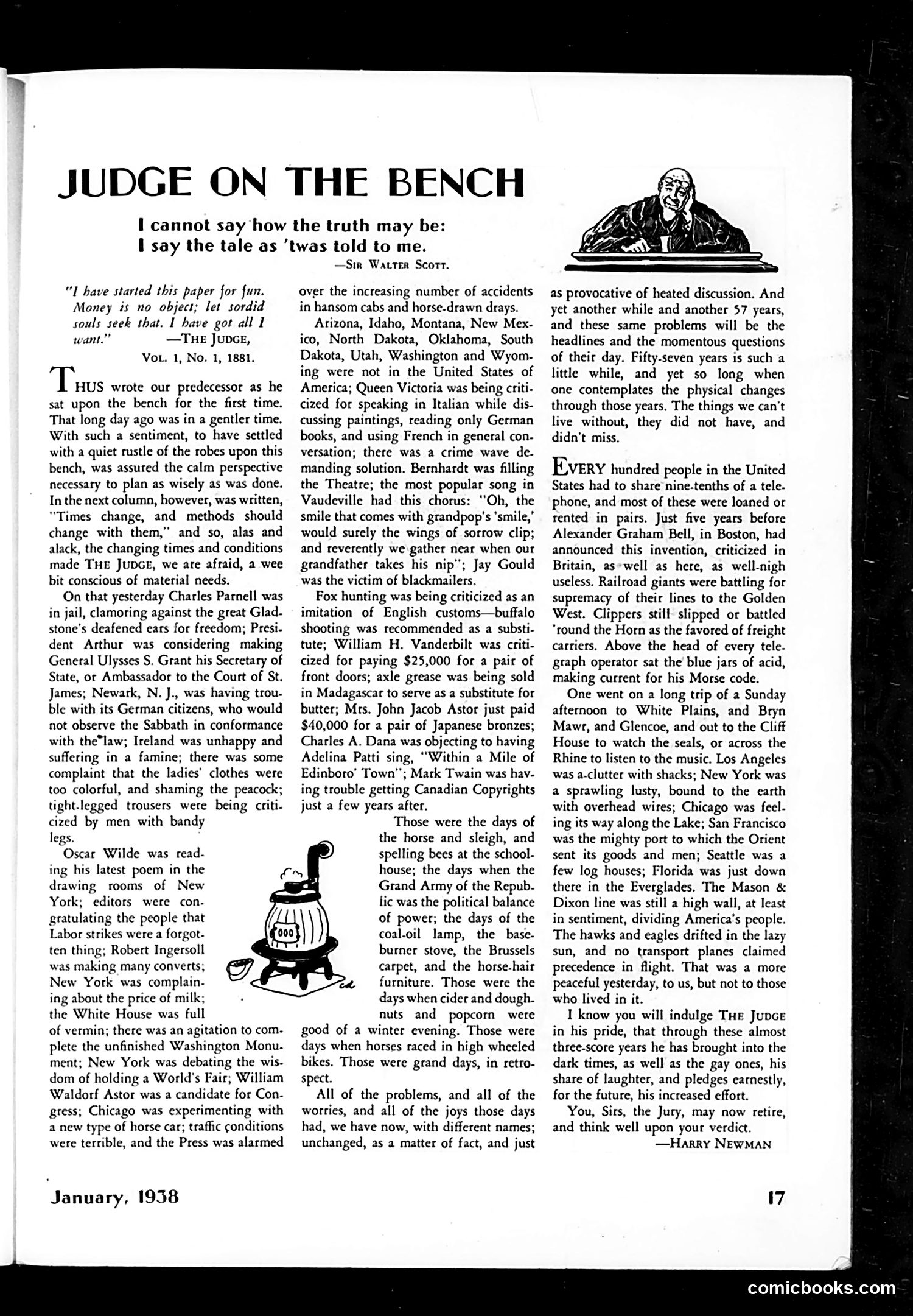
A restored page from Judge, 1938-01. Page through the whole issue in the reader above.
📄 Transcribed text from this page (OCR, searchable)
Machine-transcribed from the original scan — historical spelling and the odd misread are preserved.
JUDGE ON THE BENCH I cannot say how the truth may be: I say the tale as ‘twas told to me. "1 have started this paper for fun. Money is no object; let sordid souls seek that. | have got all I want.” —THe Jupce, VoL. 1, No. 1, 1881. Tis wrote our predecessor as he sat upon the bench for the first time. That long day ago was in a gentler time. With such a sentiment, to have settled with a quiet rustle of the robes upon this bench, was assured the calm perspective necessary to plan as wisely as was done. In the next column, however, was written, “Times change, and methods should change with them,” and so, alas and alack, the changing times and conditions made THE JUDGE, we are afraid, a wee bit conscious of material needs. On that yesterday Charles Parnell was in jail, clamoring against the great Glad- stone’s deafened ears for freedom; Presi- dent Arthur was considering making General Ulysses S. Grant his Secretary of State, or Ambassador to the Court of St. James; Newark, N. J., was having trou- ble with its German citizens, who would not observe the Sabbath in conformance with the"law; Ireland was unhappy and suffering in a famine; there was some complaint that the ladies’ clothes were too colorful, and shaming the peacock; tight-legged trousers were being criti- cized by men with bandy legs. Oscar Wilde was read- ing his latest poem in the drawing rooms of New York; editors were con- gratulating the people that Labor strikes were a forgot- ten thing; Robert Ingersoll was making many converts; New York was complain. ing about the price of milk; the White House was full of vermin; there was an agitation to com- plete the unfinished Washington Monu. ment; New York was debating the wis- dom of holding a World's Fair; William Waldorf Astor was a candidate for Con. gress; Chicago was experimenting with a new type of horse car; traffic conditions were terrible, and the Press was alarmed “January, 1958 —Sir Watter Scott. over the increasing number of accidents in hansom cabs and horse-drawn drays. Arizona, Idaho, Montana, New Mex- ico, North Dakota, Oklahoma, South Dakota, Utah, Washington and Wyom. ing were not in the United States of America; Queen Victoria was being criti- cized for speaking in Italian while dis- cussing paintings, reading only German books, and using French in general con- versation; there was a crime wave de- manding solution. Bernhardt was filling the Theatre; the most popular song in Vaudeville had this chorus: ‘Oh, the smile that comes with grandpop'’s ‘smile,’ would surely the wings of sorrow clip; and reverently we gather near when our grandfather takes his nip"; Jay Gould was the victim of blackmailers. Fox hunting was being criticized as an imitation of English customs—buffalo shooting was recommended as a substi- tute; William H. Vanderbilt was criti- cized for paying $25,000 for a pair of front doors; axle grease was being sold in Madagascar to serve as a substitute for butter; Mrs. John Jacob Astor just paid $40,000 for a pair of Japanese bronzes; Charles A. Dana was objecting to having Adelina Patti sing, “Within a Mile of Edinboro’ Town’; Mark Twain was hav- ing trouble getting Canadian Copyrights just a few years after. Those were the days of the horse and sleigh, and spelling bees at the school. house; the days when the Grand Army of the Repub. lic was the political balance of power; the days of the coal-oil lamp, the base. burner stove, the Brussels carpet, and the horse-hair furniture. Those were the days when cider and dough. nuts and popcorn were good of a winter evening. Those were days when horses raced in high wheeled bikes. Those were grand days, in retro- spect. All of the problems, and all of the worries, and all of the joys those days had, we have now, with different names; unchanged, as a matter of fact, and just as provocative of heated discussion. And yet another while and another 57 years, and these same problems will be the headlines and the momentous questions of their day. Fifty-seven years is such a little while, and yet so long when one contemplates the physical changes through those years. The things we can't live without, they did not have, and didn’t miss. Every hundred people in the United States had to share nine-tenths of a tele. phone, and most of these were loaned or rented in pairs. Just five years before Alexander Graham Bell, in Boston, had announced this invention, criticized in Britain, aswell as here, as well-nigh useless. Railroad giants were battling for supremacy of their lines to the Golden West. Clippers still slipped or battled ‘round the Horn as the favored of freight carriers. Above the head of every tele. graph operator sat the’ blue jars of acid, making current for his Morse code. One went on a long trip of a Sunday afternoon to White Plains, and Bryn Mawr, and Glencoe, and out to the Cliff House to watch the seals, or across the Rhine to listen to the music. Los Angeles was a-clutter with shacks; New York was a sprawling lusty, bound to the earth with overhead wires; Chicago was feel- ing its way along the Lake; San Francisco was the mighty port to which the Orient sent its goods and men; Seattle was a few log houses; Florida was just down there in the Everglades. The Mason & Dixon line was still a high wall, at least in sentiment, dividing America’s people. The hawks and eagles drifted in the lazy sun, and no transport planes claimed precedence in flight. That was a more peaceful yesterday, to us, but not to those who lived in it. I know you will indulge THE JupcE in his pride, that through these almost three-score years he has brought into the dark times, as well as the gay ones, his share of laughter, and pledges earnestly, for the future, his increased effort. You, Sirs, the Jury, may now retire, and think well upon your verdict. —Harry NEwMAN 17 comicbooks.com