
Judge, 1938-01 · page 13 of 88
Judge — January 1938 — page 13: what you’re looking at
What you’re looking at
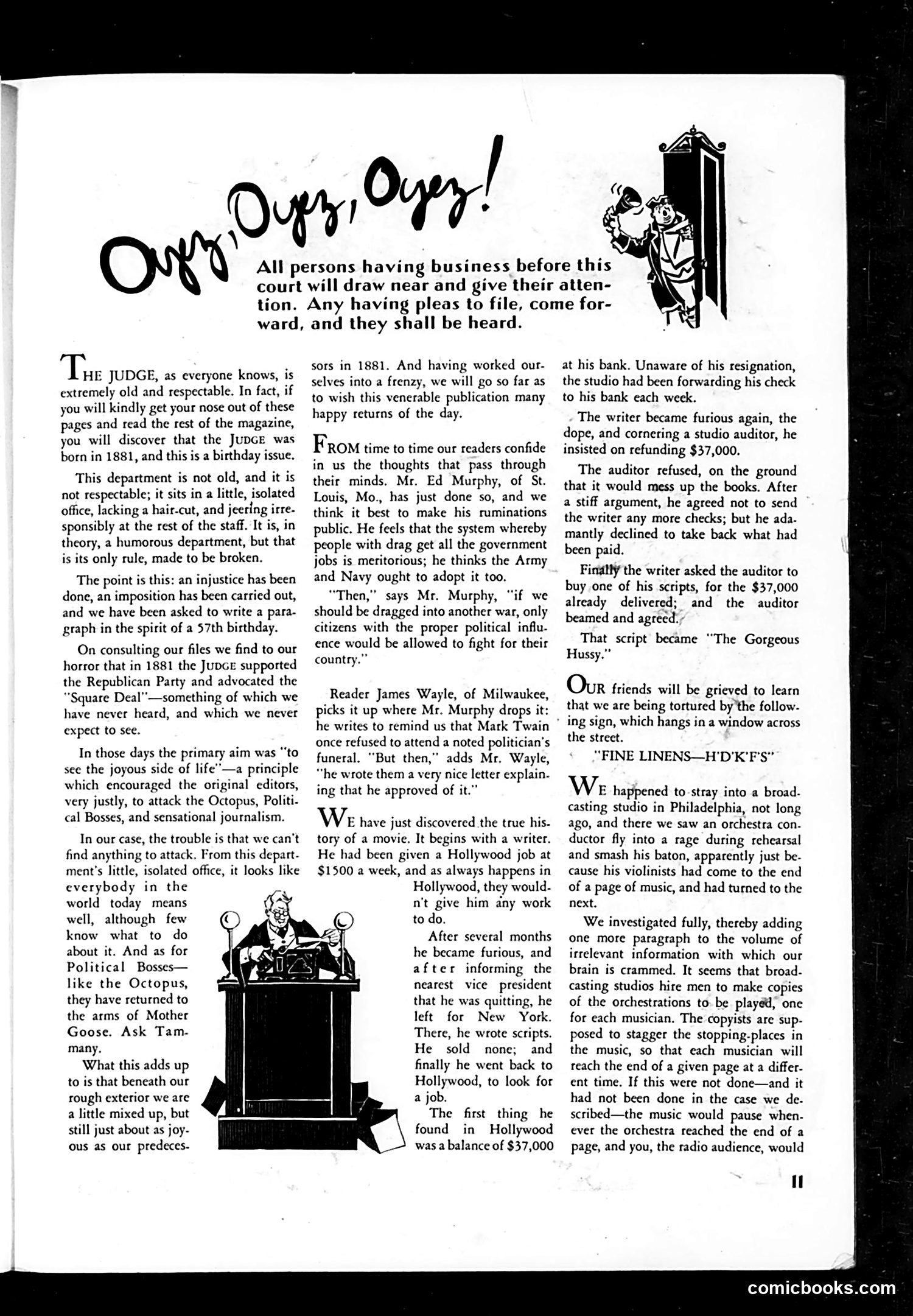
# Explanation for Modern Readers This page celebrates Judge magazine's 57th birthday (founded 1881). The masthead cartoon depicts a court crier announcing business, a visual pun on the magazine's name. The main text is self-reflective satire: Judge acknowledges that in 1881 it attacked clear villains—political machines ("the Octopus"), corrupt bosses, and sensational journalism. Today (the 1930s), the writer claims these evils have mysteriously vanished, leaving the humor department with nothing to satirize. This is ironic social commentary: the author is obliquely suggesting that corruption still exists but has become so normalized that people no longer recognize it. The reader submissions that follow mock political favoritism and bureaucratic absurdity. The Hollywood anecdote about a writer accidentally paid $37,000 for months of non-work satirizes both Hollywood's chaos and the auditor's refusal to correct obvious errors—illustrating institutional dysfunction masquerading as procedure. The overall effect is gentle, nostalgic mockery of the magazine's own aging idealism.
📄 Transcribed text from this page (OCR, searchable)
Machine-transcribed from the original scan — historical spelling and the odd misread are preserved.
All persons having business before this court will draw near and give their atten- tion. Any having pleas to file, come for- ward, and they shall be heard. Tue JUDGE, as everyone knows, is extremely old and respectable. In fact, if you will kindly get your nose out of these pages and read the rest of the magazine, you will discover that the JUDGE was born in 1881, and this is a birthday issue. This department is not old, and it is not respectable; it sits in a little, isolated office, lacking a hair-cut, and jeering irre- sponsibly at the rest of the staff. It is, in theory, a humorous department, but that is its only rule, made to be broken. The point is this: an injustice has been done, an imposition has been carried out, and we have been asked to write a para- graph in the spirit of a 57th birthday. On consulting our files we find to our horror that in 1881 the JuDGE supported the Republican Party and advocated the “Square Deal""—something of which we have never heard, and which we never expect to see. In those days the primary aim was “to see the joyous side of life’—a principle which encouraged the original editors, very justly, to attack the Octopus, Politi- cal Bosses, and sensational journalism. In our case, the trouble is that we can’t find anything to attack. From this depart- ment's little, isolated office, it looks like everybody in the world today means well, although few know what to do about it. And as for Political Bosses— like the Octopus, they have returned to the arms of Mother Goose. Ask Tam. many. What this adds up to is that beneath our rough exterior we are a little mixed up, but still just about as joy- ous as our predeces- sors in 1881. And having worked our- selves into a frenzy, we will go so far as to wish this venerable publication many happy returns of the day. From time to time our readers confide in us the thoughts that pass through their minds. Mr. Ed Murphy, of St. Louis, Mo., has just done so, and we think it best to make his ruminations public. He feels that the system whereby people with drag get all the government jobs is meritorious; he thinks the Army and Navy ought to adopt it too. “Then,” says Mr. Murphy, “if we should be dragged into another war, only citizens with the proper political influ. ence would be allowed to fight for their country.” Reader James Wayle, of Milwaukee, picks it up where Mr. Murphy drops it: he writes to remind us that Mark Twain once refused to attend a noted politician's funeral. “But then," adds Mr. Wayle, “he wrote them a very nice letter explain- ing that he approved of it.” WE have just discovered the true his- tory of a movie. It begins with a writer. He had been given a Hollywood job at $1500 a week, and as always happens in Hollywood, they would- n't give him any work to do. After several months he became furious, and after informing the nearest vice president that he was quitting, he left for New York. There, he wrote scripts. He sold none; and finally he went back to Hollywood, to look for a job. The first thing he found in Hollywood was a balance of $37,000 at his bank. Unaware of his resignation, the studio had been forwarding his check to his bank each week. The writer became furious again, the dope, and cornering a studio auditor, he insisted on refunding $37,000. The auditor refused, on the ground that it would mess up the books. After a stiff argument, he agreed not to send the writer any more checks; but he ada- mantly declined to take back what had been paid. Finally the writer asked the auditor to buy one of his scripts, for the $37,000 already delivered; and the auditor beamed and agreed: That script became “The Gorgeous Hussy.” Our friends will be grieved to learn that we are being tortured bythe follow- * ing sign, which hangs in a window across the street. “FINE LINENS—H'D'K’F'S” Ws: happened to-stray into a broad. casting studio in Philadelphia, not long ago, and there we saw an orchestra con- ductor fly into a rage during rehearsal and smash his baton, apparently just be- cause his violinists had come to the end of a page of music, and had turned to the next. We investigated fully, thereby adding one more paragraph to the volume of irrelevant information with which our brain is crammed. It seems that broad- casting studios hire men to make copies of the orchestrations to. be played, one for each musician. The copyists are sup- posed to stagger the stopping-places in the music, so that each musician will reach the end of a given page at a differ- ent time. If this were not done—and it had not been done in the case we de- scribed—the music would pause when- ever the orchestra reached the end of a page, and you, the radio audience, would comicbooks.com